
Art speaks every language but in different ways! Learning about...
 Visual Art3 zobrazení·Aktualizováno Jun 16, 2026·6 stránek
Exploring Cultural Art from Around the World


1 / 6
1
of 6
Understanding Art from Different Cultures
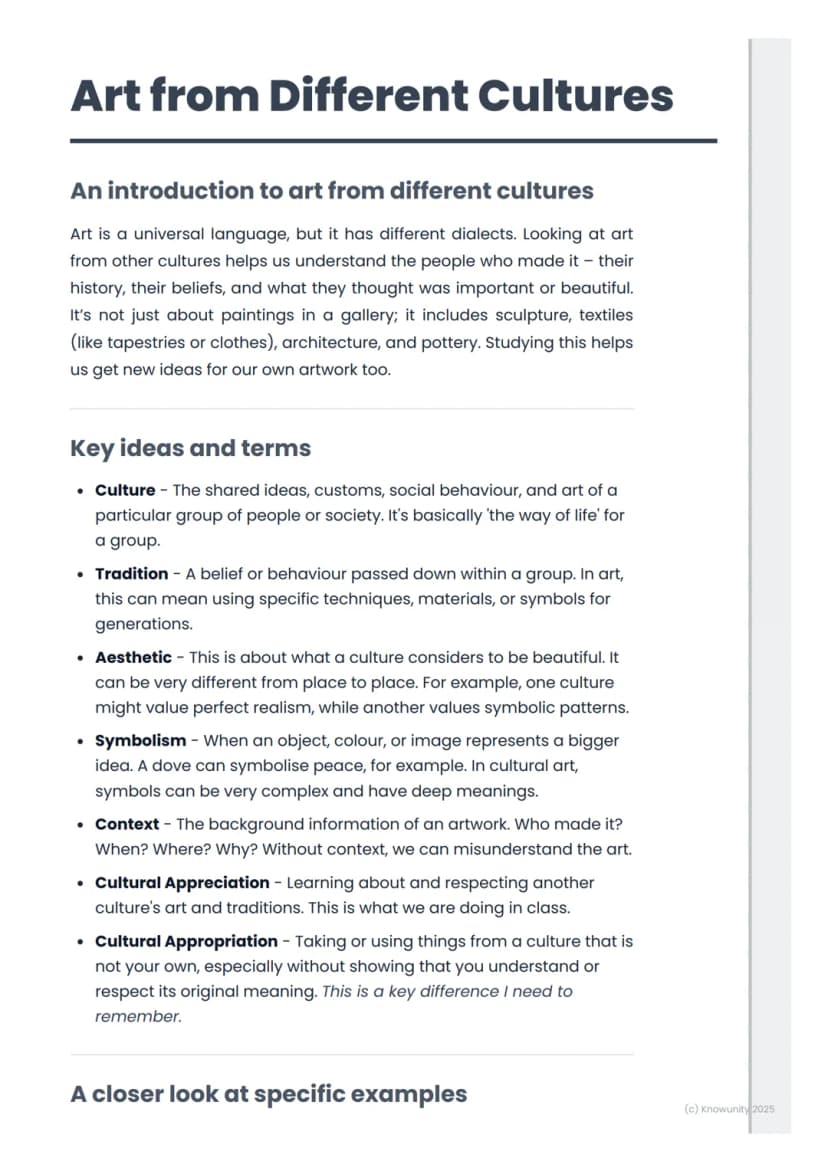
Ever wondered why art looks so different around the world? It's because every culture has its own way of seeing beauty and meaning. When you study art from other cultures, you're basically learning their visual language - and it's way more exciting than any textbook could tell you.
Culture isn't just about the art itself - it's the whole package of beliefs, customs, and ways of life that shape how people create. Think of it as the invisible hand guiding every brushstroke, carving, or pattern. Tradition keeps these artistic techniques and meanings alive, passing them down through generations like family recipes.
Here's where it gets interesting: symbolism means that nothing is just what it seems. A simple circle might represent a campsite, a spiritual place, or the cycle of life. Context is your best friend here - knowing who made something, when, where, and why completely changes how you understand it.
Remember: There's a huge difference between cultural appreciation (respectfully learning about other cultures) and cultural appropriation (taking without understanding or respect). You're doing the first one!
2
of 6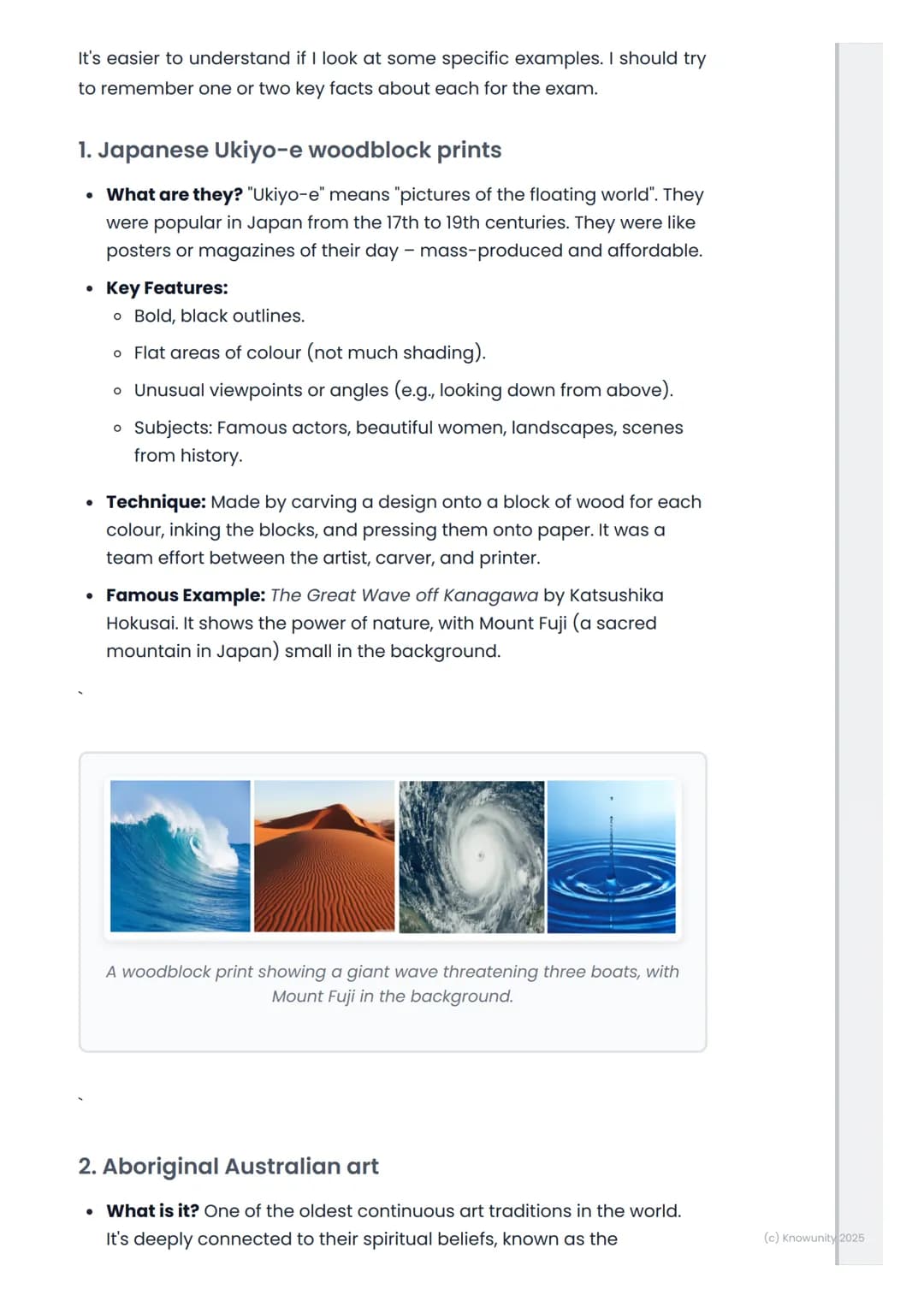
Japanese Ukiyo-e Woodblock Prints
Picture this: 17th-century Japan had no Instagram, but they had something even cooler - Ukiyo-e prints, meaning "pictures of the floating world." These were basically the social media of their time, showing everything from celebrity actors to stunning landscapes.
The technique is mind-blowing. Artists, carvers, and printers worked as a team, creating separate wooden blocks for each colour. The result? Those bold, black outlines and flat areas of colour that make Ukiyo-e instantly recognisable. No fancy shading needed - just pure, powerful simplicity.
The most famous example is Hokusai's The Great Wave off Kanagawa. That massive wave isn't just showing off nature's power - it's a cultural statement about humans versus the natural world, with Mount Fuji sitting calmly in the background like it's seen it all before.
These prints used unusual angles and viewpoints that would later blow European artists' minds. They weren't trying to copy reality perfectly - they were creating their own visual language that captured the energy and spirit of Japanese life.
3
of 6
Aboriginal Australian Art and Benin Bronzes
Aboriginal art holds the record for the world's oldest continuous art tradition - we're talking tens of thousands of years! This isn't just decoration; it's a sacred storytelling system connected to the Dreamtime, their spiritual understanding of the world.
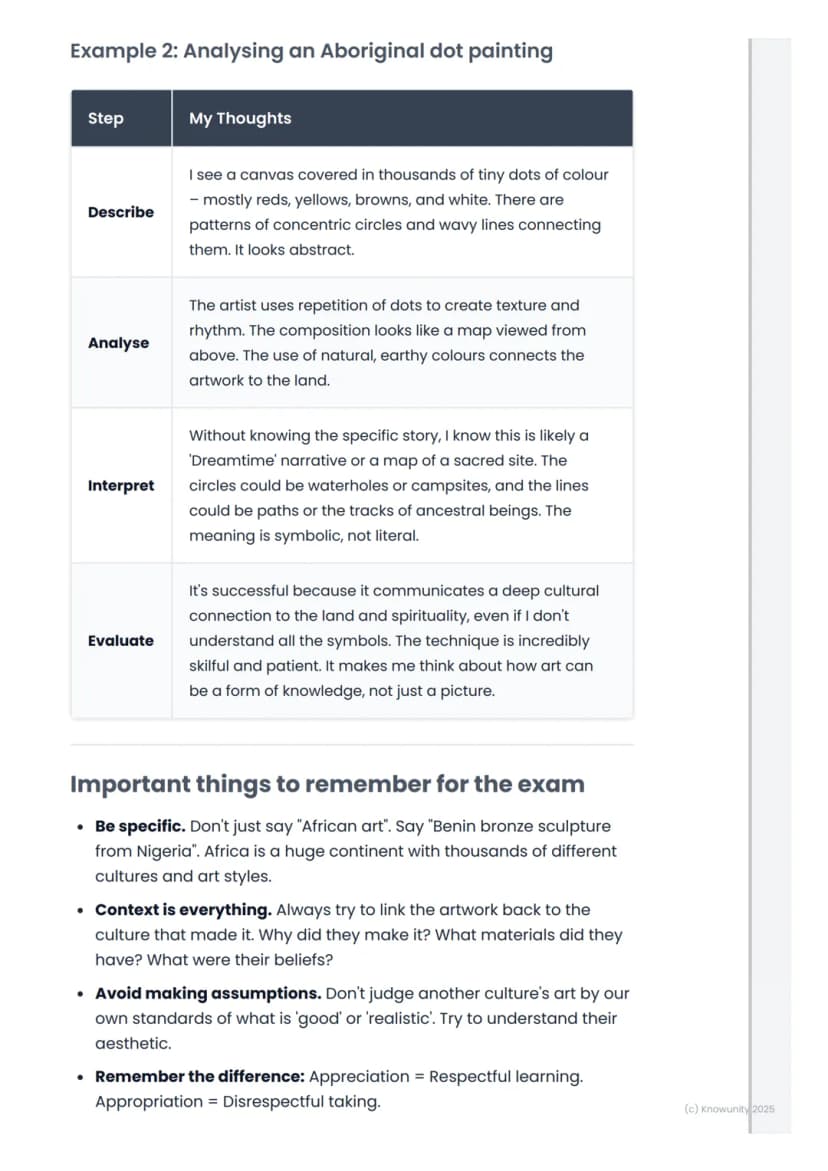
Those famous dot paintings aren't random patterns. Each dot, circle, and line has meaning - circles might show campsites or waterholes, while lines could represent ancestral paths. The bird's-eye view perspective shows the land like a living map, teaching survival skills and recording history in one beautiful package.
Meanwhile, in West Africa, the Benin bronzes from Nigeria showcase incredible metalworking skills. These brass and bronze sculptures recorded royal history using the lost-wax casting technique - a complex process where artists created wax models, covered them in clay, melted out the wax, and poured in molten metal.
Context matters: Many Benin bronzes were stolen by British forces in 1897 and are still in museums worldwide. This ongoing debate about returning cultural treasures shows why understanding art history isn't just academic - it's about justice.
4
of 6
How to Analyse Cultural Art
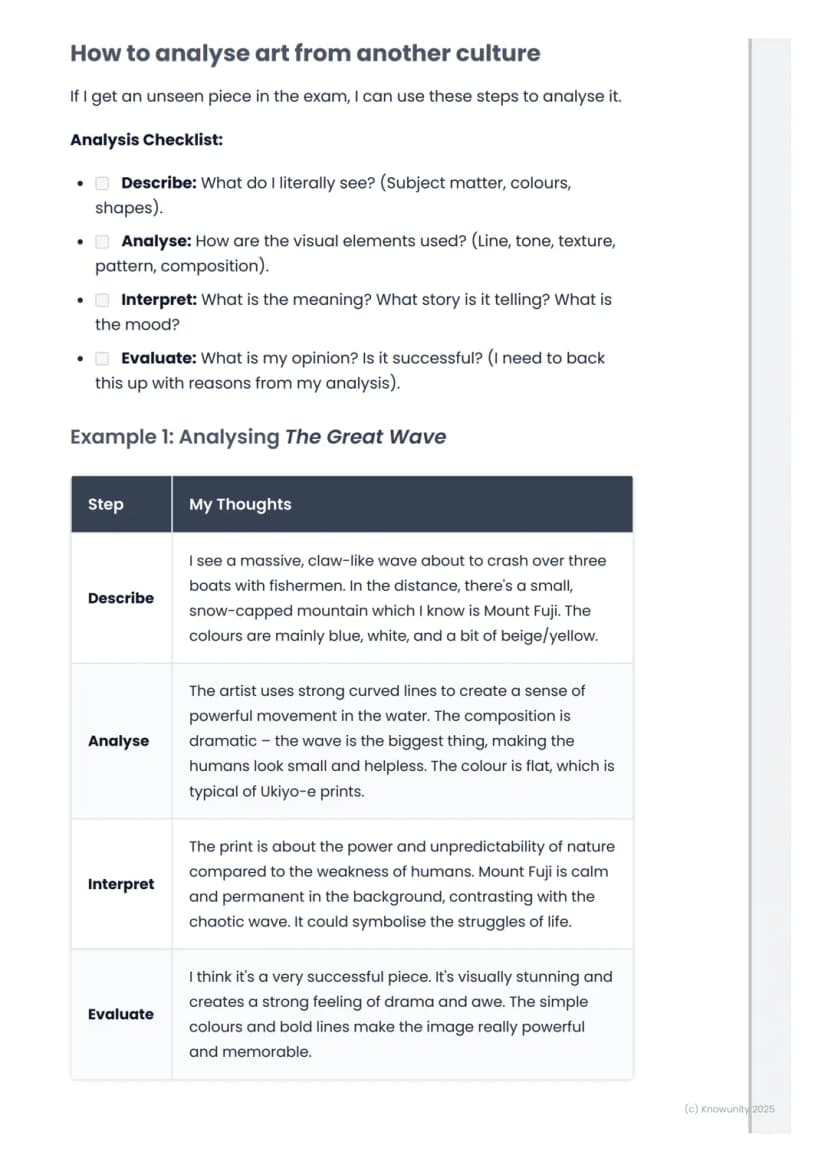
When you're faced with an artwork from another culture in your exam, don't panic! You've got a foolproof system: Describe, Analyse, Interpret, Evaluate. Think of it as your cultural art detective toolkit.
Describe what you literally see - colours, shapes, subjects. Don't overthink it yet. Then analyse how the visual elements work together. Are the lines bold or delicate? How's the composition arranged? What's the biggest element?
Interpretation is where it gets interesting. What story might this be telling? What could the symbols mean? Even if you don't know the specific cultural meanings, you can make educated guesses based on what you've learned about that culture's values and beliefs.
Finally, evaluate the artwork's success. Does it achieve what it seems to be trying to do? Back up your opinions with evidence from your analysis. Remember, you're not judging it by your own cultural standards - you're trying to understand it on its own terms.
Pro tip: Always mention the cultural context in your analysis. An Aboriginal dot painting isn't just pretty patterns - it's a complex information system that connects art, spirituality, and survival knowledge.
5
of 6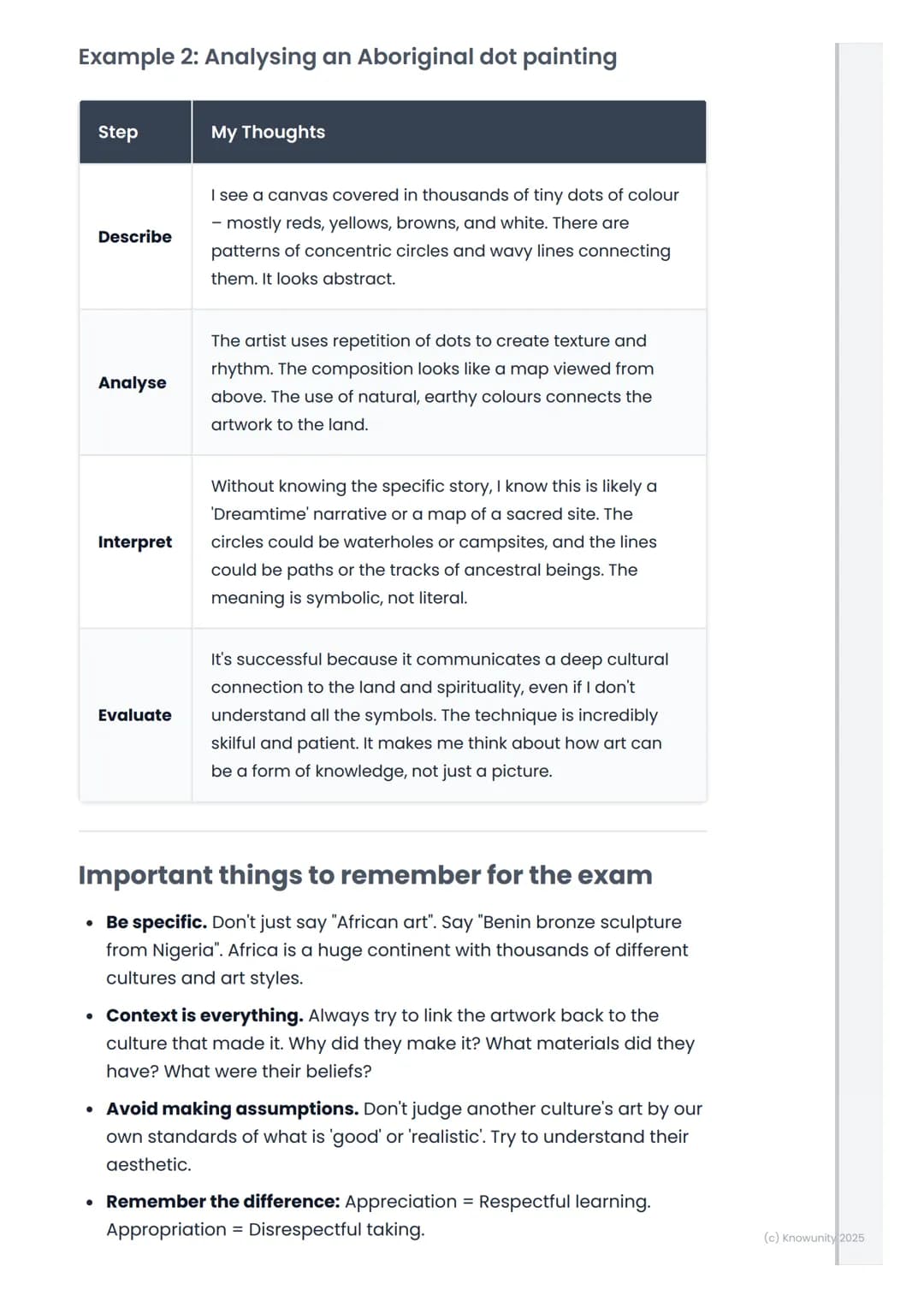
Putting It All Together - Analysis Examples
Let's see this system in action with Hokusai's Great Wave. You'd describe the massive wave threatening tiny boats with Mount Fuji in the background. Analysing the visual elements, you'd note the strong curved lines creating movement and the dramatic composition that makes humans look powerless.
For interpretation, think about Japanese culture's relationship with nature - this isn't just a scary wave, it's about the eternal struggle between human ambition and natural forces. Mount Fuji represents permanence and spiritual calm against the chaos.
Evaluating the piece, you might say it's incredibly successful because it creates immediate emotional impact while telling a deeper story about Japanese philosophy and the human condition.
Aboriginal dot paintings work differently but follow the same analysis pattern. Those thousands of dots create texture and rhythm, while the map-like composition connects viewers to sacred landscape knowledge. Even without knowing specific meanings, you can appreciate the incredible skill and cultural significance.
Exam success tip: Be specific! Don't just say "African art" - say "Benin bronze sculpture from Nigeria." Show you understand that cultures have distinct artistic traditions, even within the same continent.
6
of 6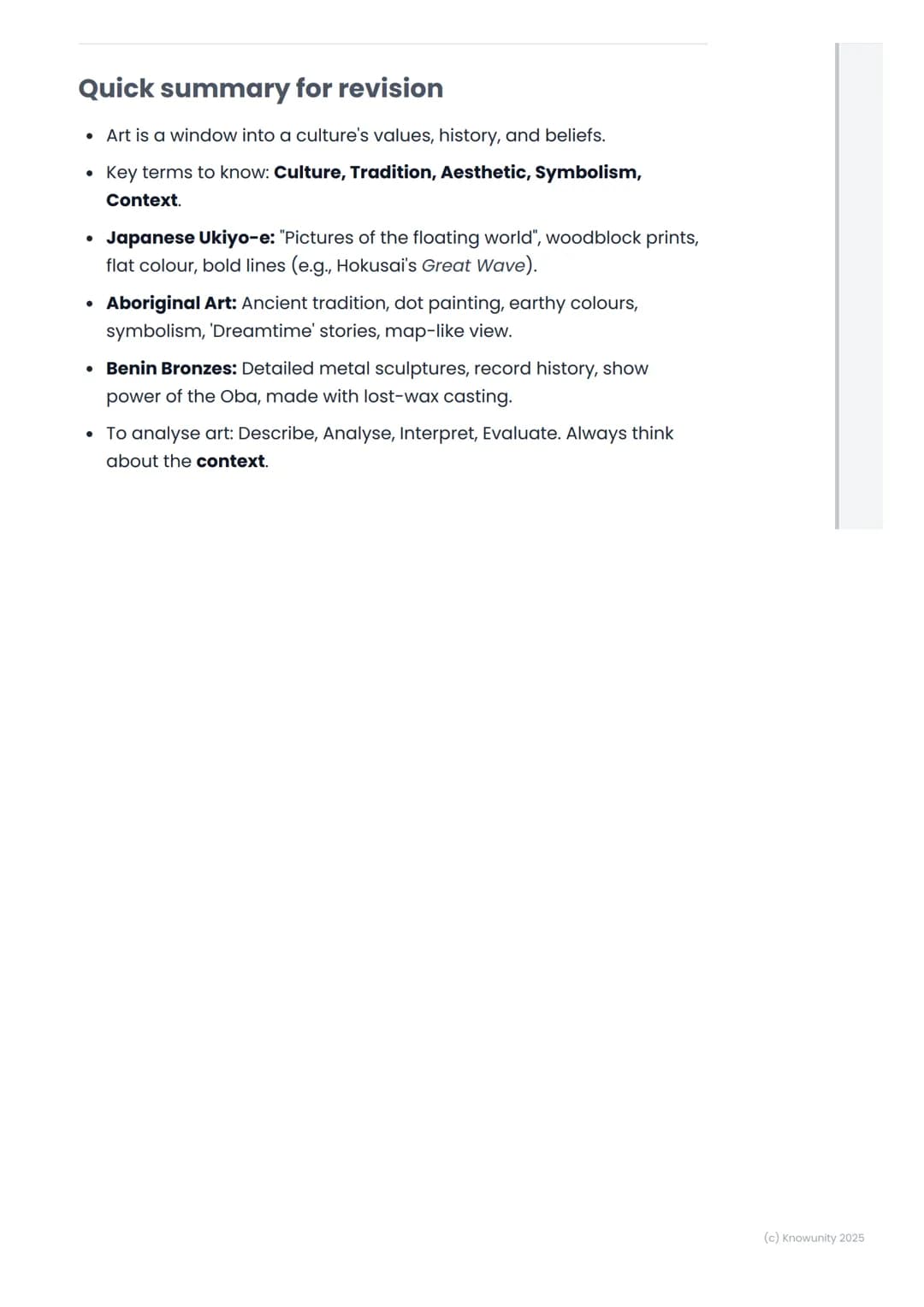
Quick Revision Summary
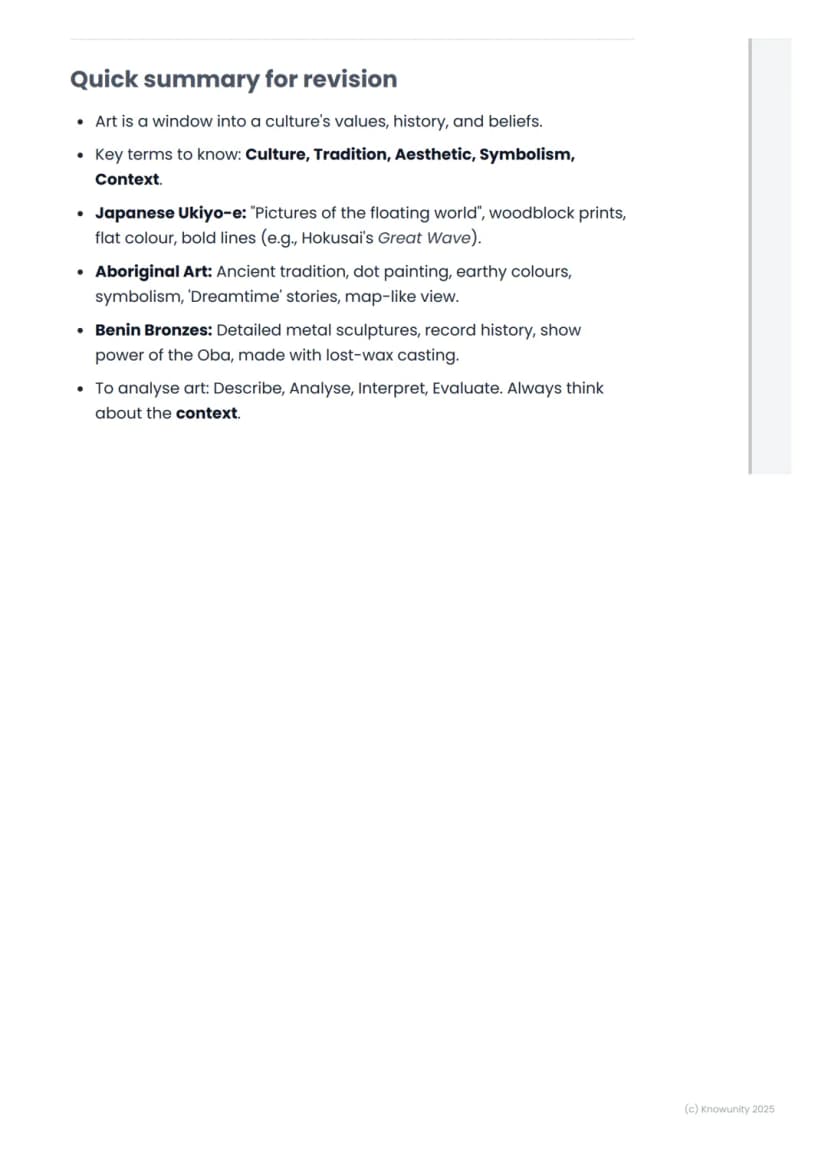
You're now equipped to tackle any cultural art analysis! Remember that art is a window into cultural values - every technique, symbol, and colour choice tells you something about the people who created it.
Your key terms are sorted: Culture (way of life), Tradition , Aesthetic (what they consider beautiful), Symbolism (deeper meanings), and Context (background info that changes everything).
The three major examples you need: Japanese Ukiyo-e (woodblock prints with flat colours and bold lines), Aboriginal art (ancient dot paintings telling Dreamtime stories), and Benin bronzes (detailed metal sculptures recording royal history).
Your analysis method is Describe, Analyse, Interpret, Evaluate - and always, always consider the cultural context. You're not just looking at pretty objects; you're decoding entire worldviews and ways of understanding life.
Final thought: The difference between appreciation and appropriation is respect and understanding. By studying these artworks properly, you're showing genuine respect for the cultures that created them.
Mysleli jsme, že se nikdy nezeptáš...
Co je AI společník Knowunity?
Náš AI společník je speciálně vytvořen pro potřeby studentů. Na základě milionů obsahových materiálů, které máme na platformě, můžeme studentům poskytovat opravdu smysluplné a relevantní odpovědi. Ale nejde jen o odpovědi, společník je ještě více o provázení studentů jejich každodenními výzvami v učení, s personalizovanými studijními plány, kvízy nebo obsahovými materiály v chatu a 100% personalizací na základě dovedností a vývoje studentů.
Kde si můžu stáhnout aplikaci Knowunity?
Aplikaci si můžete stáhnout z obchodu Google Play a Apple App Store.
Jak můžu dostat svou platbu? Kolik si můžu vydělat?
Ano, máte bezplatný přístup k obsahu v aplikaci a k našemu společníkovi s umělou inteligencí. Chcete-li odemknout určité funkce aplikace, můžete si zakoupit aplikaci Knowunity Pro.
Nejpopulárnější poznámky
9 Irish
IrishIrish oral questions and answers
Questions and answers for the leaving cert oral
5th Year4264
 English
Key Quotes : Sive
Key Quotes and explanations: Sive
6th Year2842
IrishIrish oral questions
Outline of oral questions
5th Year2055
IrishIníon- le hÁine Durkin
Aine Durkin’s poem, Iníon: Themes & summary
5th Year890
IrishIrish poetry 2027
Iníon + Dínit an Bhróin
5th Year1153
IrishLC HL notes- Iníon (poem)
Includes poem in English and Irish, theme, key words & phrases
5th Year2304
EnglishCultural Context : Shawshank Redemption : Sive : Small Things Like These
Comparative Study : Cultural Context : Shawshank Redemption, Sive and Small Things Like These
6th Year1430
IrishMo Ghrá-sa (Idir Lúibíní)
Notes on mo ghrá-sa
5th Year380
IrishAn Gaeilge Aiste
Irish Language essay
6th Year1320
Nemůžeš najít, co hledáš? Prozkoumej další předměty.
Recenze od našich uživatelů. Mají vše super — a ty taky můžeš.
4.6/5App Store
4.7/5Google Play
Aplikace je velmi jednoduchá na používání a dobře navržená. Zatím jsem našel vše, co jsem hledal, a mohl jsem se z prezentací hodně naučit! Určitě použiju aplikaci na školní úkol! A samozřejmě taky hodně pomáhá jako inspirace.
Stefan Suživatel iOS
Tahle aplikace je fakt skvělá. Je tam tolik studijních poznámek a pomůcek [...]. Můj problémový předmět je například francouzština a aplikace nabízí tolik možností pomoci. Díky této aplikaci jsem si zlepšil francouzštinu. Doporučil bych ji každému.
Samantha Klichuživatelka Androidu
Páni, jsem opravdu ohromen. Zkusil jsem aplikaci jen proto, že jsem ji mnohokrát viděl v reklamách, a byl jsem naprosto ohromen. Tato aplikace je TA POMOC, kterou chceš do školy, a především nabízí spoustu věcí, jako jsou cvičení a přehledy faktů, které mi osobně VELMI pomohly.
Annauživatelka iOS
Visual Art3 zobrazení·Aktualizováno Jun 16, 2026·6 stránekExploring Cultural Art from Around the World
Art speaks every language but in different ways! Learning about art from different cultures isn't just about pretty pictures - it's your chance to become a cultural detective, uncovering stories, beliefs, and ways of life from around the world.
1
of 6
Registruj se, abys viděl obsah. Je to zdarma!
- Přístup ke všem dokumentům
- Zlepši své známky
- Připoj se k milionům studentů
Understanding Art from Different Cultures
Ever wondered why art looks so different around the world? It's because every culture has its own way of seeing beauty and meaning. When you study art from other cultures, you're basically learning their visual language - and it's way more exciting than any textbook could tell you.
Culture isn't just about the art itself - it's the whole package of beliefs, customs, and ways of life that shape how people create. Think of it as the invisible hand guiding every brushstroke, carving, or pattern. Tradition keeps these artistic techniques and meanings alive, passing them down through generations like family recipes.
Here's where it gets interesting: symbolism means that nothing is just what it seems. A simple circle might represent a campsite, a spiritual place, or the cycle of life. Context is your best friend here - knowing who made something, when, where, and why completely changes how you understand it.
Remember: There's a huge difference between cultural appreciation (respectfully learning about other cultures) and cultural appropriation (taking without understanding or respect). You're doing the first one!
2
of 6Registruj se, abys viděl obsah. Je to zdarma!
- Přístup ke všem dokumentům
- Zlepši své známky
- Připoj se k milionům studentů
Japanese Ukiyo-e Woodblock Prints
Picture this: 17th-century Japan had no Instagram, but they had something even cooler - Ukiyo-e prints, meaning "pictures of the floating world." These were basically the social media of their time, showing everything from celebrity actors to stunning landscapes.
The technique is mind-blowing. Artists, carvers, and printers worked as a team, creating separate wooden blocks for each colour. The result? Those bold, black outlines and flat areas of colour that make Ukiyo-e instantly recognisable. No fancy shading needed - just pure, powerful simplicity.
The most famous example is Hokusai's The Great Wave off Kanagawa. That massive wave isn't just showing off nature's power - it's a cultural statement about humans versus the natural world, with Mount Fuji sitting calmly in the background like it's seen it all before.
These prints used unusual angles and viewpoints that would later blow European artists' minds. They weren't trying to copy reality perfectly - they were creating their own visual language that captured the energy and spirit of Japanese life.
3
of 6Registruj se, abys viděl obsah. Je to zdarma!
- Přístup ke všem dokumentům
- Zlepši své známky
- Připoj se k milionům studentů
Aboriginal Australian Art and Benin Bronzes
Aboriginal art holds the record for the world's oldest continuous art tradition - we're talking tens of thousands of years! This isn't just decoration; it's a sacred storytelling system connected to the Dreamtime, their spiritual understanding of the world.
Those famous dot paintings aren't random patterns. Each dot, circle, and line has meaning - circles might show campsites or waterholes, while lines could represent ancestral paths. The bird's-eye view perspective shows the land like a living map, teaching survival skills and recording history in one beautiful package.
Meanwhile, in West Africa, the Benin bronzes from Nigeria showcase incredible metalworking skills. These brass and bronze sculptures recorded royal history using the lost-wax casting technique - a complex process where artists created wax models, covered them in clay, melted out the wax, and poured in molten metal.
Context matters: Many Benin bronzes were stolen by British forces in 1897 and are still in museums worldwide. This ongoing debate about returning cultural treasures shows why understanding art history isn't just academic - it's about justice.
4
of 6Registruj se, abys viděl obsah. Je to zdarma!
- Přístup ke všem dokumentům
- Zlepši své známky
- Připoj se k milionům studentů
How to Analyse Cultural Art
When you're faced with an artwork from another culture in your exam, don't panic! You've got a foolproof system: Describe, Analyse, Interpret, Evaluate. Think of it as your cultural art detective toolkit.
Describe what you literally see - colours, shapes, subjects. Don't overthink it yet. Then analyse how the visual elements work together. Are the lines bold or delicate? How's the composition arranged? What's the biggest element?
Interpretation is where it gets interesting. What story might this be telling? What could the symbols mean? Even if you don't know the specific cultural meanings, you can make educated guesses based on what you've learned about that culture's values and beliefs.
Finally, evaluate the artwork's success. Does it achieve what it seems to be trying to do? Back up your opinions with evidence from your analysis. Remember, you're not judging it by your own cultural standards - you're trying to understand it on its own terms.
Pro tip: Always mention the cultural context in your analysis. An Aboriginal dot painting isn't just pretty patterns - it's a complex information system that connects art, spirituality, and survival knowledge.
5
of 6Registruj se, abys viděl obsah. Je to zdarma!
- Přístup ke všem dokumentům
- Zlepši své známky
- Připoj se k milionům studentů
Putting It All Together - Analysis Examples
Let's see this system in action with Hokusai's Great Wave. You'd describe the massive wave threatening tiny boats with Mount Fuji in the background. Analysing the visual elements, you'd note the strong curved lines creating movement and the dramatic composition that makes humans look powerless.
For interpretation, think about Japanese culture's relationship with nature - this isn't just a scary wave, it's about the eternal struggle between human ambition and natural forces. Mount Fuji represents permanence and spiritual calm against the chaos.
Evaluating the piece, you might say it's incredibly successful because it creates immediate emotional impact while telling a deeper story about Japanese philosophy and the human condition.
Aboriginal dot paintings work differently but follow the same analysis pattern. Those thousands of dots create texture and rhythm, while the map-like composition connects viewers to sacred landscape knowledge. Even without knowing specific meanings, you can appreciate the incredible skill and cultural significance.
Exam success tip: Be specific! Don't just say "African art" - say "Benin bronze sculpture from Nigeria." Show you understand that cultures have distinct artistic traditions, even within the same continent.
6
of 6Registruj se, abys viděl obsah. Je to zdarma!
- Přístup ke všem dokumentům
- Zlepši své známky
- Připoj se k milionům studentů
Quick Revision Summary
You're now equipped to tackle any cultural art analysis! Remember that art is a window into cultural values - every technique, symbol, and colour choice tells you something about the people who created it.
Your key terms are sorted: Culture (way of life), Tradition , Aesthetic (what they consider beautiful), Symbolism (deeper meanings), and Context (background info that changes everything).
The three major examples you need: Japanese Ukiyo-e (woodblock prints with flat colours and bold lines), Aboriginal art (ancient dot paintings telling Dreamtime stories), and Benin bronzes (detailed metal sculptures recording royal history).
Your analysis method is Describe, Analyse, Interpret, Evaluate - and always, always consider the cultural context. You're not just looking at pretty objects; you're decoding entire worldviews and ways of understanding life.
Final thought: The difference between appreciation and appropriation is respect and understanding. By studying these artworks properly, you're showing genuine respect for the cultures that created them.
Mysleli jsme, že se nikdy nezeptáš...
Co je AI společník Knowunity?
Náš AI společník je speciálně vytvořen pro potřeby studentů. Na základě milionů obsahových materiálů, které máme na platformě, můžeme studentům poskytovat opravdu smysluplné a relevantní odpovědi. Ale nejde jen o odpovědi, společník je ještě více o provázení studentů jejich každodenními výzvami v učení, s personalizovanými studijními plány, kvízy nebo obsahovými materiály v chatu a 100% personalizací na základě dovedností a vývoje studentů.
Kde si můžu stáhnout aplikaci Knowunity?
Aplikaci si můžete stáhnout z obchodu Google Play a Apple App Store.
Jak můžu dostat svou platbu? Kolik si můžu vydělat?
Ano, máte bezplatný přístup k obsahu v aplikaci a k našemu společníkovi s umělou inteligencí. Chcete-li odemknout určité funkce aplikace, můžete si zakoupit aplikaci Knowunity Pro.
Nejpopulárnější poznámky
9IrishIrish oral questions and answers
Questions and answers for the leaving cert oral
5th Year4264
EnglishKey Quotes : Sive
Key Quotes and explanations: Sive
6th Year2842
IrishIrish oral questions
Outline of oral questions
5th Year2055
IrishIníon- le hÁine Durkin
Aine Durkin’s poem, Iníon: Themes & summary
5th Year890
IrishIrish poetry 2027
Iníon + Dínit an Bhróin
5th Year1153
IrishLC HL notes- Iníon (poem)
Includes poem in English and Irish, theme, key words & phrases
5th Year2304
EnglishCultural Context : Shawshank Redemption : Sive : Small Things Like These
Comparative Study : Cultural Context : Shawshank Redemption, Sive and Small Things Like These
6th Year1430
IrishMo Ghrá-sa (Idir Lúibíní)
Notes on mo ghrá-sa
5th Year380
IrishAn Gaeilge Aiste
Irish Language essay
6th Year1320
Nemůžeš najít, co hledáš? Prozkoumej další předměty.
Recenze od našich uživatelů. Mají vše super — a ty taky můžeš.
4.6/5App Store
4.7/5Google Play
Aplikace je velmi jednoduchá na používání a dobře navržená. Zatím jsem našel vše, co jsem hledal, a mohl jsem se z prezentací hodně naučit! Určitě použiju aplikaci na školní úkol! A samozřejmě taky hodně pomáhá jako inspirace.
Stefan Suživatel iOS
Tahle aplikace je fakt skvělá. Je tam tolik studijních poznámek a pomůcek [...]. Můj problémový předmět je například francouzština a aplikace nabízí tolik možností pomoci. Díky této aplikaci jsem si zlepšil francouzštinu. Doporučil bych ji každému.
Samantha Klichuživatelka Androidu
Páni, jsem opravdu ohromen. Zkusil jsem aplikaci jen proto, že jsem ji mnohokrát viděl v reklamách, a byl jsem naprosto ohromen. Tato aplikace je TA POMOC, kterou chceš do školy, a především nabízí spoustu věcí, jako jsou cvičení a přehledy faktů, které mi osobně VELMI pomohly.
Annauživatelka iOS