
Every day you see matter changing around you - ice...
 Science2 zobrazení·Aktualizováno Jun 12, 2026·5 stránek
Understanding Chemical and Physical Changes
1 / 5
1
of 5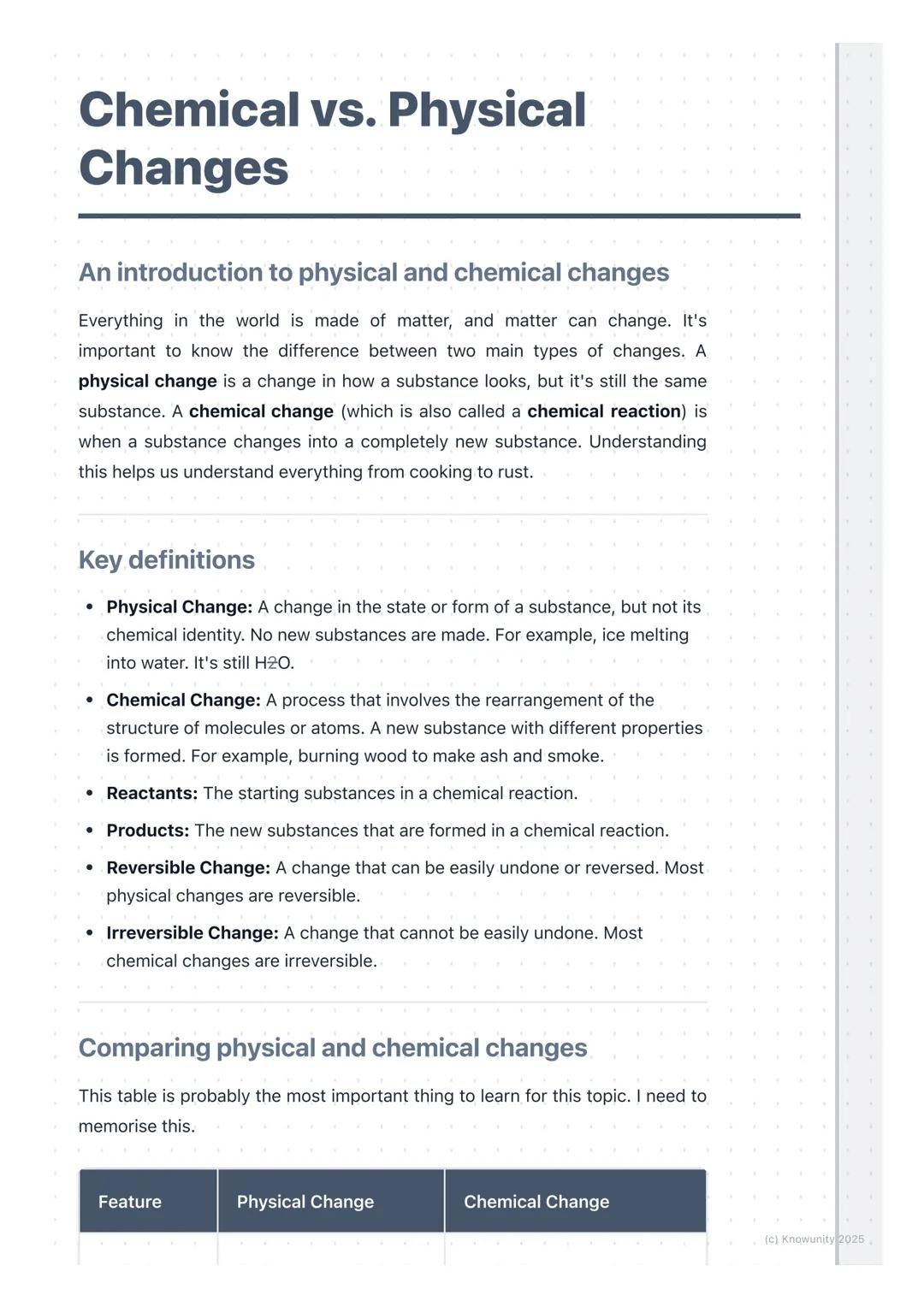
Understanding the Basics
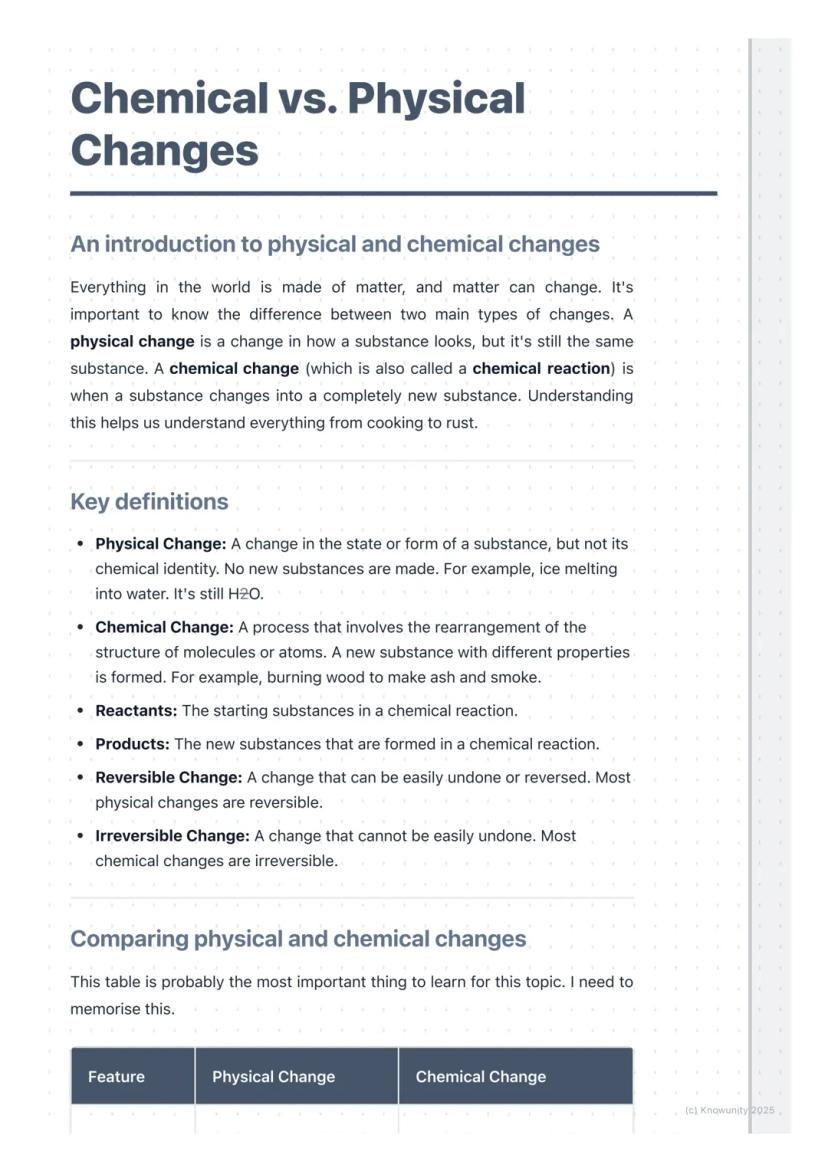
You'll find this topic everywhere in science, so getting these definitions right will make everything else much easier. A physical change happens when something looks different but is still the same substance underneath - like ice melting into water (it's still H₂O). A chemical change creates completely new substances with different properties.
Think of it this way: if you can easily undo the change, it's probably physical. If you can't turn it back to what it was, it's likely chemical.
The key players in chemical changes are reactants (what you start with) and products (what you end up with). Most physical changes are reversible, whilst chemical changes are usually irreversible.
Top Tip: Ask yourself "Is a new substance formed?" - this is the ultimate test for spotting chemical changes.
2
of 5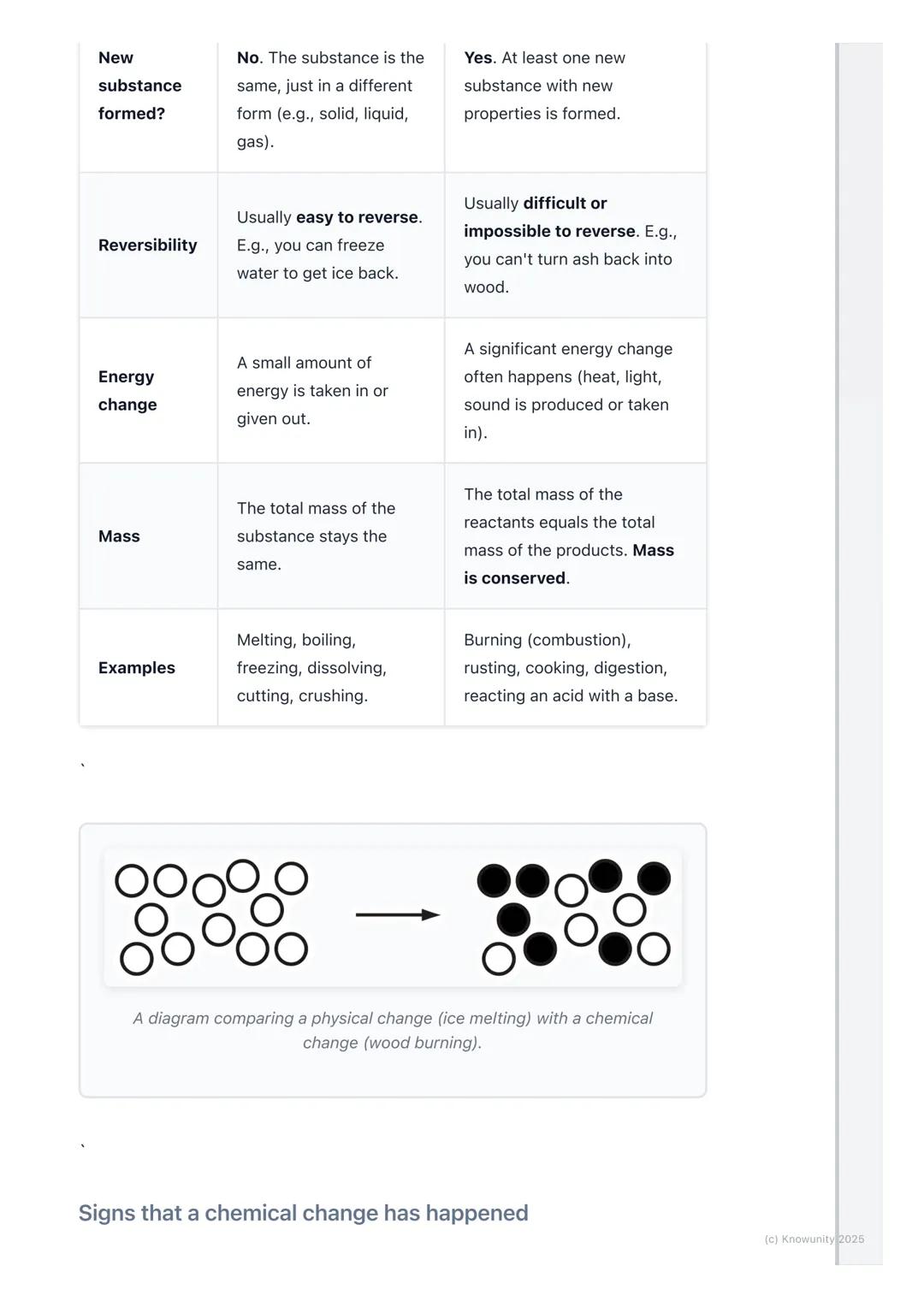
Spotting the Differences
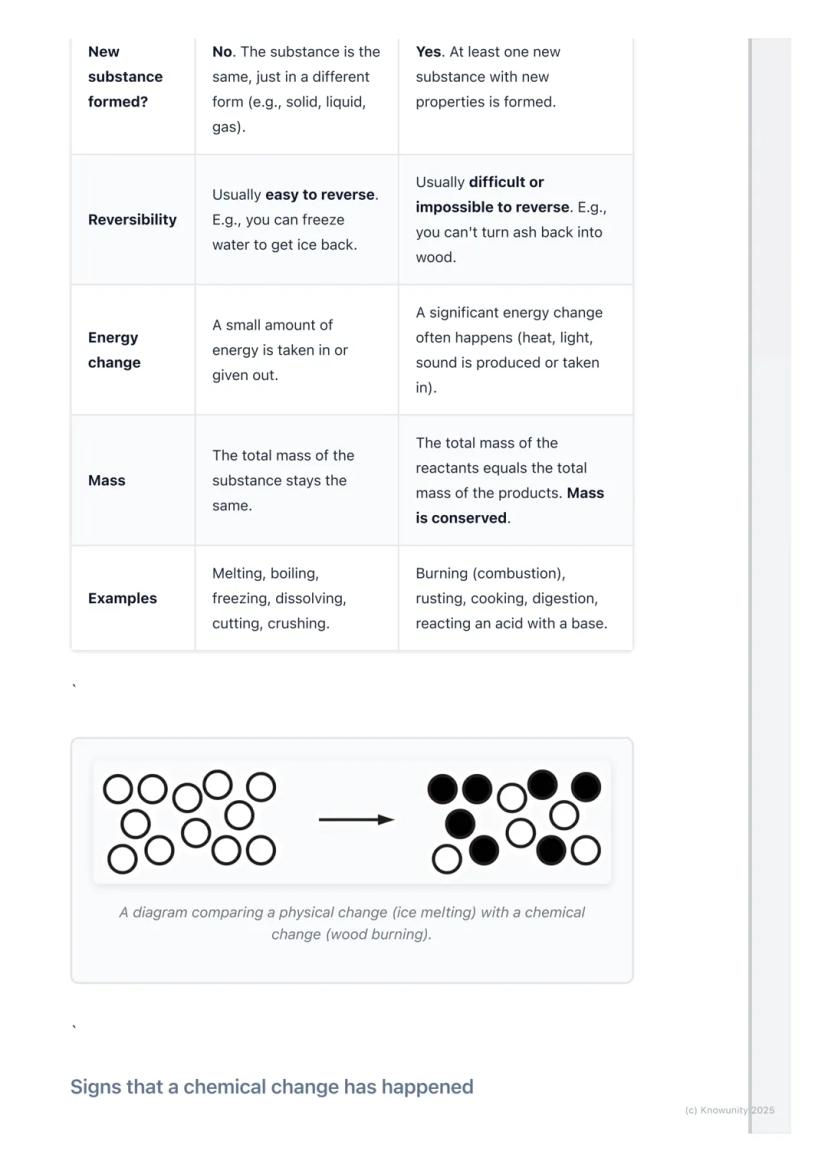
This comparison table is absolutely essential for your exams - you'll definitely need to know these differences. Physical changes keep the same substance but change its form (like crushing ice or boiling water). Chemical changes create entirely new substances with different properties.
The big giveaway is reversibility. You can easily freeze water back into ice, but you can't turn ash back into wood. Energy changes happen in both types, but chemical reactions often produce much more dramatic energy changes.
Don't worry about the mass though - it's always conserved in both types of changes. The total mass before equals the total mass after, every single time.
Remember: Changes of state (melting, freezing, boiling) are ALWAYS physical changes, no matter how dramatic they look.
3
of 5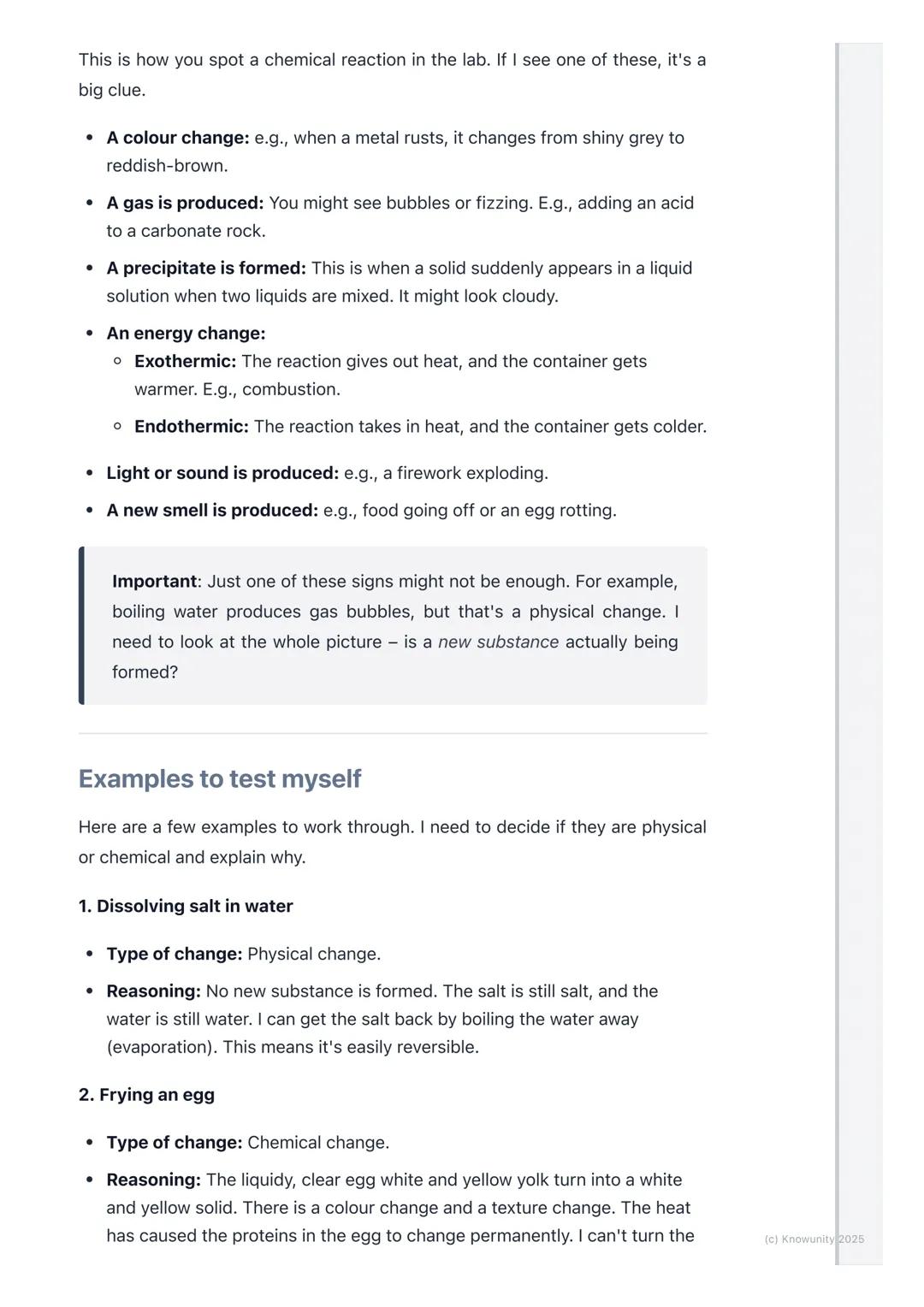
Signs of Chemical Reactions
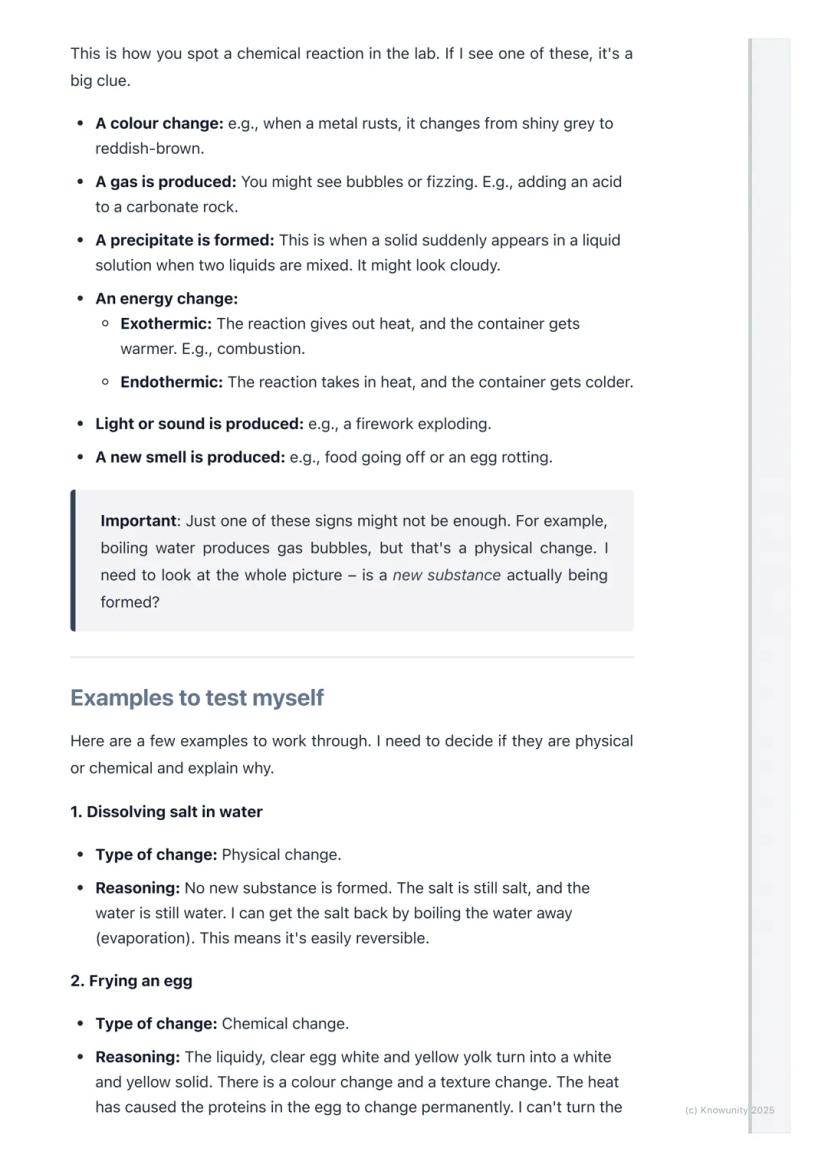
When you're in the lab, these signs will help you spot chemical reactions happening right before your eyes. Look for colour changes (like metal turning rusty), gas production (bubbling or fizzing), or a precipitate forming (when a solid suddenly appears in a clear liquid).
Energy changes are huge clues too. Exothermic reactions give out heat and warm up the container, whilst endothermic reactions absorb heat and cool things down. You might also notice light, sound, or new smells appearing.
Here's the catch though - one sign alone might not be enough. Boiling water produces bubbles, but that's still a physical change. You need to think about whether a genuinely new substance is being created.
Lab Alert: Don't just rely on one sign - look at the whole picture to determine if new substances are actually forming.
4
of 5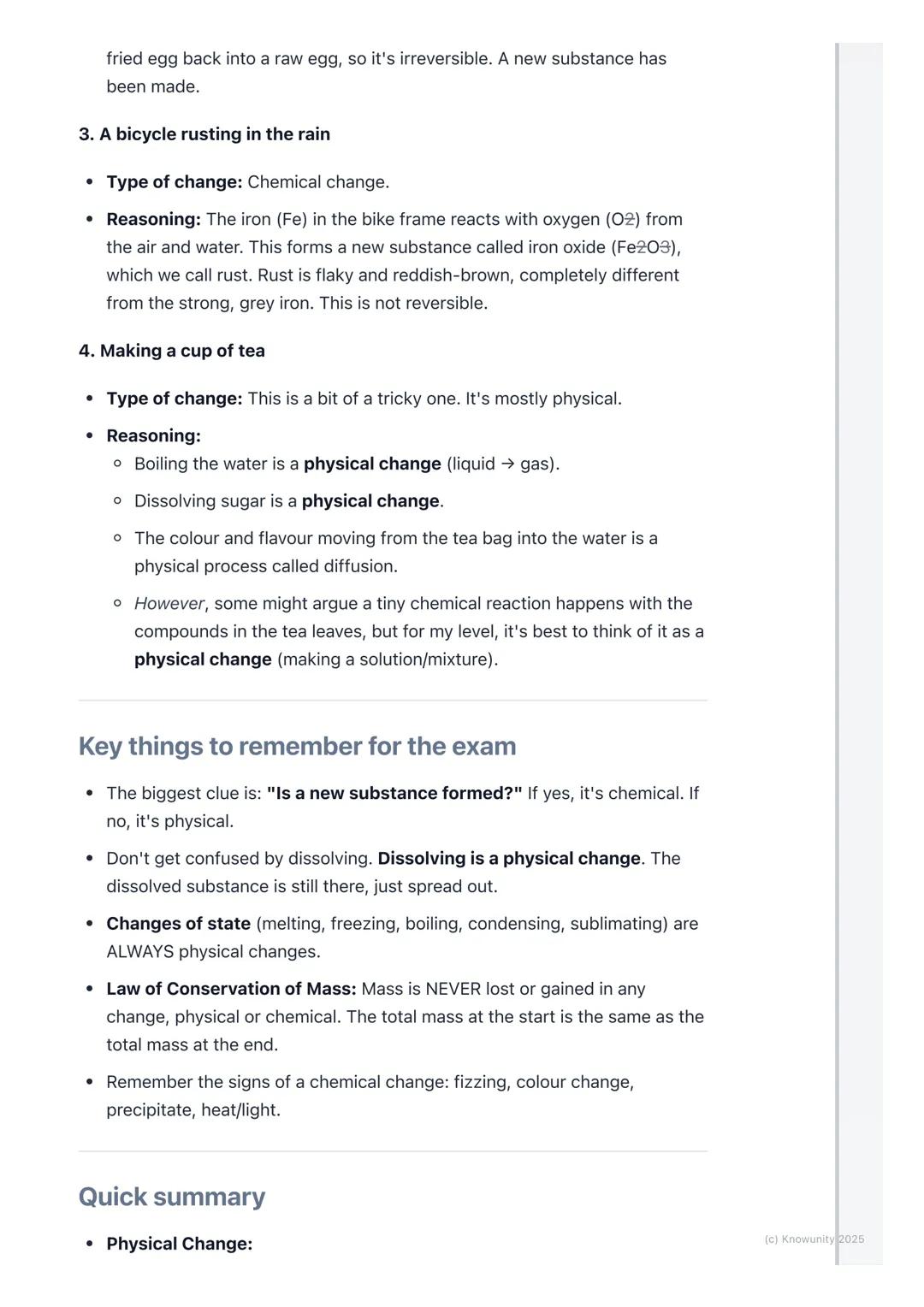
Real-World Examples
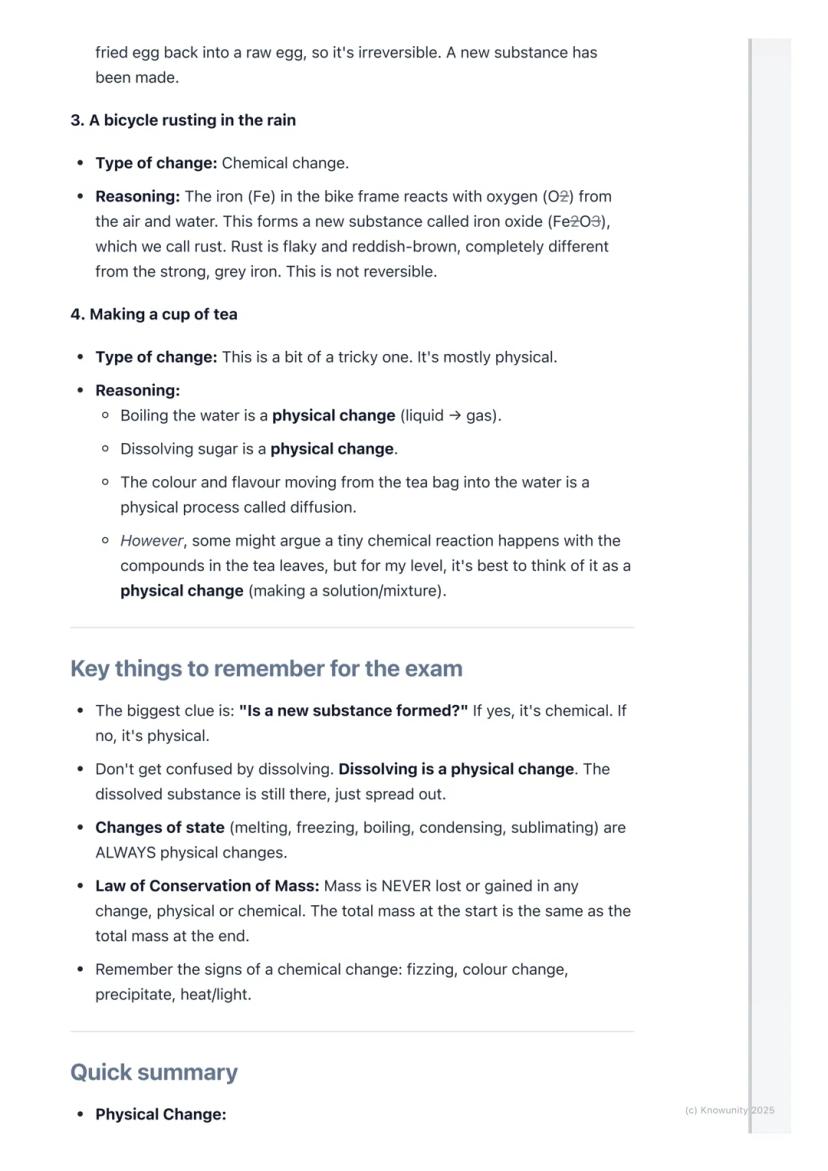
Let's test your understanding with some everyday scenarios. Dissolving salt in water is physical because no new substances form - you can get your salt back by evaporating the water. The salt and water are still chemically the same.
Frying an egg is definitely chemical. The clear, runny egg white becomes solid and white through heat, and the proteins change permanently. You'll never turn that fried egg back into a raw one!
Rusting happens when iron reacts with oxygen and water to form iron oxide - a completely new substance that's flaky and reddish-brown. Making tea is mostly physical (boiling, dissolving, diffusion), though some tiny chemical processes might occur with the tea compounds.
Exam Strategy: Always explain your reasoning - don't just say "physical" or "chemical", explain why based on whether new substances form.
5
of 5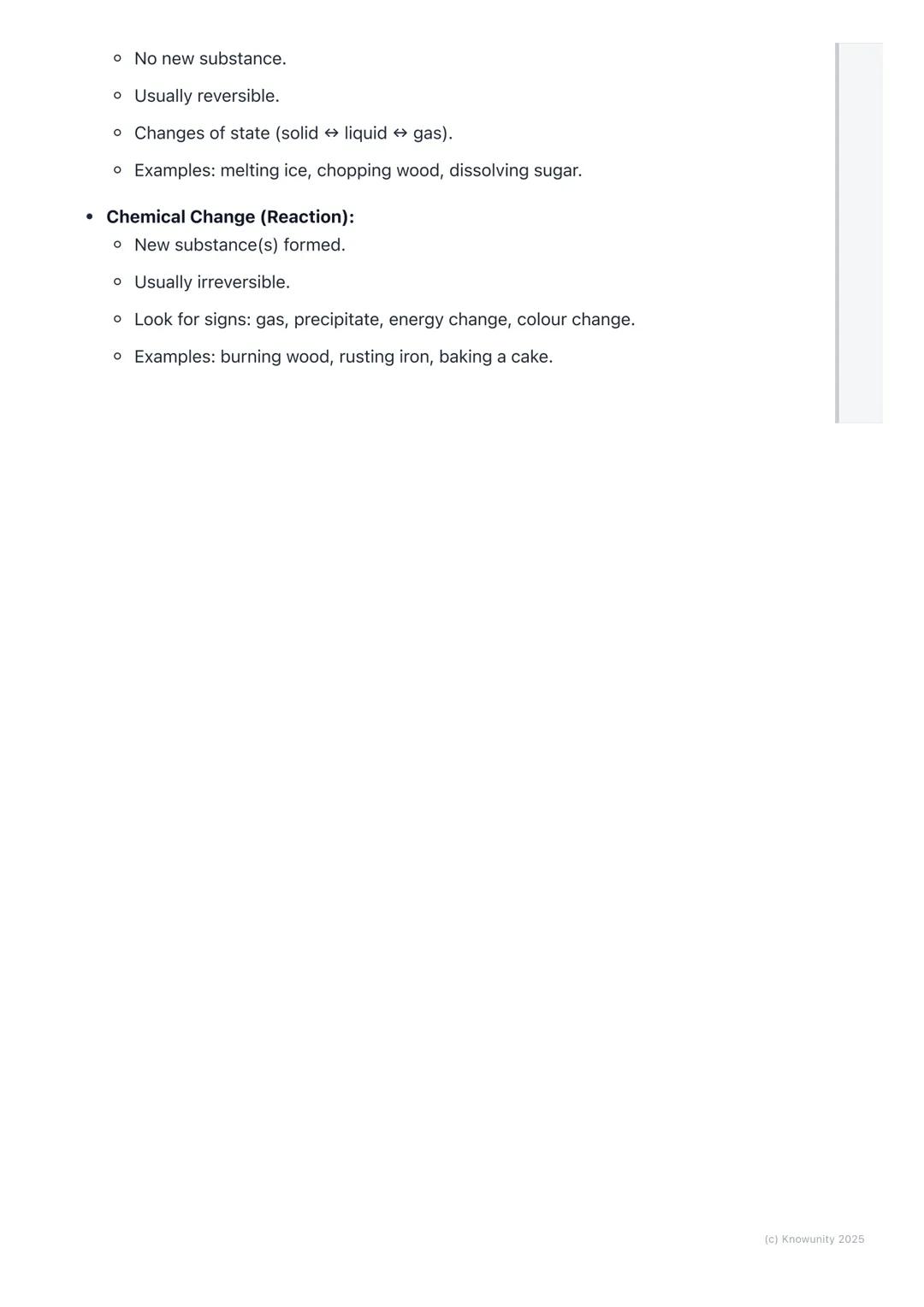
Key Points for Success
You've got this! The Law of Conservation of Mass applies to everything - mass is never lost or gained, whether it's physical or chemical changes. Remember that dissolving is always physical (the substance is just spread out, not changed), and all changes of state are physical.
For chemical changes, watch for the classic signs: fizzing, colour changes, precipitates, and energy changes. The ultimate question remains: "Is a new substance formed?"
Keep practising with everyday examples around you. Is cooking chemical or physical? What about breaking glass? The more you apply these concepts to real life, the more confident you'll become.
Confidence Boost: Once you master the "new substance" rule, you'll find this topic much easier than it first appears!
Mysleli jsme, že se nikdy nezeptáš...
Co je AI společník Knowunity?
Náš AI společník je speciálně vytvořen pro potřeby studentů. Na základě milionů obsahových materiálů, které máme na platformě, můžeme studentům poskytovat opravdu smysluplné a relevantní odpovědi. Ale nejde jen o odpovědi, společník je ještě více o provázení studentů jejich každodenními výzvami v učení, s personalizovanými studijními plány, kvízy nebo obsahovými materiály v chatu a 100% personalizací na základě dovedností a vývoje studentů.
Kde si můžu stáhnout aplikaci Knowunity?
Aplikaci si můžete stáhnout z obchodu Google Play a Apple App Store.
Jak můžu dostat svou platbu? Kolik si můžu vydělat?
Ano, máte bezplatný přístup k obsahu v aplikaci a k našemu společníkovi s umělou inteligencí. Chcete-li odemknout určité funkce aplikace, můžete si zakoupit aplikaci Knowunity Pro.
Nejpopulárnější poznámky z Science
7ScienceScience/Physics notes - Speed, density, work
Speed density work formulas
3rd Year81
ScienceAtomic Structure and the Periodic Table
Students will learn about the structure of atoms, including protons, neutrons, and electrons, and how elements are organised and classified in the Periodic Table based on their electronic configuration and chemical properties.
5th Year41
ScienceHuman Body Systems
An introduction to major human body systems such as the digestive, circulatory, respiratory, and nervous systems, understanding their basic functions.
2nd Year131
ScienceJunior Cert Science Notes: The Cell
Notes on the Cell
3rd Year261
ScienceCells
Junior cert science cells summary
1st Year611
ScienceHuman Reproductive System
A basic overview of the male and female reproductive systems, including their main structures and functions.
TY191
ScienceLight and Optics
Exploring the properties of light, including how it travels, reflects, and refracts, and how we perceive colours.
2nd Year50
Nejpopulárnější poznámky
9 Irish
IrishIrish oral questions and answers
Questions and answers for the leaving cert oral
5th Year4264
 English
Key Quotes : Sive
Key Quotes and explanations: Sive
6th Year2842
IrishIrish oral questions
Outline of oral questions
5th Year2055
IrishIníon- le hÁine Durkin
Aine Durkin’s poem, Iníon: Themes & summary
5th Year850
IrishIrish poetry 2027
Iníon + Dínit an Bhróin
5th Year1133
IrishLC HL notes- Iníon (poem)
Includes poem in English and Irish, theme, key words & phrases
5th Year2284
EnglishCultural Context : Shawshank Redemption : Sive : Small Things Like These
Comparative Study : Cultural Context : Shawshank Redemption, Sive and Small Things Like These
6th Year1430
IrishMo Ghrá-sa (Idir Lúibíní)
Notes on mo ghrá-sa
5th Year380
IrishAn Gaeilge Aiste
Irish Language essay
6th Year1320
Nemůžeš najít, co hledáš? Prozkoumej další předměty.
Recenze od našich uživatelů. Mají vše super — a ty taky můžeš.
4.6/5App Store
4.7/5Google Play
Aplikace je velmi jednoduchá na používání a dobře navržená. Zatím jsem našel vše, co jsem hledal, a mohl jsem se z prezentací hodně naučit! Určitě použiju aplikaci na školní úkol! A samozřejmě taky hodně pomáhá jako inspirace.
Stefan Suživatel iOS
Tahle aplikace je fakt skvělá. Je tam tolik studijních poznámek a pomůcek [...]. Můj problémový předmět je například francouzština a aplikace nabízí tolik možností pomoci. Díky této aplikaci jsem si zlepšil francouzštinu. Doporučil bych ji každému.
Samantha Klichuživatelka Androidu
Páni, jsem opravdu ohromen. Zkusil jsem aplikaci jen proto, že jsem ji mnohokrát viděl v reklamách, a byl jsem naprosto ohromen. Tato aplikace je TA POMOC, kterou chceš do školy, a především nabízí spoustu věcí, jako jsou cvičení a přehledy faktů, které mi osobně VELMI pomohly.
Annauživatelka iOS
Science2 zobrazení·Aktualizováno Jun 12, 2026·5 stránekUnderstanding Chemical and Physical Changes
Every day you see matter changing around you - ice melting in your drink, bread toasting, or your bike getting rusty. Understanding whether these are physical or chemical changes is crucial for understanding how the world works and will help...
1
of 5
Registruj se, abys viděl obsah. Je to zdarma!
- Přístup ke všem dokumentům
- Zlepši své známky
- Připoj se k milionům studentů
Understanding the Basics
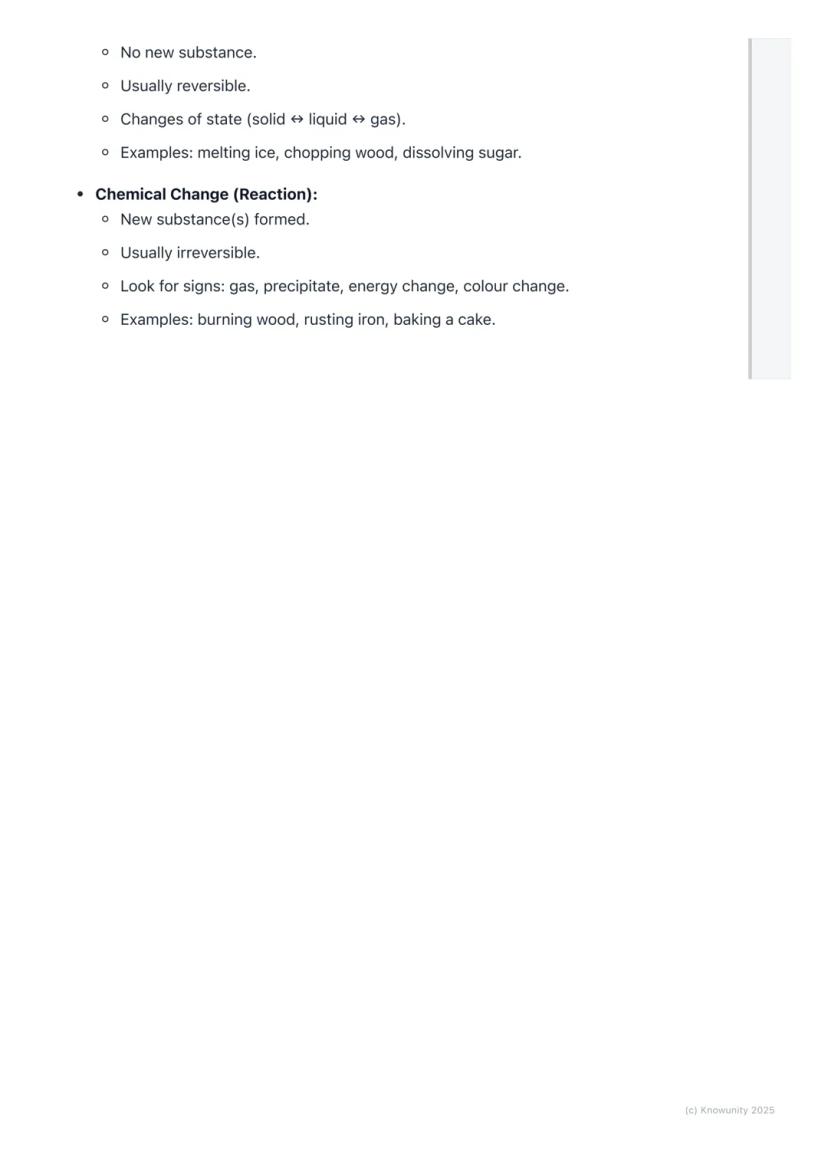
You'll find this topic everywhere in science, so getting these definitions right will make everything else much easier. A physical change happens when something looks different but is still the same substance underneath - like ice melting into water (it's still H₂O). A chemical change creates completely new substances with different properties.
Think of it this way: if you can easily undo the change, it's probably physical. If you can't turn it back to what it was, it's likely chemical.
The key players in chemical changes are reactants (what you start with) and products (what you end up with). Most physical changes are reversible, whilst chemical changes are usually irreversible.
Top Tip: Ask yourself "Is a new substance formed?" - this is the ultimate test for spotting chemical changes.
2
of 5Registruj se, abys viděl obsah. Je to zdarma!
- Přístup ke všem dokumentům
- Zlepši své známky
- Připoj se k milionům studentů
Spotting the Differences
This comparison table is absolutely essential for your exams - you'll definitely need to know these differences. Physical changes keep the same substance but change its form (like crushing ice or boiling water). Chemical changes create entirely new substances with different properties.
The big giveaway is reversibility. You can easily freeze water back into ice, but you can't turn ash back into wood. Energy changes happen in both types, but chemical reactions often produce much more dramatic energy changes.
Don't worry about the mass though - it's always conserved in both types of changes. The total mass before equals the total mass after, every single time.
Remember: Changes of state (melting, freezing, boiling) are ALWAYS physical changes, no matter how dramatic they look.
3
of 5Registruj se, abys viděl obsah. Je to zdarma!
- Přístup ke všem dokumentům
- Zlepši své známky
- Připoj se k milionům studentů
Signs of Chemical Reactions
When you're in the lab, these signs will help you spot chemical reactions happening right before your eyes. Look for colour changes (like metal turning rusty), gas production (bubbling or fizzing), or a precipitate forming (when a solid suddenly appears in a clear liquid).
Energy changes are huge clues too. Exothermic reactions give out heat and warm up the container, whilst endothermic reactions absorb heat and cool things down. You might also notice light, sound, or new smells appearing.
Here's the catch though - one sign alone might not be enough. Boiling water produces bubbles, but that's still a physical change. You need to think about whether a genuinely new substance is being created.
Lab Alert: Don't just rely on one sign - look at the whole picture to determine if new substances are actually forming.
4
of 5Registruj se, abys viděl obsah. Je to zdarma!
- Přístup ke všem dokumentům
- Zlepši své známky
- Připoj se k milionům studentů
Real-World Examples
Let's test your understanding with some everyday scenarios. Dissolving salt in water is physical because no new substances form - you can get your salt back by evaporating the water. The salt and water are still chemically the same.
Frying an egg is definitely chemical. The clear, runny egg white becomes solid and white through heat, and the proteins change permanently. You'll never turn that fried egg back into a raw one!
Rusting happens when iron reacts with oxygen and water to form iron oxide - a completely new substance that's flaky and reddish-brown. Making tea is mostly physical (boiling, dissolving, diffusion), though some tiny chemical processes might occur with the tea compounds.
Exam Strategy: Always explain your reasoning - don't just say "physical" or "chemical", explain why based on whether new substances form.
5
of 5Registruj se, abys viděl obsah. Je to zdarma!
- Přístup ke všem dokumentům
- Zlepši své známky
- Připoj se k milionům studentů
Key Points for Success
You've got this! The Law of Conservation of Mass applies to everything - mass is never lost or gained, whether it's physical or chemical changes. Remember that dissolving is always physical (the substance is just spread out, not changed), and all changes of state are physical.
For chemical changes, watch for the classic signs: fizzing, colour changes, precipitates, and energy changes. The ultimate question remains: "Is a new substance formed?"
Keep practising with everyday examples around you. Is cooking chemical or physical? What about breaking glass? The more you apply these concepts to real life, the more confident you'll become.
Confidence Boost: Once you master the "new substance" rule, you'll find this topic much easier than it first appears!
Mysleli jsme, že se nikdy nezeptáš...
Co je AI společník Knowunity?
Náš AI společník je speciálně vytvořen pro potřeby studentů. Na základě milionů obsahových materiálů, které máme na platformě, můžeme studentům poskytovat opravdu smysluplné a relevantní odpovědi. Ale nejde jen o odpovědi, společník je ještě více o provázení studentů jejich každodenními výzvami v učení, s personalizovanými studijními plány, kvízy nebo obsahovými materiály v chatu a 100% personalizací na základě dovedností a vývoje studentů.
Kde si můžu stáhnout aplikaci Knowunity?
Aplikaci si můžete stáhnout z obchodu Google Play a Apple App Store.
Jak můžu dostat svou platbu? Kolik si můžu vydělat?
Ano, máte bezplatný přístup k obsahu v aplikaci a k našemu společníkovi s umělou inteligencí. Chcete-li odemknout určité funkce aplikace, můžete si zakoupit aplikaci Knowunity Pro.
Nejpopulárnější poznámky z Science
7ScienceScience/Physics notes - Speed, density, work
Speed density work formulas
3rd Year81
ScienceAtomic Structure and the Periodic Table
Students will learn about the structure of atoms, including protons, neutrons, and electrons, and how elements are organised and classified in the Periodic Table based on their electronic configuration and chemical properties.
5th Year41
ScienceHuman Body Systems
An introduction to major human body systems such as the digestive, circulatory, respiratory, and nervous systems, understanding their basic functions.
2nd Year131
ScienceJunior Cert Science Notes: The Cell
Notes on the Cell
3rd Year261
ScienceCells
Junior cert science cells summary
1st Year611
ScienceHuman Reproductive System
A basic overview of the male and female reproductive systems, including their main structures and functions.
TY191
ScienceLight and Optics
Exploring the properties of light, including how it travels, reflects, and refracts, and how we perceive colours.
2nd Year50
Nejpopulárnější poznámky
9IrishIrish oral questions and answers
Questions and answers for the leaving cert oral
5th Year4264
EnglishKey Quotes : Sive
Key Quotes and explanations: Sive
6th Year2842
IrishIrish oral questions
Outline of oral questions
5th Year2055
IrishIníon- le hÁine Durkin
Aine Durkin’s poem, Iníon: Themes & summary
5th Year850
IrishIrish poetry 2027
Iníon + Dínit an Bhróin
5th Year1133
IrishLC HL notes- Iníon (poem)
Includes poem in English and Irish, theme, key words & phrases
5th Year2284
EnglishCultural Context : Shawshank Redemption : Sive : Small Things Like These
Comparative Study : Cultural Context : Shawshank Redemption, Sive and Small Things Like These
6th Year1430
IrishMo Ghrá-sa (Idir Lúibíní)
Notes on mo ghrá-sa
5th Year380
IrishAn Gaeilge Aiste
Irish Language essay
6th Year1320
Nemůžeš najít, co hledáš? Prozkoumej další předměty.
Recenze od našich uživatelů. Mají vše super — a ty taky můžeš.
4.6/5App Store
4.7/5Google Play
Aplikace je velmi jednoduchá na používání a dobře navržená. Zatím jsem našel vše, co jsem hledal, a mohl jsem se z prezentací hodně naučit! Určitě použiju aplikaci na školní úkol! A samozřejmě taky hodně pomáhá jako inspirace.
Stefan Suživatel iOS
Tahle aplikace je fakt skvělá. Je tam tolik studijních poznámek a pomůcek [...]. Můj problémový předmět je například francouzština a aplikace nabízí tolik možností pomoci. Díky této aplikaci jsem si zlepšil francouzštinu. Doporučil bych ji každému.
Samantha Klichuživatelka Androidu
Páni, jsem opravdu ohromen. Zkusil jsem aplikaci jen proto, že jsem ji mnohokrát viděl v reklamách, a byl jsem naprosto ohromen. Tato aplikace je TA POMOC, kterou chceš do školy, a především nabízí spoustu věcí, jako jsou cvičení a přehledy faktů, které mi osobně VELMI pomohly.
Annauživatelka iOS