
Lenses are everywhere - in your phone camera, glasses, and... Zobrazit více
 Physics
 Irish
Irish English
Registruj se, abys viděl obsahJe to zdarma!
Přístup ke všem dokumentům
Zlepši své známky
Připoj se k milionům studentů
Knowunity AI
Předměty
Triangle Congruence and Similarity Theorems
Triangle Properties and Classification
Linear Equations and Graphs
Geometric Angle Relationships
Trigonometric Functions and Identities
Equation Solving Techniques
Circle Geometry Fundamentals
Division Operations and Methods
Basic Differentiation Rules
Exponent and Logarithm Properties
Zobrazit všechna témata
Human Organ Systems
Reproductive Cell Cycles
Biological Sciences Subdisciplines
Cellular Energy Metabolism
Autotrophic Energy Processes
Inheritance Patterns and Principles
Biomolecular Structure and Organization
Cell Cycle and Division Mechanics
Cellular Organization and Development
Biological Structural Organization
Zobrazit všechna témata
Chemical Sciences and Applications
Atomic Structure and Composition
Molecular Electron Structure Representation
Atomic Electron Behavior
Matter Properties and Water
Mole Concept and Calculations
Gas Laws and Behavior
Periodic Table Organization
Chemical Thermodynamics Fundamentals
Chemical Bond Types and Properties
Zobrazit všechna témata
European Renaissance and Enlightenment
European Cultural Movements 800-1920
American Revolution Era 1763-1797
American Civil War 1861-1865
Global Imperial Systems
Mongol and Chinese Dynasties
U.S. Presidents and World Leaders
Historical Sources and Documentation
World Wars Era and Impact
World Religious Systems
Zobrazit všechna témata
Classic and Contemporary Novels
Literary Character Analysis
Rhetorical Theory and Practice
Classic Literary Narratives
Reading Analysis and Interpretation
Narrative Structure and Techniques
English Language Components
Influential English-Language Authors
Basic Sentence Structure
Narrative Voice and Perspective
Zobrazit všechna témata
5
•
Aktualizováno May 3, 2026
•
Lenses are everywhere - in your phone camera, glasses, and... Zobrazit více
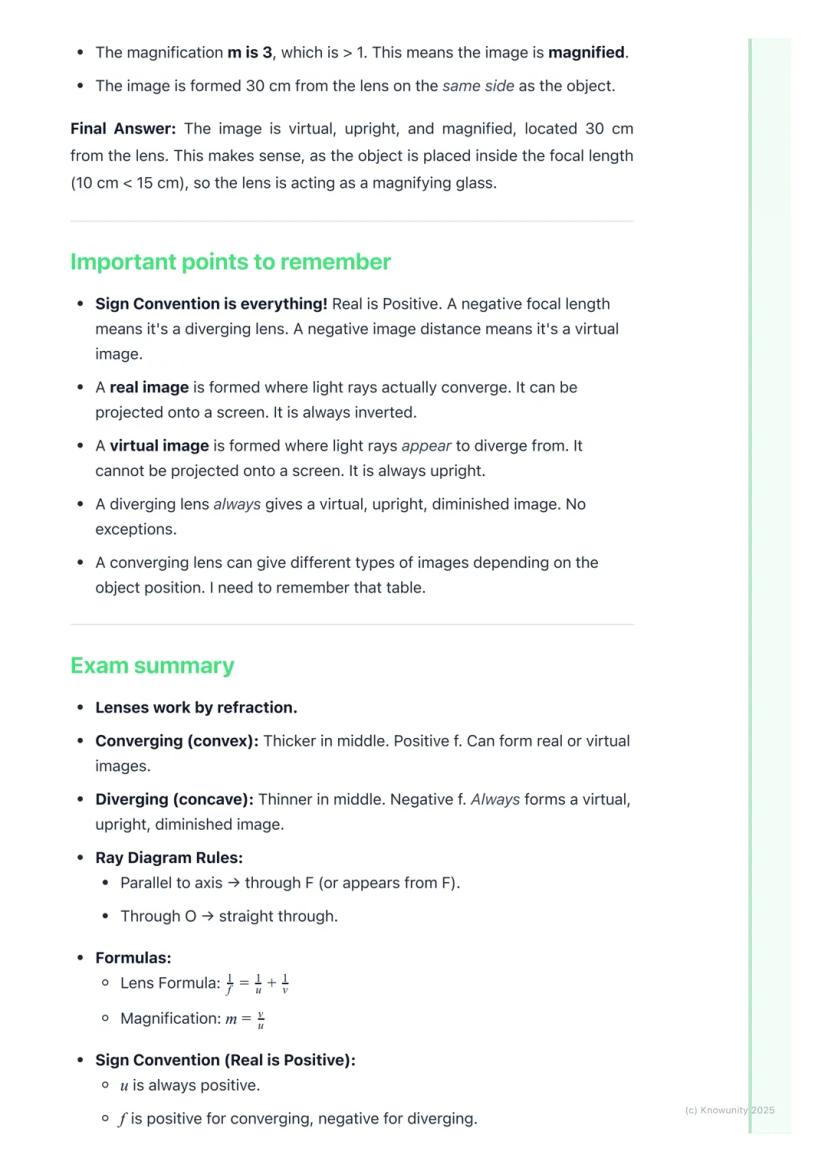

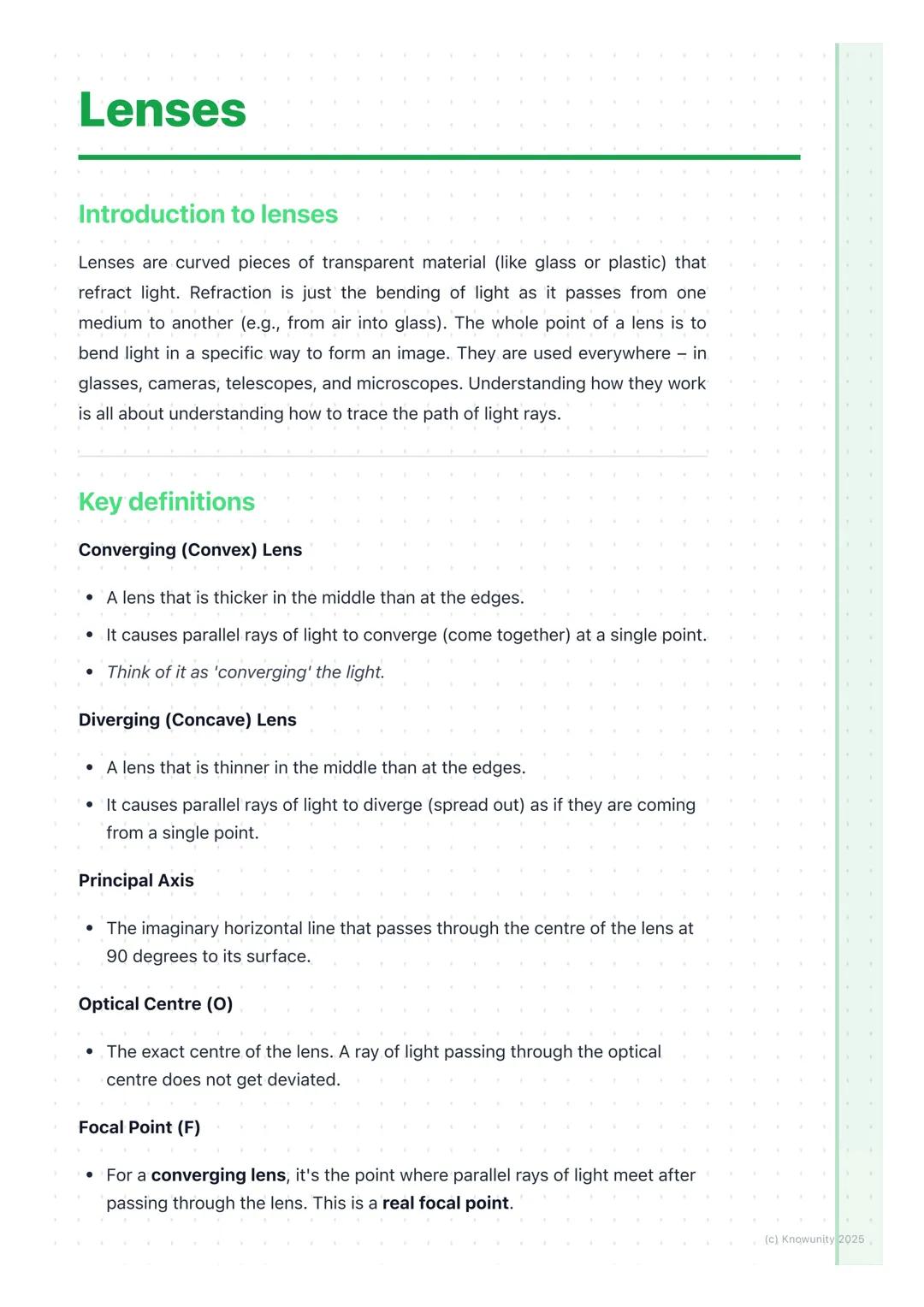
Ever wondered how your camera focuses or how glasses help you see clearly? It's all about refraction - the bending of light as it passes through different materials.
Converging (convex) lenses are thicker in the middle and bring light rays together at a focal point. Think of a magnifying glass - that's a converging lens. Diverging (concave) lenses are thinner in the middle and spread light rays apart.
The optical centre (O) is the middle of the lens where light passes straight through. The focal point (F) is where parallel light rays meet (or appear to come from), and the focal length (f) is the distance from the centre to this point.
Quick Tip: Remember "thick middle = converging, thin middle = diverging" to never mix them up!
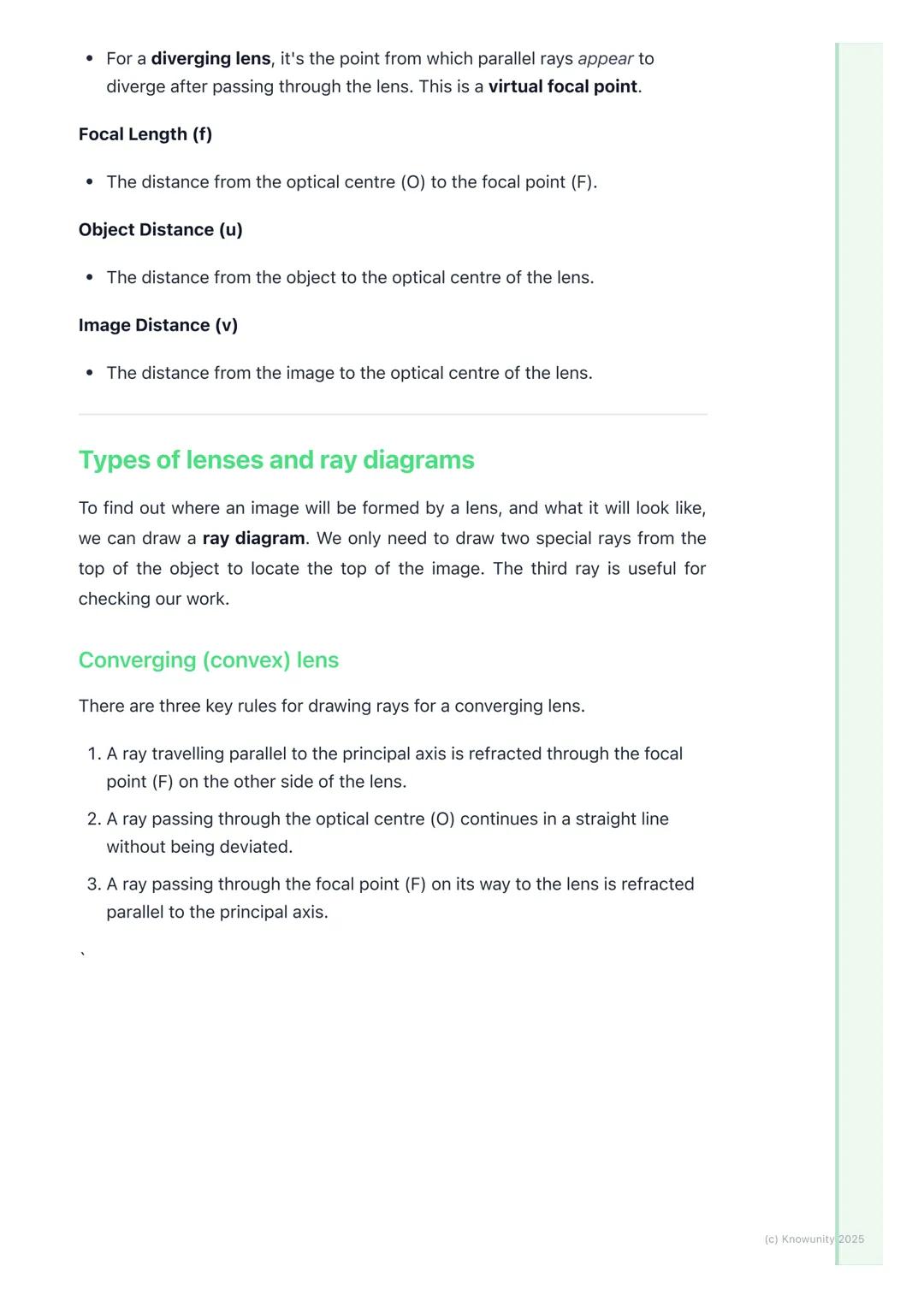
Drawing ray diagrams is like creating a map for light! You only need two special rays to find where an image forms.
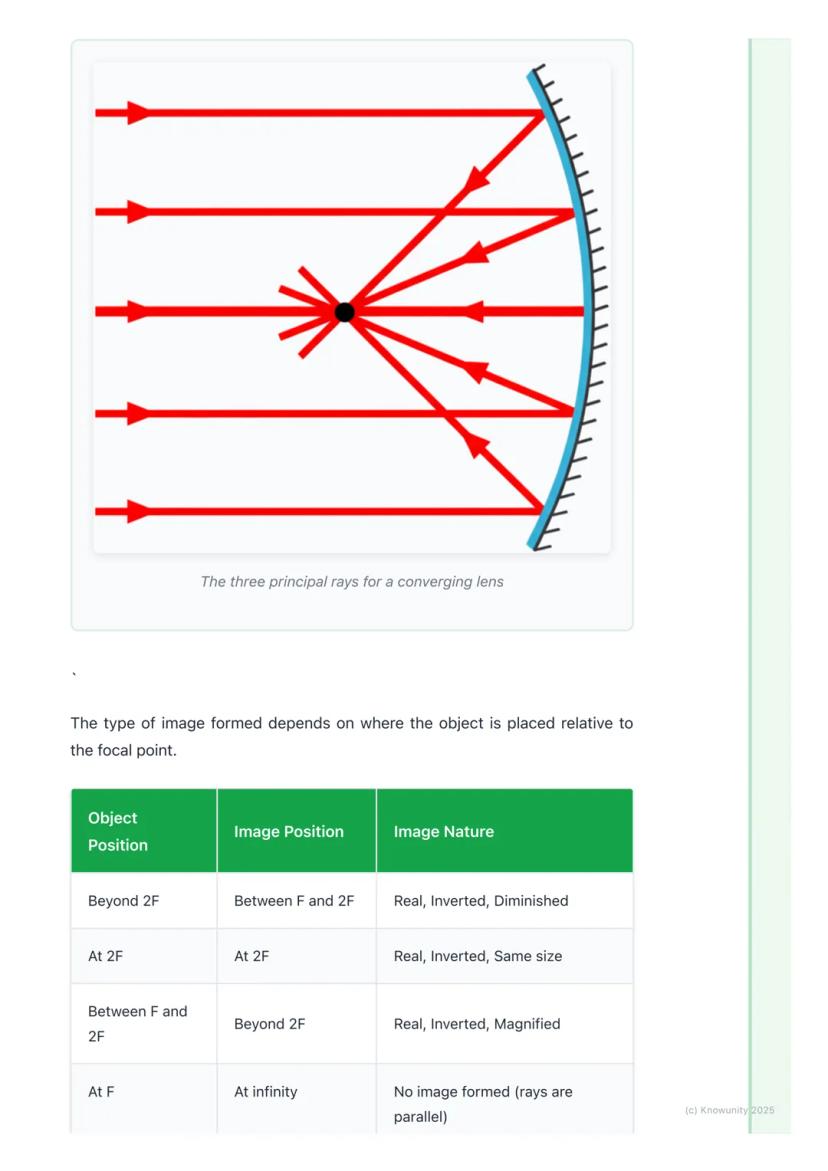
For converging lenses, follow these three rules: 1) A ray parallel to the axis bends through the focal point, 2) A ray through the optical centre goes straight, and 3) A ray through the focal point becomes parallel to the axis.
The image you get depends entirely on where you place the object. If it's beyond 2F, you get a real, inverted, smaller image. Between F and 2F? Real, inverted, but magnified. Place it inside the focal length and boom - you've got a magnifying glass with a virtual, upright, enlarged image!
Exam Success: Learn the object position table by heart - it's a guaranteed marks winner!
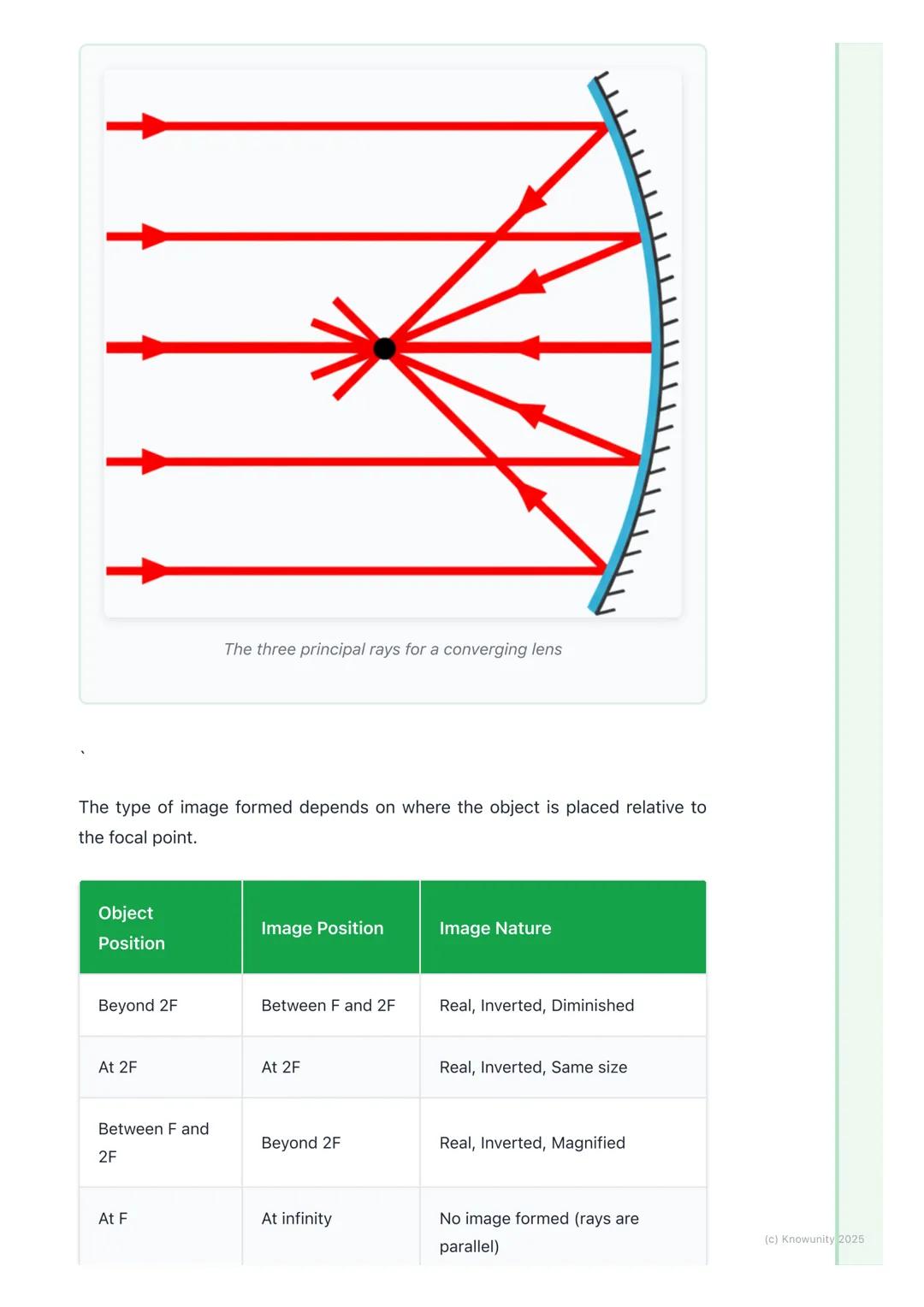
Here's where converging lenses get interesting - the image changes dramatically based on object placement!
When your object sits beyond 2F, you get a real, inverted, diminished image between F and 2F. This is exactly how camera lenses work. At exactly 2F, the image appears at 2F on the other side, same size but upside down.
Place the object between F and 2F, and suddenly your image jumps beyond 2F, becoming real, inverted, but magnified. Put it right at F and no image forms - the rays become parallel. The magic happens inside F where you get a virtual, upright, magnified image.
Memory Trick: "Real images flip, virtual images don't" - real images are always inverted, virtual ones stay upright!
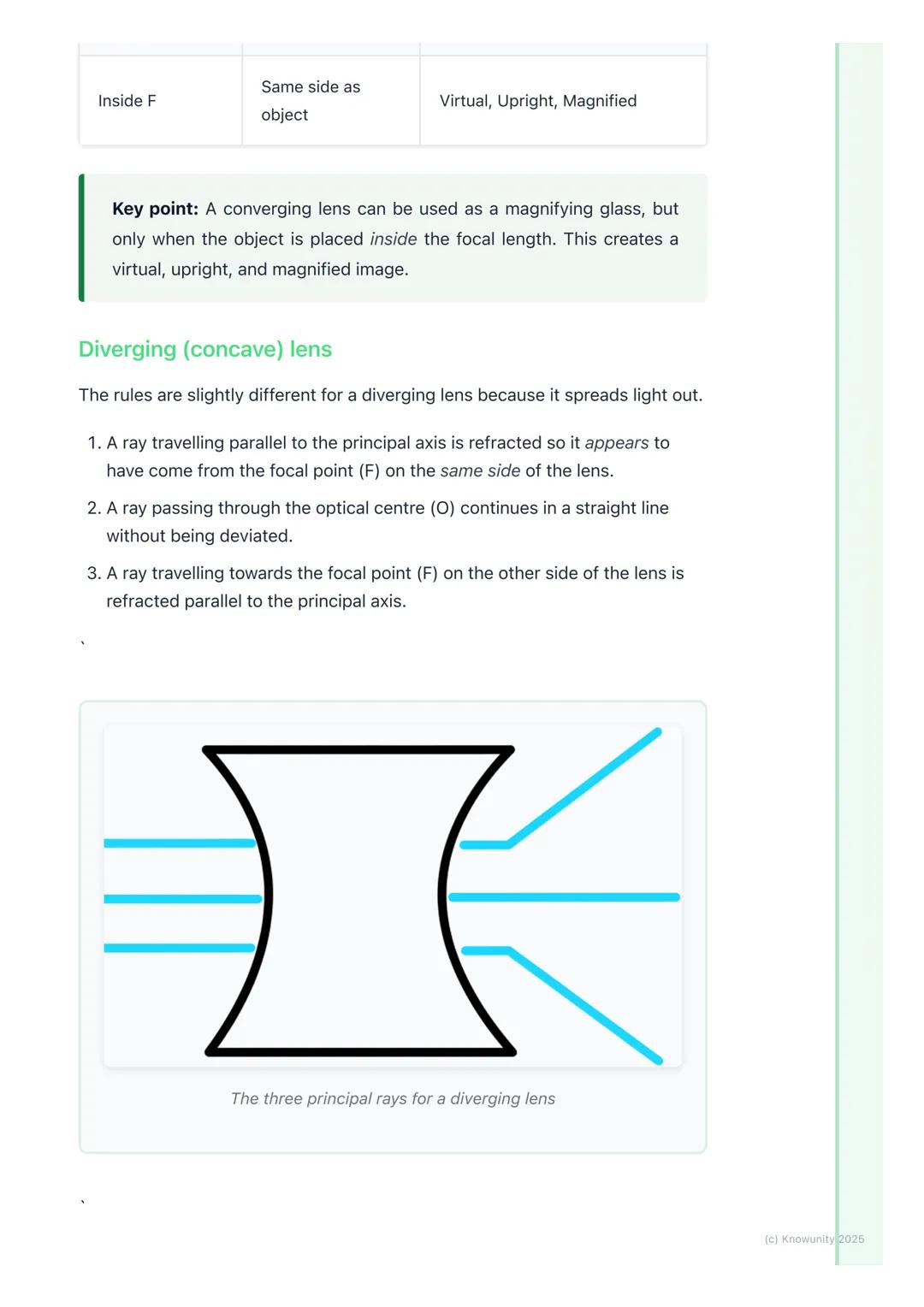
Diverging lenses are the reliable ones - they always produce the same type of image, no matter where you put the object!
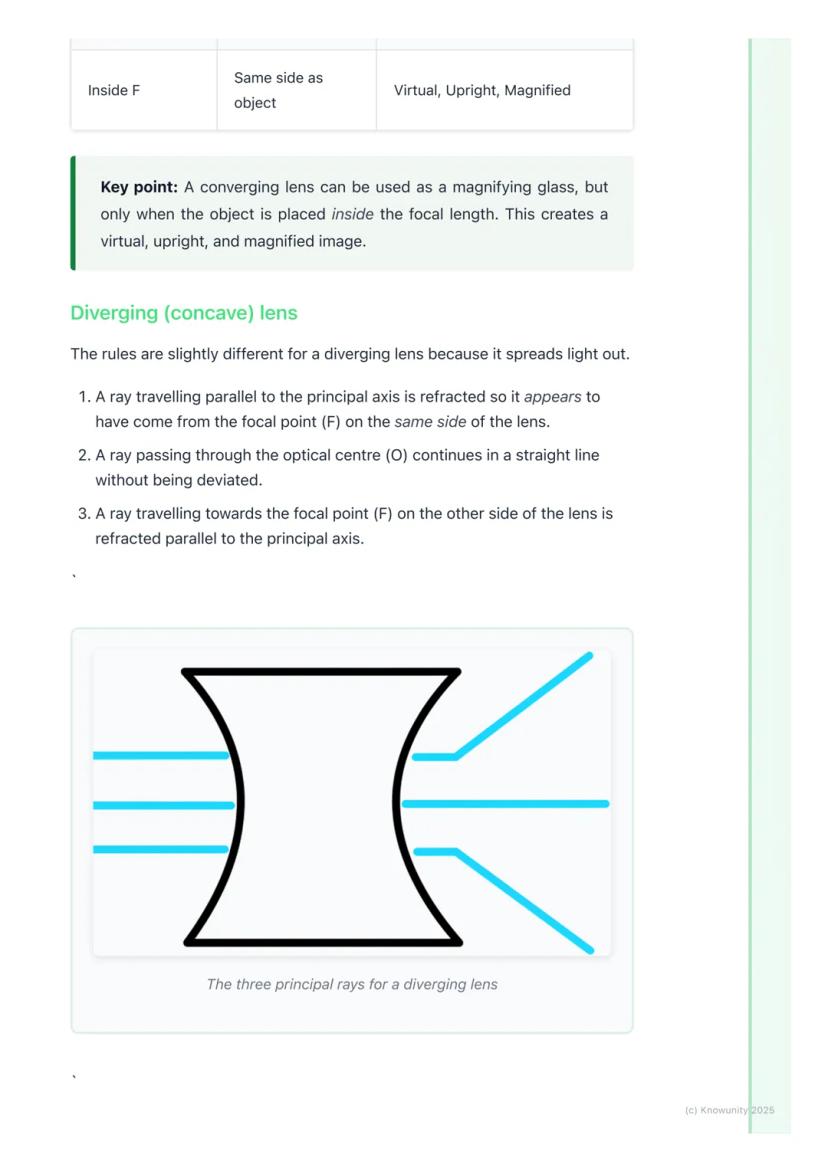
The ray rules are similar but with a twist: parallel rays appear to come from the focal point on the same side as the object. A ray towards the far focal point gets bent parallel to the axis.
No matter what you do with a diverging lens, you'll always get a virtual, upright, diminished image. Always. This makes them perfect for things like peepholes in doors or certain types of glasses for short-sightedness.
Study Smart: Since diverging lenses are predictable, focus your revision time on the trickier converging lens scenarios!
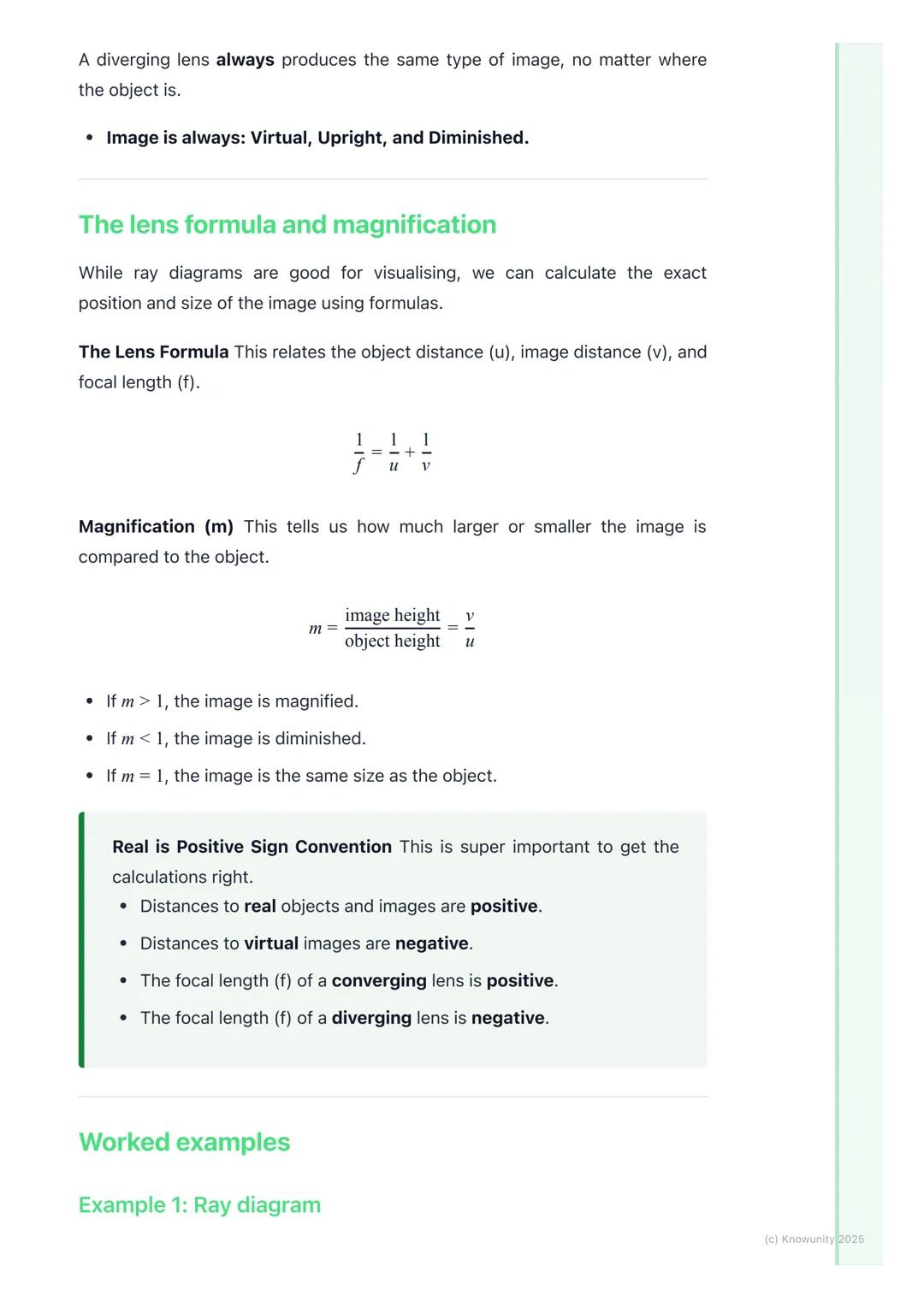
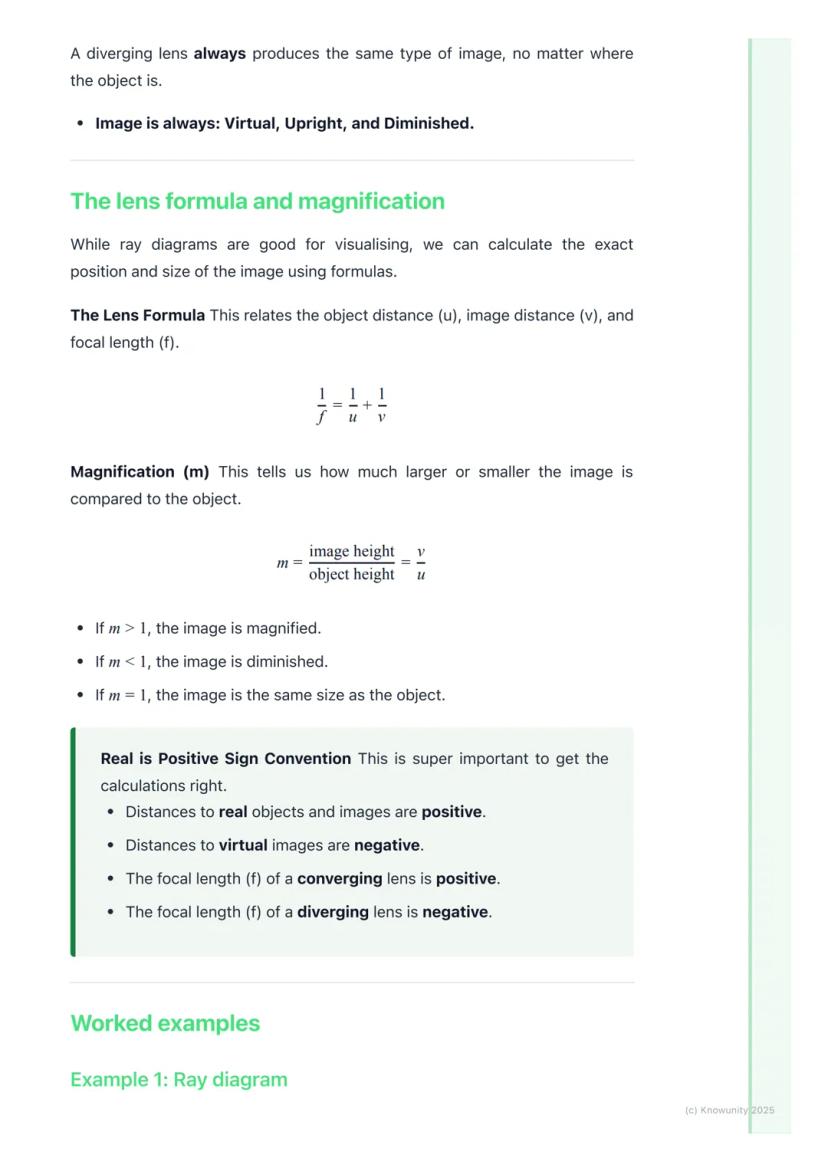
Time to put numbers to your diagrams! The lens formula connects everything: 1/f = 1/u + 1/v, where f is focal length, u is object distance, and v is image distance.
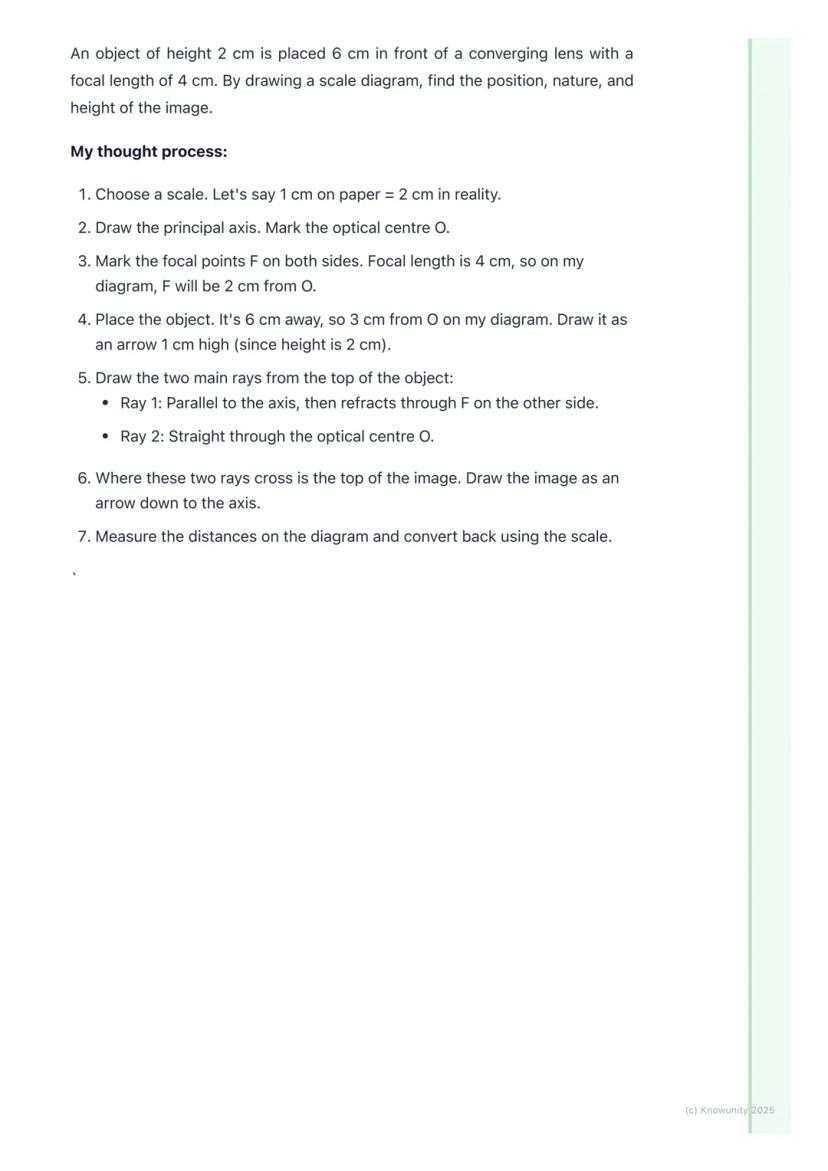
Magnification tells you how much bigger or smaller your image is: m = v/u. If m > 1, your image is magnified. If m < 1, it's diminished. Simple!
The sign convention is crucial: "Real is Positive" means real objects and images get positive distances, virtual images get negative distances. Converging lenses have positive focal lengths, diverging ones negative.
Calculation Confidence: Practice the sign convention until it's automatic - getting signs wrong will mess up your entire answer!
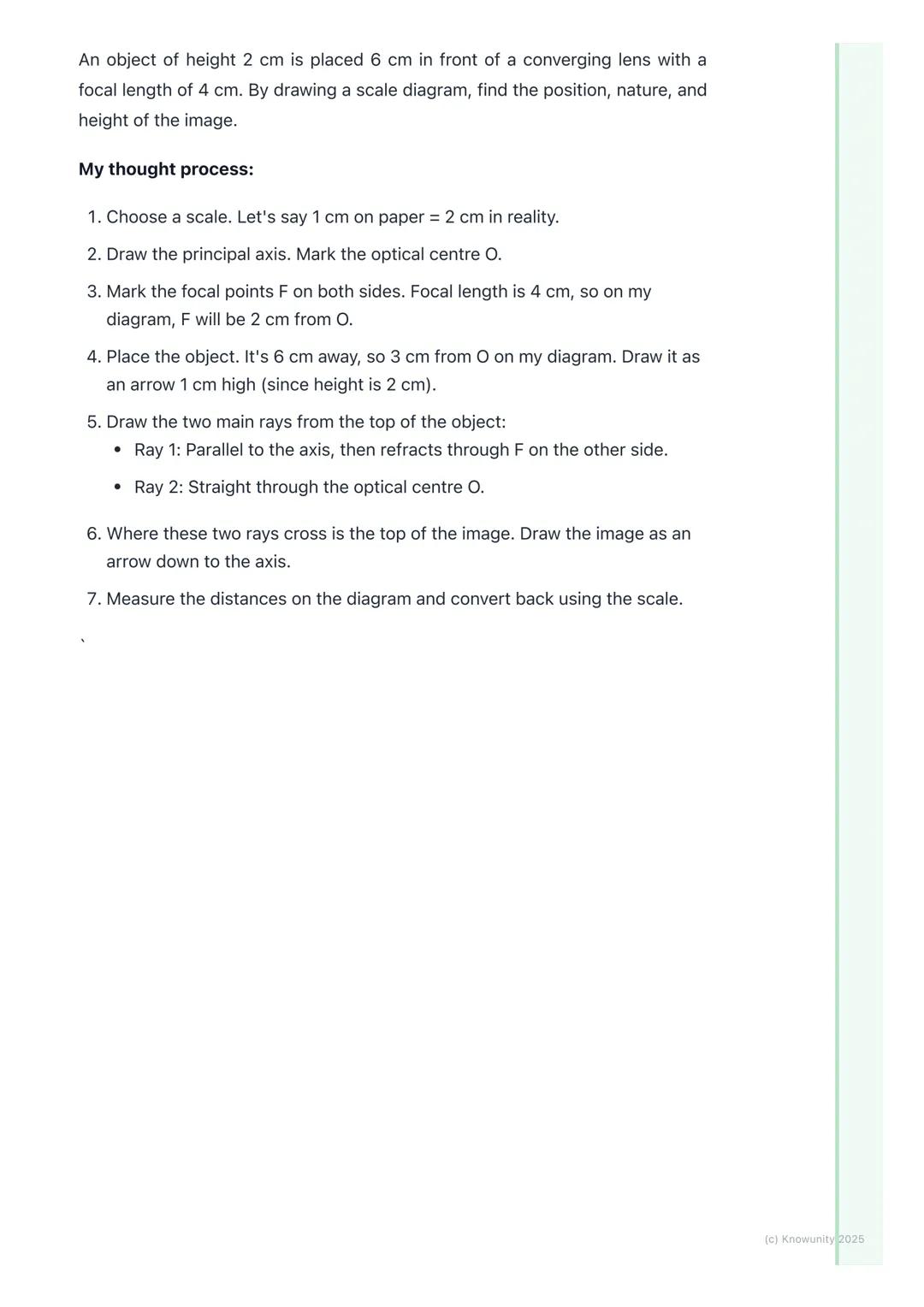
Let's solve a real problem! An object (2 cm tall) sits 6 cm from a converging lens with focal length 4 cm.
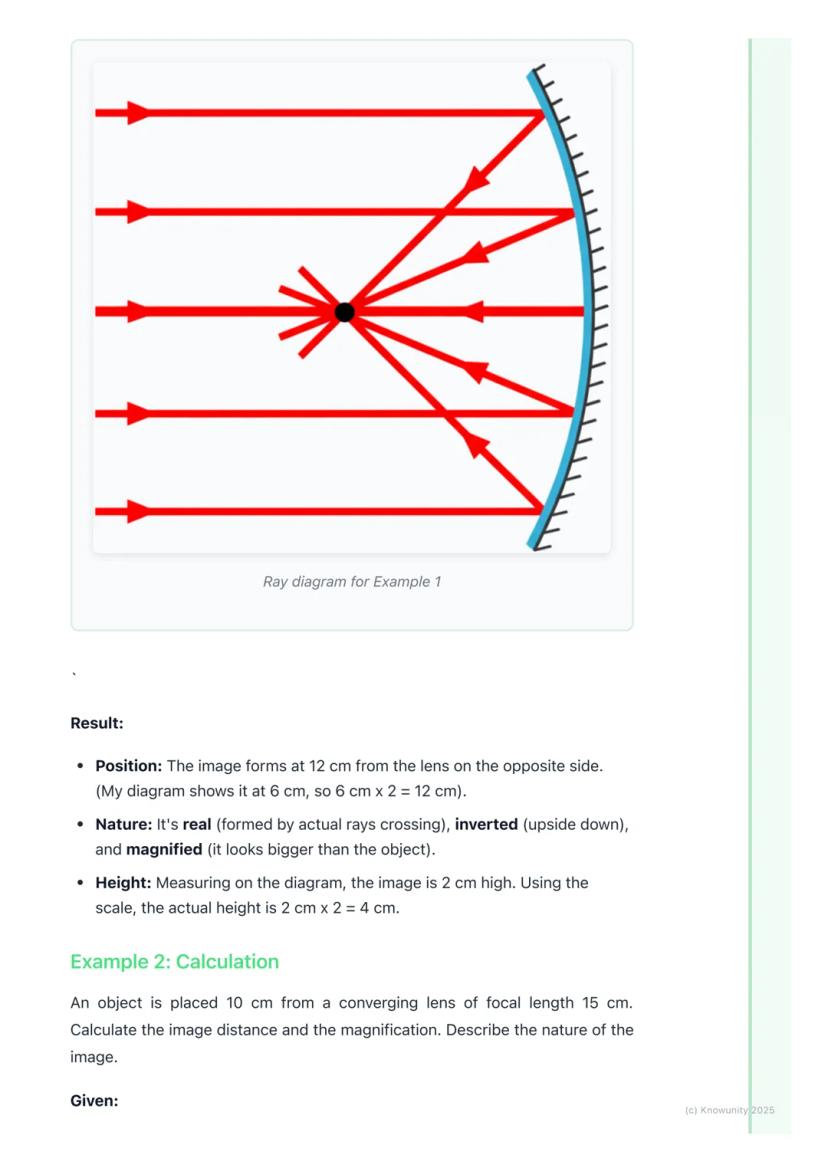
First, choose your scale - say 1 cm on paper = 2 cm reality. Draw your axis, mark the optical centre O, then place focal points F at 2 cm from O on your diagram.
Place your object 3 cm from O (representing 6 cm) and draw it 1 cm tall. Now trace your two main rays: one parallel to the axis (bends through F), another straight through O. Where they cross is your image!
Measuring gives us an image 6 cm from O on the diagram (12 cm in reality), 2 cm tall on diagram (4 cm reality). It's real, inverted, and magnified.
Diagram Success: Always use a ruler and draw large, clear diagrams - messy drawings lead to wrong answers!
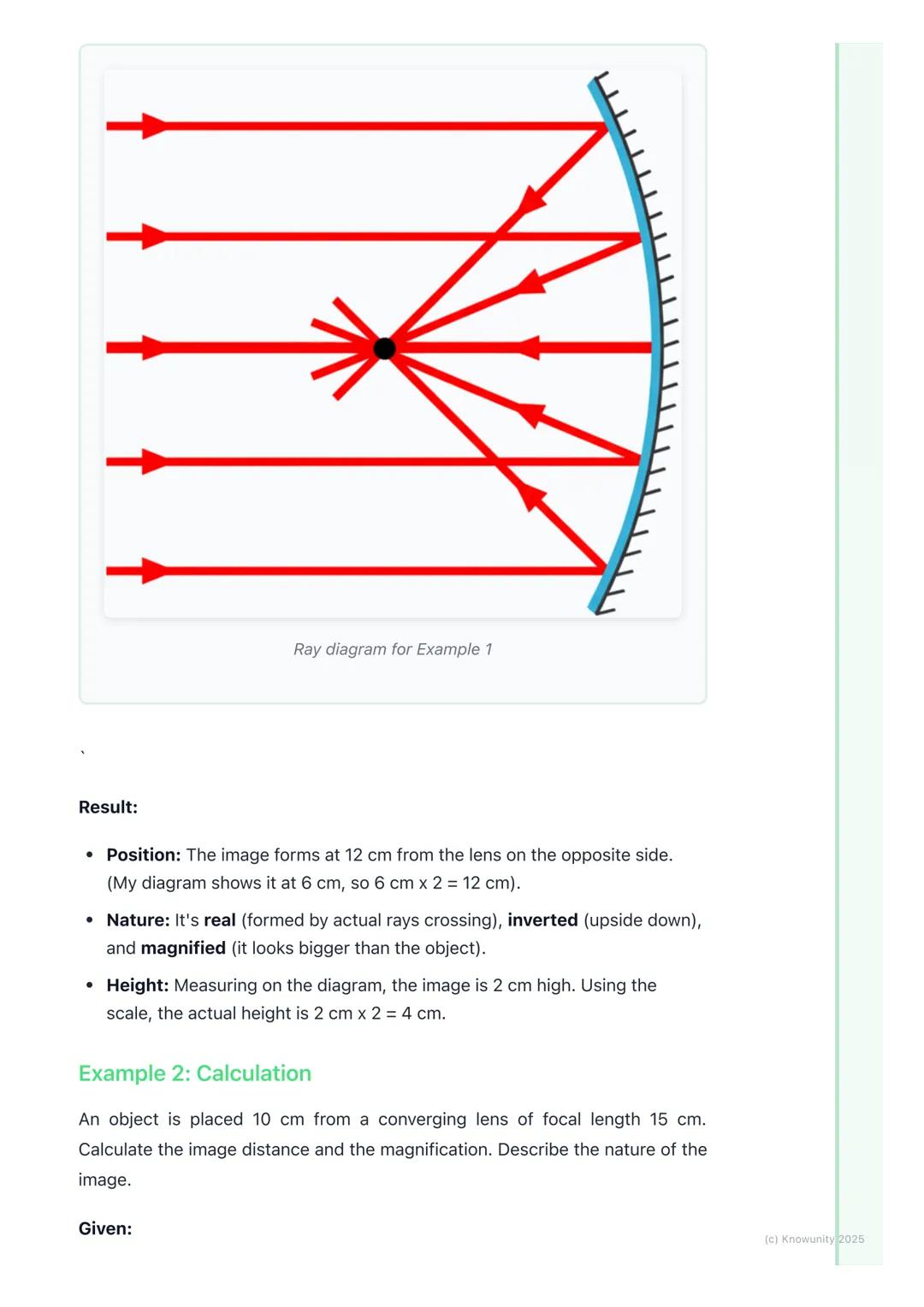
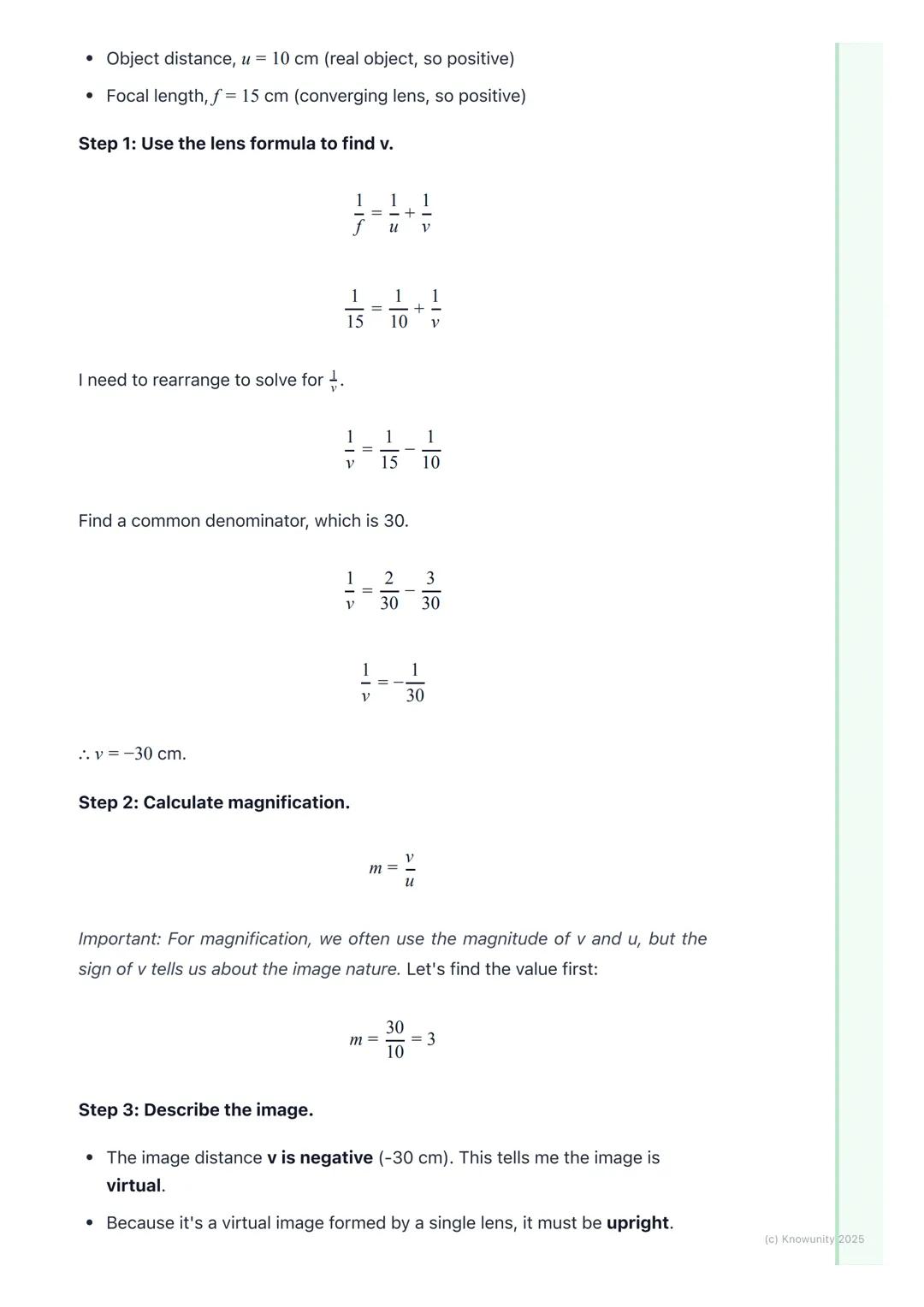
Now let's use pure maths! Object at 10 cm from a converging lens with focal length 15 cm.
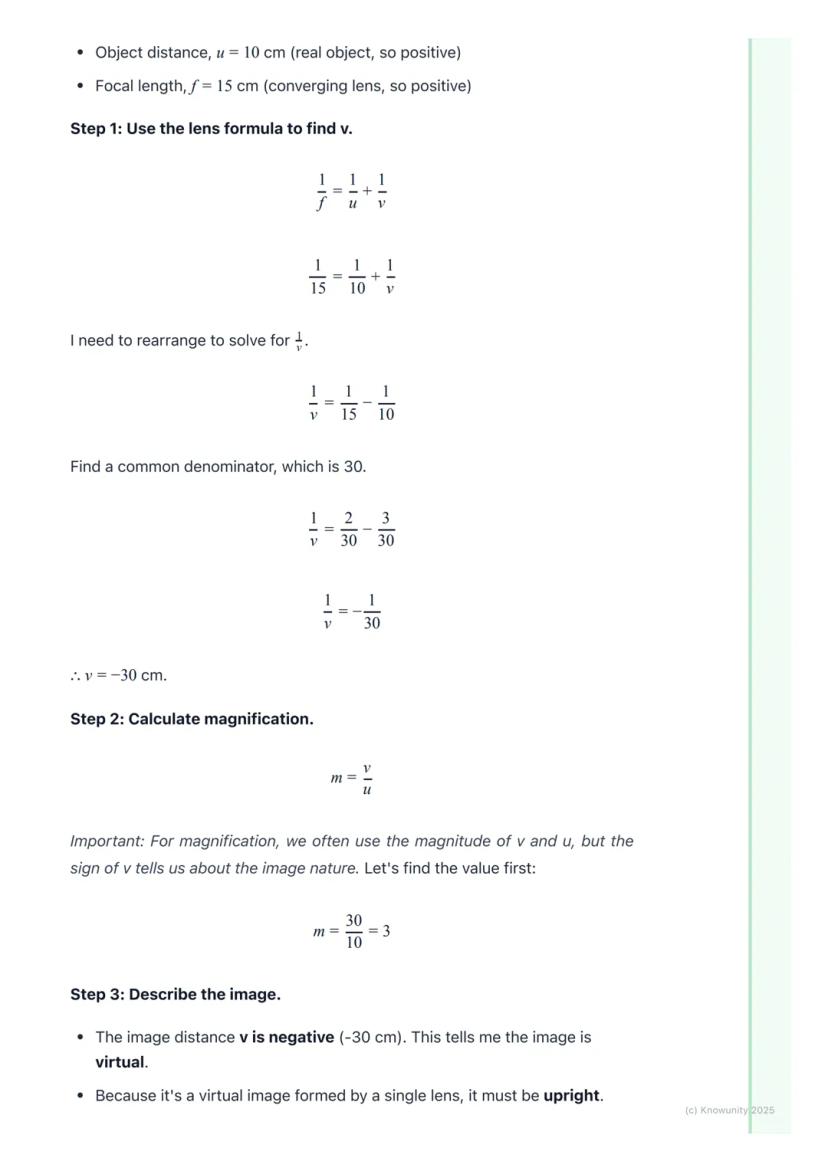
Using 1/f = 1/u + 1/v: 1/15 = 1/10 + 1/v. Rearranging: 1/v = 1/15 - 1/10 = 2/30 - 3/30 = -1/30. Therefore v = -30 cm.
The negative v means a virtual image! Magnification m = v/u = 30/10 = 3, so it's magnified threefold.
Since the object is inside the focal length (10 < 15), this makes perfect sense - the lens acts as a magnifying glass, creating a virtual, upright, magnified image 30 cm from the lens.
Check Your Logic: Always verify your mathematical answer makes physical sense - it prevents silly mistakes!
Getting signs right separates the top students from the rest! The golden rule is "Real is Positive".
Object distance u is always positive (real objects). Focal length f is positive for converging lenses, negative for diverging ones. Image distance v is positive for real images, negative for virtual images.
When calculating magnification, use m = v/u with the actual values (including signs). The sign of v tells you if the image is real (positive) or virtual (negative).
A negative image distance always means virtual, upright image. A positive image distance means real, inverted image. Master this and you'll never get confused again!
Sign Mastery: Write "Real = +" at the top of every lens problem - it's your safety net!
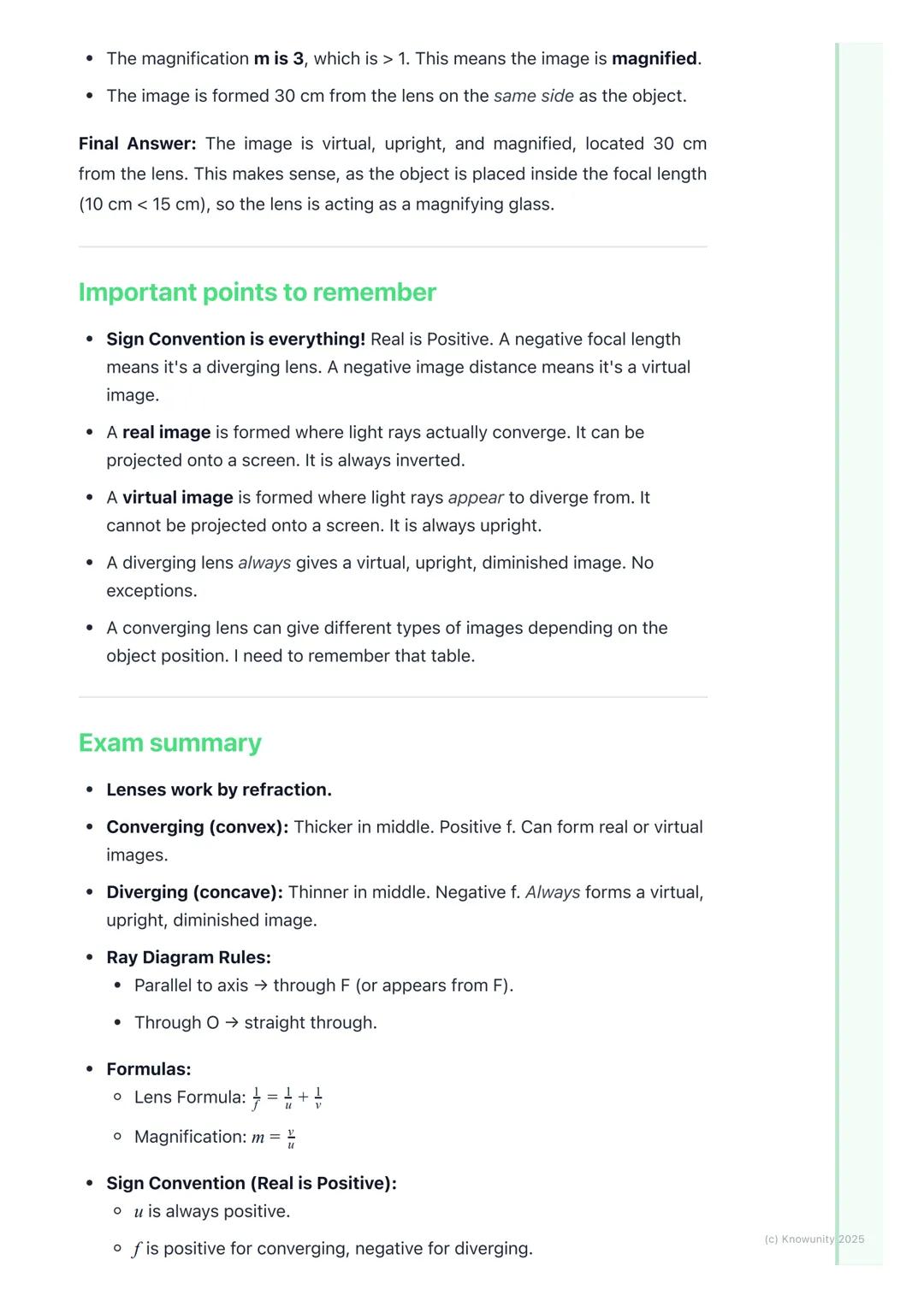
Here's what you absolutely must remember for exams: lenses work by refraction, converging lenses have positive focal lengths and can form various image types, while diverging lenses have negative focal lengths and always form virtual, upright, diminished images.
For ray diagrams, know your three rules inside out. For calculations, master the lens formula and magnification .
The sign convention is your best friend - real is positive, virtual images have negative distances. A real image can be projected on a screen and is always inverted. A virtual image cannot be projected and is always upright.
Exam Strategy: Practice both ray diagrams and calculations for the same scenario - understanding both methods deeply will boost your confidence massively!

Náš AI společník je speciálně vytvořen pro potřeby studentů. Na základě milionů obsahových materiálů, které máme na platformě, můžeme studentům poskytovat opravdu smysluplné a relevantní odpovědi. Ale nejde jen o odpovědi, společník je ještě více o provázení studentů jejich každodenními výzvami v učení, s personalizovanými studijními plány, kvízy nebo obsahovými materiály v chatu a 100% personalizací na základě dovedností a vývoje studentů.
Aplikaci si můžete stáhnout z obchodu Google Play a Apple App Store.
Ano, máte bezplatný přístup k obsahu v aplikaci a k našemu společníkovi s umělou inteligencí. Chcete-li odemknout určité funkce aplikace, můžete si zakoupit aplikaci Knowunity Pro.
App Store
Google Play
Aplikace je velmi jednoduchá na používání a dobře navržená. Zatím jsem našel vše, co jsem hledal, a mohl jsem se z prezentací hodně naučit! Určitě použiju aplikaci na školní úkol! A samozřejmě taky hodně pomáhá jako inspirace.
Stefan S
uživatel iOS
Tahle aplikace je fakt skvělá. Je tam tolik studijních poznámek a pomůcek [...]. Můj problémový předmět je například francouzština a aplikace nabízí tolik možností pomoci. Díky této aplikaci jsem si zlepšil francouzštinu. Doporučil bych ji každému.
Samantha Klich
uživatelka Androidu
Páni, jsem opravdu ohromen. Zkusil jsem aplikaci jen proto, že jsem ji mnohokrát viděl v reklamách, a byl jsem naprosto ohromen. Tato aplikace je TA POMOC, kterou chceš do školy, a především nabízí spoustu věcí, jako jsou cvičení a přehledy faktů, které mi osobně VELMI pomohly.
Anna
uživatelka iOS
Dříve jsem měl problémy s dokončováním úkolů včas, dokud jsem neobjevil Knowunity, který nejen usnadňuje nahrávání mého vlastního obsahu, ale také poskytuje skvělé shrnutí, díky kterým je moje práce rychlejší a efektivnější.
Thomas R
uživatel iOS
Vždy bylo výzvou najít všechny důležité informace pro mé úkoly – od té doby, co používám Knowunity, můžu jednoduše nahrát svůj obsah a těžit ze shrnutí ostatních, což mi hodně pomáhá s organizací.
Lisa M
uživatelka Androidu
Často jsem měl pocit, že nemám dostatečný přehled při učení, ale od té doby, co používám Knowunity, to už neplatí – nahraju svůj obsah a vždy najdu užitečná shrnutí na platformě, což mi učení značně usnadňuje.
David K
uživatel iOS
Ta aplikace je prostě skvělá! Stačí zadat téma do vyhledávání a dostanu odpověď opravdu rychle. Nemusím koukat na 10 YouTube videí, abych něčemu porozuměl, takže šetřím čas. Vřele doporučuji!
Sudenaz Ocak
uživatel Androidu
Ve škole mi matematika vůbec nešla, ale díky této aplikaci se mi teď daří lépe. Jsem moc vděčný, že jste tuhle aplikaci vytvořili.
Greenlight Bonnie
uživatel Androidu
Dřív bylo opravdu těžké shromáždit všechny informace na moje prezentace. Ale od té doby, co používám Knowunity, prostě nahraju svoje poznámky a najdu skvělé souhrny od ostatních – díky tomu je moje studium mnohem efektivnější!
Julia S
uživatelka Androidu
Byl jsem neustále ve stresu kvůli všem studijním materiálům, ale od té doby, co používám Knowunity, nahrávám svoje věci a koukám na super souhrny od ostatních – opravdu mi to pomáhá všechno lépe zvládat a je to mnohem méně stresující.
Marco B
uživatel iOS
TY KVÍZY A KARTIČKY SOU TAK UŽITEČNÝ A MILUJU Knowunity AI. JE TO TAKY DOSLOVA JAKO CHATGPT ALE CHYTŘEJŠÍ!! POMOHLO MI TO I S PROBLÉMY S ŘASENKOU!! A TAKY S MÝMA SKUTEČNÝMA PŘEDMĚTAMA! JASNÝ 😍😁😲🤑💗✨🎀😮
Sarah L
uživatelka Androidu
Dřív jsem trávil hodiny googlováním školních materiálů, ale teď prostě nahraju svoje věci na Knowunity a prohlížím si užitečné souhrny od ostatních – při přípravě na zkoušky se cítím mnohem jistější.
Paul T
uživatel iOS
Aplikace je velmi jednoduchá na používání a dobře navržená. Zatím jsem našel vše, co jsem hledal, a mohl jsem se z prezentací hodně naučit! Určitě použiju aplikaci na školní úkol! A samozřejmě taky hodně pomáhá jako inspirace.
Stefan S
uživatel iOS
Tahle aplikace je fakt skvělá. Je tam tolik studijních poznámek a pomůcek [...]. Můj problémový předmět je například francouzština a aplikace nabízí tolik možností pomoci. Díky této aplikaci jsem si zlepšil francouzštinu. Doporučil bych ji každému.
Samantha Klich
uživatelka Androidu
Páni, jsem opravdu ohromen. Zkusil jsem aplikaci jen proto, že jsem ji mnohokrát viděl v reklamách, a byl jsem naprosto ohromen. Tato aplikace je TA POMOC, kterou chceš do školy, a především nabízí spoustu věcí, jako jsou cvičení a přehledy faktů, které mi osobně VELMI pomohly.
Anna
uživatelka iOS
Dříve jsem měl problémy s dokončováním úkolů včas, dokud jsem neobjevil Knowunity, který nejen usnadňuje nahrávání mého vlastního obsahu, ale také poskytuje skvělé shrnutí, díky kterým je moje práce rychlejší a efektivnější.
Thomas R
uživatel iOS
Vždy bylo výzvou najít všechny důležité informace pro mé úkoly – od té doby, co používám Knowunity, můžu jednoduše nahrát svůj obsah a těžit ze shrnutí ostatních, což mi hodně pomáhá s organizací.
Lisa M
uživatelka Androidu
Často jsem měl pocit, že nemám dostatečný přehled při učení, ale od té doby, co používám Knowunity, to už neplatí – nahraju svůj obsah a vždy najdu užitečná shrnutí na platformě, což mi učení značně usnadňuje.
David K
uživatel iOS
Ta aplikace je prostě skvělá! Stačí zadat téma do vyhledávání a dostanu odpověď opravdu rychle. Nemusím koukat na 10 YouTube videí, abych něčemu porozuměl, takže šetřím čas. Vřele doporučuji!
Sudenaz Ocak
uživatel Androidu
Ve škole mi matematika vůbec nešla, ale díky této aplikaci se mi teď daří lépe. Jsem moc vděčný, že jste tuhle aplikaci vytvořili.
Greenlight Bonnie
uživatel Androidu
Dřív bylo opravdu těžké shromáždit všechny informace na moje prezentace. Ale od té doby, co používám Knowunity, prostě nahraju svoje poznámky a najdu skvělé souhrny od ostatních – díky tomu je moje studium mnohem efektivnější!
Julia S
uživatelka Androidu
Byl jsem neustále ve stresu kvůli všem studijním materiálům, ale od té doby, co používám Knowunity, nahrávám svoje věci a koukám na super souhrny od ostatních – opravdu mi to pomáhá všechno lépe zvládat a je to mnohem méně stresující.
Marco B
uživatel iOS
TY KVÍZY A KARTIČKY SOU TAK UŽITEČNÝ A MILUJU Knowunity AI. JE TO TAKY DOSLOVA JAKO CHATGPT ALE CHYTŘEJŠÍ!! POMOHLO MI TO I S PROBLÉMY S ŘASENKOU!! A TAKY S MÝMA SKUTEČNÝMA PŘEDMĚTAMA! JASNÝ 😍😁😲🤑💗✨🎀😮
Sarah L
uživatelka Androidu
Dřív jsem trávil hodiny googlováním školních materiálů, ale teď prostě nahraju svoje věci na Knowunity a prohlížím si užitečné souhrny od ostatních – při přípravě na zkoušky se cítím mnohem jistější.
Paul T
uživatel iOS
Lenses are everywhere - in your phone camera, glasses, and even your eyes! They're simply curved pieces of glass or plastic that bend light to create images. Understanding how they work is all about tracking light rays and knowing a... Zobrazit více
Přístup ke všem dokumentům
Zlepši své známky
Připoj se k milionům studentů
Ever wondered how your camera focuses or how glasses help you see clearly? It's all about refraction - the bending of light as it passes through different materials.
Converging (convex) lenses are thicker in the middle and bring light rays together at a focal point. Think of a magnifying glass - that's a converging lens. Diverging (concave) lenses are thinner in the middle and spread light rays apart.
The optical centre (O) is the middle of the lens where light passes straight through. The focal point (F) is where parallel light rays meet (or appear to come from), and the focal length (f) is the distance from the centre to this point.
Quick Tip: Remember "thick middle = converging, thin middle = diverging" to never mix them up!
Přístup ke všem dokumentům
Zlepši své známky
Připoj se k milionům studentů
Drawing ray diagrams is like creating a map for light! You only need two special rays to find where an image forms.
For converging lenses, follow these three rules: 1) A ray parallel to the axis bends through the focal point, 2) A ray through the optical centre goes straight, and 3) A ray through the focal point becomes parallel to the axis.
The image you get depends entirely on where you place the object. If it's beyond 2F, you get a real, inverted, smaller image. Between F and 2F? Real, inverted, but magnified. Place it inside the focal length and boom - you've got a magnifying glass with a virtual, upright, enlarged image!
Exam Success: Learn the object position table by heart - it's a guaranteed marks winner!
Přístup ke všem dokumentům
Zlepši své známky
Připoj se k milionům studentů
Here's where converging lenses get interesting - the image changes dramatically based on object placement!
When your object sits beyond 2F, you get a real, inverted, diminished image between F and 2F. This is exactly how camera lenses work. At exactly 2F, the image appears at 2F on the other side, same size but upside down.
Place the object between F and 2F, and suddenly your image jumps beyond 2F, becoming real, inverted, but magnified. Put it right at F and no image forms - the rays become parallel. The magic happens inside F where you get a virtual, upright, magnified image.
Memory Trick: "Real images flip, virtual images don't" - real images are always inverted, virtual ones stay upright!
Přístup ke všem dokumentům
Zlepši své známky
Připoj se k milionům studentů
Diverging lenses are the reliable ones - they always produce the same type of image, no matter where you put the object!
The ray rules are similar but with a twist: parallel rays appear to come from the focal point on the same side as the object. A ray towards the far focal point gets bent parallel to the axis.
No matter what you do with a diverging lens, you'll always get a virtual, upright, diminished image. Always. This makes them perfect for things like peepholes in doors or certain types of glasses for short-sightedness.
Study Smart: Since diverging lenses are predictable, focus your revision time on the trickier converging lens scenarios!
Přístup ke všem dokumentům
Zlepši své známky
Připoj se k milionům studentů
Time to put numbers to your diagrams! The lens formula connects everything: 1/f = 1/u + 1/v, where f is focal length, u is object distance, and v is image distance.
Magnification tells you how much bigger or smaller your image is: m = v/u. If m > 1, your image is magnified. If m < 1, it's diminished. Simple!
The sign convention is crucial: "Real is Positive" means real objects and images get positive distances, virtual images get negative distances. Converging lenses have positive focal lengths, diverging ones negative.
Calculation Confidence: Practice the sign convention until it's automatic - getting signs wrong will mess up your entire answer!
Přístup ke všem dokumentům
Zlepši své známky
Připoj se k milionům studentů
Let's solve a real problem! An object (2 cm tall) sits 6 cm from a converging lens with focal length 4 cm.
First, choose your scale - say 1 cm on paper = 2 cm reality. Draw your axis, mark the optical centre O, then place focal points F at 2 cm from O on your diagram.
Place your object 3 cm from O (representing 6 cm) and draw it 1 cm tall. Now trace your two main rays: one parallel to the axis (bends through F), another straight through O. Where they cross is your image!
Measuring gives us an image 6 cm from O on the diagram (12 cm in reality), 2 cm tall on diagram (4 cm reality). It's real, inverted, and magnified.
Diagram Success: Always use a ruler and draw large, clear diagrams - messy drawings lead to wrong answers!
Přístup ke všem dokumentům
Zlepši své známky
Připoj se k milionům studentů
Now let's use pure maths! Object at 10 cm from a converging lens with focal length 15 cm.
Using 1/f = 1/u + 1/v: 1/15 = 1/10 + 1/v. Rearranging: 1/v = 1/15 - 1/10 = 2/30 - 3/30 = -1/30. Therefore v = -30 cm.
The negative v means a virtual image! Magnification m = v/u = 30/10 = 3, so it's magnified threefold.
Since the object is inside the focal length (10 < 15), this makes perfect sense - the lens acts as a magnifying glass, creating a virtual, upright, magnified image 30 cm from the lens.
Check Your Logic: Always verify your mathematical answer makes physical sense - it prevents silly mistakes!
Přístup ke všem dokumentům
Zlepši své známky
Připoj se k milionům studentů
Getting signs right separates the top students from the rest! The golden rule is "Real is Positive".
Object distance u is always positive (real objects). Focal length f is positive for converging lenses, negative for diverging ones. Image distance v is positive for real images, negative for virtual images.
When calculating magnification, use m = v/u with the actual values (including signs). The sign of v tells you if the image is real (positive) or virtual (negative).
A negative image distance always means virtual, upright image. A positive image distance means real, inverted image. Master this and you'll never get confused again!
Sign Mastery: Write "Real = +" at the top of every lens problem - it's your safety net!
Přístup ke všem dokumentům
Zlepši své známky
Připoj se k milionům studentů
Here's what you absolutely must remember for exams: lenses work by refraction, converging lenses have positive focal lengths and can form various image types, while diverging lenses have negative focal lengths and always form virtual, upright, diminished images.
For ray diagrams, know your three rules inside out. For calculations, master the lens formula and magnification .
The sign convention is your best friend - real is positive, virtual images have negative distances. A real image can be projected on a screen and is always inverted. A virtual image cannot be projected and is always upright.
Exam Strategy: Practice both ray diagrams and calculations for the same scenario - understanding both methods deeply will boost your confidence massively!
Přístup ke všem dokumentům
Zlepši své známky
Připoj se k milionům studentů
Náš AI společník je speciálně vytvořen pro potřeby studentů. Na základě milionů obsahových materiálů, které máme na platformě, můžeme studentům poskytovat opravdu smysluplné a relevantní odpovědi. Ale nejde jen o odpovědi, společník je ještě více o provázení studentů jejich každodenními výzvami v učení, s personalizovanými studijními plány, kvízy nebo obsahovými materiály v chatu a 100% personalizací na základě dovedností a vývoje studentů.
Aplikaci si můžete stáhnout z obchodu Google Play a Apple App Store.
Ano, máte bezplatný přístup k obsahu v aplikaci a k našemu společníkovi s umělou inteligencí. Chcete-li odemknout určité funkce aplikace, můžete si zakoupit aplikaci Knowunity Pro.
0
Chytré Nástroje NOVÉ
Přeměň tyto poznámky na: ✓ 50+ Cvičných Otázek ✓ Interaktivní Kartičky ✓ Úplný zkušební test ✓ Osnovy Esejů
App Store
Google Play
Aplikace je velmi jednoduchá na používání a dobře navržená. Zatím jsem našel vše, co jsem hledal, a mohl jsem se z prezentací hodně naučit! Určitě použiju aplikaci na školní úkol! A samozřejmě taky hodně pomáhá jako inspirace.
Stefan S
uživatel iOS
Tahle aplikace je fakt skvělá. Je tam tolik studijních poznámek a pomůcek [...]. Můj problémový předmět je například francouzština a aplikace nabízí tolik možností pomoci. Díky této aplikaci jsem si zlepšil francouzštinu. Doporučil bych ji každému.
Samantha Klich
uživatelka Androidu
Páni, jsem opravdu ohromen. Zkusil jsem aplikaci jen proto, že jsem ji mnohokrát viděl v reklamách, a byl jsem naprosto ohromen. Tato aplikace je TA POMOC, kterou chceš do školy, a především nabízí spoustu věcí, jako jsou cvičení a přehledy faktů, které mi osobně VELMI pomohly.
Anna
uživatelka iOS
Dříve jsem měl problémy s dokončováním úkolů včas, dokud jsem neobjevil Knowunity, který nejen usnadňuje nahrávání mého vlastního obsahu, ale také poskytuje skvělé shrnutí, díky kterým je moje práce rychlejší a efektivnější.
Thomas R
uživatel iOS
Vždy bylo výzvou najít všechny důležité informace pro mé úkoly – od té doby, co používám Knowunity, můžu jednoduše nahrát svůj obsah a těžit ze shrnutí ostatních, což mi hodně pomáhá s organizací.
Lisa M
uživatelka Androidu
Často jsem měl pocit, že nemám dostatečný přehled při učení, ale od té doby, co používám Knowunity, to už neplatí – nahraju svůj obsah a vždy najdu užitečná shrnutí na platformě, což mi učení značně usnadňuje.
David K
uživatel iOS
Ta aplikace je prostě skvělá! Stačí zadat téma do vyhledávání a dostanu odpověď opravdu rychle. Nemusím koukat na 10 YouTube videí, abych něčemu porozuměl, takže šetřím čas. Vřele doporučuji!
Sudenaz Ocak
uživatel Androidu
Ve škole mi matematika vůbec nešla, ale díky této aplikaci se mi teď daří lépe. Jsem moc vděčný, že jste tuhle aplikaci vytvořili.
Greenlight Bonnie
uživatel Androidu
Dřív bylo opravdu těžké shromáždit všechny informace na moje prezentace. Ale od té doby, co používám Knowunity, prostě nahraju svoje poznámky a najdu skvělé souhrny od ostatních – díky tomu je moje studium mnohem efektivnější!
Julia S
uživatelka Androidu
Byl jsem neustále ve stresu kvůli všem studijním materiálům, ale od té doby, co používám Knowunity, nahrávám svoje věci a koukám na super souhrny od ostatních – opravdu mi to pomáhá všechno lépe zvládat a je to mnohem méně stresující.
Marco B
uživatel iOS
TY KVÍZY A KARTIČKY SOU TAK UŽITEČNÝ A MILUJU Knowunity AI. JE TO TAKY DOSLOVA JAKO CHATGPT ALE CHYTŘEJŠÍ!! POMOHLO MI TO I S PROBLÉMY S ŘASENKOU!! A TAKY S MÝMA SKUTEČNÝMA PŘEDMĚTAMA! JASNÝ 😍😁😲🤑💗✨🎀😮
Sarah L
uživatelka Androidu
Dřív jsem trávil hodiny googlováním školních materiálů, ale teď prostě nahraju svoje věci na Knowunity a prohlížím si užitečné souhrny od ostatních – při přípravě na zkoušky se cítím mnohem jistější.
Paul T
uživatel iOS
Aplikace je velmi jednoduchá na používání a dobře navržená. Zatím jsem našel vše, co jsem hledal, a mohl jsem se z prezentací hodně naučit! Určitě použiju aplikaci na školní úkol! A samozřejmě taky hodně pomáhá jako inspirace.
Stefan S
uživatel iOS
Tahle aplikace je fakt skvělá. Je tam tolik studijních poznámek a pomůcek [...]. Můj problémový předmět je například francouzština a aplikace nabízí tolik možností pomoci. Díky této aplikaci jsem si zlepšil francouzštinu. Doporučil bych ji každému.
Samantha Klich
uživatelka Androidu
Páni, jsem opravdu ohromen. Zkusil jsem aplikaci jen proto, že jsem ji mnohokrát viděl v reklamách, a byl jsem naprosto ohromen. Tato aplikace je TA POMOC, kterou chceš do školy, a především nabízí spoustu věcí, jako jsou cvičení a přehledy faktů, které mi osobně VELMI pomohly.
Anna
uživatelka iOS
Dříve jsem měl problémy s dokončováním úkolů včas, dokud jsem neobjevil Knowunity, který nejen usnadňuje nahrávání mého vlastního obsahu, ale také poskytuje skvělé shrnutí, díky kterým je moje práce rychlejší a efektivnější.
Thomas R
uživatel iOS
Vždy bylo výzvou najít všechny důležité informace pro mé úkoly – od té doby, co používám Knowunity, můžu jednoduše nahrát svůj obsah a těžit ze shrnutí ostatních, což mi hodně pomáhá s organizací.
Lisa M
uživatelka Androidu
Často jsem měl pocit, že nemám dostatečný přehled při učení, ale od té doby, co používám Knowunity, to už neplatí – nahraju svůj obsah a vždy najdu užitečná shrnutí na platformě, což mi učení značně usnadňuje.
David K
uživatel iOS
Ta aplikace je prostě skvělá! Stačí zadat téma do vyhledávání a dostanu odpověď opravdu rychle. Nemusím koukat na 10 YouTube videí, abych něčemu porozuměl, takže šetřím čas. Vřele doporučuji!
Sudenaz Ocak
uživatel Androidu
Ve škole mi matematika vůbec nešla, ale díky této aplikaci se mi teď daří lépe. Jsem moc vděčný, že jste tuhle aplikaci vytvořili.
Greenlight Bonnie
uživatel Androidu
Dřív bylo opravdu těžké shromáždit všechny informace na moje prezentace. Ale od té doby, co používám Knowunity, prostě nahraju svoje poznámky a najdu skvělé souhrny od ostatních – díky tomu je moje studium mnohem efektivnější!
Julia S
uživatelka Androidu
Byl jsem neustále ve stresu kvůli všem studijním materiálům, ale od té doby, co používám Knowunity, nahrávám svoje věci a koukám na super souhrny od ostatních – opravdu mi to pomáhá všechno lépe zvládat a je to mnohem méně stresující.
Marco B
uživatel iOS
TY KVÍZY A KARTIČKY SOU TAK UŽITEČNÝ A MILUJU Knowunity AI. JE TO TAKY DOSLOVA JAKO CHATGPT ALE CHYTŘEJŠÍ!! POMOHLO MI TO I S PROBLÉMY S ŘASENKOU!! A TAKY S MÝMA SKUTEČNÝMA PŘEDMĚTAMA! JASNÝ 😍😁😲🤑💗✨🎀😮
Sarah L
uživatelka Androidu
Dřív jsem trávil hodiny googlováním školních materiálů, ale teď prostě nahraju svoje věci na Knowunity a prohlížím si užitečné souhrny od ostatních – při přípravě na zkoušky se cítím mnohem jistější.
Paul T
uživatel iOS