
Physics gets interesting when we start talking about motion! This... Zobrazit více
 Physics6 zobrazení·Aktualizováno May 11, 2026·7 stránek
Understanding Distance, Displacement, Speed, and Velocity

1 / 7
1
of 7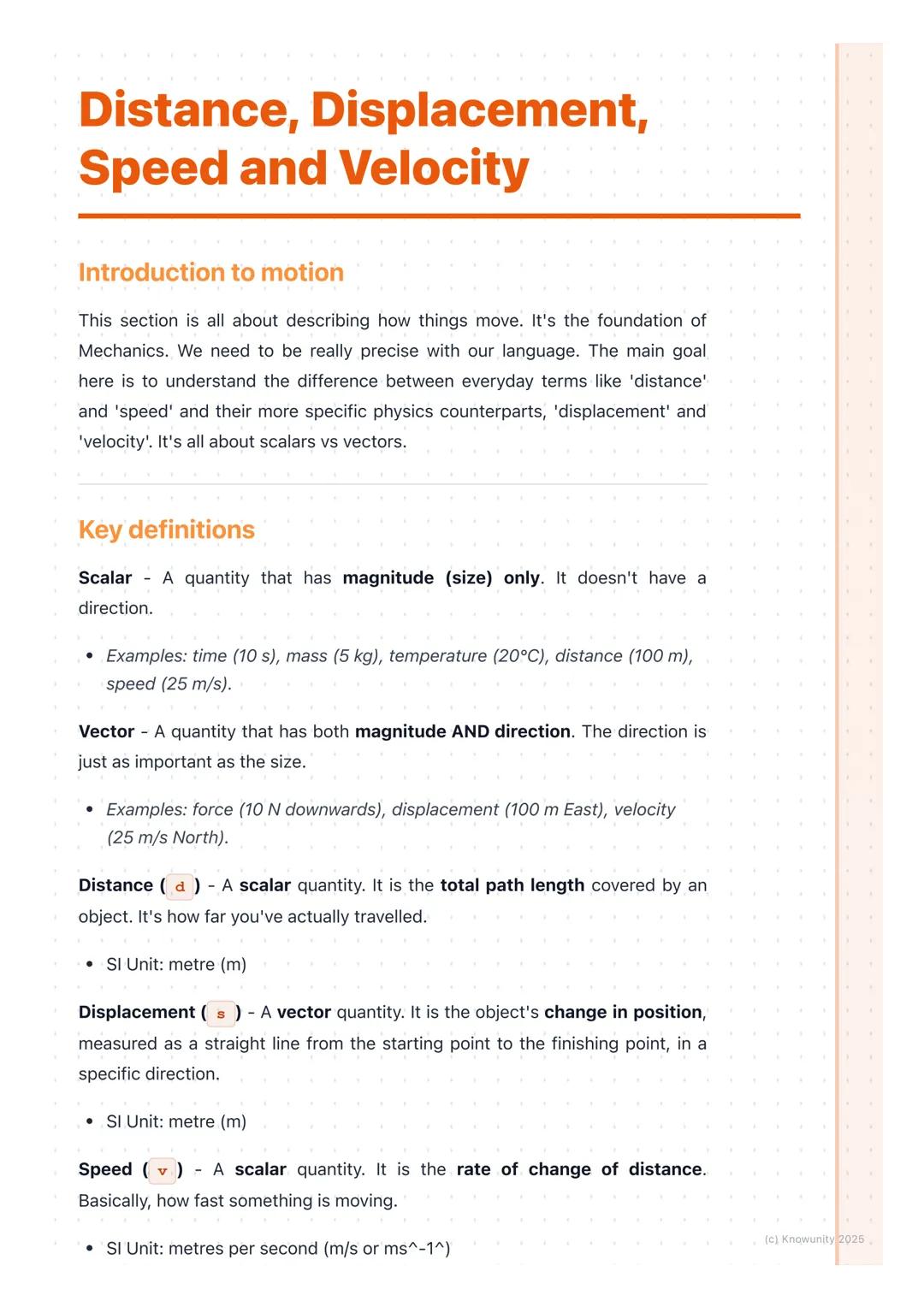
Distance, Displacement, Speed and Velocity
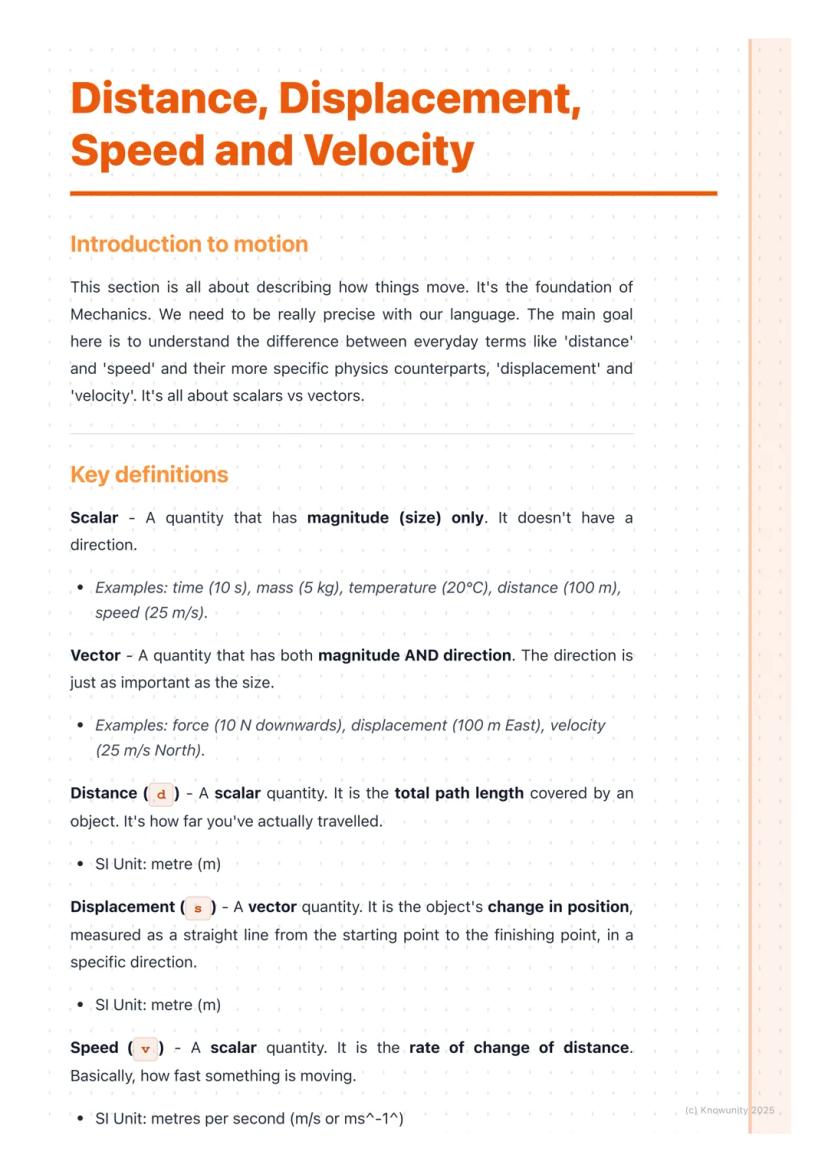
Ever wonder why physics needs special terms to describe movement? It's all about being precise. In physics, we distinguish between scalar quantities (which have only size) and vector quantities (which have both size and direction).
Distance is a scalar quantity measuring the total path length an object travels, measured in metres (m). Think of it as the actual ground covered. When you walk to school taking a winding route, your distance is the total length you walked.
Displacement is a vector quantity measuring the straight-line distance from start to finish in a specific direction, also measured in metres (m). If you drew an arrow from your starting point to your ending point, that's displacement.
Remember this! Distance tells you how far you've travelled, while displacement tells you how far you are from where you started. They use the same unit (metres) but represent different concepts.
2
of 7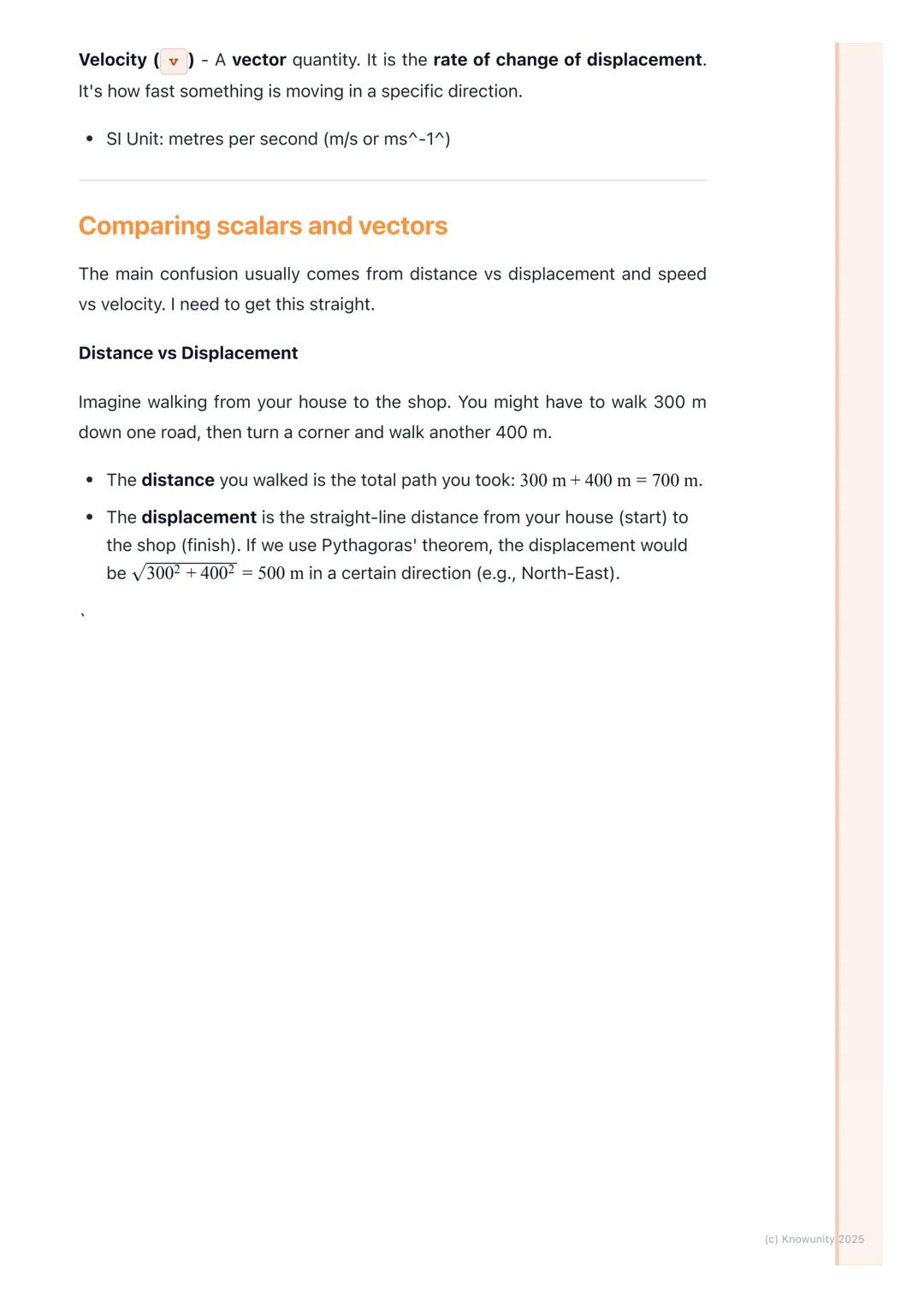
Scalar vs Vector Quantities
When describing movement, we need to be precise about whether direction matters. This is where the difference between speed and velocity becomes crucial.
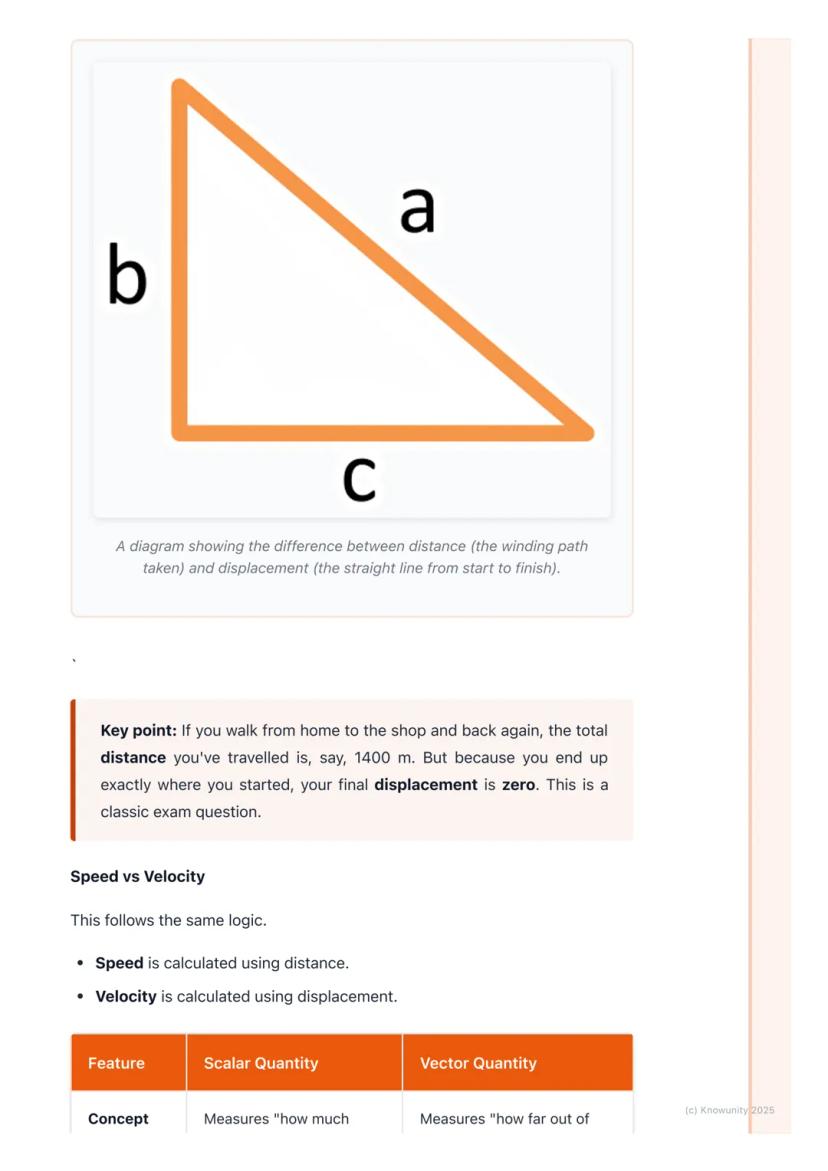
Speed is a scalar quantity measuring how fast something moves, calculated as distance ÷ time and measured in metres per second . It tells you the rate of distance change but says nothing about direction.
Velocity is a vector quantity measuring how fast something moves in a specific direction, calculated as displacement ÷ time and measured in metres per second . It tells you the rate of displacement change.
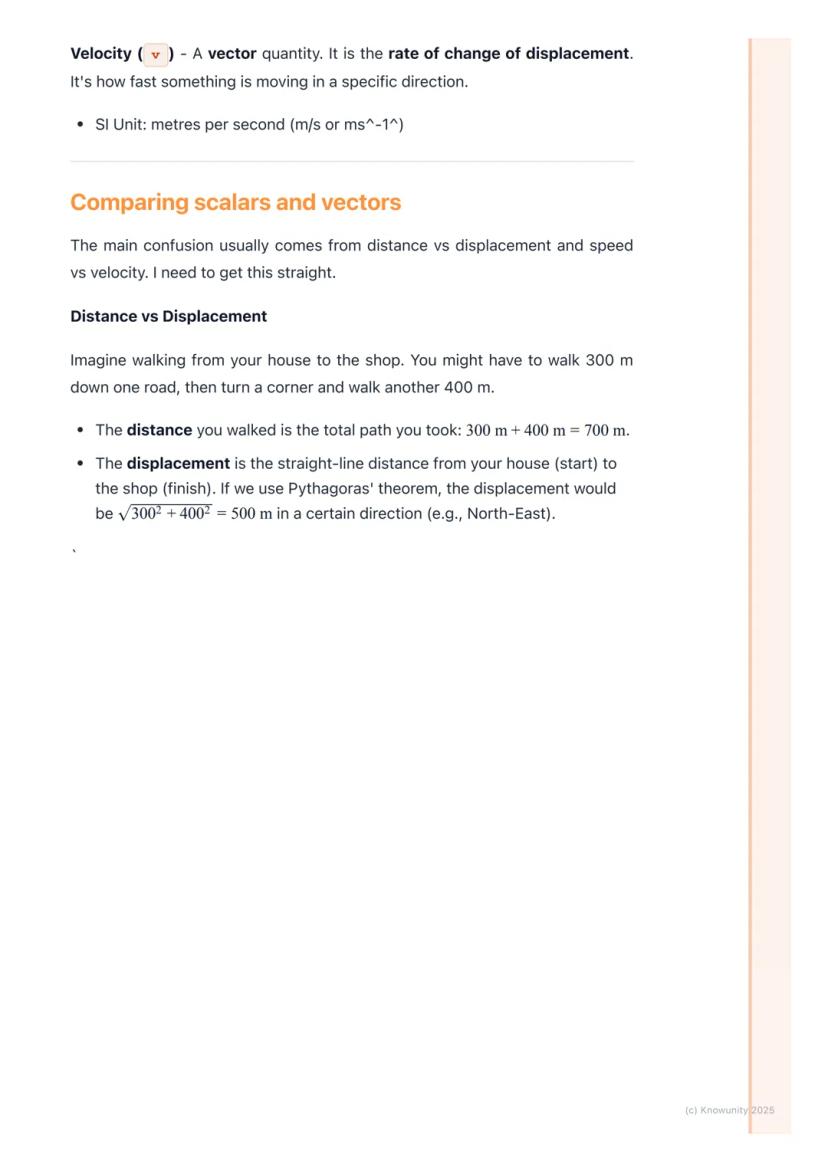
Consider walking to the shop: if you walk 300m down one road, then turn and walk 400m along another, your total distance is 700m. However, your displacement is only 500m (calculated using Pythagoras' theorem) in a specific direction.
Top tip: If you walk from home to the shop and back again, your total distance might be 1400m, but your final displacement is zero! This is a classic exam question that catches many students out.
3
of 7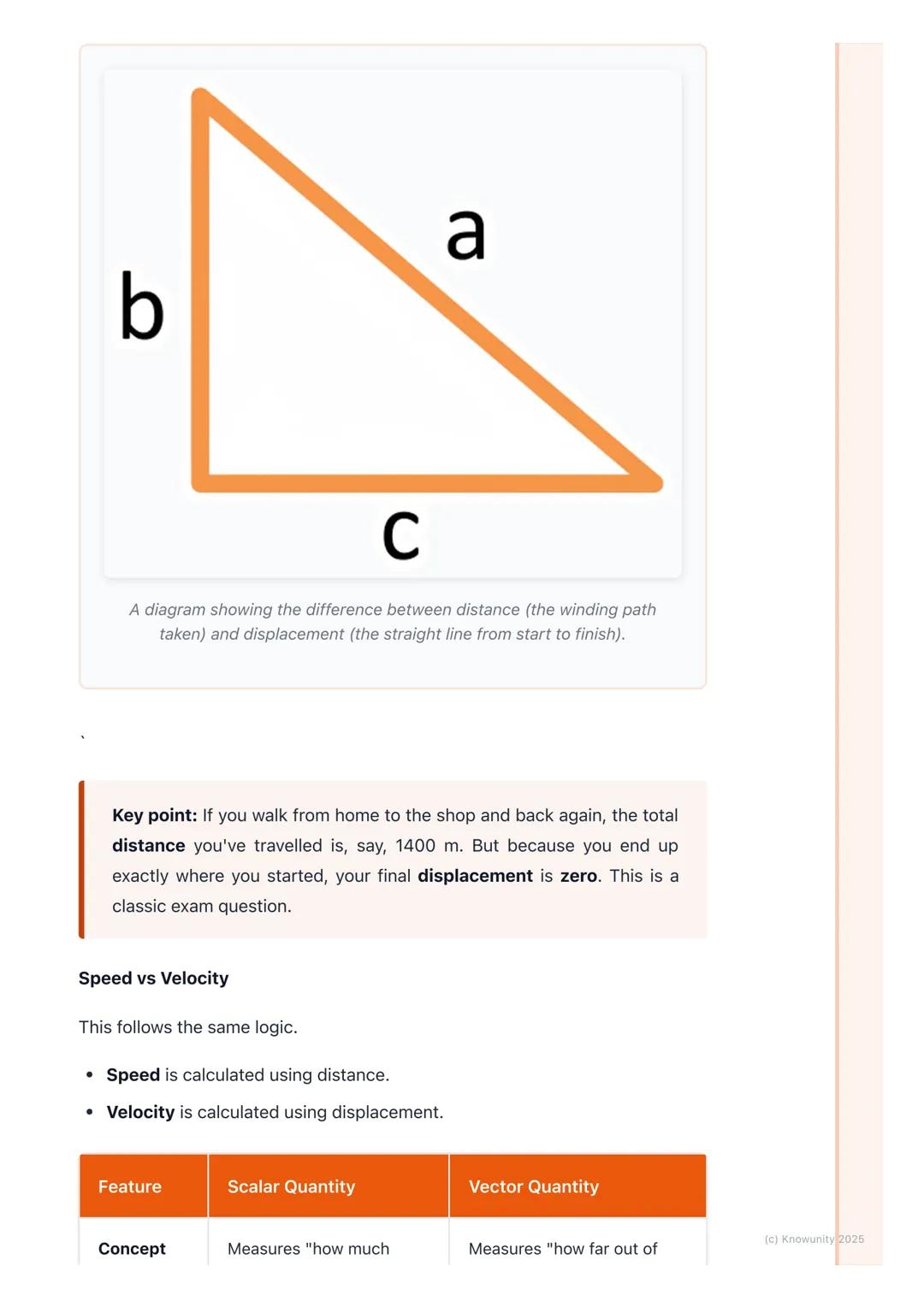
Calculating Speed and Velocity
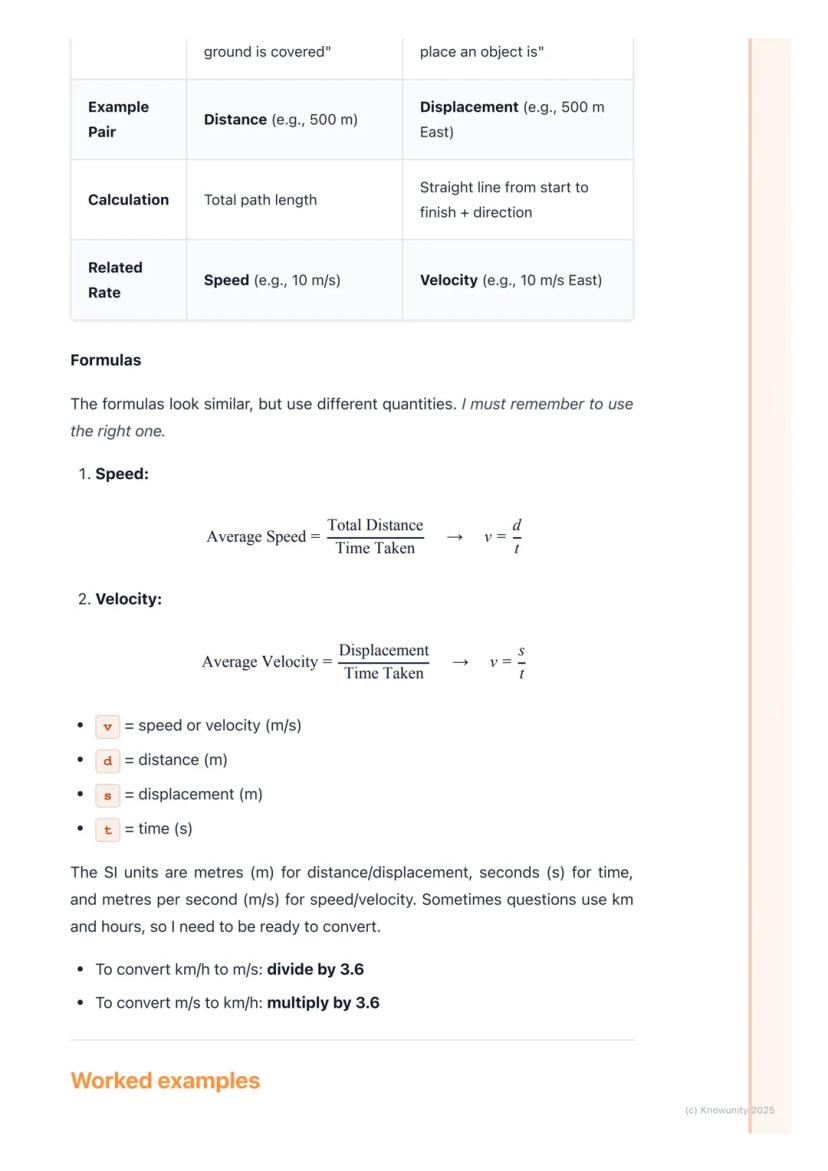
The formulas for speed and velocity look similar but use different quantities:
Average Speed = Total Distance ÷ Time Taken → v = d/t
Average Velocity = Displacement ÷ Time Taken → v = s/t
When an object moves in a straight line, the magnitude of displacement equals the distance, making the magnitude of velocity equal to speed. However, when direction changes, these values differ.
Remember these unit conversions:
- To convert km/h to m/s: divide by 3.6
- To convert m/s to km/h: multiply by 3.6
A key difference between these quantities appears in circular motion. If you complete one lap around a track, you've covered a significant distance, but your displacement is zero (you're back where you started). This means your average speed is positive, but your average velocity is zero!
Exam alert: Questions often ask about round trips. Remember that when you return to your starting point, displacement is zero, making average velocity zero regardless of the distance travelled.
4
of 7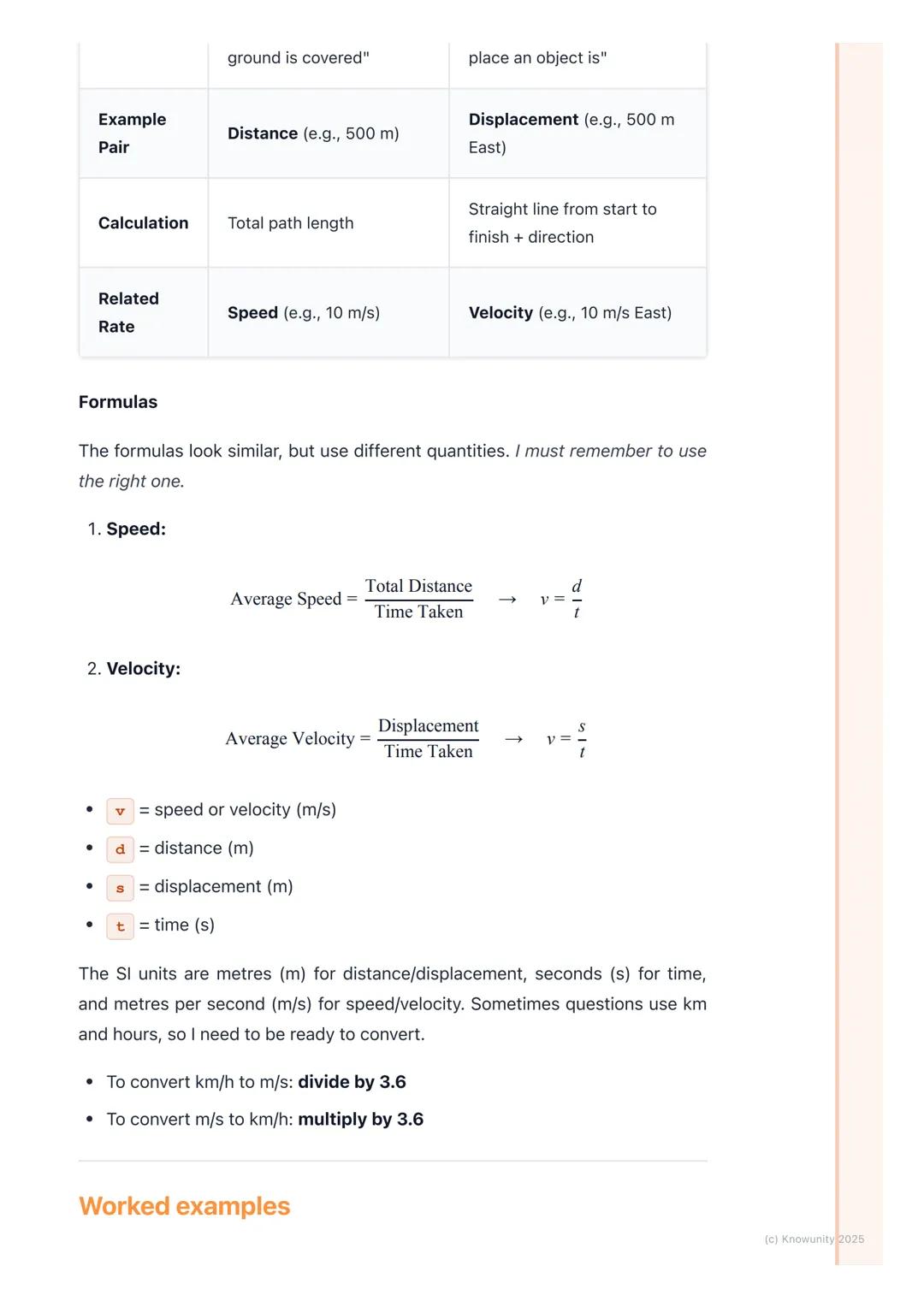
Worked Examples
Let's apply these concepts with two examples:
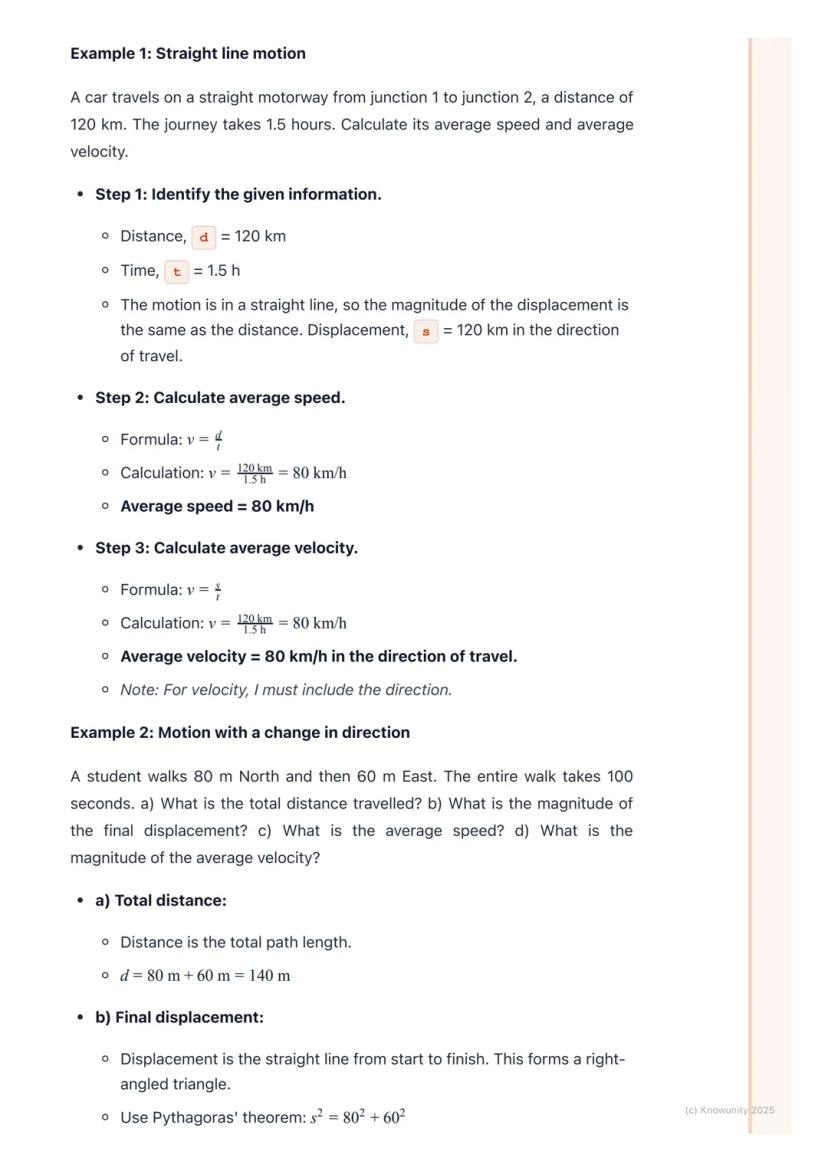
Example 1: Straight-Line Motion A car travels 120 km on a straight motorway in 1.5 hours. Since the motion is in a straight line, the magnitude of displacement equals distance (120 km).
Average Speed = 120 km ÷ 1.5 h = 80 km/h Average Velocity = 80 km/h in the direction of travel
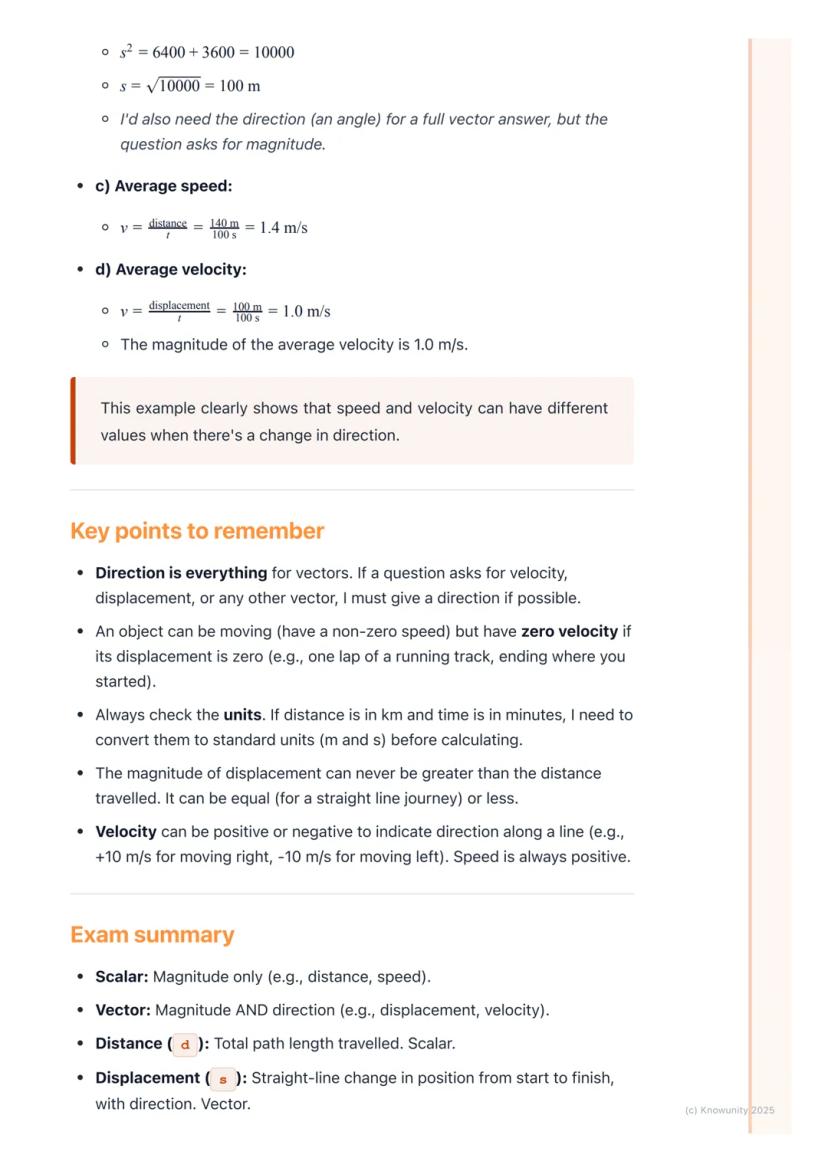
Example 2: Motion with Direction Change A student walks 80m North, then 60m East, taking 100 seconds.
Total distance = 80m + 60m = 140m Displacement magnitude (using Pythagoras) = √(80² + 60²) = 100m Average Speed = 140m ÷ 100s = 1.4 m/s Average Velocity magnitude = 100m ÷ 100s = 1.0 m/s
This clearly shows how speed and velocity can differ when direction changes.
Pro tip: Always specify direction for vectors. Velocity can be positive or negative to indicate direction , while speed is always positive.
5
of 7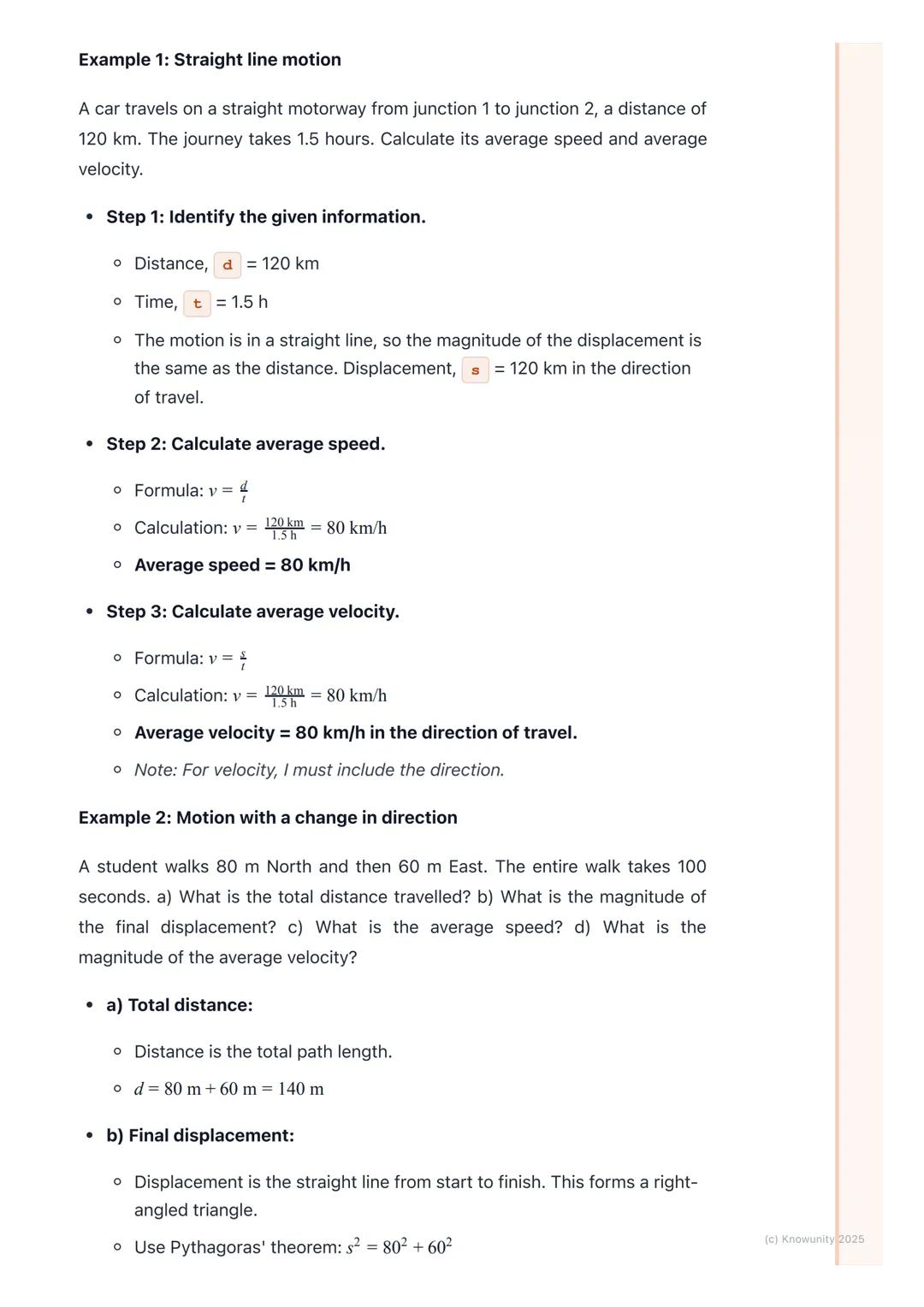
Key Points to Remember
You've now mastered the fundamental concepts of motion! Here's what you need to remember:
Scalar vs Vector: Scalars have magnitude only; vectors have magnitude and direction. Distance and speed are scalars; displacement and velocity are vectors.
Direction matters: For vectors, direction is essential. Always include direction when calculating velocity or displacement.
Displacement vs Distance: Displacement can never exceed distance. They're equal only in straight-line motion.
Round trips: If you end where you started, displacement is zero, making average velocity zero regardless of distance travelled.
When approaching exam questions, watch for scenarios involving changes in direction or round trips. These are designed to test your understanding of the scalar/vector distinction.
Exam success strategy: Questions often involve situations where speed and velocity have different values. If you're asked for velocity but calculate speed (or vice versa), you'll lose marks. Always check whether the question is asking for a scalar or vector quantity.
6
of 7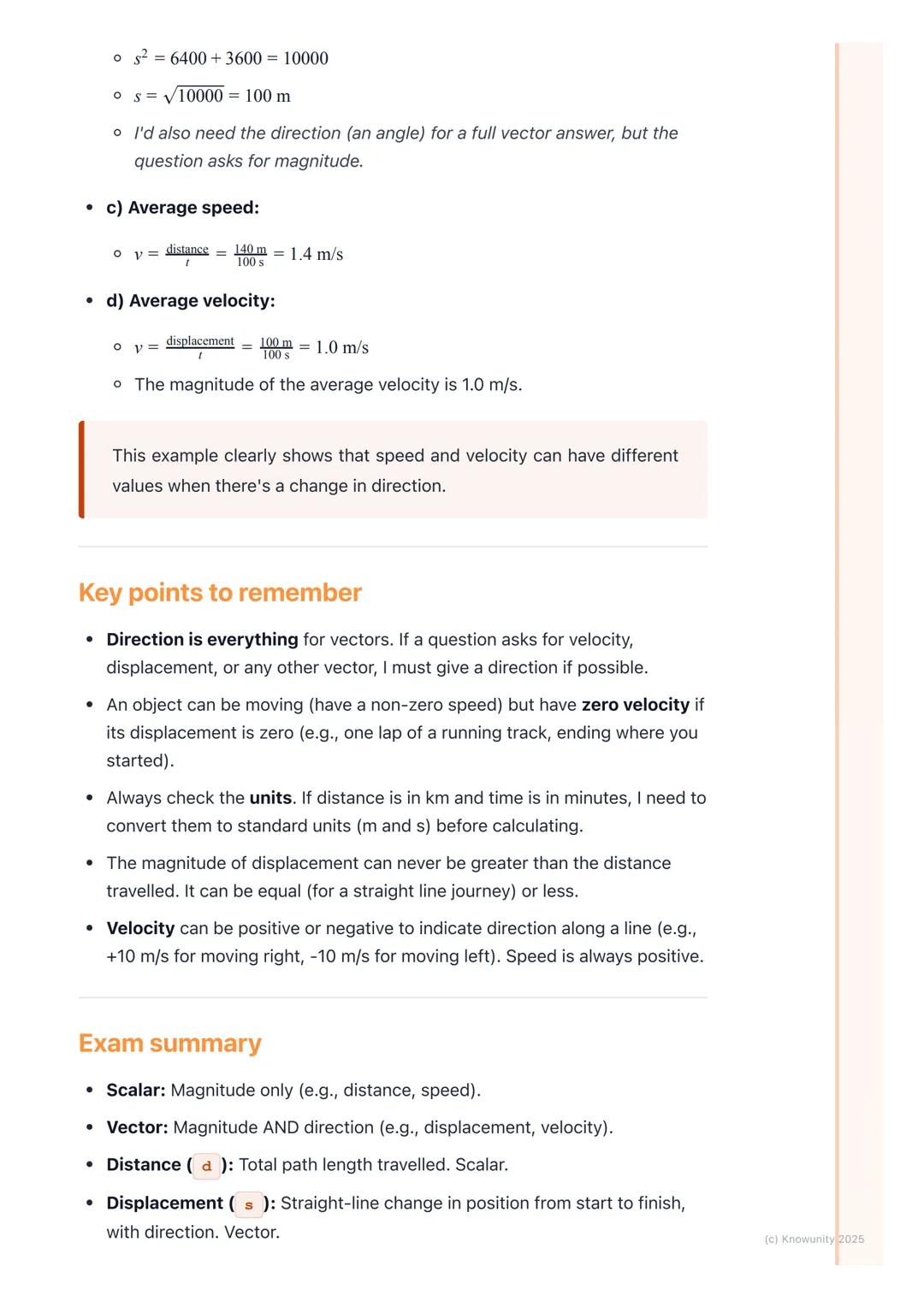
7
of 7
Mysleli jsme, že se nikdy nezeptáš...
Co je AI společník Knowunity?
Náš AI společník je speciálně vytvořen pro potřeby studentů. Na základě milionů obsahových materiálů, které máme na platformě, můžeme studentům poskytovat opravdu smysluplné a relevantní odpovědi. Ale nejde jen o odpovědi, společník je ještě více o provázení studentů jejich každodenními výzvami v učení, s personalizovanými studijními plány, kvízy nebo obsahovými materiály v chatu a 100% personalizací na základě dovedností a vývoje studentů.
Kde si můžu stáhnout aplikaci Knowunity?
Aplikaci si můžete stáhnout z obchodu Google Play a Apple App Store.
Jak můžu dostat svou platbu? Kolik si můžu vydělat?
Ano, máte bezplatný přístup k obsahu v aplikaci a k našemu společníkovi s umělou inteligencí. Chcete-li odemknout určité funkce aplikace, můžete si zakoupit aplikaci Knowunity Pro.
Nejpopulárnější poznámky z Physics
3PhysicsBalanced and Unbalanced Forces
Students will explore how balanced forces result in no change in motion, while unbalanced forces cause an object to accelerate or change direction.
2nd Year421
PhysicsTypes of Forces
Students will identify common forces such as gravity (pulling objects down), friction (opposing motion), and air resistance (slowing objects in the air).
2nd Year460
PhysicsSpeed, Distance, and Time
Students will learn the basic concepts of speed, distance, and time, and how they relate to each other in describing motion.
2nd Year100
Nejpopulárnější poznámky
9 Irish
IrishIrish oral questions and answers
Questions and answers for the leaving cert oral
5th Year4254
IrishIrish oral questions
Outline of oral questions
5th Year2055
IrishGaeilge Grammar Office
All the basics you need to know on Irish grammar.
6th Year893
 English
Key Quotes : Sive
Key Quotes and explanations: Sive
6th Year2262
IrishAn Gaeilge Aiste
Irish Language essay
6th Year1250
IrishIrish poetry 2027
Iníon + Dínit an Bhróin
5th Year1133
IrishMé Féin & Mo Chlann (Myself & My Family)
Students will learn vocabulary to describe themselves, their family members, and daily routines. This helps in personal introductions and discussions.
TY291
IrishLC HL notes- Iníon (poem)
Includes poem in English and Irish, theme, key words & phrases
5th Year2284
 Geography
Territory, economic activities in Paris basin
essay
6th Year80
Nemůžeš najít, co hledáš? Prozkoumej další předměty.
Recenze od našich uživatelů. Mají vše super — a ty taky můžeš.
4.6/5App Store
4.7/5Google Play
Aplikace je velmi jednoduchá na používání a dobře navržená. Zatím jsem našel vše, co jsem hledal, a mohl jsem se z prezentací hodně naučit! Určitě použiju aplikaci na školní úkol! A samozřejmě taky hodně pomáhá jako inspirace.
Stefan Suživatel iOS
Tahle aplikace je fakt skvělá. Je tam tolik studijních poznámek a pomůcek [...]. Můj problémový předmět je například francouzština a aplikace nabízí tolik možností pomoci. Díky této aplikaci jsem si zlepšil francouzštinu. Doporučil bych ji každému.
Samantha Klichuživatelka Androidu
Páni, jsem opravdu ohromen. Zkusil jsem aplikaci jen proto, že jsem ji mnohokrát viděl v reklamách, a byl jsem naprosto ohromen. Tato aplikace je TA POMOC, kterou chceš do školy, a především nabízí spoustu věcí, jako jsou cvičení a přehledy faktů, které mi osobně VELMI pomohly.
Annauživatelka iOS
Physics6 zobrazení·Aktualizováno May 11, 2026·7 stránekUnderstanding Distance, Displacement, Speed, and Velocity
Physics gets interesting when we start talking about motion! This topic explores how objects move and the precise ways we describe that movement. Understanding the difference between everyday terms like distance and speed, and their physics counterparts, displacement and velocity,... Zobrazit více
1
of 7Registruj se, abys viděl obsah. Je to zdarma!
- Přístup ke všem dokumentům
- Zlepši své známky
- Připoj se k milionům studentů
Distance, Displacement, Speed and Velocity
Ever wonder why physics needs special terms to describe movement? It's all about being precise. In physics, we distinguish between scalar quantities (which have only size) and vector quantities (which have both size and direction).
Distance is a scalar quantity measuring the total path length an object travels, measured in metres (m). Think of it as the actual ground covered. When you walk to school taking a winding route, your distance is the total length you walked.
Displacement is a vector quantity measuring the straight-line distance from start to finish in a specific direction, also measured in metres (m). If you drew an arrow from your starting point to your ending point, that's displacement.
Remember this! Distance tells you how far you've travelled, while displacement tells you how far you are from where you started. They use the same unit (metres) but represent different concepts.
2
of 7Registruj se, abys viděl obsah. Je to zdarma!
- Přístup ke všem dokumentům
- Zlepši své známky
- Připoj se k milionům studentů
Scalar vs Vector Quantities
When describing movement, we need to be precise about whether direction matters. This is where the difference between speed and velocity becomes crucial.
Speed is a scalar quantity measuring how fast something moves, calculated as distance ÷ time and measured in metres per second . It tells you the rate of distance change but says nothing about direction.
Velocity is a vector quantity measuring how fast something moves in a specific direction, calculated as displacement ÷ time and measured in metres per second . It tells you the rate of displacement change.
Consider walking to the shop: if you walk 300m down one road, then turn and walk 400m along another, your total distance is 700m. However, your displacement is only 500m (calculated using Pythagoras' theorem) in a specific direction.
Top tip: If you walk from home to the shop and back again, your total distance might be 1400m, but your final displacement is zero! This is a classic exam question that catches many students out.
3
of 7Registruj se, abys viděl obsah. Je to zdarma!
- Přístup ke všem dokumentům
- Zlepši své známky
- Připoj se k milionům studentů
Calculating Speed and Velocity
The formulas for speed and velocity look similar but use different quantities:
Average Speed = Total Distance ÷ Time Taken → v = d/t
Average Velocity = Displacement ÷ Time Taken → v = s/t
When an object moves in a straight line, the magnitude of displacement equals the distance, making the magnitude of velocity equal to speed. However, when direction changes, these values differ.
Remember these unit conversions:
- To convert km/h to m/s: divide by 3.6
- To convert m/s to km/h: multiply by 3.6
A key difference between these quantities appears in circular motion. If you complete one lap around a track, you've covered a significant distance, but your displacement is zero (you're back where you started). This means your average speed is positive, but your average velocity is zero!
Exam alert: Questions often ask about round trips. Remember that when you return to your starting point, displacement is zero, making average velocity zero regardless of the distance travelled.
4
of 7Registruj se, abys viděl obsah. Je to zdarma!
- Přístup ke všem dokumentům
- Zlepši své známky
- Připoj se k milionům studentů
Worked Examples
Let's apply these concepts with two examples:
Example 1: Straight-Line Motion A car travels 120 km on a straight motorway in 1.5 hours. Since the motion is in a straight line, the magnitude of displacement equals distance (120 km).
Average Speed = 120 km ÷ 1.5 h = 80 km/h Average Velocity = 80 km/h in the direction of travel
Example 2: Motion with Direction Change A student walks 80m North, then 60m East, taking 100 seconds.
Total distance = 80m + 60m = 140m Displacement magnitude (using Pythagoras) = √(80² + 60²) = 100m Average Speed = 140m ÷ 100s = 1.4 m/s Average Velocity magnitude = 100m ÷ 100s = 1.0 m/s
This clearly shows how speed and velocity can differ when direction changes.
Pro tip: Always specify direction for vectors. Velocity can be positive or negative to indicate direction , while speed is always positive.
5
of 7Registruj se, abys viděl obsah. Je to zdarma!
- Přístup ke všem dokumentům
- Zlepši své známky
- Připoj se k milionům studentů
Key Points to Remember
You've now mastered the fundamental concepts of motion! Here's what you need to remember:
Scalar vs Vector: Scalars have magnitude only; vectors have magnitude and direction. Distance and speed are scalars; displacement and velocity are vectors.
Direction matters: For vectors, direction is essential. Always include direction when calculating velocity or displacement.
Displacement vs Distance: Displacement can never exceed distance. They're equal only in straight-line motion.
Round trips: If you end where you started, displacement is zero, making average velocity zero regardless of distance travelled.
When approaching exam questions, watch for scenarios involving changes in direction or round trips. These are designed to test your understanding of the scalar/vector distinction.
Exam success strategy: Questions often involve situations where speed and velocity have different values. If you're asked for velocity but calculate speed (or vice versa), you'll lose marks. Always check whether the question is asking for a scalar or vector quantity.
6
of 7Registruj se, abys viděl obsah. Je to zdarma!
- Přístup ke všem dokumentům
- Zlepši své známky
- Připoj se k milionům studentů
7
of 7Registruj se, abys viděl obsah. Je to zdarma!
- Přístup ke všem dokumentům
- Zlepši své známky
- Připoj se k milionům studentů
Mysleli jsme, že se nikdy nezeptáš...
Co je AI společník Knowunity?
Náš AI společník je speciálně vytvořen pro potřeby studentů. Na základě milionů obsahových materiálů, které máme na platformě, můžeme studentům poskytovat opravdu smysluplné a relevantní odpovědi. Ale nejde jen o odpovědi, společník je ještě více o provázení studentů jejich každodenními výzvami v učení, s personalizovanými studijními plány, kvízy nebo obsahovými materiály v chatu a 100% personalizací na základě dovedností a vývoje studentů.
Kde si můžu stáhnout aplikaci Knowunity?
Aplikaci si můžete stáhnout z obchodu Google Play a Apple App Store.
Jak můžu dostat svou platbu? Kolik si můžu vydělat?
Ano, máte bezplatný přístup k obsahu v aplikaci a k našemu společníkovi s umělou inteligencí. Chcete-li odemknout určité funkce aplikace, můžete si zakoupit aplikaci Knowunity Pro.
Nejpopulárnější poznámky z Physics
3PhysicsBalanced and Unbalanced Forces
Students will explore how balanced forces result in no change in motion, while unbalanced forces cause an object to accelerate or change direction.
2nd Year421
PhysicsTypes of Forces
Students will identify common forces such as gravity (pulling objects down), friction (opposing motion), and air resistance (slowing objects in the air).
2nd Year460
PhysicsSpeed, Distance, and Time
Students will learn the basic concepts of speed, distance, and time, and how they relate to each other in describing motion.
2nd Year100
Nejpopulárnější poznámky
9IrishIrish oral questions and answers
Questions and answers for the leaving cert oral
5th Year4254
IrishIrish oral questions
Outline of oral questions
5th Year2055
IrishGaeilge Grammar Office
All the basics you need to know on Irish grammar.
6th Year893
EnglishKey Quotes : Sive
Key Quotes and explanations: Sive
6th Year2262
IrishAn Gaeilge Aiste
Irish Language essay
6th Year1250
IrishIrish poetry 2027
Iníon + Dínit an Bhróin
5th Year1133
IrishMé Féin & Mo Chlann (Myself & My Family)
Students will learn vocabulary to describe themselves, their family members, and daily routines. This helps in personal introductions and discussions.
TY291
IrishLC HL notes- Iníon (poem)
Includes poem in English and Irish, theme, key words & phrases
5th Year2284
GeographyTerritory, economic activities in Paris basin
essay
6th Year80
Nemůžeš najít, co hledáš? Prozkoumej další předměty.
Recenze od našich uživatelů. Mají vše super — a ty taky můžeš.
4.6/5App Store
4.7/5Google Play
Aplikace je velmi jednoduchá na používání a dobře navržená. Zatím jsem našel vše, co jsem hledal, a mohl jsem se z prezentací hodně naučit! Určitě použiju aplikaci na školní úkol! A samozřejmě taky hodně pomáhá jako inspirace.
Stefan Suživatel iOS
Tahle aplikace je fakt skvělá. Je tam tolik studijních poznámek a pomůcek [...]. Můj problémový předmět je například francouzština a aplikace nabízí tolik možností pomoci. Díky této aplikaci jsem si zlepšil francouzštinu. Doporučil bych ji každému.
Samantha Klichuživatelka Androidu
Páni, jsem opravdu ohromen. Zkusil jsem aplikaci jen proto, že jsem ji mnohokrát viděl v reklamách, a byl jsem naprosto ohromen. Tato aplikace je TA POMOC, kterou chceš do školy, a především nabízí spoustu věcí, jako jsou cvičení a přehledy faktů, které mi osobně VELMI pomohly.
Annauživatelka iOS