
Athletics (or track and field) is one of the oldest... Zobrazit více
 Physical Education10 zobrazení·Aktualizováno Jun 6, 2026·6 stránek
Master Athletics Skills: Running, Jumping, and Throwing
1 / 6
1
of 6
Introduction to Athletics
Ever wondered why athletics is such a big deal at the Olympics? Athletics tests the fundamental human abilities of running, jumping and throwing. When you participate in athletics, you're developing multiple fitness components at once!
Track events are all about racing and are measured by time. These include sprints (short, fast races like 100m) and middle distance events (like 800m) that require both speed and endurance. Field events include jumps and throws, all measured by distance or height.
Some key terms you'll need to know: a foul is when you break a rule (like stepping over the line in long jump), a Personal Best (PB) is your best ever performance, and stance refers to how you position your body before starting.
Quick Tip: Athletics is a brilliant way to discover your natural talents - you might be surprised to find you excel at an event you've never tried before!
2
of 6
Sprinting Technique
The start can make or break your sprint! When you hear "On your marks," position your hands just behind the start line with your back knee on the ground. At "Set," lift your hips higher than your shoulders with your weight forward - this is the power position.
When you hear "Go!" or the starting gun, push off explosively with both feet. Keep low for the first 10-15 metres (this is called the drive phase), then gradually rise to an upright running position. Remember to pump your arms from the shoulders, not just the elbows, and keep your knees high.
For the finish, run straight through the line at full speed. A common mistake is slowing down just before the finish - this can cost you vital seconds!
Remember: In sprinting, your reaction time at the start can be just as important as your top speed during the race.
3
of 6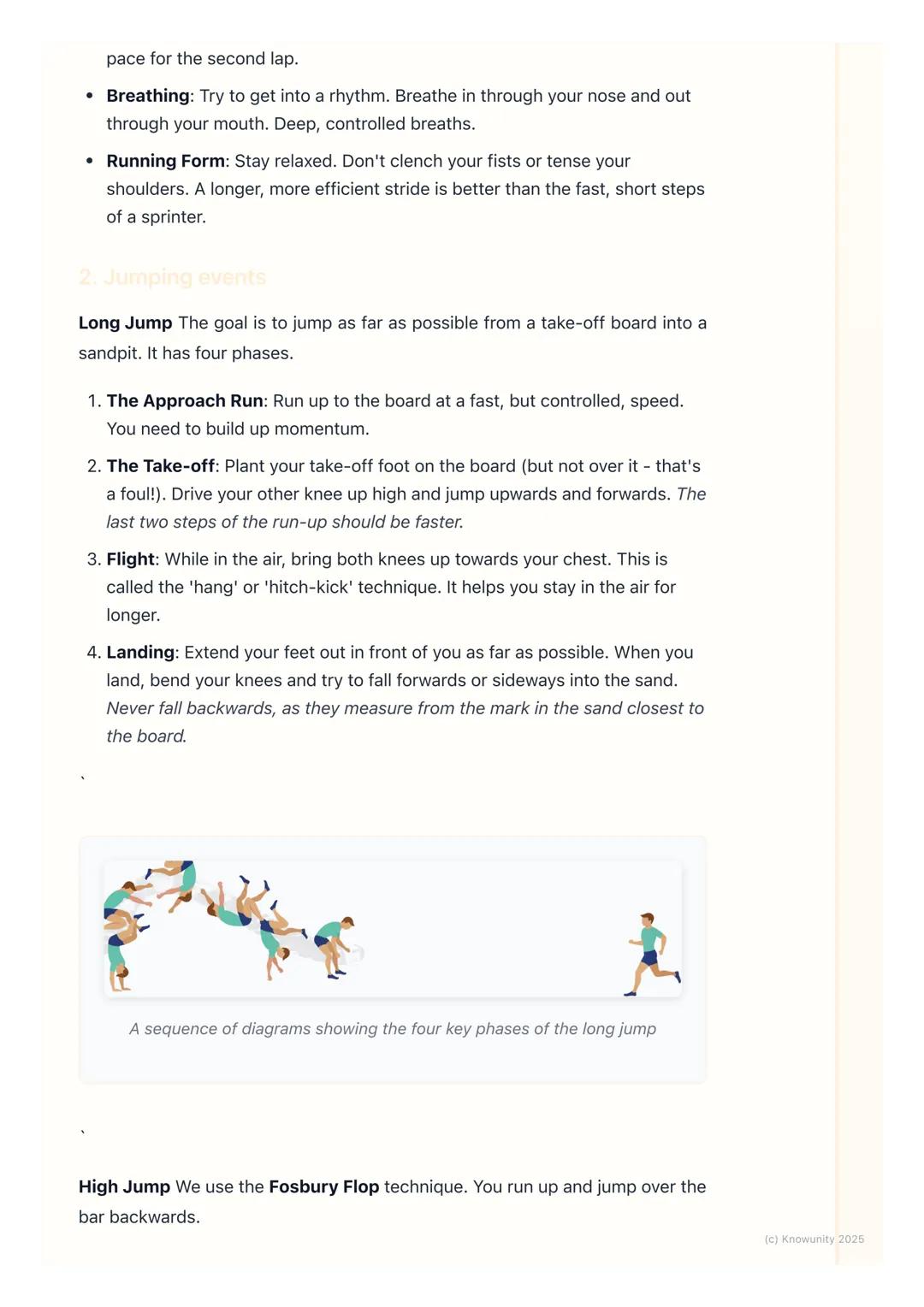
Middle Distance and Jumping Events
Middle distance races require clever pacing - if you sprint from the start, you'll run out of energy! The first lap is typically a bit faster, then you settle into a steady rhythm. Keep your breathing deep and controlled, and maintain a relaxed running form with efficient strides.
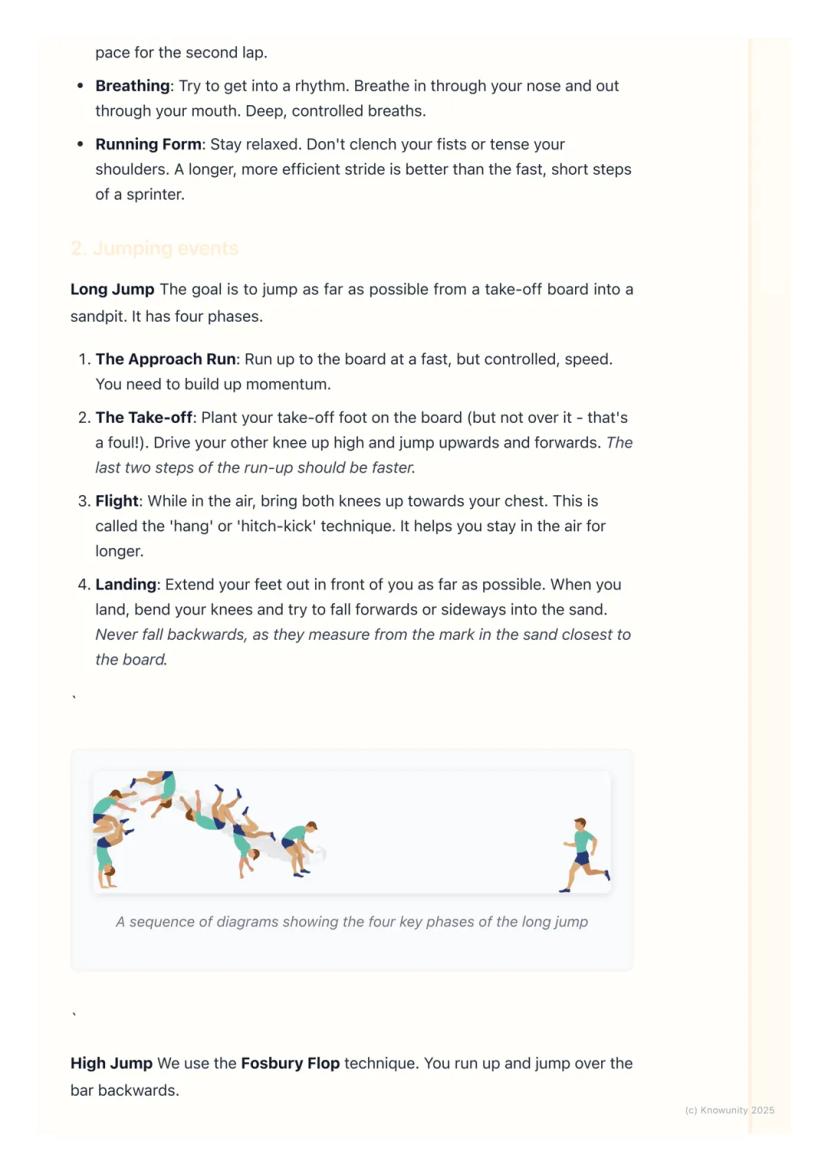
Long jump is all about combining speed with precise technique. It has four key phases: the approach run (building momentum), the take-off (planting your foot on the board without going over), the flight (bringing your knees up to your chest), and the landing (extending your feet forward and falling forwards).
The high jump uses the Fosbury Flop technique. You run a J-shaped approach, jump off one foot, and twist to go over the bar backwards. You arch your back to get your hips over, then kick your legs up to clear the bar. Always land on your upper back on the mat.
Safety first: Never attempt the Fosbury Flop without proper landing mats and teacher supervision!
4
of 6
Throwing Events
Shot put is a push, not a throw! Hold the shot at the base of your fingers against your neck, tucked under your jaw. The power comes from your legs and body rotation, not just your arm. Start facing away from the throwing area, then "glide" across the circle before pushing the shot at roughly a 45-degree angle.
For javelin, grip the corded middle section and hold it above your shoulder. After your run-up, plant your front foot firmly and bring your throwing arm forward, leading with the elbow. Release the javelin up and over your head in a smooth motion.
Safety is absolutely crucial in throwing events. Never throw when someone is in the landing area, always check behind you, and carry the javelin vertically. Wait for your teacher to say it's safe before collecting equipment.
Technique tip: In shot put, remember it's a PUSH from the neck with your elbow high - not a throw from behind your ear like a ball!
5
of 6
Event Checklists and Safety
Having a mental checklist for each event helps you remember the key steps. For the 100m sprint: warm up, set blocks correctly, position properly for "On your marks" and "Set," explode out at "Go," maintain good form, and run through the finish line.
For long jump: mark your run-up starting point, maintain controlled speed, hit (not cross) the take-off board, drive your knee and arms up, bring knees to chest mid-air, extend feet for landing, and fall forwards.
Always do a proper warm-up before any athletic activity. This should include light jogging followed by dynamic stretches like leg swings. After your session, cool down with static stretches to help your muscles recover.
Practice makes progress: Don't expect perfection straight away. Athletics techniques develop through repeated practice and applying feedback from your teacher.
6
of 6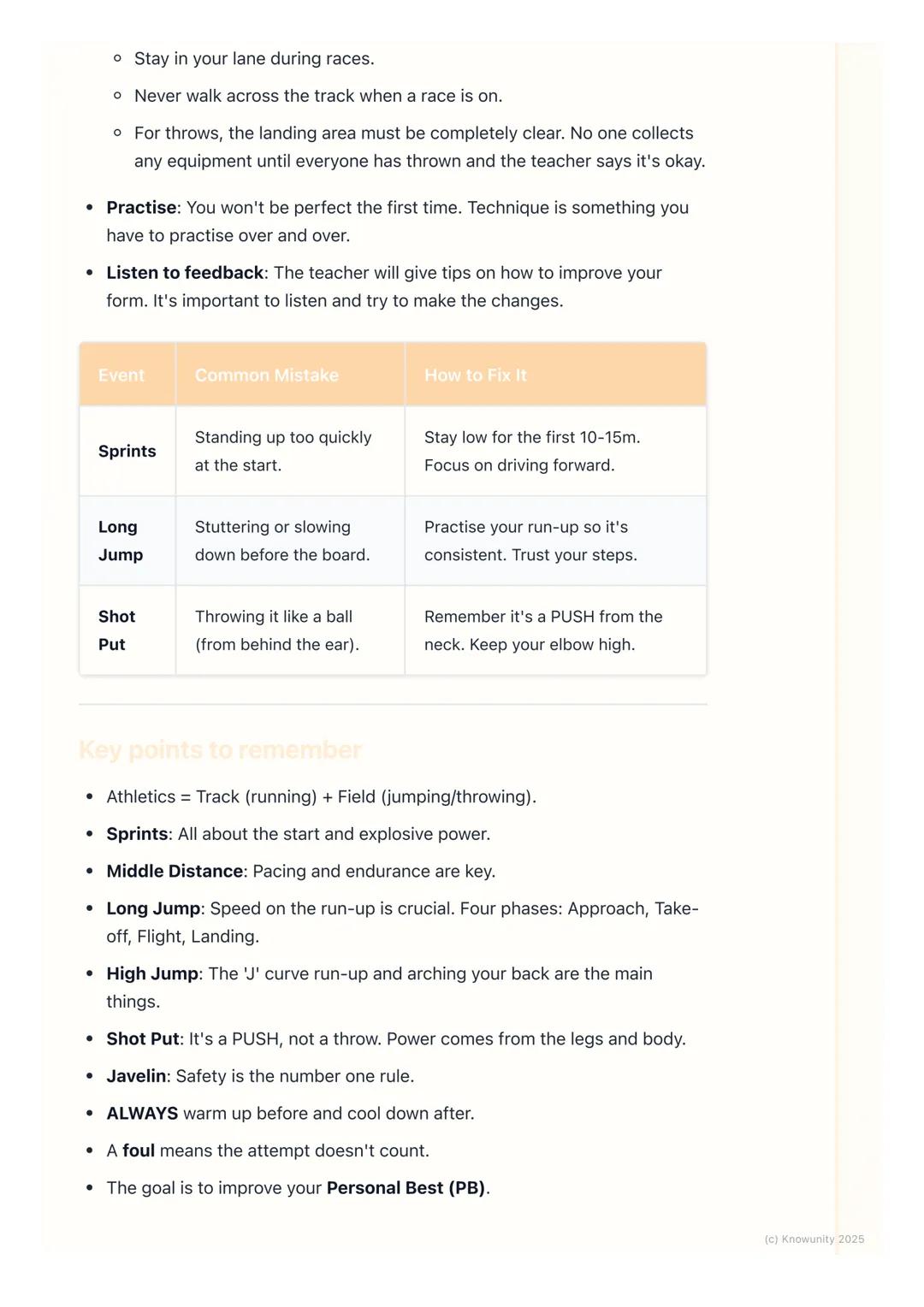
Safety Tips and Key Points to Remember
Safety rules exist for good reason in athletics. Always stay in your lane during races and never walk across the track during an event. For throws, ensure the landing area is completely clear before anyone throws, and only collect equipment when your teacher gives permission.
Common mistakes include standing up too quickly in sprints , stuttering before the long jump board , and throwing the shot put like a ball (remember it's a push from the neck).
Athletics combines track events (running) and field events , each with specific techniques. Sprints need explosive power, middle distance requires pacing, jumps need speed plus technique, and throws demand proper form and safety awareness. Your goal is always to improve your own Personal Best.
Final thought: Every champion started as a beginner. Focus on improving your technique and personal performance rather than just comparing yourself to others.
Mysleli jsme, že se nikdy nezeptáš...
Co je AI společník Knowunity?
Náš AI společník je speciálně vytvořen pro potřeby studentů. Na základě milionů obsahových materiálů, které máme na platformě, můžeme studentům poskytovat opravdu smysluplné a relevantní odpovědi. Ale nejde jen o odpovědi, společník je ještě více o provázení studentů jejich každodenními výzvami v učení, s personalizovanými studijními plány, kvízy nebo obsahovými materiály v chatu a 100% personalizací na základě dovedností a vývoje studentů.
Kde si můžu stáhnout aplikaci Knowunity?
Aplikaci si můžete stáhnout z obchodu Google Play a Apple App Store.
Jak můžu dostat svou platbu? Kolik si můžu vydělat?
Ano, máte bezplatný přístup k obsahu v aplikaci a k našemu společníkovi s umělou inteligencí. Chcete-li odemknout určité funkce aplikace, můžete si zakoupit aplikaci Knowunity Pro.
Nejpopulárnější poznámky
9Nemůžeš najít, co hledáš? Prozkoumej další předměty.
Recenze od našich uživatelů. Mají vše super — a ty taky můžeš.
4.6/5App Store
4.7/5Google Play
Aplikace je velmi jednoduchá na používání a dobře navržená. Zatím jsem našel vše, co jsem hledal, a mohl jsem se z prezentací hodně naučit! Určitě použiju aplikaci na školní úkol! A samozřejmě taky hodně pomáhá jako inspirace.
Stefan Suživatel iOS
Tahle aplikace je fakt skvělá. Je tam tolik studijních poznámek a pomůcek [...]. Můj problémový předmět je například francouzština a aplikace nabízí tolik možností pomoci. Díky této aplikaci jsem si zlepšil francouzštinu. Doporučil bych ji každému.
Samantha Klichuživatelka Androidu
Páni, jsem opravdu ohromen. Zkusil jsem aplikaci jen proto, že jsem ji mnohokrát viděl v reklamách, a byl jsem naprosto ohromen. Tato aplikace je TA POMOC, kterou chceš do školy, a především nabízí spoustu věcí, jako jsou cvičení a přehledy faktů, které mi osobně VELMI pomohly.
Annauživatelka iOS
Physical Education10 zobrazení·Aktualizováno Jun 6, 2026·6 stránekMaster Athletics Skills: Running, Jumping, and Throwing
Athletics (or track and field) is one of the oldest sports around, focusing on running, jumping and throwing events. It's fantastic for building all-round fitness including speed, strength and endurance. Athletics is divided into track events (races) and field events... Zobrazit více
1
of 6Registruj se, abys viděl obsah. Je to zdarma!
- Přístup ke všem dokumentům
- Zlepši své známky
- Připoj se k milionům studentů
Introduction to Athletics
Ever wondered why athletics is such a big deal at the Olympics? Athletics tests the fundamental human abilities of running, jumping and throwing. When you participate in athletics, you're developing multiple fitness components at once!
Track events are all about racing and are measured by time. These include sprints (short, fast races like 100m) and middle distance events (like 800m) that require both speed and endurance. Field events include jumps and throws, all measured by distance or height.
Some key terms you'll need to know: a foul is when you break a rule (like stepping over the line in long jump), a Personal Best (PB) is your best ever performance, and stance refers to how you position your body before starting.
Quick Tip: Athletics is a brilliant way to discover your natural talents - you might be surprised to find you excel at an event you've never tried before!
2
of 6Registruj se, abys viděl obsah. Je to zdarma!
- Přístup ke všem dokumentům
- Zlepši své známky
- Připoj se k milionům studentů
Sprinting Technique
The start can make or break your sprint! When you hear "On your marks," position your hands just behind the start line with your back knee on the ground. At "Set," lift your hips higher than your shoulders with your weight forward - this is the power position.
When you hear "Go!" or the starting gun, push off explosively with both feet. Keep low for the first 10-15 metres (this is called the drive phase), then gradually rise to an upright running position. Remember to pump your arms from the shoulders, not just the elbows, and keep your knees high.
For the finish, run straight through the line at full speed. A common mistake is slowing down just before the finish - this can cost you vital seconds!
Remember: In sprinting, your reaction time at the start can be just as important as your top speed during the race.
3
of 6Registruj se, abys viděl obsah. Je to zdarma!
- Přístup ke všem dokumentům
- Zlepši své známky
- Připoj se k milionům studentů
Middle Distance and Jumping Events
Middle distance races require clever pacing - if you sprint from the start, you'll run out of energy! The first lap is typically a bit faster, then you settle into a steady rhythm. Keep your breathing deep and controlled, and maintain a relaxed running form with efficient strides.
Long jump is all about combining speed with precise technique. It has four key phases: the approach run (building momentum), the take-off (planting your foot on the board without going over), the flight (bringing your knees up to your chest), and the landing (extending your feet forward and falling forwards).
The high jump uses the Fosbury Flop technique. You run a J-shaped approach, jump off one foot, and twist to go over the bar backwards. You arch your back to get your hips over, then kick your legs up to clear the bar. Always land on your upper back on the mat.
Safety first: Never attempt the Fosbury Flop without proper landing mats and teacher supervision!
4
of 6Registruj se, abys viděl obsah. Je to zdarma!
- Přístup ke všem dokumentům
- Zlepši své známky
- Připoj se k milionům studentů
Throwing Events
Shot put is a push, not a throw! Hold the shot at the base of your fingers against your neck, tucked under your jaw. The power comes from your legs and body rotation, not just your arm. Start facing away from the throwing area, then "glide" across the circle before pushing the shot at roughly a 45-degree angle.
For javelin, grip the corded middle section and hold it above your shoulder. After your run-up, plant your front foot firmly and bring your throwing arm forward, leading with the elbow. Release the javelin up and over your head in a smooth motion.
Safety is absolutely crucial in throwing events. Never throw when someone is in the landing area, always check behind you, and carry the javelin vertically. Wait for your teacher to say it's safe before collecting equipment.
Technique tip: In shot put, remember it's a PUSH from the neck with your elbow high - not a throw from behind your ear like a ball!
5
of 6Registruj se, abys viděl obsah. Je to zdarma!
- Přístup ke všem dokumentům
- Zlepši své známky
- Připoj se k milionům studentů
Event Checklists and Safety
Having a mental checklist for each event helps you remember the key steps. For the 100m sprint: warm up, set blocks correctly, position properly for "On your marks" and "Set," explode out at "Go," maintain good form, and run through the finish line.
For long jump: mark your run-up starting point, maintain controlled speed, hit (not cross) the take-off board, drive your knee and arms up, bring knees to chest mid-air, extend feet for landing, and fall forwards.
Always do a proper warm-up before any athletic activity. This should include light jogging followed by dynamic stretches like leg swings. After your session, cool down with static stretches to help your muscles recover.
Practice makes progress: Don't expect perfection straight away. Athletics techniques develop through repeated practice and applying feedback from your teacher.
6
of 6Registruj se, abys viděl obsah. Je to zdarma!
- Přístup ke všem dokumentům
- Zlepši své známky
- Připoj se k milionům studentů
Safety Tips and Key Points to Remember
Safety rules exist for good reason in athletics. Always stay in your lane during races and never walk across the track during an event. For throws, ensure the landing area is completely clear before anyone throws, and only collect equipment when your teacher gives permission.
Common mistakes include standing up too quickly in sprints , stuttering before the long jump board , and throwing the shot put like a ball (remember it's a push from the neck).
Athletics combines track events (running) and field events , each with specific techniques. Sprints need explosive power, middle distance requires pacing, jumps need speed plus technique, and throws demand proper form and safety awareness. Your goal is always to improve your own Personal Best.
Final thought: Every champion started as a beginner. Focus on improving your technique and personal performance rather than just comparing yourself to others.
Mysleli jsme, že se nikdy nezeptáš...
Co je AI společník Knowunity?
Náš AI společník je speciálně vytvořen pro potřeby studentů. Na základě milionů obsahových materiálů, které máme na platformě, můžeme studentům poskytovat opravdu smysluplné a relevantní odpovědi. Ale nejde jen o odpovědi, společník je ještě více o provázení studentů jejich každodenními výzvami v učení, s personalizovanými studijními plány, kvízy nebo obsahovými materiály v chatu a 100% personalizací na základě dovedností a vývoje studentů.
Kde si můžu stáhnout aplikaci Knowunity?
Aplikaci si můžete stáhnout z obchodu Google Play a Apple App Store.
Jak můžu dostat svou platbu? Kolik si můžu vydělat?
Ano, máte bezplatný přístup k obsahu v aplikaci a k našemu společníkovi s umělou inteligencí. Chcete-li odemknout určité funkce aplikace, můžete si zakoupit aplikaci Knowunity Pro.
Nejpopulárnější poznámky
9Nemůžeš najít, co hledáš? Prozkoumej další předměty.
Recenze od našich uživatelů. Mají vše super — a ty taky můžeš.
4.6/5App Store
4.7/5Google Play
Aplikace je velmi jednoduchá na používání a dobře navržená. Zatím jsem našel vše, co jsem hledal, a mohl jsem se z prezentací hodně naučit! Určitě použiju aplikaci na školní úkol! A samozřejmě taky hodně pomáhá jako inspirace.
Stefan Suživatel iOS
Tahle aplikace je fakt skvělá. Je tam tolik studijních poznámek a pomůcek [...]. Můj problémový předmět je například francouzština a aplikace nabízí tolik možností pomoci. Díky této aplikaci jsem si zlepšil francouzštinu. Doporučil bych ji každému.
Samantha Klichuživatelka Androidu
Páni, jsem opravdu ohromen. Zkusil jsem aplikaci jen proto, že jsem ji mnohokrát viděl v reklamách, a byl jsem naprosto ohromen. Tato aplikace je TA POMOC, kterou chceš do školy, a především nabízí spoustu věcí, jako jsou cvičení a přehledy faktů, které mi osobně VELMI pomohly.
Annauživatelka iOS