
Linear inequalities are like normal equations, but instead of finding...
 Mathematics2 zobrazení·Aktualizováno Jun 13, 2026·6 stránek
Mastering Linear Inequalities
1 / 6
1
of 6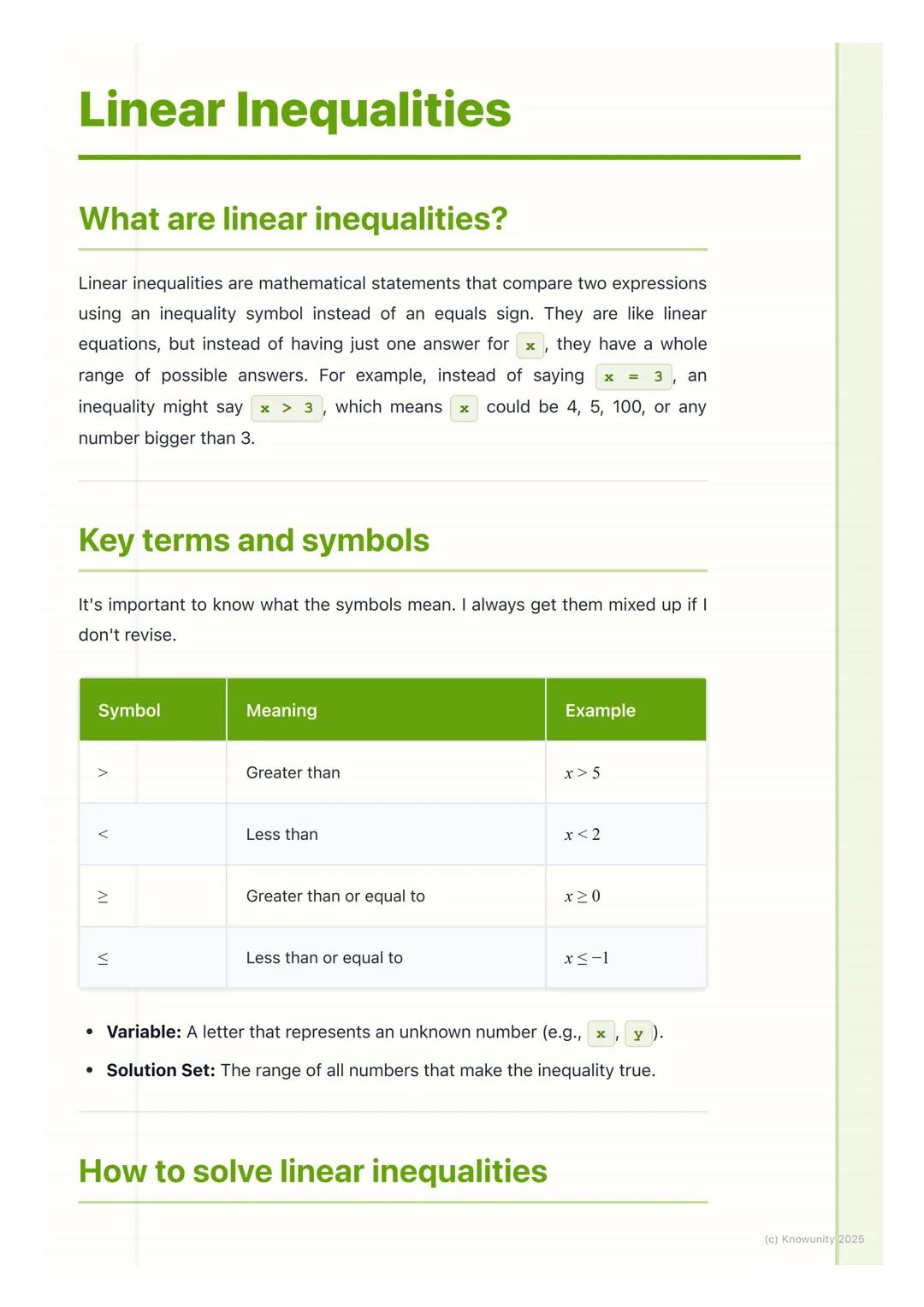
What are Linear Inequalities?
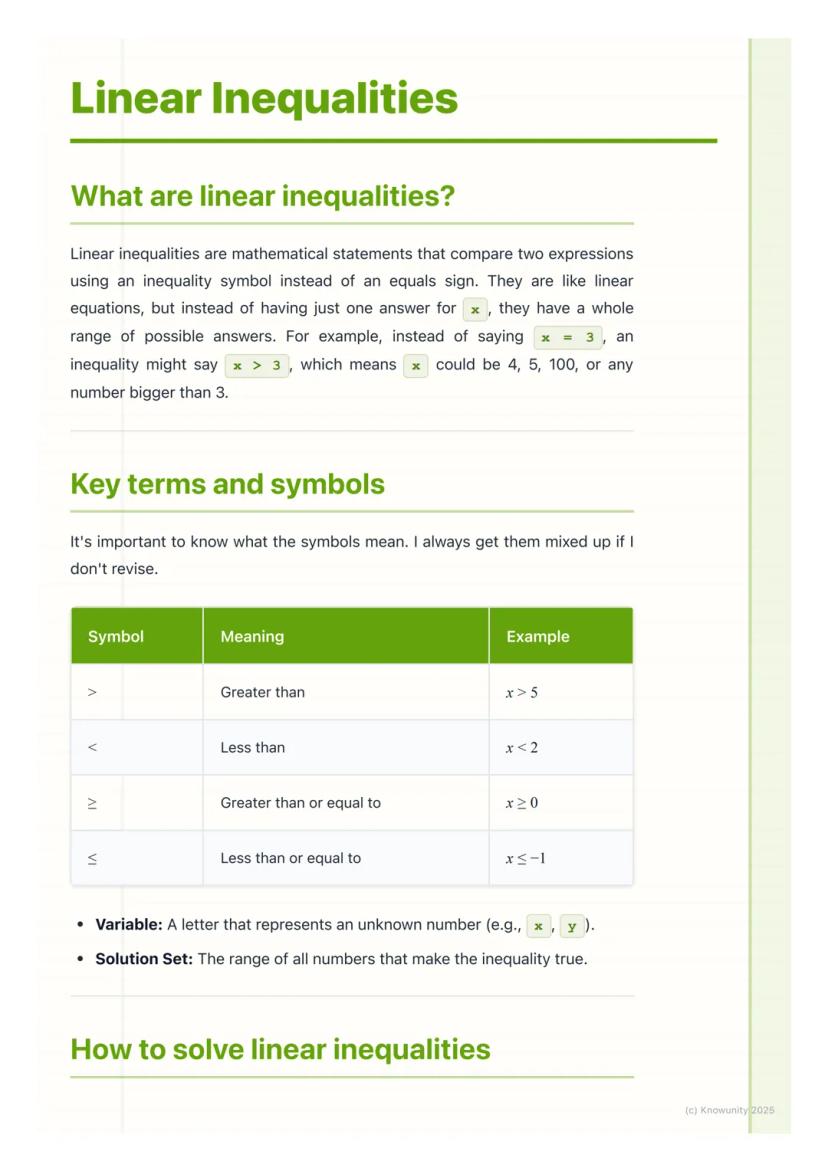
Think of linear inequalities as equations with attitude - they don't settle for just one answer! Instead of saying x = 3, they might say x > 3, meaning x could be any number greater than 3.
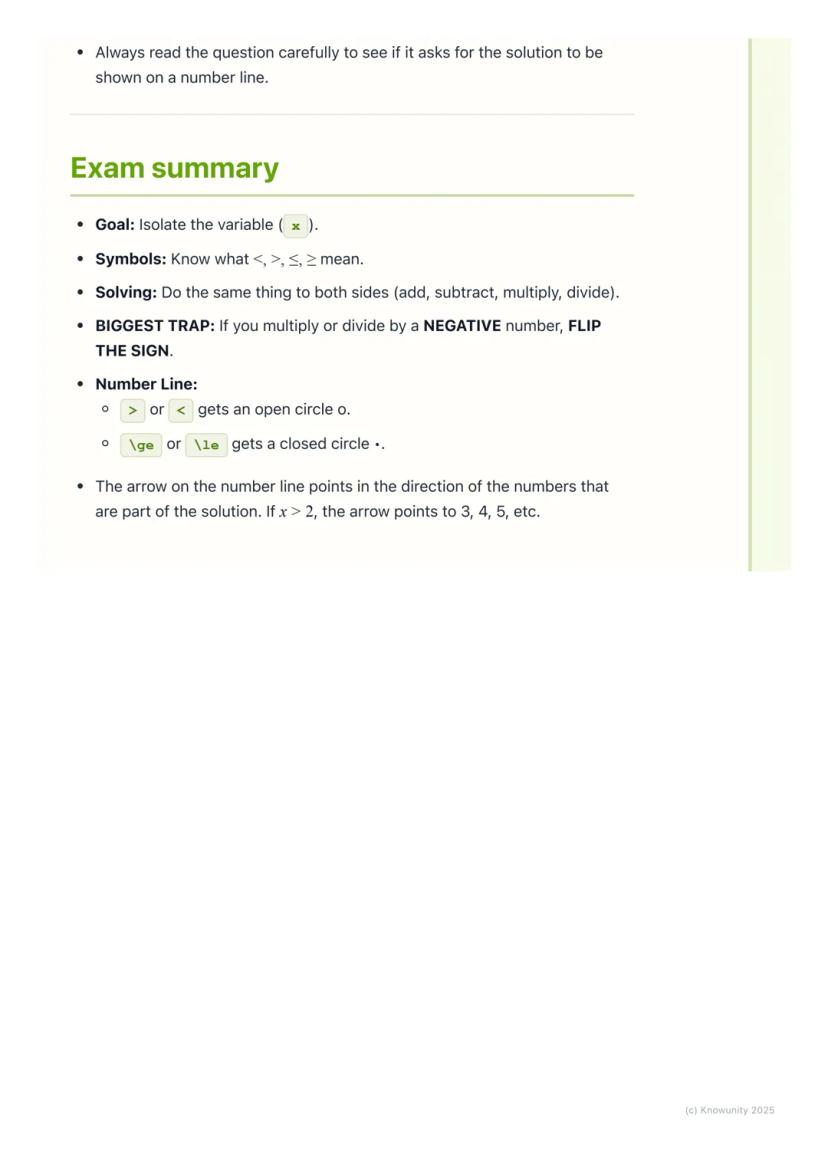
The inequality symbols are your new best mates. Greater than (>) and less than (<) exclude the actual number, whilst greater than or equal to (≥) and less than or equal to (≤) include it. A variable like x represents your unknown number, and the solution set is all the numbers that make your inequality true.
Quick Tip: Remember that > points to the bigger side - if you get confused, think of it as a hungry mouth wanting to eat the larger number!
2
of 6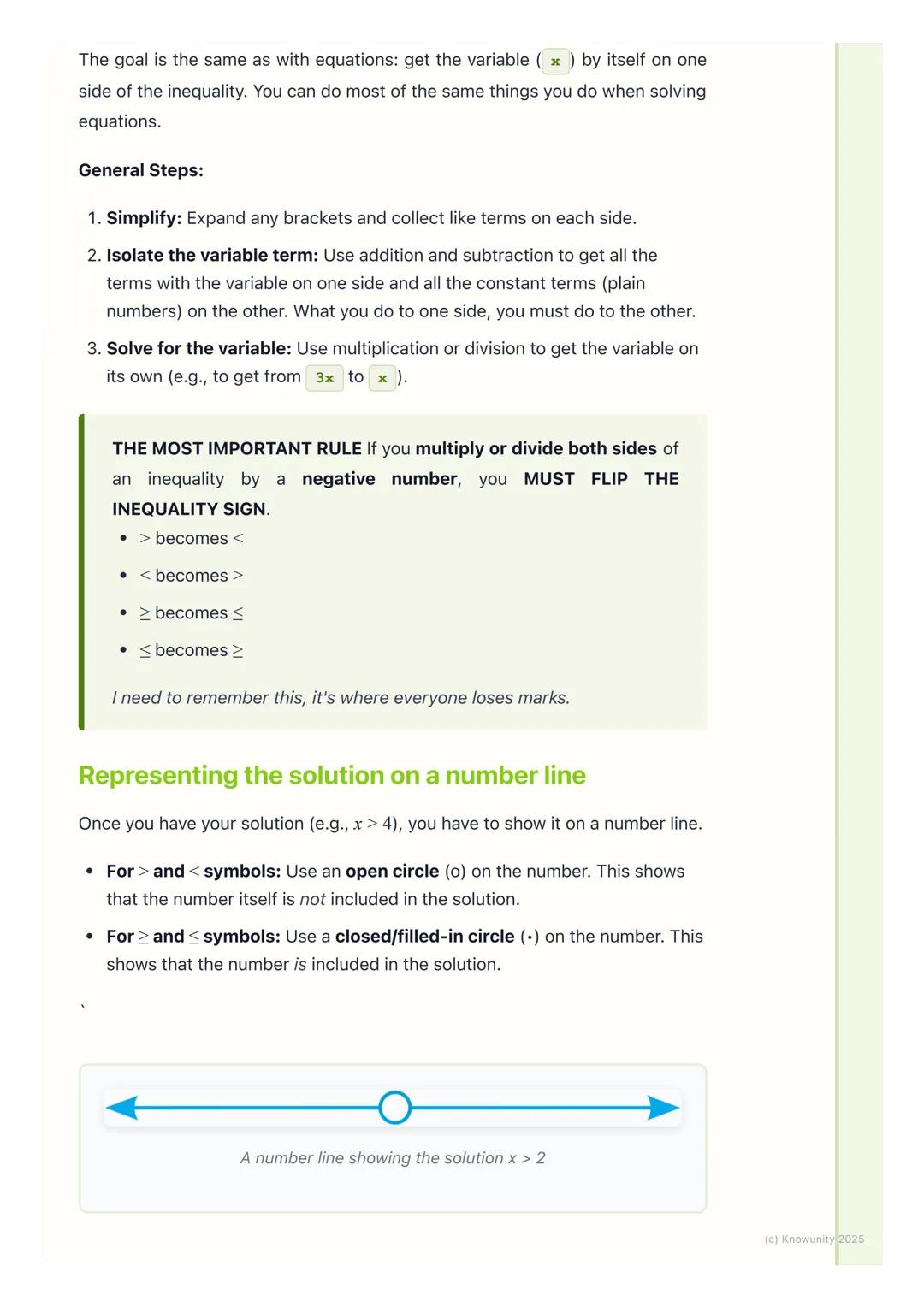
Solving Linear Inequalities - The Process
Solving inequalities follows the same steps as normal equations: simplify, isolate the variable term, then solve. You can add, subtract, multiply, and divide just like usual equations.
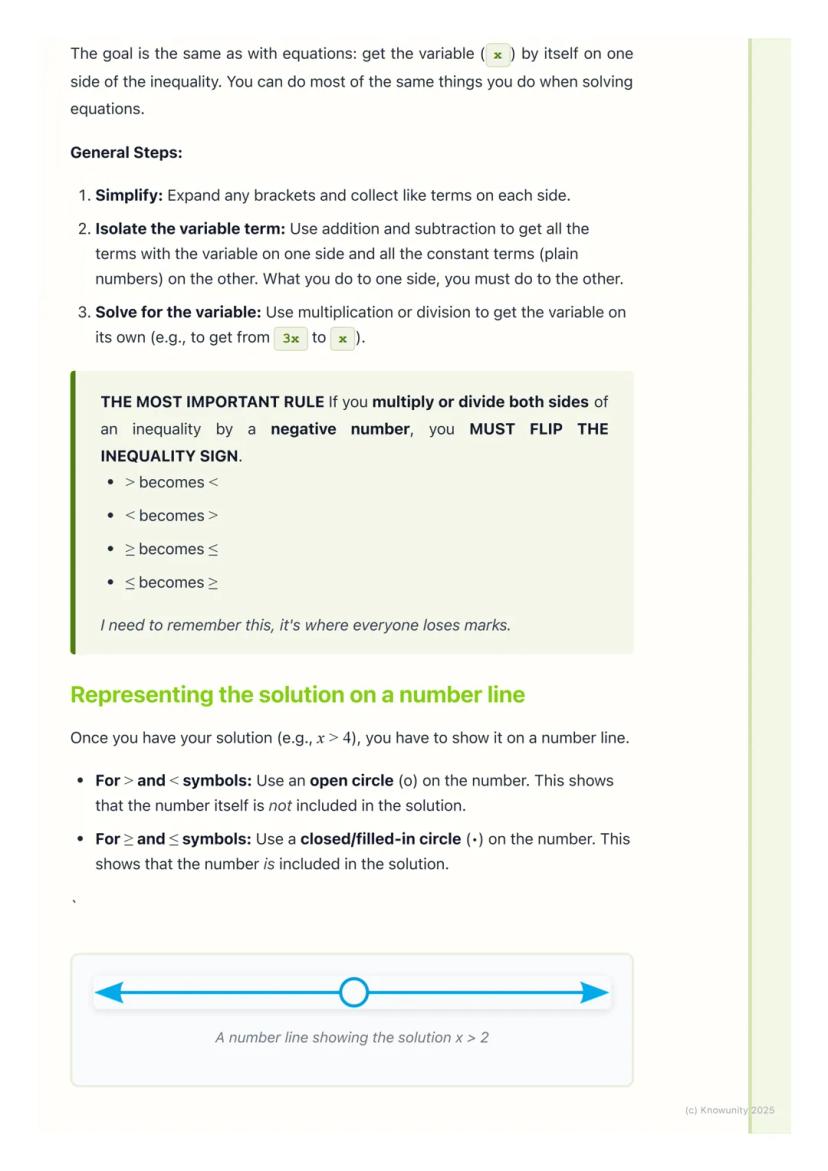
However, there's one massive rule that trips everyone up: when you multiply or divide both sides by a negative number, you must flip the inequality sign. So > becomes <, and ≤ becomes ≥.
Once you've got your solution, you'll often need to show it on a number line. Use an open circle for > and < (the number isn't included) and a closed circle for ≥ and ≤ (the number is included).
Don't Forget: The sign-flipping rule is where most students lose marks - it's the number one exam trap!
3
of 6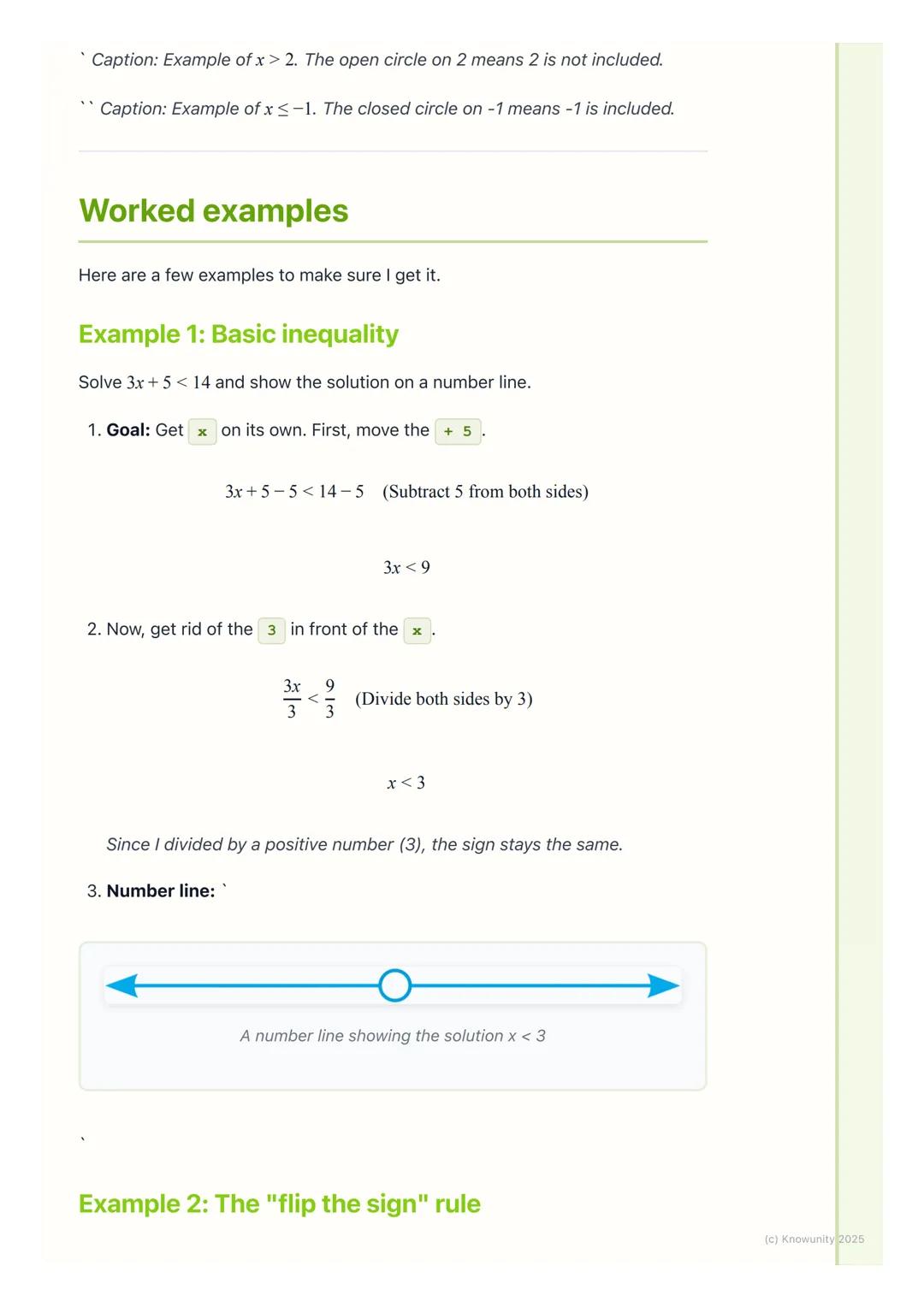
Worked Examples - Getting the Hang of It
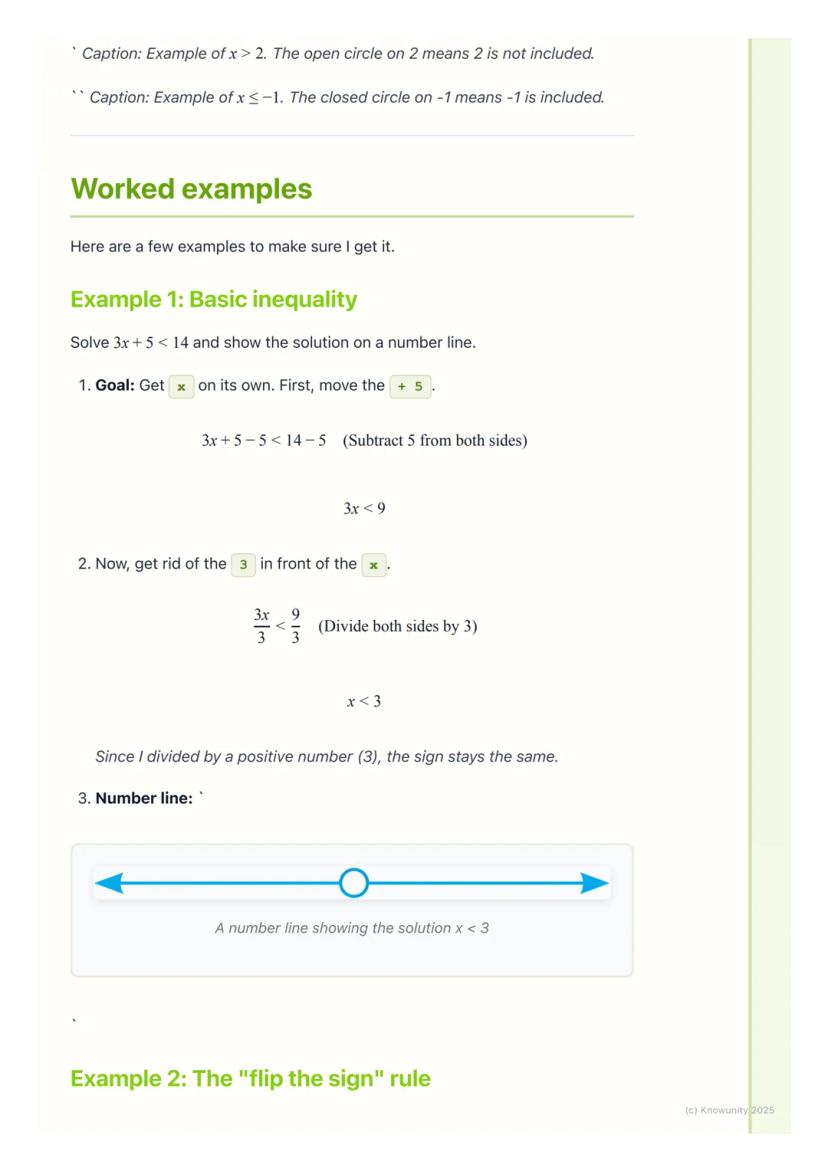
Let's tackle 3x + 5 < 14. First, subtract 5 from both sides to get 3x < 9. Then divide by 3 (positive number, so no sign flip) to get x < 3. On your number line, use an open circle at 3 with an arrow pointing left.
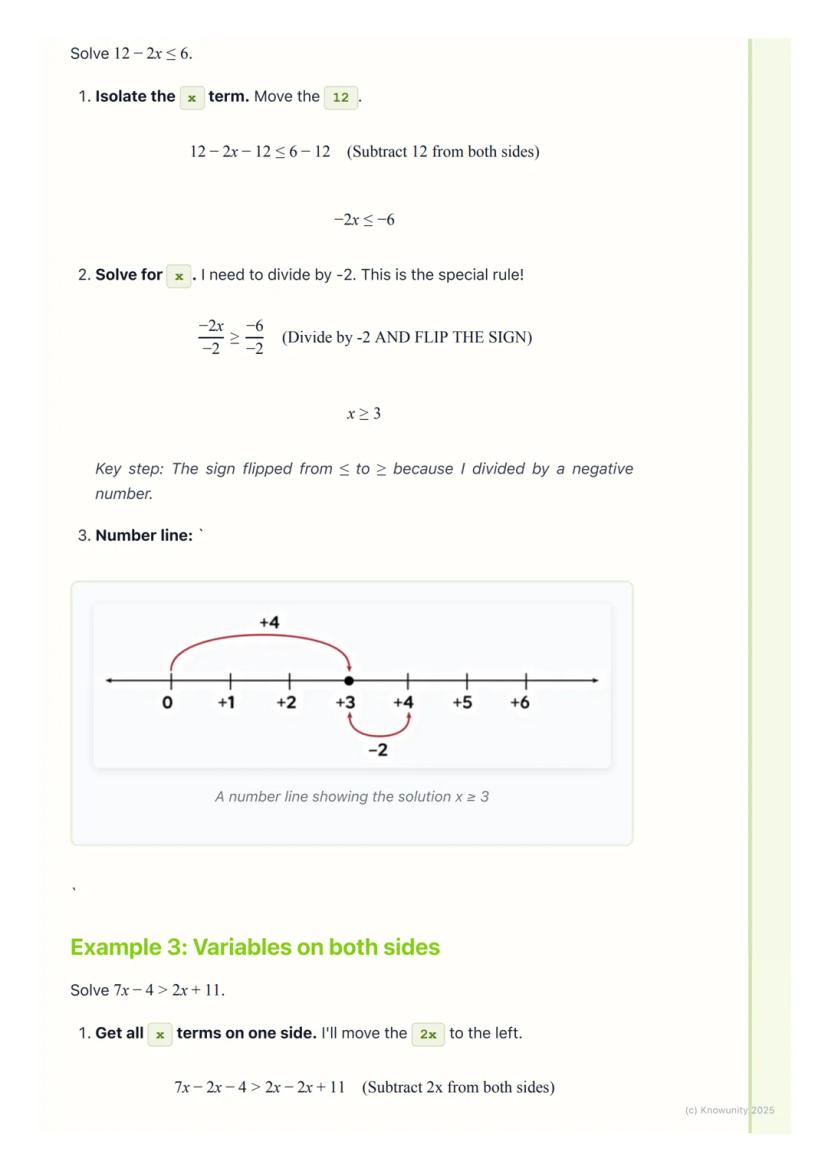
For the sign-flipping example, try 12 - 2x ≤ 6. Subtract 12 from both sides to get -2x ≤ -6. Now divide by -2 (negative!), so flip the sign: x ≥ 3. Your number line shows a closed circle at 3 pointing right.
Pro Strategy: When solving, pretend it's a normal equation until you hit that negative multiplication or division - then remember to flip!
4
of 6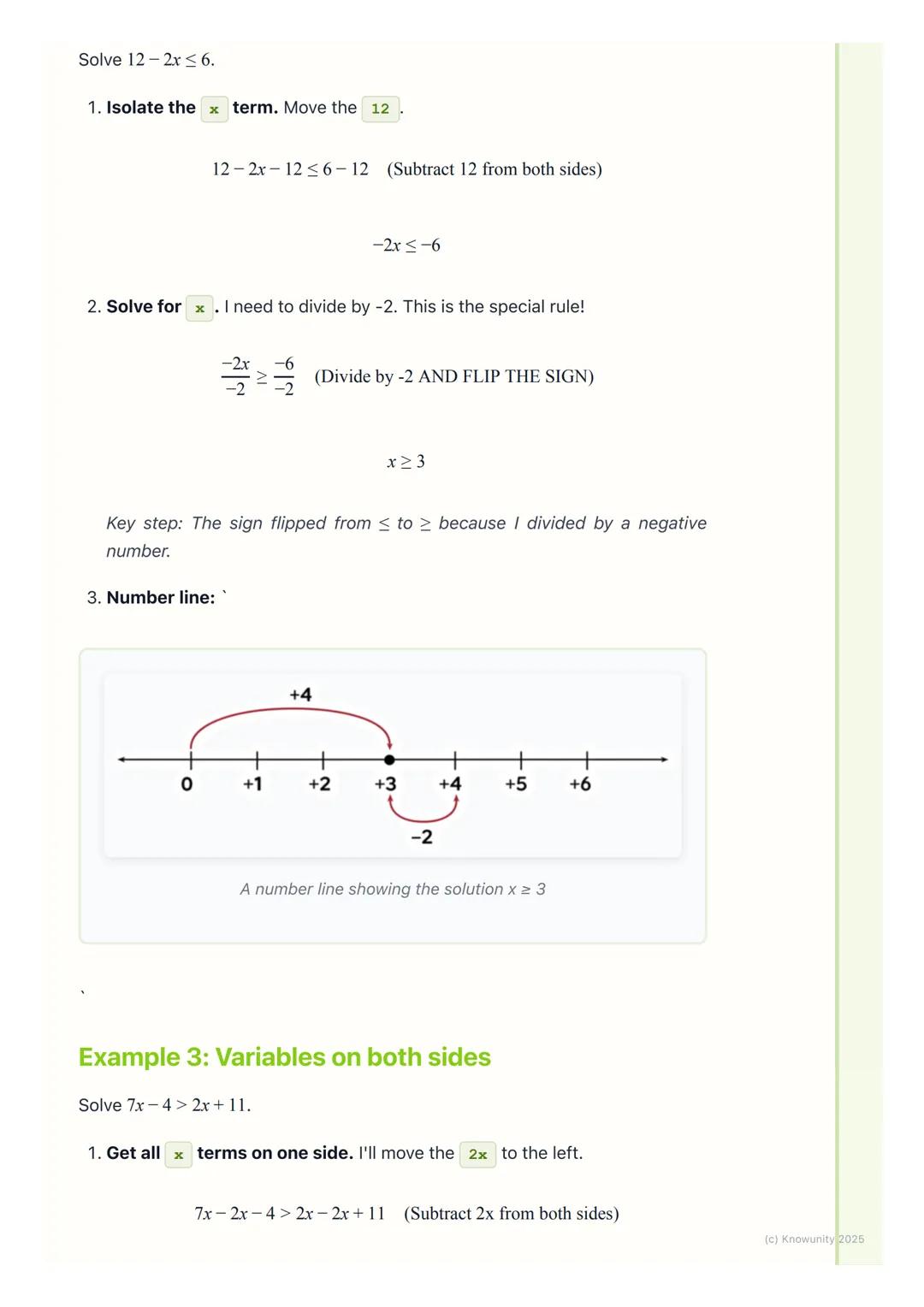
Variables on Both Sides
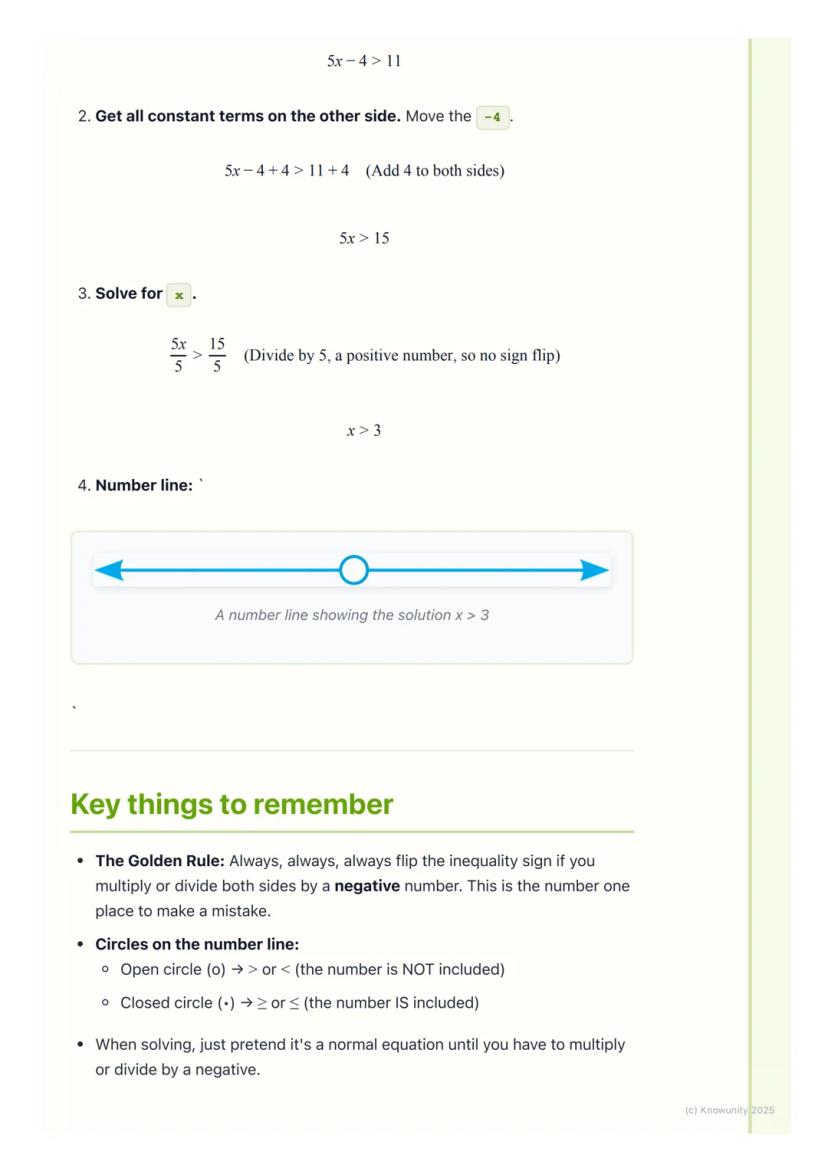
When you've got variables on both sides like 7x - 4 > 2x + 11, don't panic! Move all x terms to one side by subtracting 2x from both sides: 5x - 4 > 11.
Add 4 to both sides to get 5x > 15. Finally, divide by 5 (positive number) to get x > 3. Since you divided by a positive, the inequality sign stays the same.
The key is treating it like any other equation - just keep that sign-flipping rule in your back pocket for when you need it.
Remember: Always double-check whether you're multiplying or dividing by a positive or negative number - it makes all the difference!
5
of 6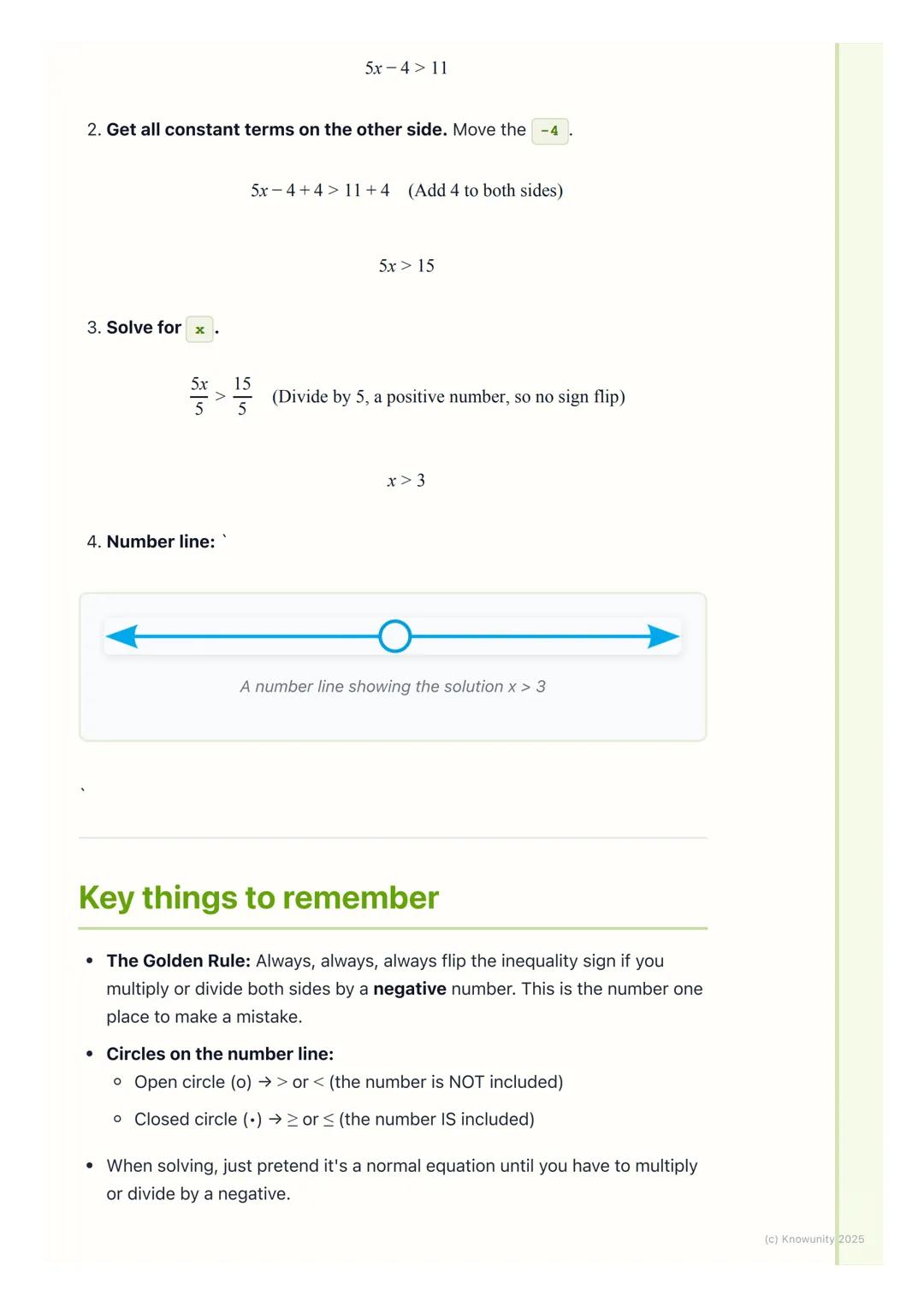
Number Lines and Visual Solutions
Your number line is like a visual map of your solution. The circle tells you whether the boundary number is included, and the arrow shows which direction contains your solutions.
For open circles (> or <), imagine the number is "off-limits" - you can get infinitely close but never actually reach it. For closed circles (≥ or ≤), the number is part of your solution family.
The arrow direction is logical: if x > 3, then 4, 5, 6 and beyond all work, so your arrow points right towards those larger numbers.
Visual Trick: Think of the arrow as pointing towards all the numbers that would make your inequality true - it's your solution's home!
6
of 6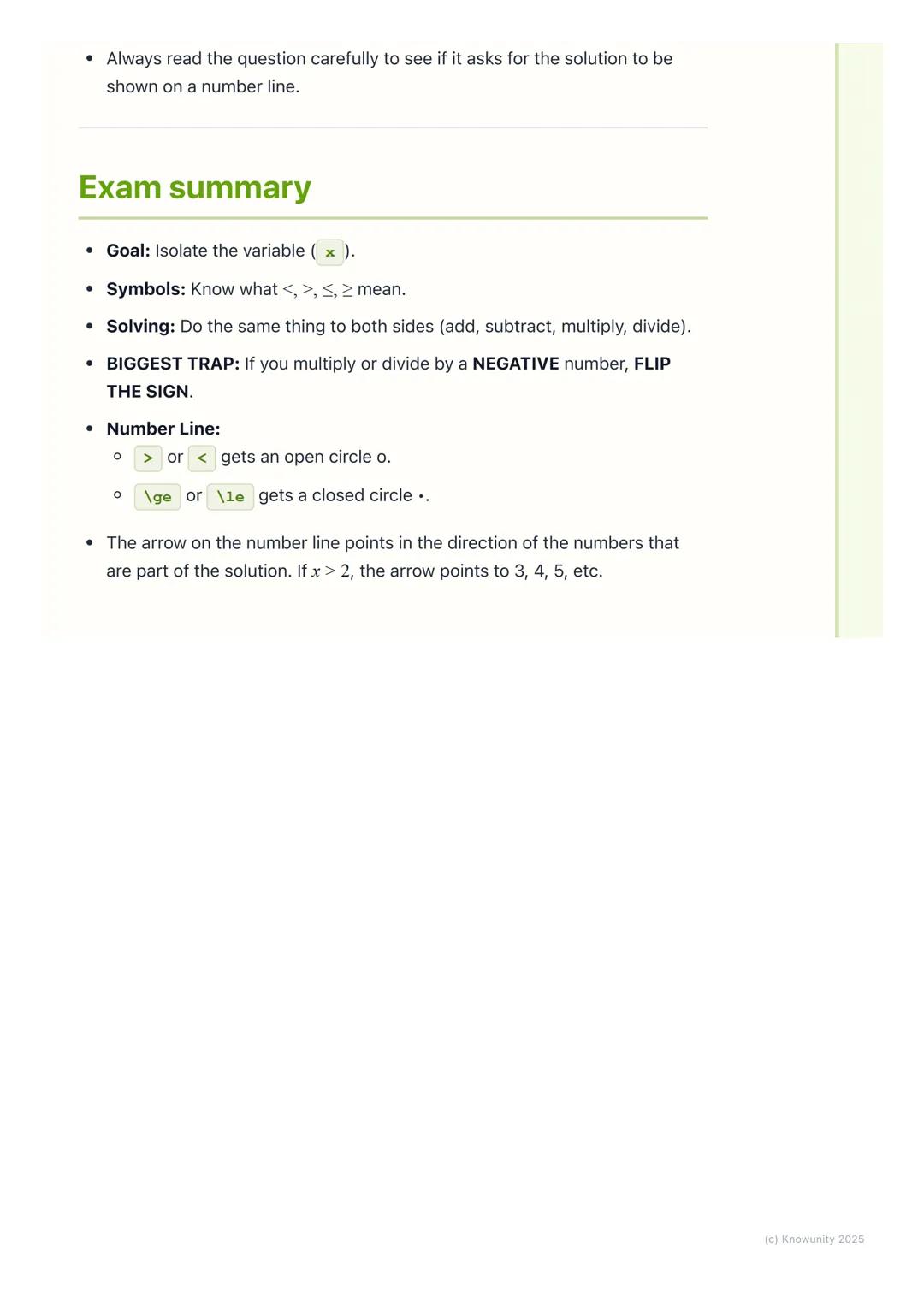
Exam Success - Key Takeaways
Your exam strategy should focus on the basics: isolate the variable using the same operations on both sides. Know your inequality symbols inside out, and always check if you're multiplying or dividing by a negative.
The biggest exam trap is forgetting to flip the sign when working with negatives. Make this your automatic reflex - negative operation means flip the sign!
For number line questions, remember that open circles go with > and <, whilst closed circles pair with ≥ and ≤. Your arrow direction shows where the solutions live.
Exam Confidence: Master the sign-flipping rule and you've conquered the hardest part - the rest is just like solving regular equations!
Mysleli jsme, že se nikdy nezeptáš...
Co je AI společník Knowunity?
Náš AI společník je speciálně vytvořen pro potřeby studentů. Na základě milionů obsahových materiálů, které máme na platformě, můžeme studentům poskytovat opravdu smysluplné a relevantní odpovědi. Ale nejde jen o odpovědi, společník je ještě více o provázení studentů jejich každodenními výzvami v učení, s personalizovanými studijními plány, kvízy nebo obsahovými materiály v chatu a 100% personalizací na základě dovedností a vývoje studentů.
Kde si můžu stáhnout aplikaci Knowunity?
Aplikaci si můžete stáhnout z obchodu Google Play a Apple App Store.
Jak můžu dostat svou platbu? Kolik si můžu vydělat?
Ano, máte bezplatný přístup k obsahu v aplikaci a k našemu společníkovi s umělou inteligencí. Chcete-li odemknout určité funkce aplikace, můžete si zakoupit aplikaci Knowunity Pro.
Nejpopulárnější poznámky z Mathematics
8MathematicsAlgebra
Algebra
5th Year91
MathematicsAlgebra 2
Algebra notes focusing on the factor theorem, completing the square, -b formula, graphs of polynomials
5th Year130
MathematicsSolving Equations
This section focuses on solving one-step and two-step linear equations to find the value of an unknown variable.
1st Year131
MathematicsArithmetic sequences and series
With examples
5th Year130
MathematicsIntroduction to Probability
This topic introduces basic probability concepts, including calculating the probability of simple events and understanding the difference between experimental and theoretical probability.
2nd Year91
MathematicsMaths jc algebra
Maths jc
1st Year230
MathematicsNatural Numbers and Integers
Students will learn about positive whole numbers, zero, and negative whole numbers, and how to add, subtract, multiply, and divide them correctly.
1st Year131
MathematicsDifferential Calculus
Calculus is a topic that comes up nearly everywhere on your maths LC. This is just starter notes that could be useful end of 5th year or start of 6th year
5th Year271
Nejpopulárnější poznámky
9 Irish
IrishIrish oral questions and answers
Questions and answers for the leaving cert oral
5th Year4264
 English
Key Quotes : Sive
Key Quotes and explanations: Sive
6th Year2842
IrishIrish oral questions
Outline of oral questions
5th Year2055
IrishIníon- le hÁine Durkin
Aine Durkin’s poem, Iníon: Themes & summary
5th Year890
IrishIrish poetry 2027
Iníon + Dínit an Bhróin
5th Year1153
IrishLC HL notes- Iníon (poem)
Includes poem in English and Irish, theme, key words & phrases
5th Year2304
EnglishCultural Context : Shawshank Redemption : Sive : Small Things Like These
Comparative Study : Cultural Context : Shawshank Redemption, Sive and Small Things Like These
6th Year1430
IrishMo Ghrá-sa (Idir Lúibíní)
Notes on mo ghrá-sa
5th Year380
IrishAn Gaeilge Aiste
Irish Language essay
6th Year1320
Nemůžeš najít, co hledáš? Prozkoumej další předměty.
Recenze od našich uživatelů. Mají vše super — a ty taky můžeš.
4.6/5App Store
4.7/5Google Play
Aplikace je velmi jednoduchá na používání a dobře navržená. Zatím jsem našel vše, co jsem hledal, a mohl jsem se z prezentací hodně naučit! Určitě použiju aplikaci na školní úkol! A samozřejmě taky hodně pomáhá jako inspirace.
Stefan Suživatel iOS
Tahle aplikace je fakt skvělá. Je tam tolik studijních poznámek a pomůcek [...]. Můj problémový předmět je například francouzština a aplikace nabízí tolik možností pomoci. Díky této aplikaci jsem si zlepšil francouzštinu. Doporučil bych ji každému.
Samantha Klichuživatelka Androidu
Páni, jsem opravdu ohromen. Zkusil jsem aplikaci jen proto, že jsem ji mnohokrát viděl v reklamách, a byl jsem naprosto ohromen. Tato aplikace je TA POMOC, kterou chceš do školy, a především nabízí spoustu věcí, jako jsou cvičení a přehledy faktů, které mi osobně VELMI pomohly.
Annauživatelka iOS
Mathematics2 zobrazení·Aktualizováno Jun 13, 2026·6 stránekMastering Linear Inequalities
Linear inequalities are like normal equations, but instead of finding one exact answer, you get a whole range of possible solutions. They use symbols like > and < instead of equals signs, and mastering them is crucial for your maths...
1
of 6
Registruj se, abys viděl obsah. Je to zdarma!
- Přístup ke všem dokumentům
- Zlepši své známky
- Připoj se k milionům studentů
What are Linear Inequalities?
Think of linear inequalities as equations with attitude - they don't settle for just one answer! Instead of saying x = 3, they might say x > 3, meaning x could be any number greater than 3.
The inequality symbols are your new best mates. Greater than (>) and less than (<) exclude the actual number, whilst greater than or equal to (≥) and less than or equal to (≤) include it. A variable like x represents your unknown number, and the solution set is all the numbers that make your inequality true.
Quick Tip: Remember that > points to the bigger side - if you get confused, think of it as a hungry mouth wanting to eat the larger number!
2
of 6Registruj se, abys viděl obsah. Je to zdarma!
- Přístup ke všem dokumentům
- Zlepši své známky
- Připoj se k milionům studentů
Solving Linear Inequalities - The Process
Solving inequalities follows the same steps as normal equations: simplify, isolate the variable term, then solve. You can add, subtract, multiply, and divide just like usual equations.
However, there's one massive rule that trips everyone up: when you multiply or divide both sides by a negative number, you must flip the inequality sign. So > becomes <, and ≤ becomes ≥.
Once you've got your solution, you'll often need to show it on a number line. Use an open circle for > and < (the number isn't included) and a closed circle for ≥ and ≤ (the number is included).
Don't Forget: The sign-flipping rule is where most students lose marks - it's the number one exam trap!
3
of 6Registruj se, abys viděl obsah. Je to zdarma!
- Přístup ke všem dokumentům
- Zlepši své známky
- Připoj se k milionům studentů
Worked Examples - Getting the Hang of It
Let's tackle 3x + 5 < 14. First, subtract 5 from both sides to get 3x < 9. Then divide by 3 (positive number, so no sign flip) to get x < 3. On your number line, use an open circle at 3 with an arrow pointing left.
For the sign-flipping example, try 12 - 2x ≤ 6. Subtract 12 from both sides to get -2x ≤ -6. Now divide by -2 (negative!), so flip the sign: x ≥ 3. Your number line shows a closed circle at 3 pointing right.
Pro Strategy: When solving, pretend it's a normal equation until you hit that negative multiplication or division - then remember to flip!
4
of 6Registruj se, abys viděl obsah. Je to zdarma!
- Přístup ke všem dokumentům
- Zlepši své známky
- Připoj se k milionům studentů
Variables on Both Sides
When you've got variables on both sides like 7x - 4 > 2x + 11, don't panic! Move all x terms to one side by subtracting 2x from both sides: 5x - 4 > 11.
Add 4 to both sides to get 5x > 15. Finally, divide by 5 (positive number) to get x > 3. Since you divided by a positive, the inequality sign stays the same.
The key is treating it like any other equation - just keep that sign-flipping rule in your back pocket for when you need it.
Remember: Always double-check whether you're multiplying or dividing by a positive or negative number - it makes all the difference!
5
of 6Registruj se, abys viděl obsah. Je to zdarma!
- Přístup ke všem dokumentům
- Zlepši své známky
- Připoj se k milionům studentů
Number Lines and Visual Solutions
Your number line is like a visual map of your solution. The circle tells you whether the boundary number is included, and the arrow shows which direction contains your solutions.
For open circles (> or <), imagine the number is "off-limits" - you can get infinitely close but never actually reach it. For closed circles (≥ or ≤), the number is part of your solution family.
The arrow direction is logical: if x > 3, then 4, 5, 6 and beyond all work, so your arrow points right towards those larger numbers.
Visual Trick: Think of the arrow as pointing towards all the numbers that would make your inequality true - it's your solution's home!
6
of 6Registruj se, abys viděl obsah. Je to zdarma!
- Přístup ke všem dokumentům
- Zlepši své známky
- Připoj se k milionům studentů
Exam Success - Key Takeaways
Your exam strategy should focus on the basics: isolate the variable using the same operations on both sides. Know your inequality symbols inside out, and always check if you're multiplying or dividing by a negative.
The biggest exam trap is forgetting to flip the sign when working with negatives. Make this your automatic reflex - negative operation means flip the sign!
For number line questions, remember that open circles go with > and <, whilst closed circles pair with ≥ and ≤. Your arrow direction shows where the solutions live.
Exam Confidence: Master the sign-flipping rule and you've conquered the hardest part - the rest is just like solving regular equations!
Mysleli jsme, že se nikdy nezeptáš...
Co je AI společník Knowunity?
Náš AI společník je speciálně vytvořen pro potřeby studentů. Na základě milionů obsahových materiálů, které máme na platformě, můžeme studentům poskytovat opravdu smysluplné a relevantní odpovědi. Ale nejde jen o odpovědi, společník je ještě více o provázení studentů jejich každodenními výzvami v učení, s personalizovanými studijními plány, kvízy nebo obsahovými materiály v chatu a 100% personalizací na základě dovedností a vývoje studentů.
Kde si můžu stáhnout aplikaci Knowunity?
Aplikaci si můžete stáhnout z obchodu Google Play a Apple App Store.
Jak můžu dostat svou platbu? Kolik si můžu vydělat?
Ano, máte bezplatný přístup k obsahu v aplikaci a k našemu společníkovi s umělou inteligencí. Chcete-li odemknout určité funkce aplikace, můžete si zakoupit aplikaci Knowunity Pro.
Nejpopulárnější poznámky z Mathematics
8MathematicsAlgebra
Algebra
5th Year91
MathematicsAlgebra 2
Algebra notes focusing on the factor theorem, completing the square, -b formula, graphs of polynomials
5th Year130
MathematicsSolving Equations
This section focuses on solving one-step and two-step linear equations to find the value of an unknown variable.
1st Year131
MathematicsArithmetic sequences and series
With examples
5th Year130
MathematicsIntroduction to Probability
This topic introduces basic probability concepts, including calculating the probability of simple events and understanding the difference between experimental and theoretical probability.
2nd Year91
MathematicsMaths jc algebra
Maths jc
1st Year230
MathematicsNatural Numbers and Integers
Students will learn about positive whole numbers, zero, and negative whole numbers, and how to add, subtract, multiply, and divide them correctly.
1st Year131
MathematicsDifferential Calculus
Calculus is a topic that comes up nearly everywhere on your maths LC. This is just starter notes that could be useful end of 5th year or start of 6th year
5th Year271
Nejpopulárnější poznámky
9IrishIrish oral questions and answers
Questions and answers for the leaving cert oral
5th Year4264
EnglishKey Quotes : Sive
Key Quotes and explanations: Sive
6th Year2842
IrishIrish oral questions
Outline of oral questions
5th Year2055
IrishIníon- le hÁine Durkin
Aine Durkin’s poem, Iníon: Themes & summary
5th Year890
IrishIrish poetry 2027
Iníon + Dínit an Bhróin
5th Year1153
IrishLC HL notes- Iníon (poem)
Includes poem in English and Irish, theme, key words & phrases
5th Year2304
EnglishCultural Context : Shawshank Redemption : Sive : Small Things Like These
Comparative Study : Cultural Context : Shawshank Redemption, Sive and Small Things Like These
6th Year1430
IrishMo Ghrá-sa (Idir Lúibíní)
Notes on mo ghrá-sa
5th Year380
IrishAn Gaeilge Aiste
Irish Language essay
6th Year1320
Nemůžeš najít, co hledáš? Prozkoumej další předměty.
Recenze od našich uživatelů. Mají vše super — a ty taky můžeš.
4.6/5App Store
4.7/5Google Play
Aplikace je velmi jednoduchá na používání a dobře navržená. Zatím jsem našel vše, co jsem hledal, a mohl jsem se z prezentací hodně naučit! Určitě použiju aplikaci na školní úkol! A samozřejmě taky hodně pomáhá jako inspirace.
Stefan Suživatel iOS
Tahle aplikace je fakt skvělá. Je tam tolik studijních poznámek a pomůcek [...]. Můj problémový předmět je například francouzština a aplikace nabízí tolik možností pomoci. Díky této aplikaci jsem si zlepšil francouzštinu. Doporučil bych ji každému.
Samantha Klichuživatelka Androidu
Páni, jsem opravdu ohromen. Zkusil jsem aplikaci jen proto, že jsem ji mnohokrát viděl v reklamách, a byl jsem naprosto ohromen. Tato aplikace je TA POMOC, kterou chceš do školy, a především nabízí spoustu věcí, jako jsou cvičení a přehledy faktů, které mi osobně VELMI pomohly.
Annauživatelka iOS