
Ever wondered why we use letters in maths? Algebraic expressions... Zobrazit více
 Mathematics13 zobrazení·Aktualizováno Jun 8, 2026·5 stránek
Understanding and Simplifying Algebraic Expressions
1 / 5
1
of 5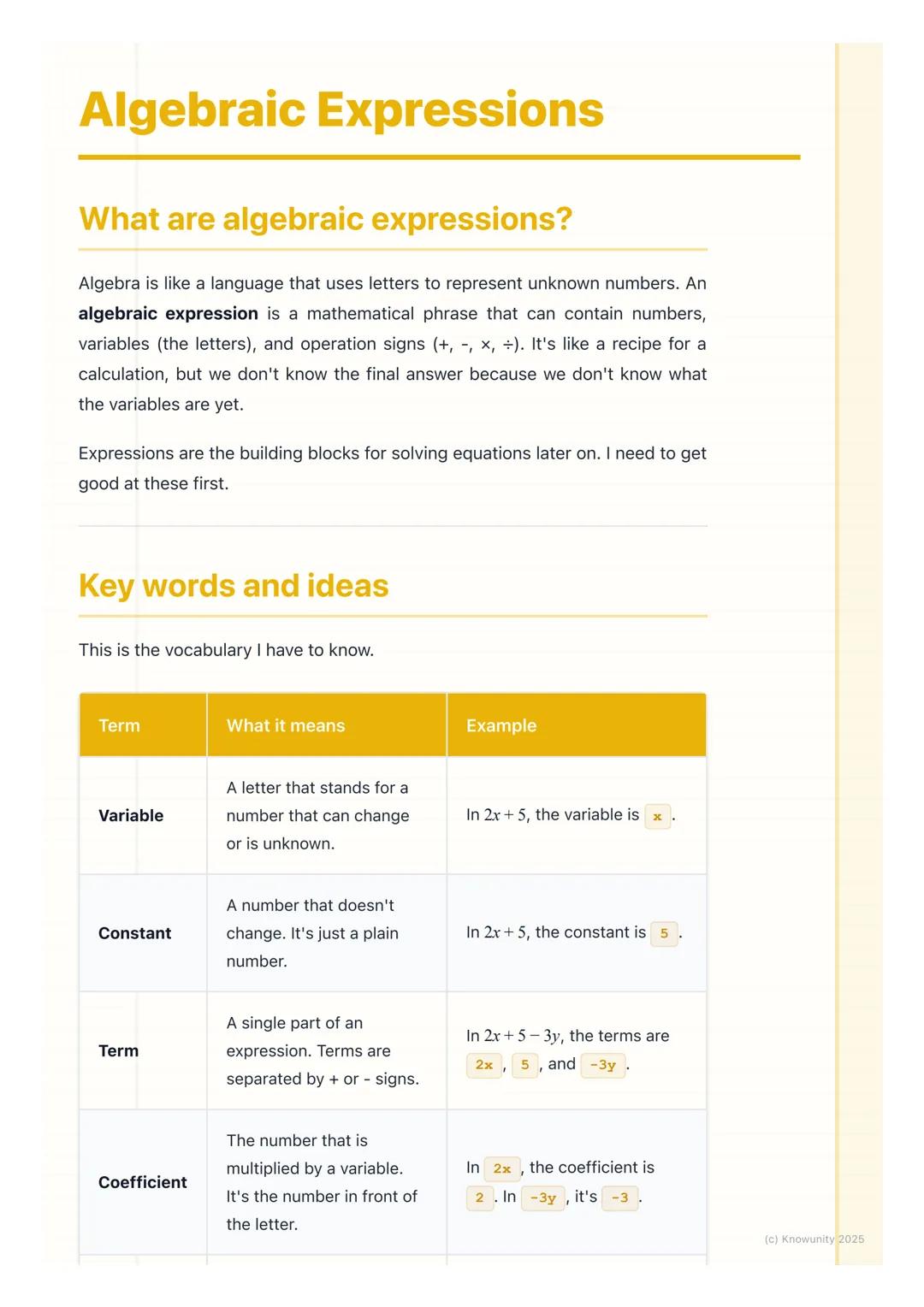
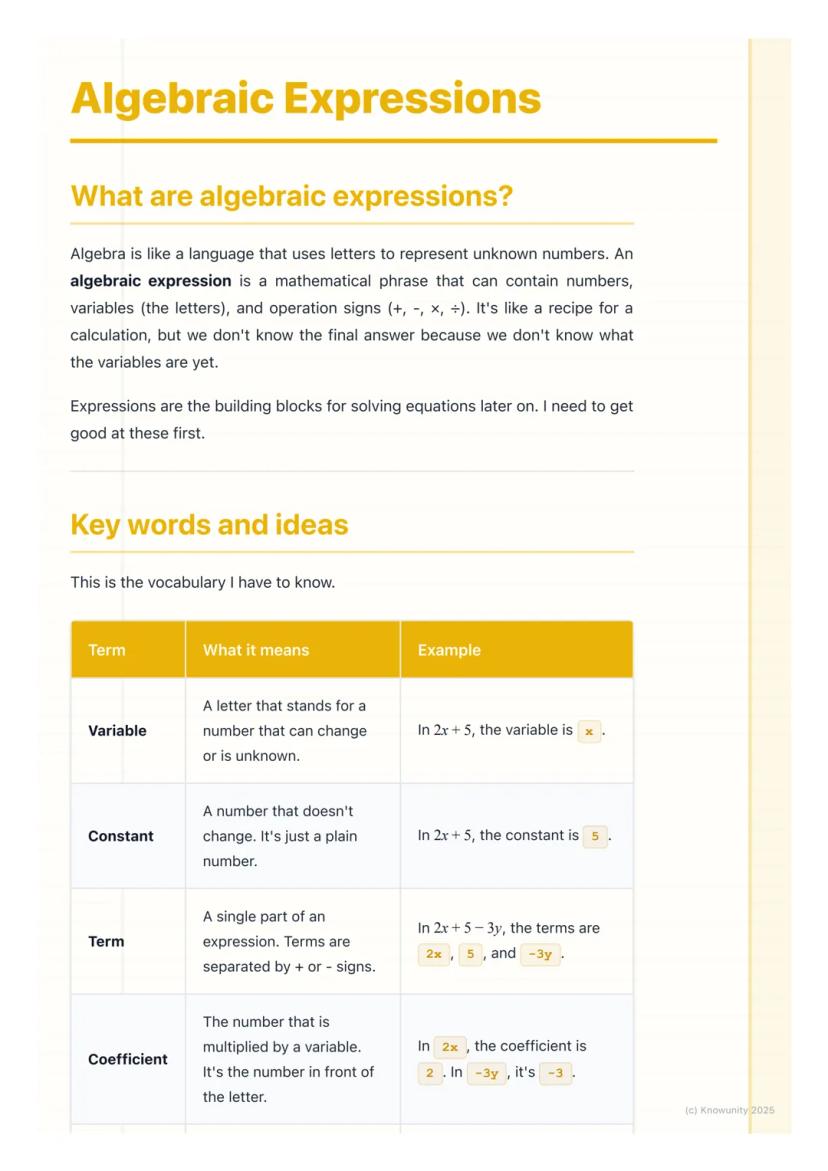
What are Algebraic Expressions?
Think of algebraic expressions as mathematical phrases that mix numbers, letters, and operation signs (+, -, ×, ÷). Unlike equations, expressions don't have an equals sign - they're just a collection of mathematical terms waiting to be worked with.
The letters in expressions are called variables, and they represent unknown numbers. A term is each separate part of an expression, like 4x, -5y, or just 8 on its own.
Like terms are terms that have exactly the same variable part, including any powers. For example, 3x and -5x are like terms because they both have just 'x'. However, 3x and 3x² are NOT like terms because one has x and the other has x².
Remember: Expressions are the foundation for solving equations later, so getting comfortable with these basics now will make your life much easier!
2
of 5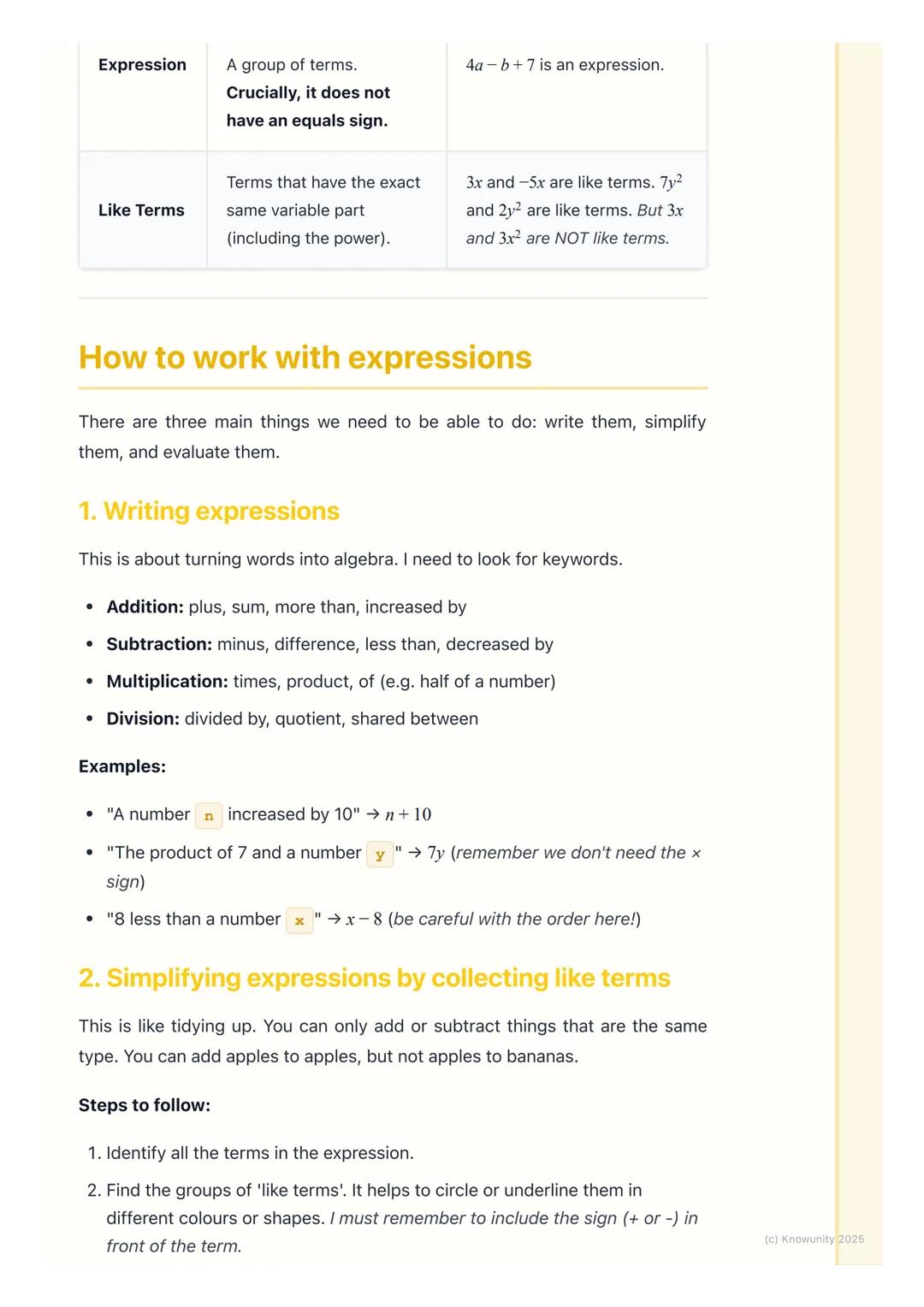
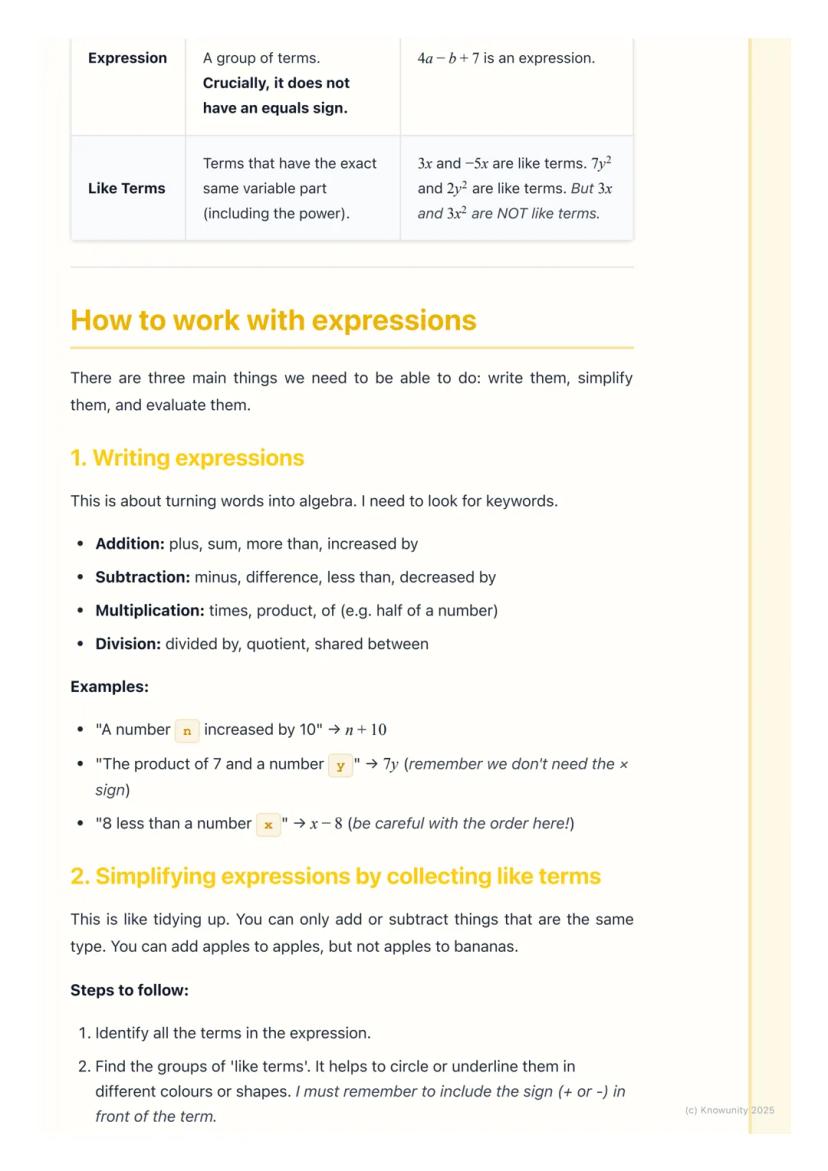
Writing Expressions from Words
Converting word problems into algebraic expressions is all about spotting the right keywords. Once you know what to look for, it becomes like translating from English to maths.
Addition keywords: plus, sum, more than, increased by
Subtraction keywords: minus, difference, less than, decreased by
Multiplication keywords: times, product, of (like "half of a number")
Division keywords: divided by, quotient, shared between
Watch out for tricky phrases like "8 less than a number x" - this becomes x - 8, not 8 - x. The order matters! "A number n increased by 10" simply becomes n + 10, while "the product of 7 and a number y" becomes 7y (no multiplication sign needed).
Top tip: Always double-check the order, especially with subtraction. "Less than" flips the order around!
3
of 5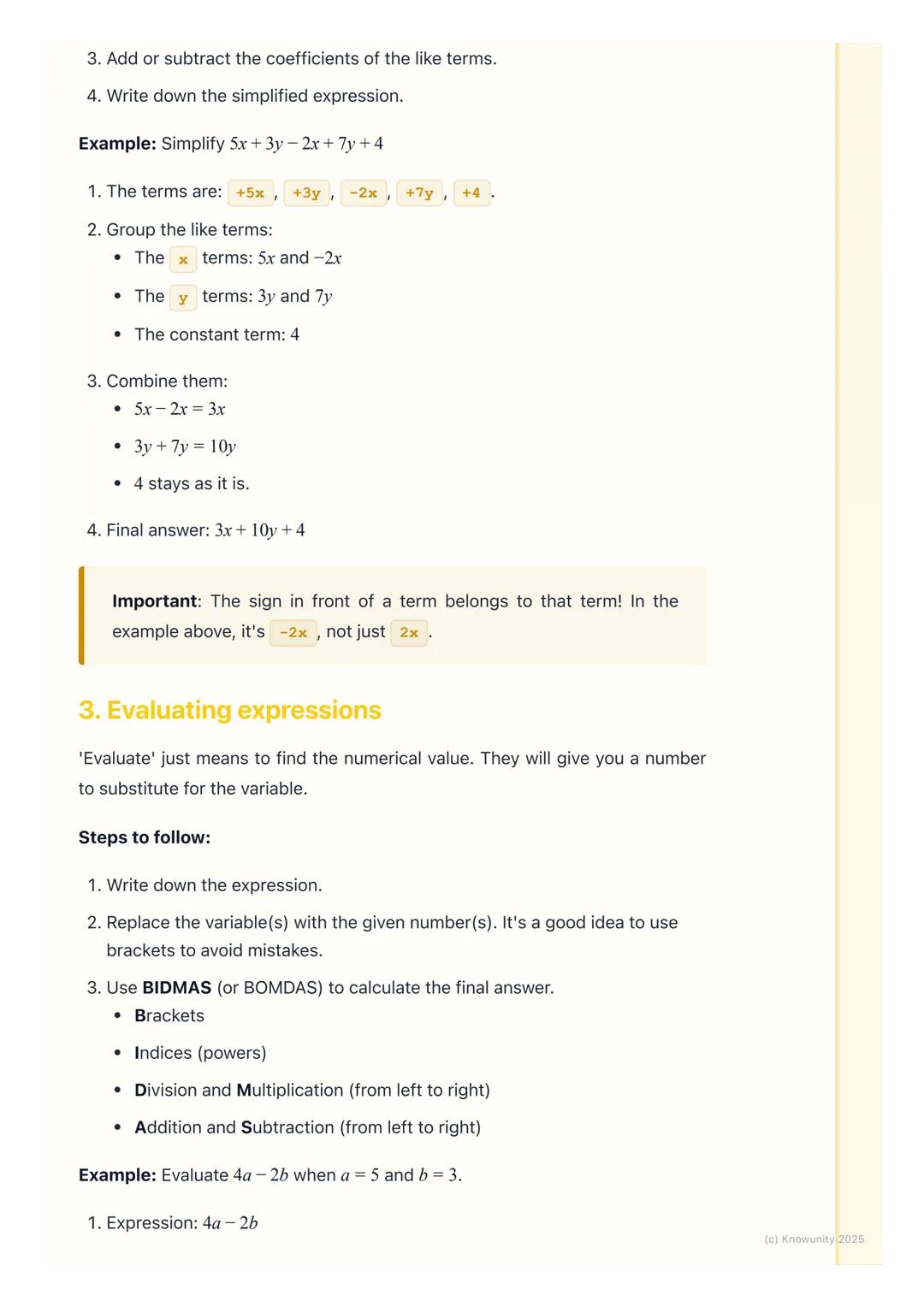
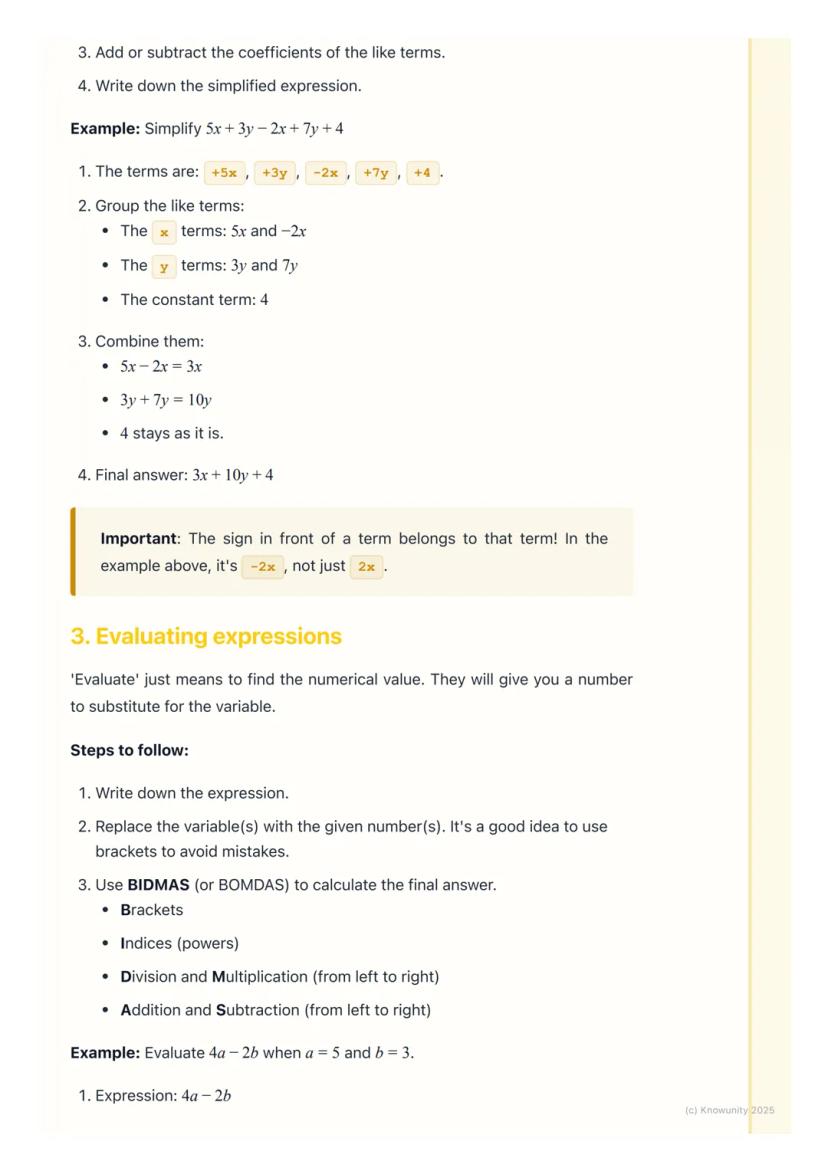
Simplifying by Collecting Like Terms
Simplifying expressions is like tidying your room - you group similar things together. You can only combine terms that are exactly the same type, just like you can add apples to apples but not apples to oranges.
Here's your step-by-step process: First, identify all the terms in the expression. Next, find groups of like terms - it helps to circle them in different colours. Remember to include the + or - sign with each term!
Then add or subtract the coefficients (the numbers in front) of like terms. Finally, write your simplified expression.
Let's try: 5x + 3y - 2x + 7y + 4. Group the x terms , the y terms (3y and 7y), and the constant (4). Combine: 5x - 2x = 3x, 3y + 7y = 10y, and 4 stays as is. Your answer: 3x + 10y + 4.
Watch out: The sign in front of a term belongs to that term! So -2x means negative 2x, not positive 2x that you subtract later.
4
of 5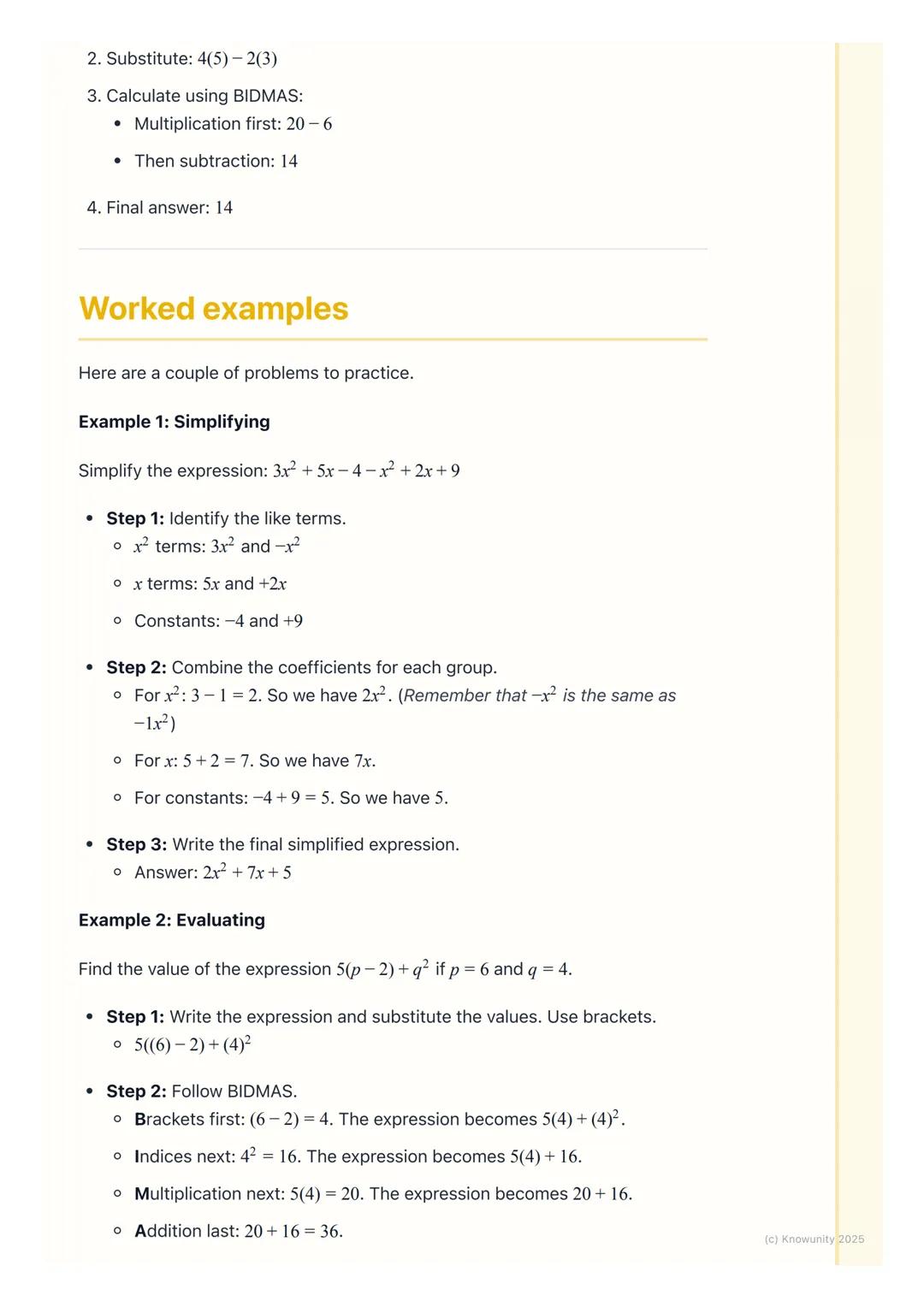
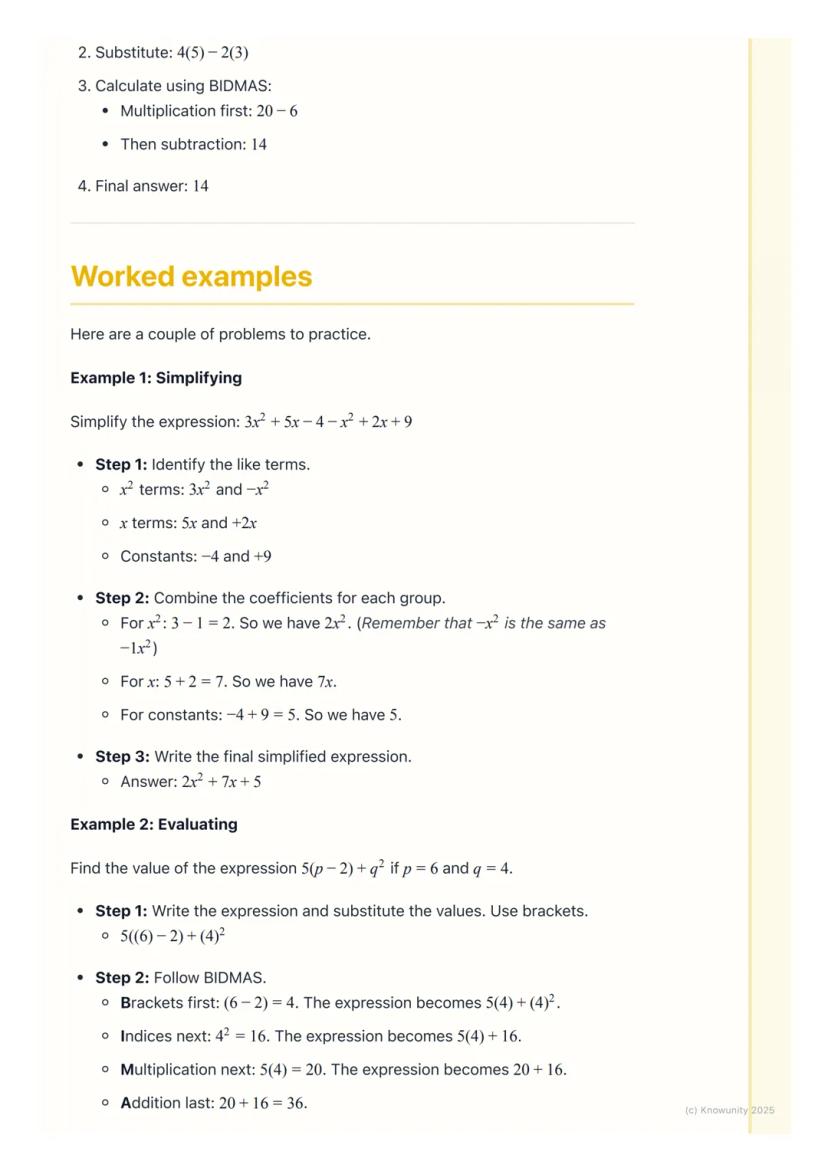
Evaluating Expressions
Evaluating expressions means finding the actual number value when you're given specific values for the variables. It's like following a recipe when you finally know all the ingredients.
Your method is simple: write the expression, replace each variable with its given number (use brackets to avoid mistakes!), then use BIDMAS to calculate your final answer.
BIDMAS stands for: Brackets, Indices (powers), Division and Multiplication (left to right), Addition and Subtraction (left to right).
Example: Evaluate 4a - 2b when a = 5 and b = 3. Substitute: 4(5) - 2(3). Calculate: 20 - 6 = 14.
Pro tip: Always use brackets when substituting, especially with negative numbers. If x = -3, then x² = (-3)² = 9, not -3² = -9!
5
of 5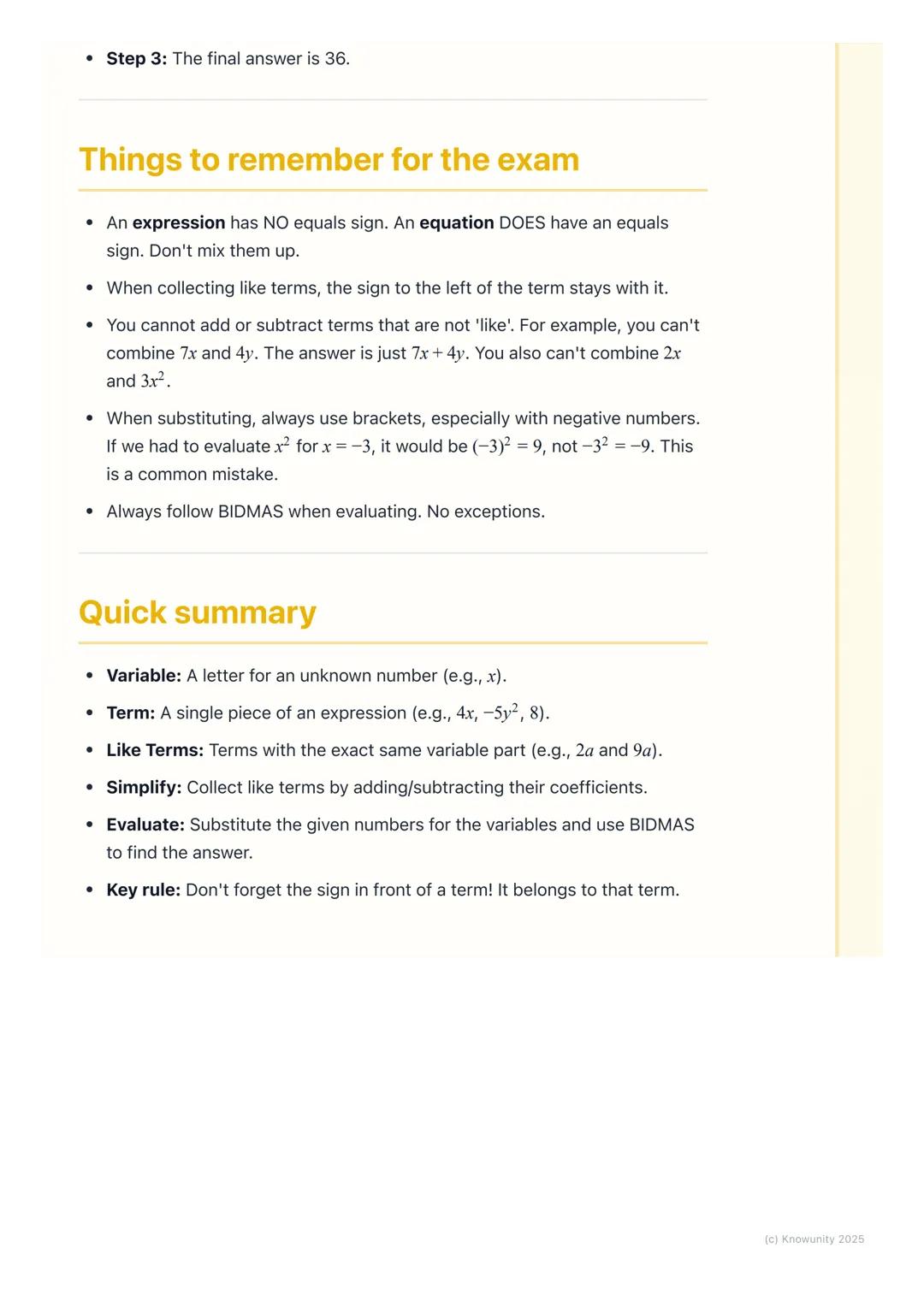
Key Points for Success
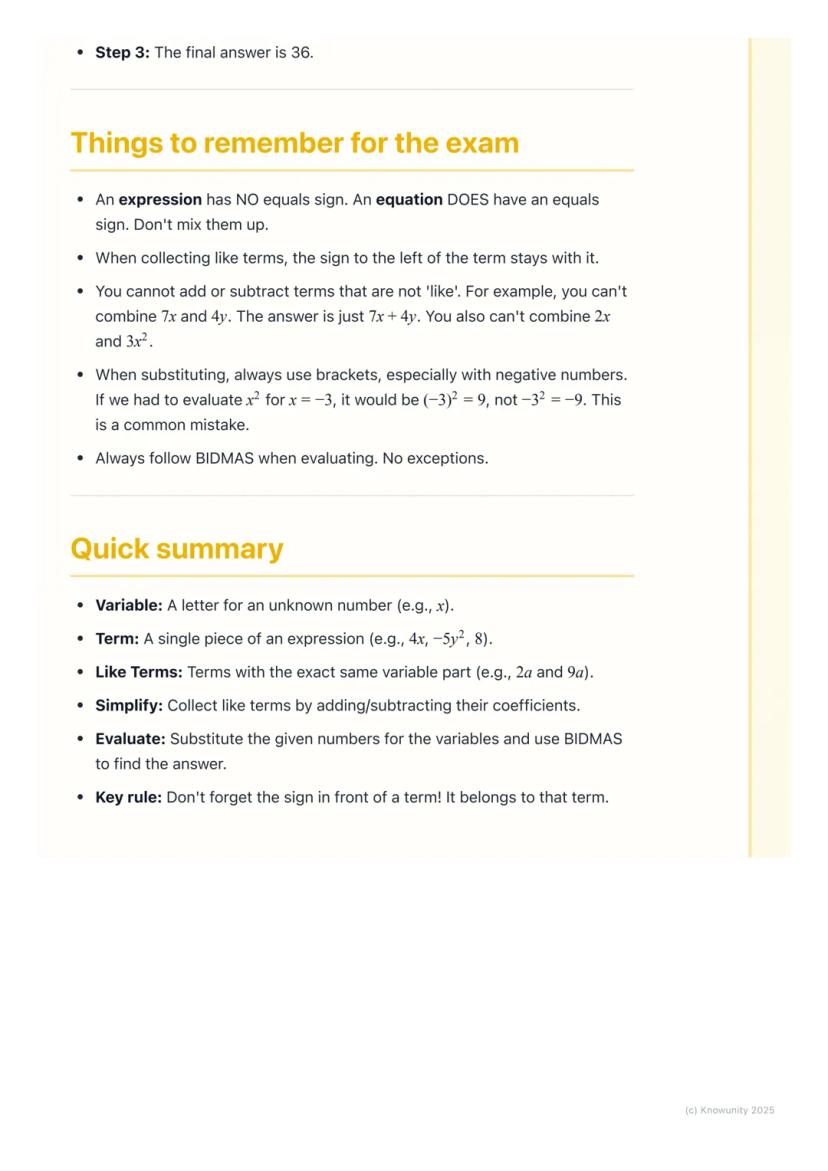
The most important thing to remember is that expressions have no equals sign, while equations do. Don't mix them up in exams!
When collecting like terms, that + or - sign stays with its term. You can't combine terms that aren't alike - 7x and 4y stay as 7x + 4y, and 2x and 3x² can't be combined either.
Always use brackets when substituting values, and never skip BIDMAS when evaluating. These simple rules will save you from most common mistakes.
Quick recap: Variables are letters for unknown numbers, terms are the separate parts of expressions, like terms have identical variable parts, simplifying means collecting like terms, and evaluating means substituting numbers and calculating.
Exam success: Master these basics now, and algebraic expressions will become your mathematical superpower for tackling more complex problems later!
Mysleli jsme, že se nikdy nezeptáš...
Co je AI společník Knowunity?
Náš AI společník je speciálně vytvořen pro potřeby studentů. Na základě milionů obsahových materiálů, které máme na platformě, můžeme studentům poskytovat opravdu smysluplné a relevantní odpovědi. Ale nejde jen o odpovědi, společník je ještě více o provázení studentů jejich každodenními výzvami v učení, s personalizovanými studijními plány, kvízy nebo obsahovými materiály v chatu a 100% personalizací na základě dovedností a vývoje studentů.
Kde si můžu stáhnout aplikaci Knowunity?
Aplikaci si můžete stáhnout z obchodu Google Play a Apple App Store.
Jak můžu dostat svou platbu? Kolik si můžu vydělat?
Ano, máte bezplatný přístup k obsahu v aplikaci a k našemu společníkovi s umělou inteligencí. Chcete-li odemknout určité funkce aplikace, můžete si zakoupit aplikaci Knowunity Pro.
Nejpopulárnější poznámky z Mathematics
8MathematicsAlgebra
Algebra
5th Year91
MathematicsAlgebra 2
Algebra notes focusing on the factor theorem, completing the square, -b formula, graphs of polynomials
5th Year130
MathematicsSolving Equations
This section focuses on solving one-step and two-step linear equations to find the value of an unknown variable.
1st Year131
MathematicsArithmetic sequences and series
With examples
5th Year130
MathematicsIntroduction to Probability
This topic introduces basic probability concepts, including calculating the probability of simple events and understanding the difference between experimental and theoretical probability.
2nd Year91
MathematicsMaths jc algebra
Maths jc
1st Year230
MathematicsNatural Numbers and Integers
Students will learn about positive whole numbers, zero, and negative whole numbers, and how to add, subtract, multiply, and divide them correctly.
1st Year131
MathematicsDifferential Calculus
Calculus is a topic that comes up nearly everywhere on your maths LC. This is just starter notes that could be useful end of 5th year or start of 6th year
5th Year271
Nejpopulárnější poznámky
9 Irish
IrishIrish oral questions and answers
Questions and answers for the leaving cert oral
5th Year4264
 English
Key Quotes : Sive
Key Quotes and explanations: Sive
6th Year2842
IrishIrish oral questions
Outline of oral questions
5th Year2055
IrishIníon- le hÁine Durkin
Aine Durkin’s poem, Iníon: Themes & summary
5th Year850
IrishIrish poetry 2027
Iníon + Dínit an Bhróin
5th Year1133
IrishLC HL notes- Iníon (poem)
Includes poem in English and Irish, theme, key words & phrases
5th Year2284
EnglishCultural Context : Shawshank Redemption : Sive : Small Things Like These
Comparative Study : Cultural Context : Shawshank Redemption, Sive and Small Things Like These
6th Year1430
IrishMo Ghrá-sa (Idir Lúibíní)
Notes on mo ghrá-sa
5th Year380
IrishAn Gaeilge Aiste
Irish Language essay
6th Year1320
Nemůžeš najít, co hledáš? Prozkoumej další předměty.
Recenze od našich uživatelů. Mají vše super — a ty taky můžeš.
4.6/5App Store
4.7/5Google Play
Aplikace je velmi jednoduchá na používání a dobře navržená. Zatím jsem našel vše, co jsem hledal, a mohl jsem se z prezentací hodně naučit! Určitě použiju aplikaci na školní úkol! A samozřejmě taky hodně pomáhá jako inspirace.
Stefan Suživatel iOS
Tahle aplikace je fakt skvělá. Je tam tolik studijních poznámek a pomůcek [...]. Můj problémový předmět je například francouzština a aplikace nabízí tolik možností pomoci. Díky této aplikaci jsem si zlepšil francouzštinu. Doporučil bych ji každému.
Samantha Klichuživatelka Androidu
Páni, jsem opravdu ohromen. Zkusil jsem aplikaci jen proto, že jsem ji mnohokrát viděl v reklamách, a byl jsem naprosto ohromen. Tato aplikace je TA POMOC, kterou chceš do školy, a především nabízí spoustu věcí, jako jsou cvičení a přehledy faktů, které mi osobně VELMI pomohly.
Annauživatelka iOS
Mathematics13 zobrazení·Aktualizováno Jun 8, 2026·5 stránekUnderstanding and Simplifying Algebraic Expressions
Ever wondered why we use letters in maths? Algebraic expressions are like mathematical recipes that use letters (called variables) to represent unknown numbers. They're the building blocks you'll need to master before tackling equations, and once you get the hang... Zobrazit více
1
of 5Registruj se, abys viděl obsah. Je to zdarma!
- Přístup ke všem dokumentům
- Zlepši své známky
- Připoj se k milionům studentů
What are Algebraic Expressions?
Think of algebraic expressions as mathematical phrases that mix numbers, letters, and operation signs (+, -, ×, ÷). Unlike equations, expressions don't have an equals sign - they're just a collection of mathematical terms waiting to be worked with.
The letters in expressions are called variables, and they represent unknown numbers. A term is each separate part of an expression, like 4x, -5y, or just 8 on its own.
Like terms are terms that have exactly the same variable part, including any powers. For example, 3x and -5x are like terms because they both have just 'x'. However, 3x and 3x² are NOT like terms because one has x and the other has x².
Remember: Expressions are the foundation for solving equations later, so getting comfortable with these basics now will make your life much easier!
2
of 5Registruj se, abys viděl obsah. Je to zdarma!
- Přístup ke všem dokumentům
- Zlepši své známky
- Připoj se k milionům studentů
Writing Expressions from Words
Converting word problems into algebraic expressions is all about spotting the right keywords. Once you know what to look for, it becomes like translating from English to maths.
Addition keywords: plus, sum, more than, increased by
Subtraction keywords: minus, difference, less than, decreased by
Multiplication keywords: times, product, of (like "half of a number")
Division keywords: divided by, quotient, shared between
Watch out for tricky phrases like "8 less than a number x" - this becomes x - 8, not 8 - x. The order matters! "A number n increased by 10" simply becomes n + 10, while "the product of 7 and a number y" becomes 7y (no multiplication sign needed).
Top tip: Always double-check the order, especially with subtraction. "Less than" flips the order around!
3
of 5Registruj se, abys viděl obsah. Je to zdarma!
- Přístup ke všem dokumentům
- Zlepši své známky
- Připoj se k milionům studentů
Simplifying by Collecting Like Terms
Simplifying expressions is like tidying your room - you group similar things together. You can only combine terms that are exactly the same type, just like you can add apples to apples but not apples to oranges.
Here's your step-by-step process: First, identify all the terms in the expression. Next, find groups of like terms - it helps to circle them in different colours. Remember to include the + or - sign with each term!
Then add or subtract the coefficients (the numbers in front) of like terms. Finally, write your simplified expression.
Let's try: 5x + 3y - 2x + 7y + 4. Group the x terms , the y terms (3y and 7y), and the constant (4). Combine: 5x - 2x = 3x, 3y + 7y = 10y, and 4 stays as is. Your answer: 3x + 10y + 4.
Watch out: The sign in front of a term belongs to that term! So -2x means negative 2x, not positive 2x that you subtract later.
4
of 5Registruj se, abys viděl obsah. Je to zdarma!
- Přístup ke všem dokumentům
- Zlepši své známky
- Připoj se k milionům studentů
Evaluating Expressions
Evaluating expressions means finding the actual number value when you're given specific values for the variables. It's like following a recipe when you finally know all the ingredients.
Your method is simple: write the expression, replace each variable with its given number (use brackets to avoid mistakes!), then use BIDMAS to calculate your final answer.
BIDMAS stands for: Brackets, Indices (powers), Division and Multiplication (left to right), Addition and Subtraction (left to right).
Example: Evaluate 4a - 2b when a = 5 and b = 3. Substitute: 4(5) - 2(3). Calculate: 20 - 6 = 14.
Pro tip: Always use brackets when substituting, especially with negative numbers. If x = -3, then x² = (-3)² = 9, not -3² = -9!
5
of 5Registruj se, abys viděl obsah. Je to zdarma!
- Přístup ke všem dokumentům
- Zlepši své známky
- Připoj se k milionům studentů
Key Points for Success
The most important thing to remember is that expressions have no equals sign, while equations do. Don't mix them up in exams!
When collecting like terms, that + or - sign stays with its term. You can't combine terms that aren't alike - 7x and 4y stay as 7x + 4y, and 2x and 3x² can't be combined either.
Always use brackets when substituting values, and never skip BIDMAS when evaluating. These simple rules will save you from most common mistakes.
Quick recap: Variables are letters for unknown numbers, terms are the separate parts of expressions, like terms have identical variable parts, simplifying means collecting like terms, and evaluating means substituting numbers and calculating.
Exam success: Master these basics now, and algebraic expressions will become your mathematical superpower for tackling more complex problems later!
Mysleli jsme, že se nikdy nezeptáš...
Co je AI společník Knowunity?
Náš AI společník je speciálně vytvořen pro potřeby studentů. Na základě milionů obsahových materiálů, které máme na platformě, můžeme studentům poskytovat opravdu smysluplné a relevantní odpovědi. Ale nejde jen o odpovědi, společník je ještě více o provázení studentů jejich každodenními výzvami v učení, s personalizovanými studijními plány, kvízy nebo obsahovými materiály v chatu a 100% personalizací na základě dovedností a vývoje studentů.
Kde si můžu stáhnout aplikaci Knowunity?
Aplikaci si můžete stáhnout z obchodu Google Play a Apple App Store.
Jak můžu dostat svou platbu? Kolik si můžu vydělat?
Ano, máte bezplatný přístup k obsahu v aplikaci a k našemu společníkovi s umělou inteligencí. Chcete-li odemknout určité funkce aplikace, můžete si zakoupit aplikaci Knowunity Pro.
Nejpopulárnější poznámky z Mathematics
8MathematicsAlgebra
Algebra
5th Year91
MathematicsAlgebra 2
Algebra notes focusing on the factor theorem, completing the square, -b formula, graphs of polynomials
5th Year130
MathematicsSolving Equations
This section focuses on solving one-step and two-step linear equations to find the value of an unknown variable.
1st Year131
MathematicsArithmetic sequences and series
With examples
5th Year130
MathematicsIntroduction to Probability
This topic introduces basic probability concepts, including calculating the probability of simple events and understanding the difference between experimental and theoretical probability.
2nd Year91
MathematicsMaths jc algebra
Maths jc
1st Year230
MathematicsNatural Numbers and Integers
Students will learn about positive whole numbers, zero, and negative whole numbers, and how to add, subtract, multiply, and divide them correctly.
1st Year131
MathematicsDifferential Calculus
Calculus is a topic that comes up nearly everywhere on your maths LC. This is just starter notes that could be useful end of 5th year or start of 6th year
5th Year271
Nejpopulárnější poznámky
9IrishIrish oral questions and answers
Questions and answers for the leaving cert oral
5th Year4264
EnglishKey Quotes : Sive
Key Quotes and explanations: Sive
6th Year2842
IrishIrish oral questions
Outline of oral questions
5th Year2055
IrishIníon- le hÁine Durkin
Aine Durkin’s poem, Iníon: Themes & summary
5th Year850
IrishIrish poetry 2027
Iníon + Dínit an Bhróin
5th Year1133
IrishLC HL notes- Iníon (poem)
Includes poem in English and Irish, theme, key words & phrases
5th Year2284
EnglishCultural Context : Shawshank Redemption : Sive : Small Things Like These
Comparative Study : Cultural Context : Shawshank Redemption, Sive and Small Things Like These
6th Year1430
IrishMo Ghrá-sa (Idir Lúibíní)
Notes on mo ghrá-sa
5th Year380
IrishAn Gaeilge Aiste
Irish Language essay
6th Year1320
Nemůžeš najít, co hledáš? Prozkoumej další předměty.
Recenze od našich uživatelů. Mají vše super — a ty taky můžeš.
4.6/5App Store
4.7/5Google Play
Aplikace je velmi jednoduchá na používání a dobře navržená. Zatím jsem našel vše, co jsem hledal, a mohl jsem se z prezentací hodně naučit! Určitě použiju aplikaci na školní úkol! A samozřejmě taky hodně pomáhá jako inspirace.
Stefan Suživatel iOS
Tahle aplikace je fakt skvělá. Je tam tolik studijních poznámek a pomůcek [...]. Můj problémový předmět je například francouzština a aplikace nabízí tolik možností pomoci. Díky této aplikaci jsem si zlepšil francouzštinu. Doporučil bych ji každému.
Samantha Klichuživatelka Androidu
Páni, jsem opravdu ohromen. Zkusil jsem aplikaci jen proto, že jsem ji mnohokrát viděl v reklamách, a byl jsem naprosto ohromen. Tato aplikace je TA POMOC, kterou chceš do školy, a především nabízí spoustu věcí, jako jsou cvičení a přehledy faktů, které mi osobně VELMI pomohly.
Annauživatelka iOS