
Understanding how your body moves during sport is absolutely crucial...
 LCPE3 zobrazení·Aktualizováno Jun 16, 2026·7 stránek
The Skeletal and Muscular Systems Explained
1 / 7
1
of 7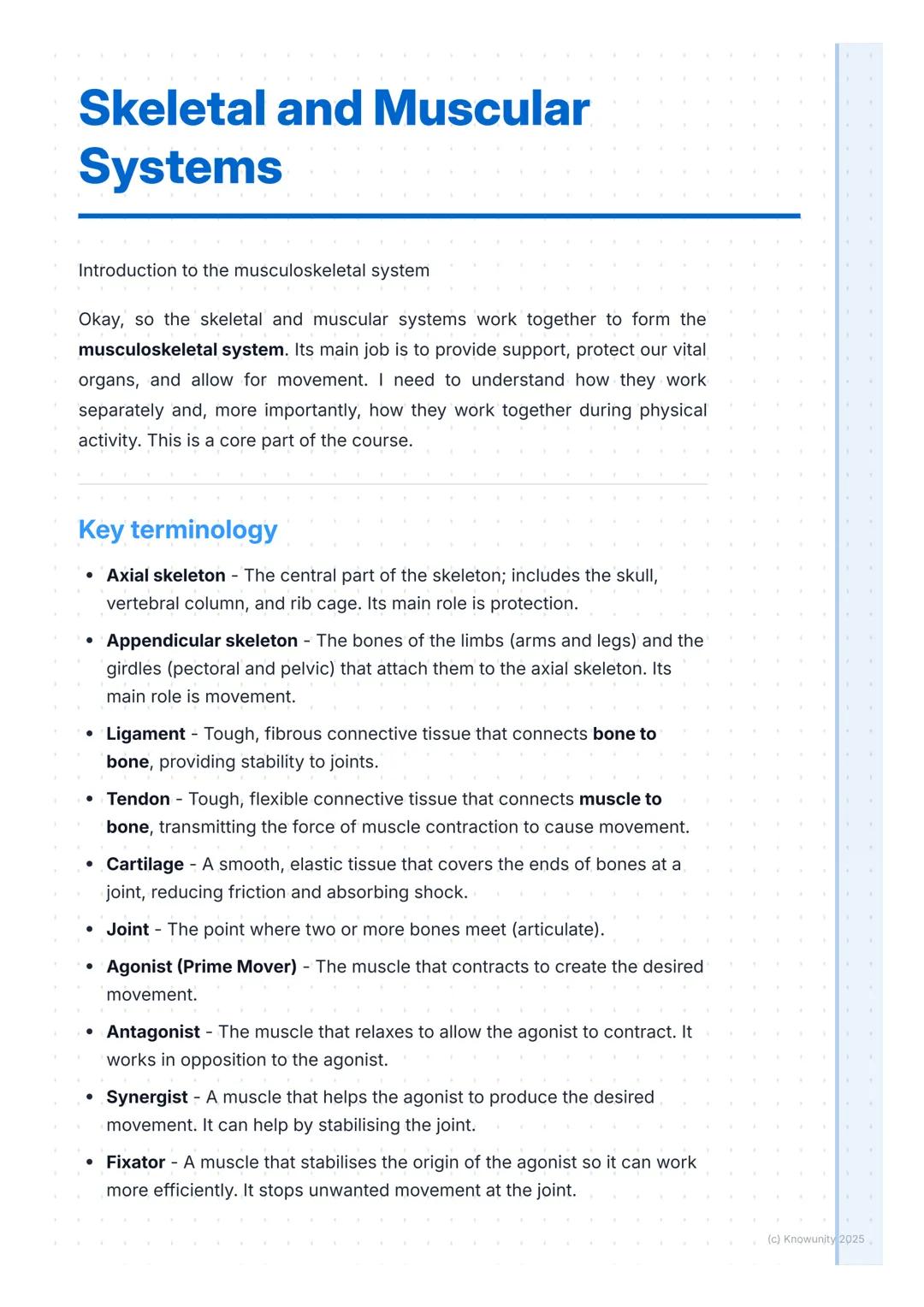
Foundation Knowledge and Key Terms
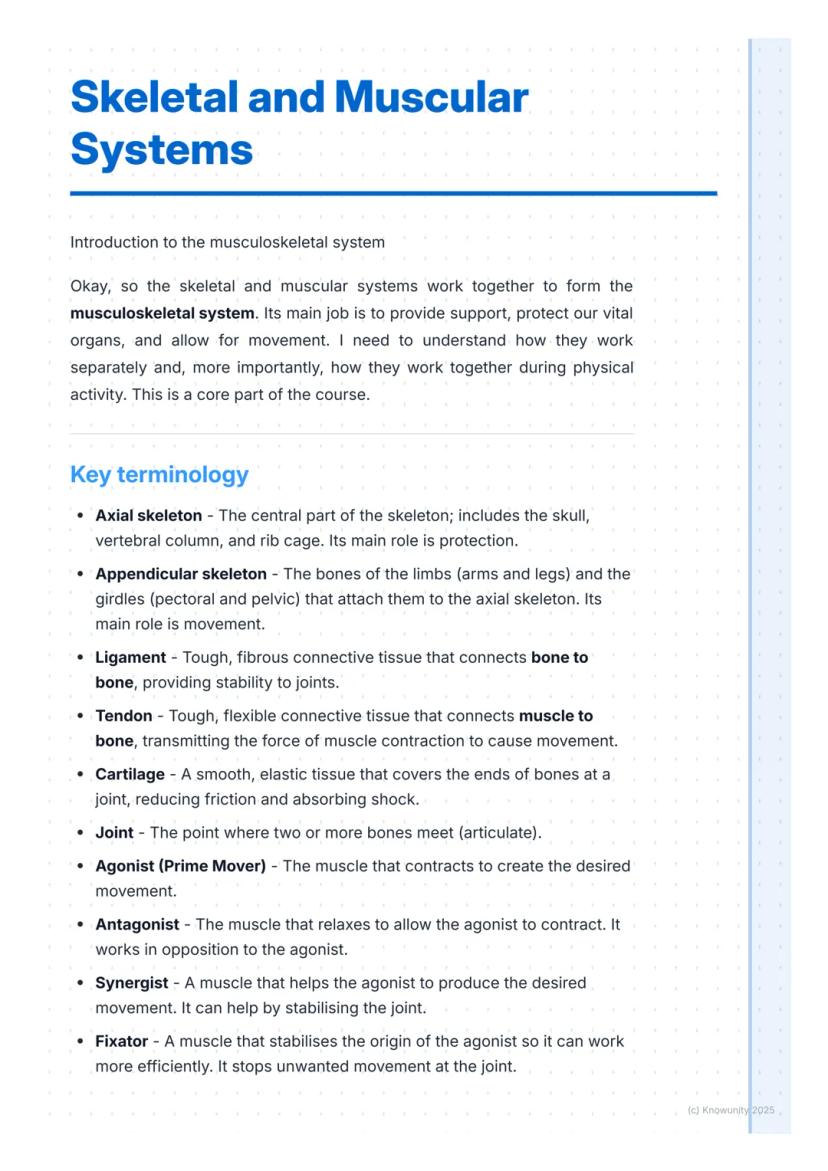
Think about every sporting movement you make - from shooting a basketball to tackling in rugby. Your musculoskeletal system makes it all possible by combining your skeleton (the framework) with your muscles (the power).
The skeleton divides into two main parts. The axial skeleton includes your skull, spine, and rib cage - basically your central protective core. The appendicular skeleton covers your arms, legs, and the bits that connect them to your body - this is your movement centre.
Here's a memory trick that'll save you in exams: Ligaments Link Bone to Bone (LBB), whilst Tendons Tie Muscle to Bone (TMB). Don't mix these up! Cartilage acts like a cushion between bones, reducing friction when you move.
When muscles work together, they have specific roles. The agonist (prime mover) does the main work, whilst the antagonist relaxes to allow movement. Synergists help out, and fixators keep everything stable.
Quick Tip: Understanding muscle roles is guaranteed to come up in your exam - make sure you can identify each one in any sporting action.
2
of 7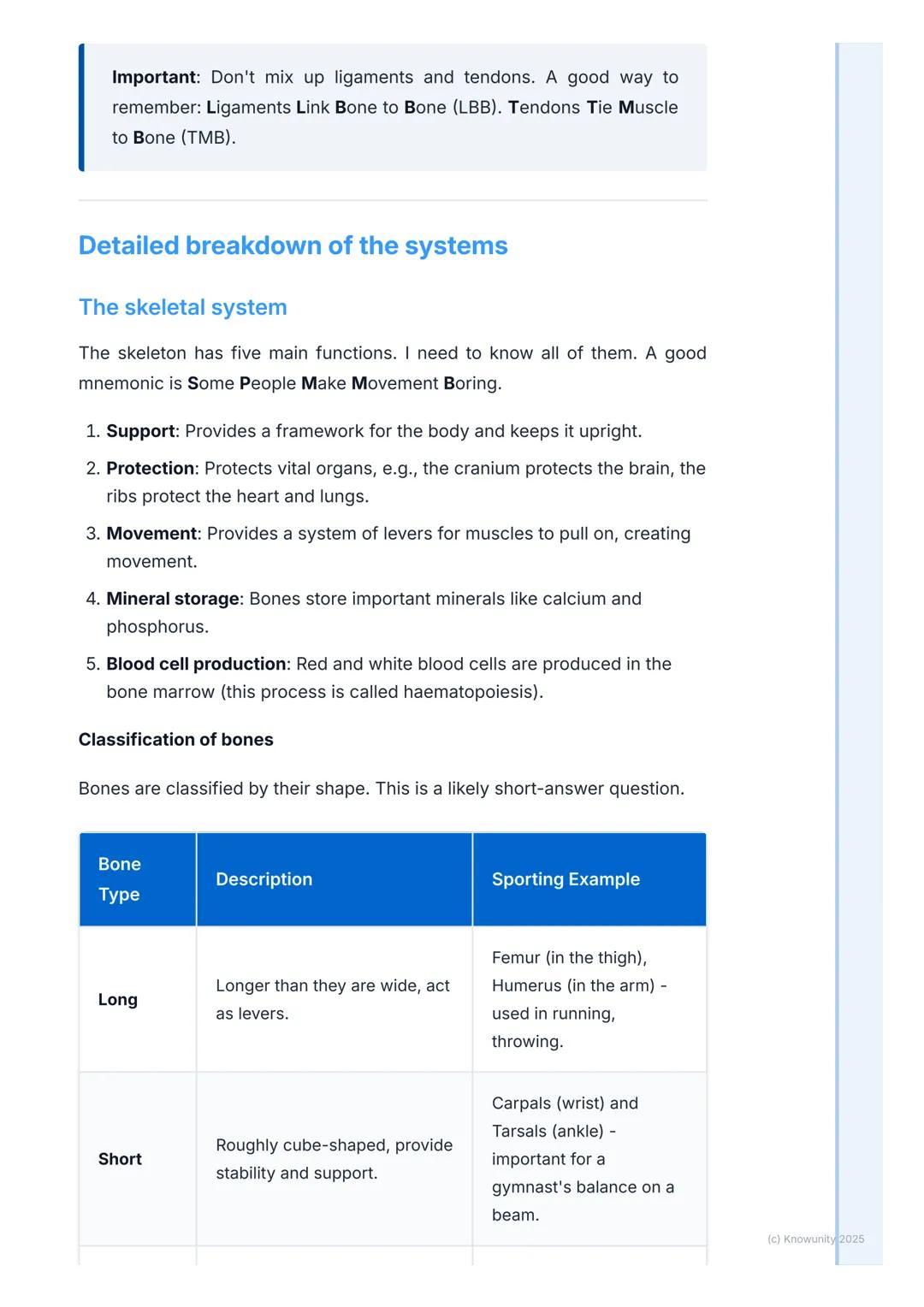
The Skeletal System Structure
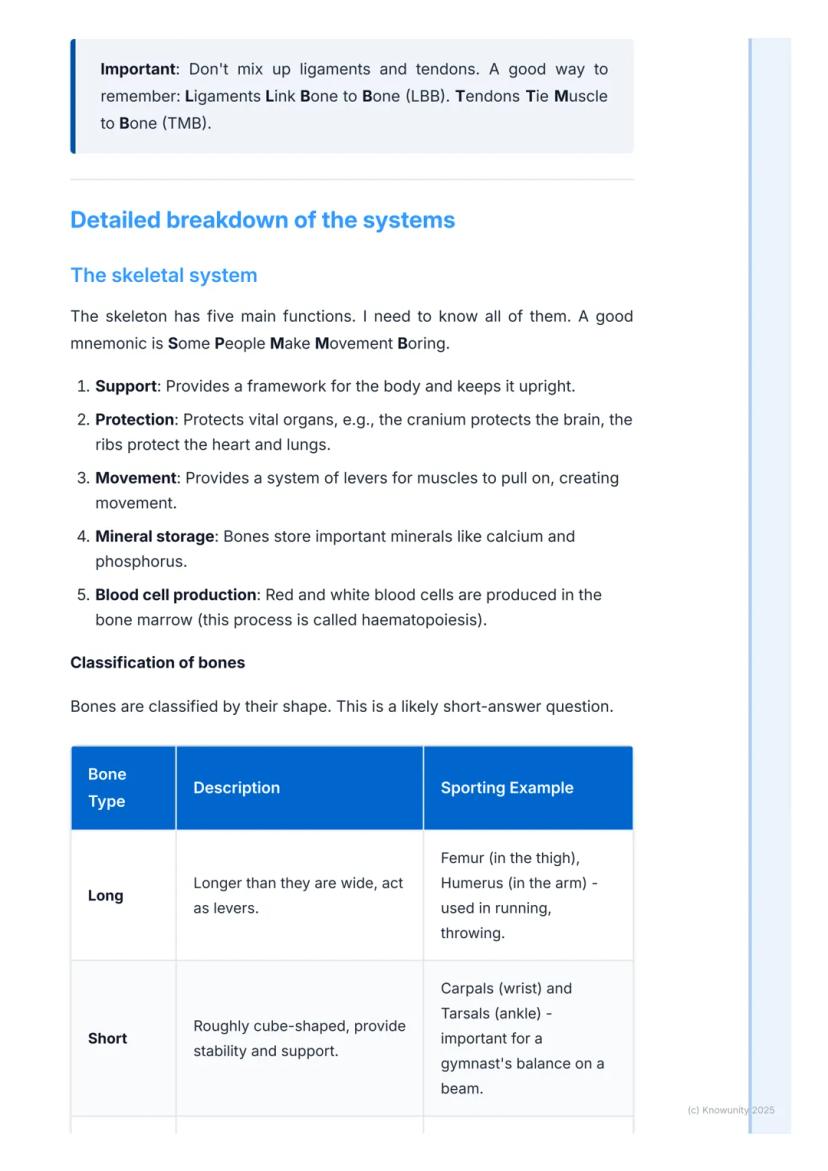
Your skeleton does five essential jobs, and there's a handy memory trick: Some People Make Movement Boring. That's Support (keeps you upright), Protection (guards vital organs), Movement (provides levers for muscles), Mineral storage (calcium and phosphorus), and Blood cell production (happens in bone marrow).
Bone classification is a likely short-answer question, so learn this well. Long bones like your femur and humerus work as levers for major movements. Short bones in your hands and feet provide stability and fine motor control.
Flat bones such as your skull and ribs offer protection and muscle attachment sites. Irregular bones like vertebrae have complex shapes for specific jobs. Sesamoid bones like your kneecap (patella) sit within tendons to improve leverage.
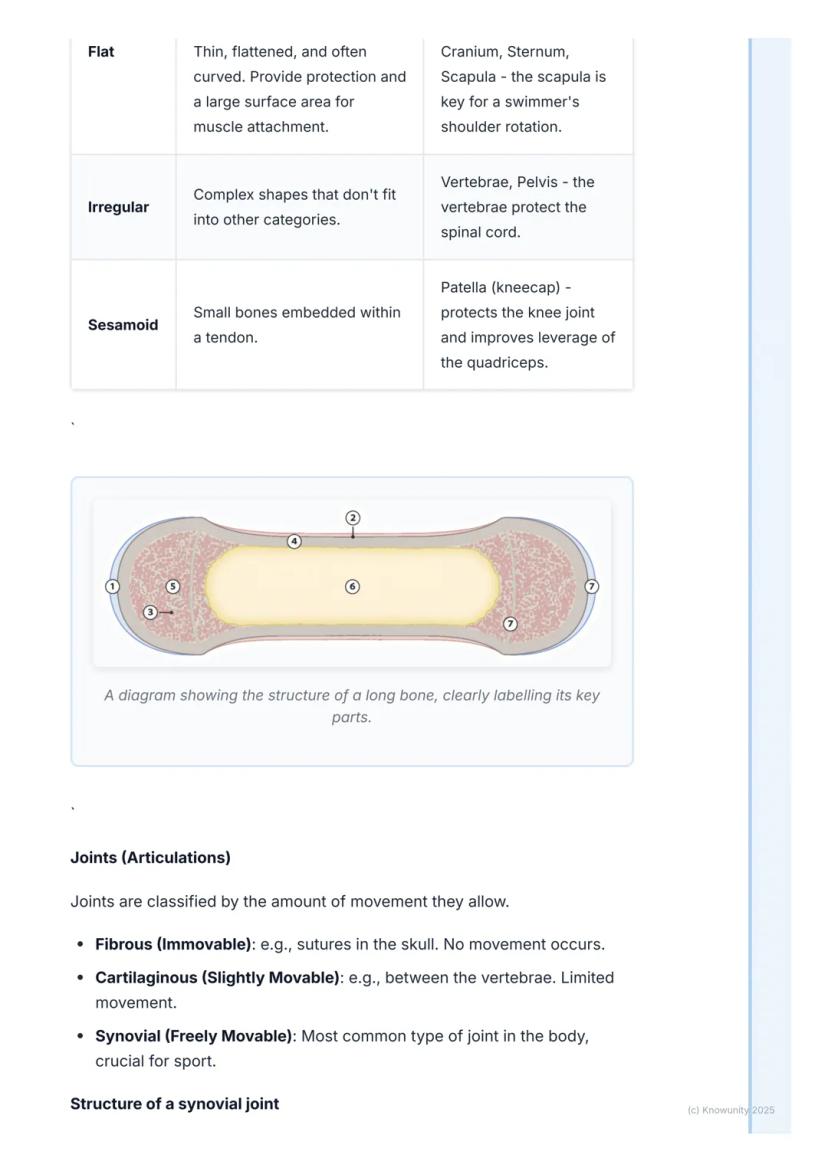
The structure matters too. Long bones have a shaft (diaphysis) and enlarged ends (epiphyses) where growth occurs. This knowledge helps explain why young athletes need to be careful about overtraining during growth periods.
Remember: Bone classification by shape is one of the most predictable exam questions - make sure you know an example of each type.
3
of 7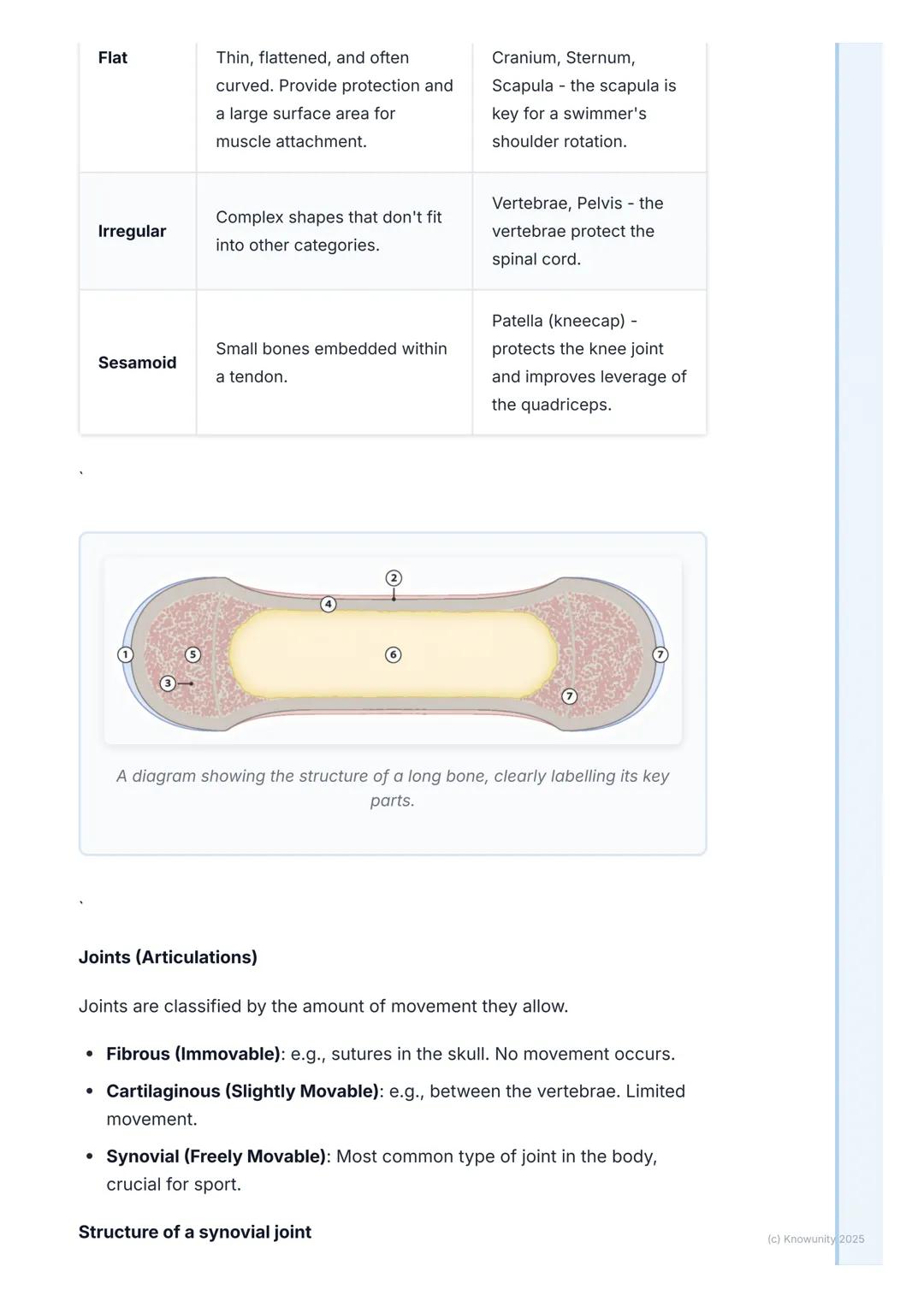
Joint Classification and Movement
Joints determine how much you can move, and they're classified by mobility. Fibrous joints (like skull sutures) don't move at all. Cartilaginous joints (between vertebrae) allow slight movement. But synovial joints are your sporting superstars - they're freely movable.
Synovial joint structure is crucial knowledge. Articular cartilage covers bone ends to reduce friction. The joint capsule wraps around everything, whilst the synovial membrane produces synovial fluid for lubrication. Ligaments provide stability and prevent excessive movement.
You need to know six types of synovial joints. Ball and socket joints (shoulder, hip) allow movement in all directions. Hinge joints (elbow, knee) work like a door - flexion and extension only. Pivot joints (neck) rotate, whilst condyloid joints (wrist) move in most directions except rotation.
Saddle joints (thumb) allow complex movements for gripping, and gliding joints (between small bones) permit sliding movements. Each joint type determines what sporting actions are possible.
Exam Focus: Be ready to identify joint types, give examples, and explain what movements they allow - this comes up every year.
4
of 7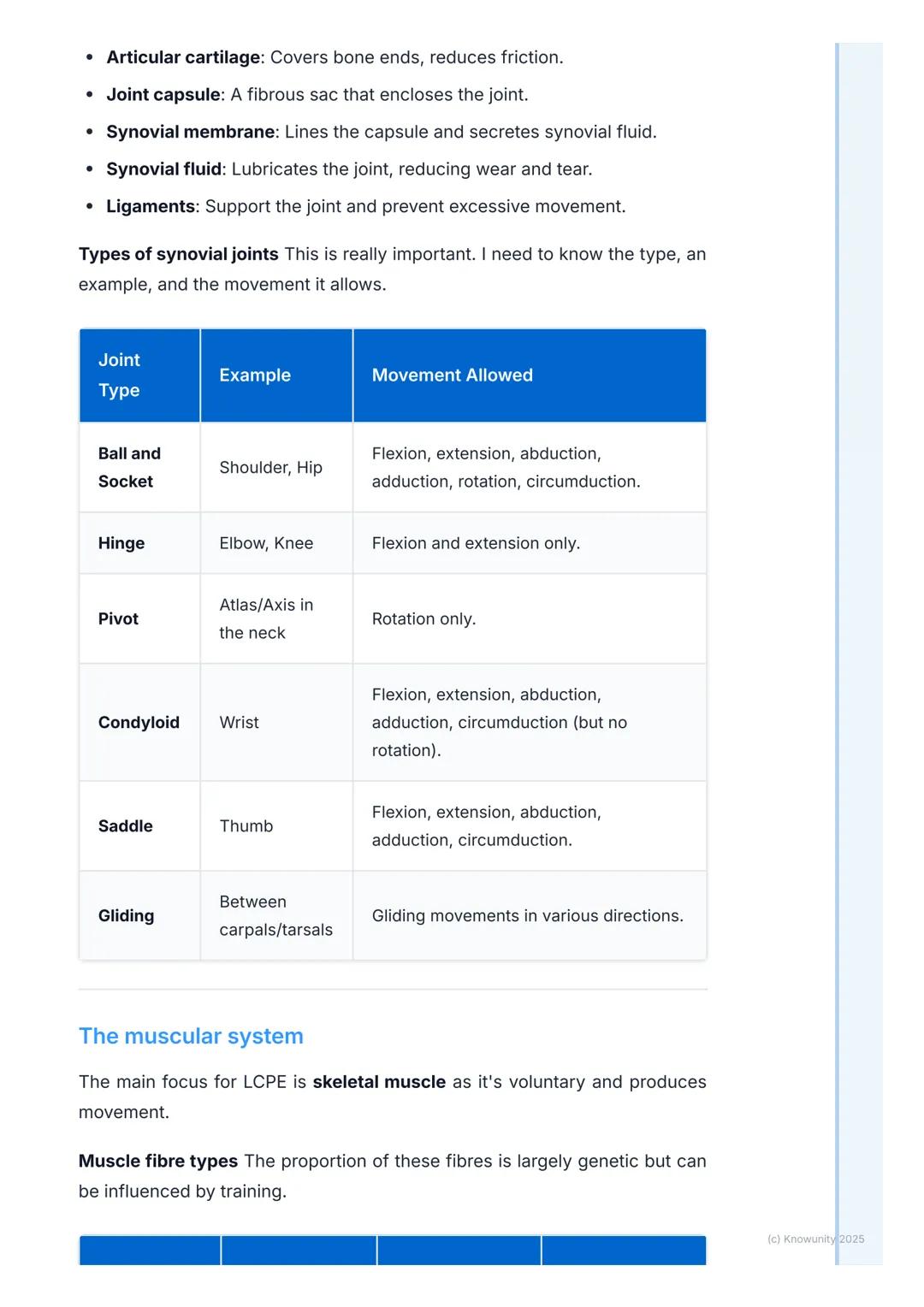
Muscle Fibre Types and Contractions
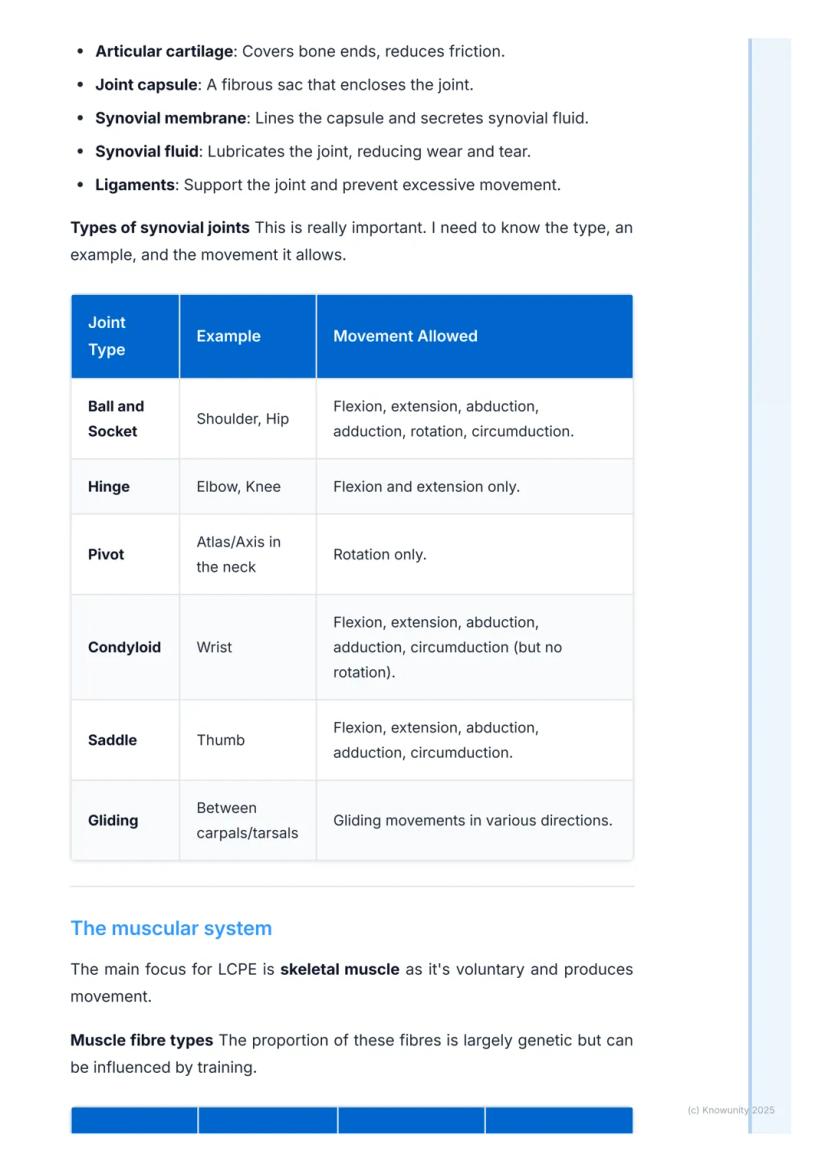
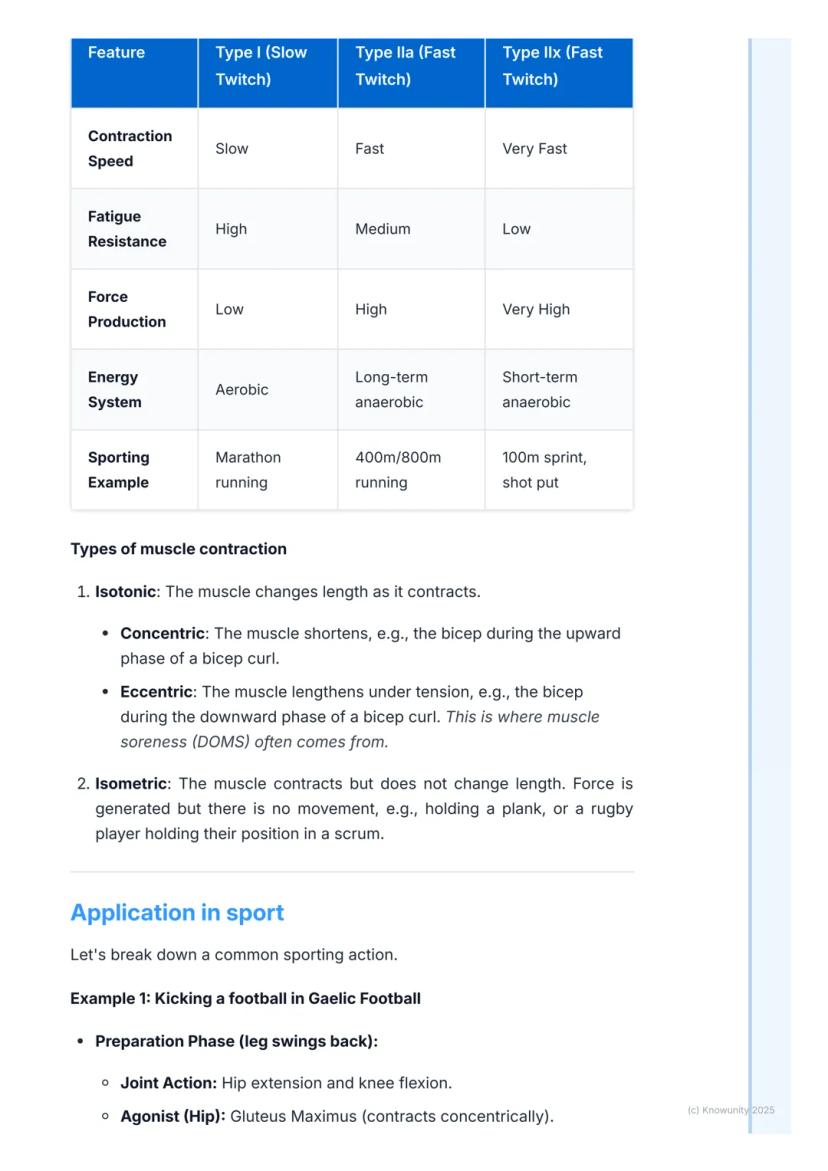
Your muscles contain different fibre types that determine your sporting strengths. Type I (slow twitch) fibres resist fatigue brilliantly - perfect for marathon running or long football matches. Type IIa (fast twitch) fibres are the all-rounders, great for 400m or 800m running. Type IIx (fast twitch) fibres produce explosive power for sprinting or shot putting.
The proportion of these fibres is largely genetic, but training can influence them. Endurance training improves Type I efficiency, whilst power training develops Type II capabilities.
Muscle contractions work in three ways. Isotonic contractions involve length changes - concentric means shortening (bicep curl up), eccentric means lengthening under tension (bicep curl down). This eccentric phase often causes muscle soreness (DOMS).
Isometric contractions generate force without movement - think holding a plank or maintaining position in a rugby scrum. These are crucial for stability and strength development.
Training Tip: Understanding fibre types explains why some athletes excel at different events - it's not just training, it's biology too.
5
of 7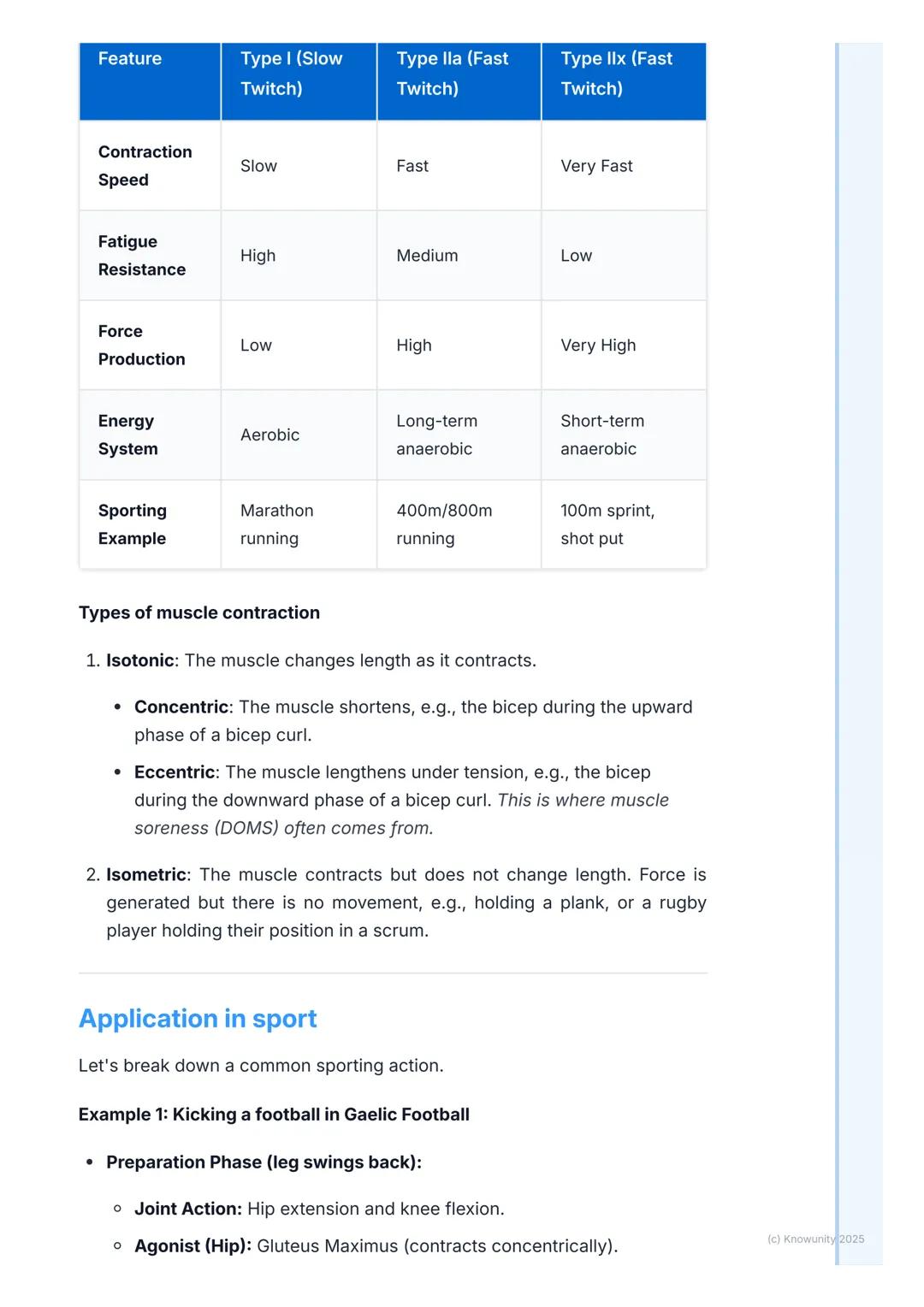
Muscle Action in Sport
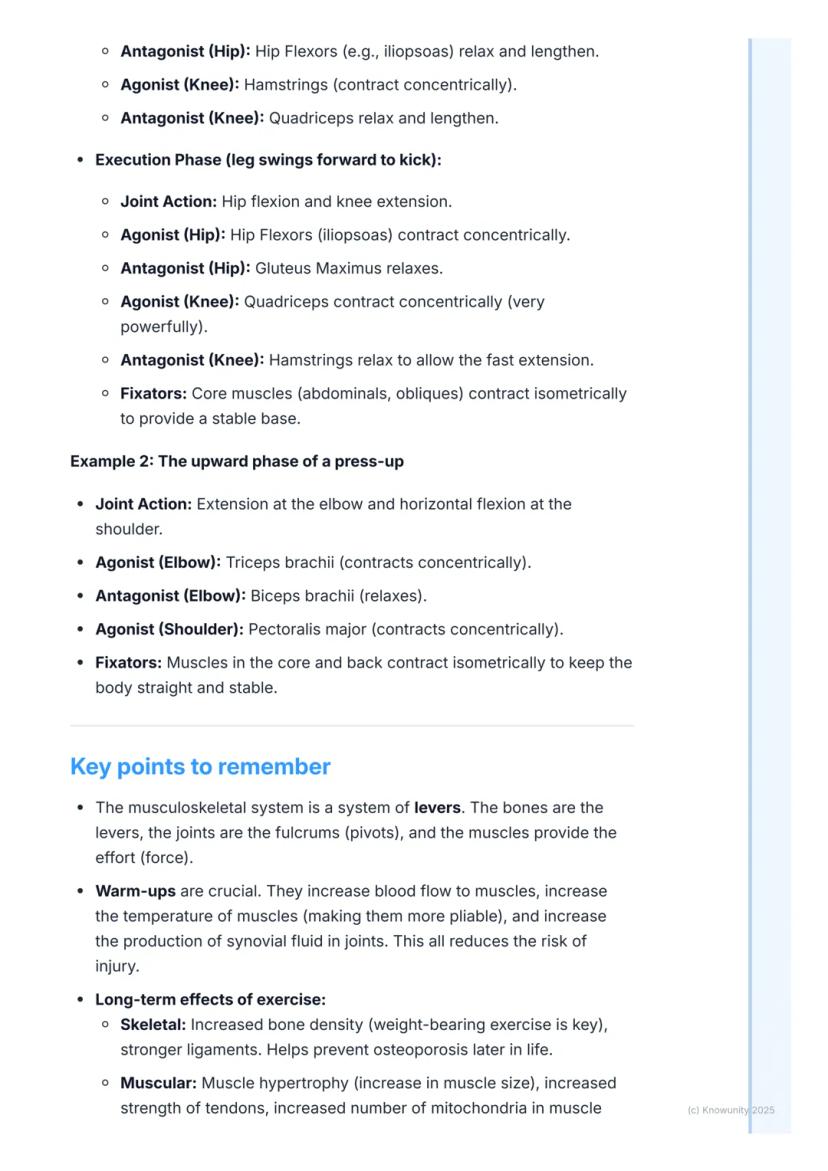
Let's break down a Gaelic football kick to understand muscle teamwork. During the preparation phase (leg swings back), your hip extends using the gluteus maximus as agonist, whilst hip flexors act as antagonists and relax.
Your knee flexes using hamstrings as agonists, with quadriceps as relaxed antagonists. This coordination creates the backswing.
In the execution phase (leg swings forward), everything reverses. Hip flexors become the agonists for hip flexion, whilst quadriceps contract powerfully for knee extension. The gluteus maximus and hamstrings now act as antagonists.
Throughout this action, your core muscles work as fixators, contracting isometrically to provide a stable base. Without this stability, your kick would be weak and inaccurate.
Exam Strategy: Practice analysing different sporting movements using this agonist-antagonist-fixator approach - it's a guaranteed exam topic.
6
of 7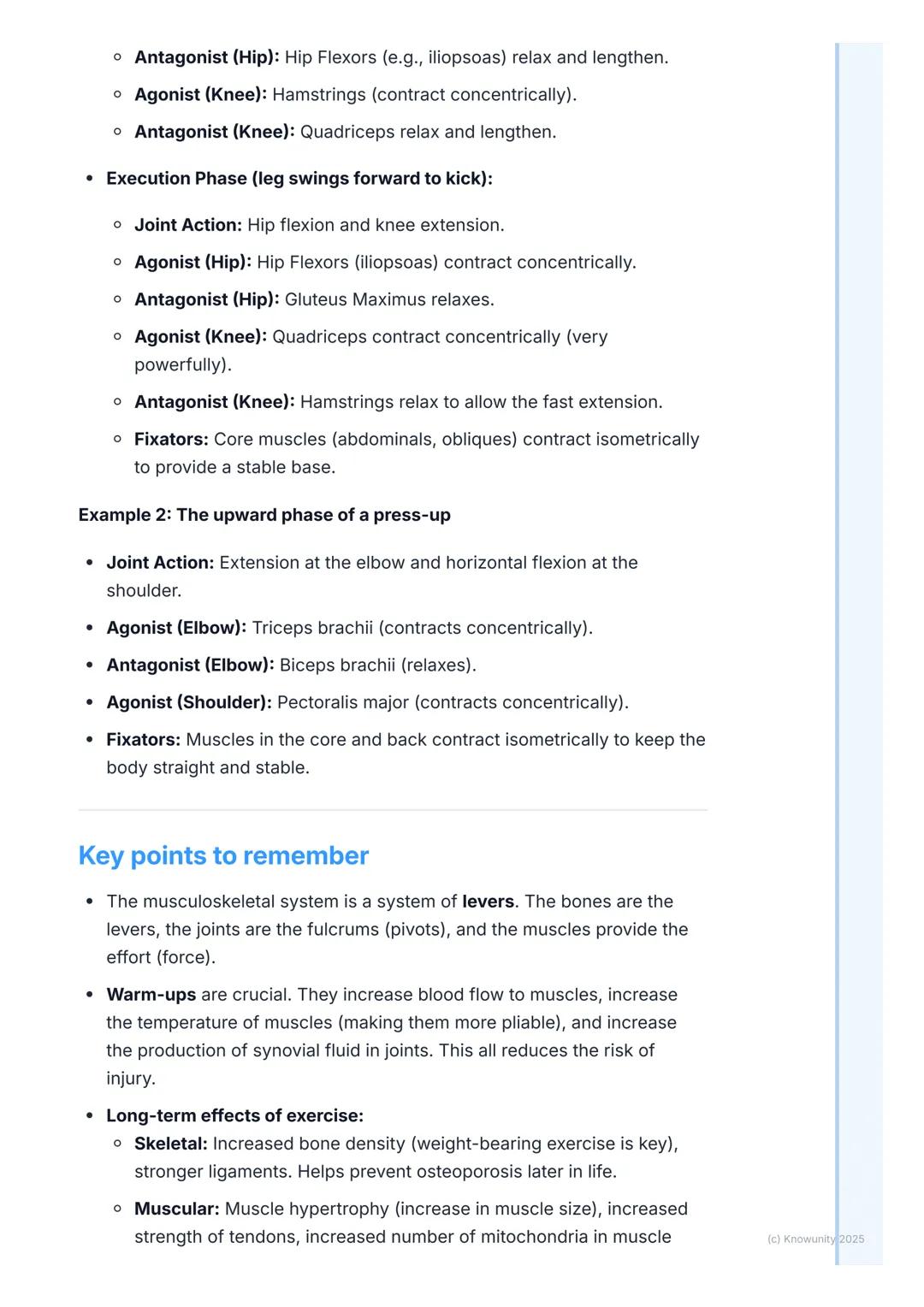
Sporting Applications and Analysis
A press-up demonstrates multiple joint actions working together. During the upward phase, your elbows extend using triceps brachii as agonists, whilst biceps brachii relax as antagonists. Your shoulders perform horizontal flexion with pectoralis major as the prime mover.
Core and back muscles work isometrically as fixators, maintaining that straight body position. This coordination between different muscle groups creates efficient, powerful movement.
The musculoskeletal system works as a lever system. Bones are the levers, joints are the fulcrums (pivot points), and muscles provide the effort. Understanding this helps explain why technique matters so much in sport.
Warm-ups become essential when you understand the science. They increase blood flow and muscle temperature, making muscles more pliable. They also boost synovial fluid production, lubricating joints and reducing injury risk.
Long-term exercise creates positive adaptations. Your bones become denser , preventing osteoporosis later. Muscles grow larger (hypertrophy), tendons strengthen, and muscle cells develop more mitochondria for better energy production.
Injury Prevention: Remember the difference - strains affect muscles/tendons, sprains affect ligaments. The 'T' in strain helps you remember Tendon.
7
of 7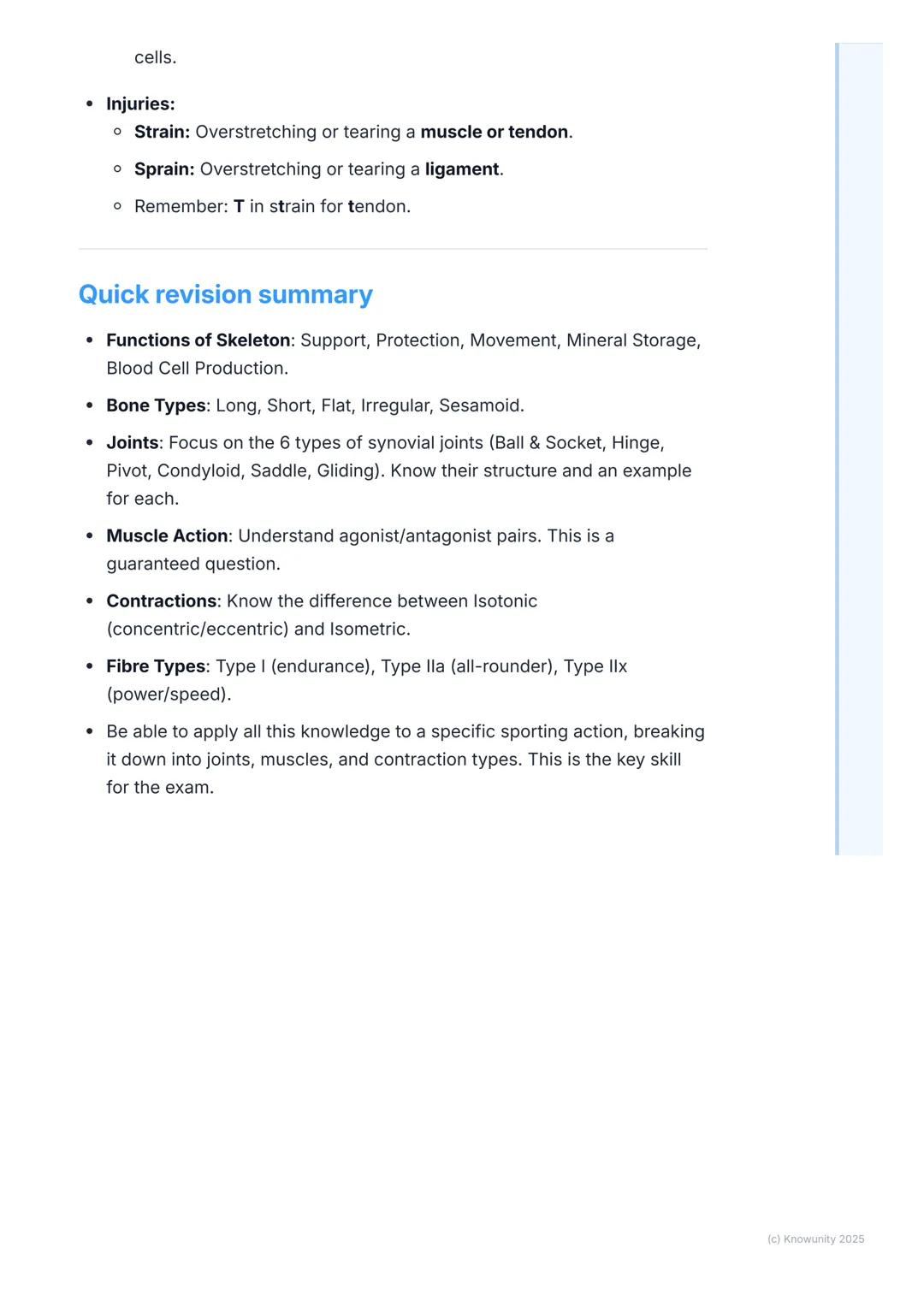
Exam Success Summary
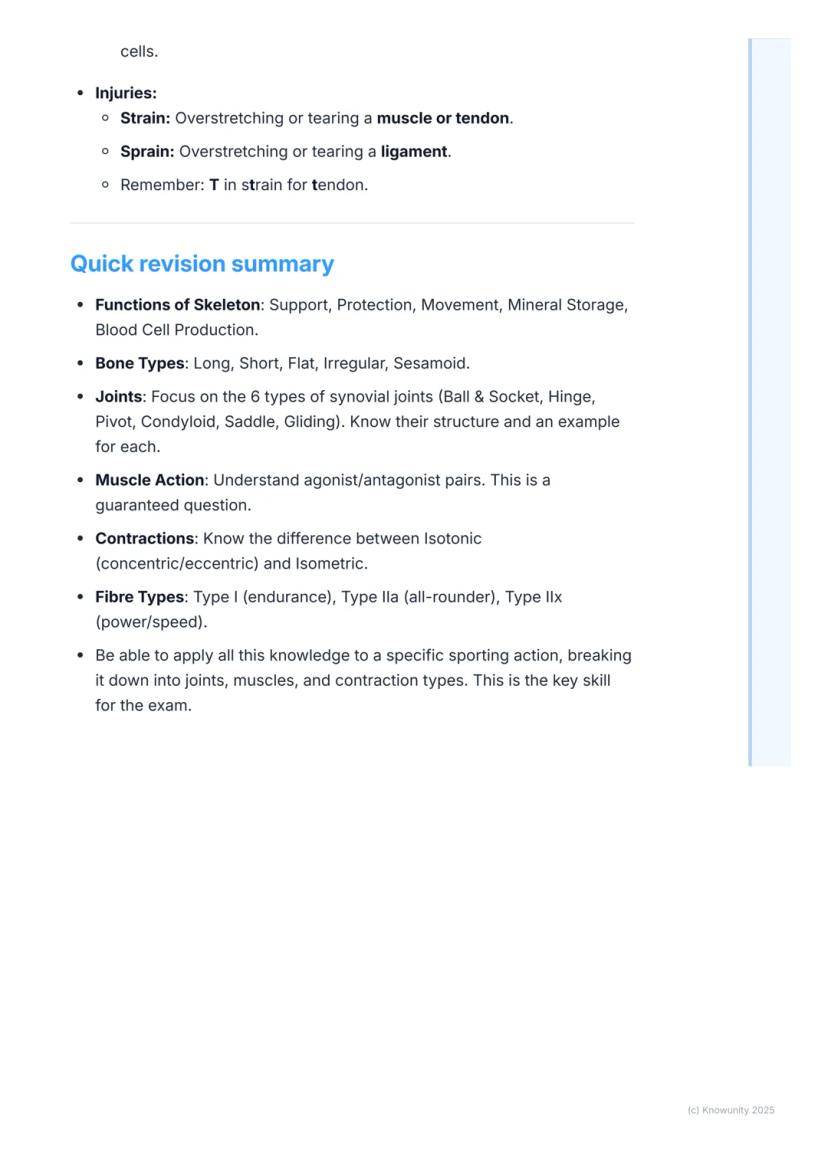
Master these key points for exam success. The five functions of skeleton spell out "Some People Make Movement Boring" - Support, Protection, Movement, Mineral storage, Blood cell production. Know your bone types with examples: long (femur), short (carpals), flat (skull), irregular (vertebrae), sesamoid (patella).
Synovial joints are exam gold - memorise all six types with examples and movements. Ball and socket (shoulder) allows everything, hinge (elbow) allows flexion/extension only, pivot (neck) rotates, and so on.
Muscle action analysis is guaranteed to appear. Identify agonists (main workers), antagonists (relaxers), and fixators (stabilisers) for any sporting movement. Understanding contraction types - isotonic (concentric and eccentric) versus isometric - completes the picture.
Fibre types explain athletic performance: Type I for endurance, Type IIa for middle distances, Type IIx for power and speed. Apply this knowledge to real sporting examples.
Practice breaking down sporting actions into joint movements, muscle actions, and contraction types. This analytical skill is what separates top students from the rest.
Final Tip: The examiners love seeing you apply anatomical knowledge to real sporting situations - always use specific examples from Irish sports when possible.
Mysleli jsme, že se nikdy nezeptáš...
Co je AI společník Knowunity?
Náš AI společník je speciálně vytvořen pro potřeby studentů. Na základě milionů obsahových materiálů, které máme na platformě, můžeme studentům poskytovat opravdu smysluplné a relevantní odpovědi. Ale nejde jen o odpovědi, společník je ještě více o provázení studentů jejich každodenními výzvami v učení, s personalizovanými studijními plány, kvízy nebo obsahovými materiály v chatu a 100% personalizací na základě dovedností a vývoje studentů.
Kde si můžu stáhnout aplikaci Knowunity?
Aplikaci si můžete stáhnout z obchodu Google Play a Apple App Store.
Jak můžu dostat svou platbu? Kolik si můžu vydělat?
Ano, máte bezplatný přístup k obsahu v aplikaci a k našemu společníkovi s umělou inteligencí. Chcete-li odemknout určité funkce aplikace, můžete si zakoupit aplikaci Knowunity Pro.
Nejpopulárnější poznámky z LCPE
4LCPEHealthy Eating Guidelines
This section explores national healthy eating guidelines, such as the food pyramid or healthy eating plate, to promote balanced dietary choices.
5th Year50
LCPEBiomechanics of Movement
Applying fundamental biomechanical principles such as force, motion, levers, and stability to analyse and improve human movement efficiency and performance in sport.
6th Year200
LCPEFactors effecting sports psychology ( confidence and self efficacy)
Higher Level LCPE psychological preprration notes
5th Year230
LCPETechnology in Sport
Investigating how technology is used in areas such as performance analysis, equipment design, officiating, and athlete monitoring to enhance training and competition.
6th Year50
Nejpopulárnější poznámky
9 Irish
IrishIrish oral questions and answers
Questions and answers for the leaving cert oral
5th Year4264
 English
Key Quotes : Sive
Key Quotes and explanations: Sive
6th Year2842
IrishIrish oral questions
Outline of oral questions
5th Year2055
IrishIníon- le hÁine Durkin
Aine Durkin’s poem, Iníon: Themes & summary
5th Year890
IrishIrish poetry 2027
Iníon + Dínit an Bhróin
5th Year1153
IrishLC HL notes- Iníon (poem)
Includes poem in English and Irish, theme, key words & phrases
5th Year2304
EnglishCultural Context : Shawshank Redemption : Sive : Small Things Like These
Comparative Study : Cultural Context : Shawshank Redemption, Sive and Small Things Like These
6th Year1430
IrishMo Ghrá-sa (Idir Lúibíní)
Notes on mo ghrá-sa
5th Year380
IrishAn Gaeilge Aiste
Irish Language essay
6th Year1320
Nemůžeš najít, co hledáš? Prozkoumej další předměty.
Recenze od našich uživatelů. Mají vše super — a ty taky můžeš.
4.6/5App Store
4.7/5Google Play
Aplikace je velmi jednoduchá na používání a dobře navržená. Zatím jsem našel vše, co jsem hledal, a mohl jsem se z prezentací hodně naučit! Určitě použiju aplikaci na školní úkol! A samozřejmě taky hodně pomáhá jako inspirace.
Stefan Suživatel iOS
Tahle aplikace je fakt skvělá. Je tam tolik studijních poznámek a pomůcek [...]. Můj problémový předmět je například francouzština a aplikace nabízí tolik možností pomoci. Díky této aplikaci jsem si zlepšil francouzštinu. Doporučil bych ji každému.
Samantha Klichuživatelka Androidu
Páni, jsem opravdu ohromen. Zkusil jsem aplikaci jen proto, že jsem ji mnohokrát viděl v reklamách, a byl jsem naprosto ohromen. Tato aplikace je TA POMOC, kterou chceš do školy, a především nabízí spoustu věcí, jako jsou cvičení a přehledy faktů, které mi osobně VELMI pomohly.
Annauživatelka iOS
LCPE3 zobrazení·Aktualizováno Jun 16, 2026·7 stránekThe Skeletal and Muscular Systems Explained
Understanding how your body moves during sport is absolutely crucial for your Leaving Cert PE exam. The skeletal and muscular systems work together as the musculoskeletal system to provide support, protect vital organs, and create all movement in sport.
1
of 7
Registruj se, abys viděl obsah. Je to zdarma!
- Přístup ke všem dokumentům
- Zlepši své známky
- Připoj se k milionům studentů
Foundation Knowledge and Key Terms
Think about every sporting movement you make - from shooting a basketball to tackling in rugby. Your musculoskeletal system makes it all possible by combining your skeleton (the framework) with your muscles (the power).
The skeleton divides into two main parts. The axial skeleton includes your skull, spine, and rib cage - basically your central protective core. The appendicular skeleton covers your arms, legs, and the bits that connect them to your body - this is your movement centre.
Here's a memory trick that'll save you in exams: Ligaments Link Bone to Bone (LBB), whilst Tendons Tie Muscle to Bone (TMB). Don't mix these up! Cartilage acts like a cushion between bones, reducing friction when you move.
When muscles work together, they have specific roles. The agonist (prime mover) does the main work, whilst the antagonist relaxes to allow movement. Synergists help out, and fixators keep everything stable.
Quick Tip: Understanding muscle roles is guaranteed to come up in your exam - make sure you can identify each one in any sporting action.
2
of 7Registruj se, abys viděl obsah. Je to zdarma!
- Přístup ke všem dokumentům
- Zlepši své známky
- Připoj se k milionům studentů
The Skeletal System Structure
Your skeleton does five essential jobs, and there's a handy memory trick: Some People Make Movement Boring. That's Support (keeps you upright), Protection (guards vital organs), Movement (provides levers for muscles), Mineral storage (calcium and phosphorus), and Blood cell production (happens in bone marrow).
Bone classification is a likely short-answer question, so learn this well. Long bones like your femur and humerus work as levers for major movements. Short bones in your hands and feet provide stability and fine motor control.
Flat bones such as your skull and ribs offer protection and muscle attachment sites. Irregular bones like vertebrae have complex shapes for specific jobs. Sesamoid bones like your kneecap (patella) sit within tendons to improve leverage.
The structure matters too. Long bones have a shaft (diaphysis) and enlarged ends (epiphyses) where growth occurs. This knowledge helps explain why young athletes need to be careful about overtraining during growth periods.
Remember: Bone classification by shape is one of the most predictable exam questions - make sure you know an example of each type.
3
of 7Registruj se, abys viděl obsah. Je to zdarma!
- Přístup ke všem dokumentům
- Zlepši své známky
- Připoj se k milionům studentů
Joint Classification and Movement
Joints determine how much you can move, and they're classified by mobility. Fibrous joints (like skull sutures) don't move at all. Cartilaginous joints (between vertebrae) allow slight movement. But synovial joints are your sporting superstars - they're freely movable.
Synovial joint structure is crucial knowledge. Articular cartilage covers bone ends to reduce friction. The joint capsule wraps around everything, whilst the synovial membrane produces synovial fluid for lubrication. Ligaments provide stability and prevent excessive movement.
You need to know six types of synovial joints. Ball and socket joints (shoulder, hip) allow movement in all directions. Hinge joints (elbow, knee) work like a door - flexion and extension only. Pivot joints (neck) rotate, whilst condyloid joints (wrist) move in most directions except rotation.
Saddle joints (thumb) allow complex movements for gripping, and gliding joints (between small bones) permit sliding movements. Each joint type determines what sporting actions are possible.
Exam Focus: Be ready to identify joint types, give examples, and explain what movements they allow - this comes up every year.
4
of 7Registruj se, abys viděl obsah. Je to zdarma!
- Přístup ke všem dokumentům
- Zlepši své známky
- Připoj se k milionům studentů
Muscle Fibre Types and Contractions
Your muscles contain different fibre types that determine your sporting strengths. Type I (slow twitch) fibres resist fatigue brilliantly - perfect for marathon running or long football matches. Type IIa (fast twitch) fibres are the all-rounders, great for 400m or 800m running. Type IIx (fast twitch) fibres produce explosive power for sprinting or shot putting.
The proportion of these fibres is largely genetic, but training can influence them. Endurance training improves Type I efficiency, whilst power training develops Type II capabilities.
Muscle contractions work in three ways. Isotonic contractions involve length changes - concentric means shortening (bicep curl up), eccentric means lengthening under tension (bicep curl down). This eccentric phase often causes muscle soreness (DOMS).
Isometric contractions generate force without movement - think holding a plank or maintaining position in a rugby scrum. These are crucial for stability and strength development.
Training Tip: Understanding fibre types explains why some athletes excel at different events - it's not just training, it's biology too.
5
of 7Registruj se, abys viděl obsah. Je to zdarma!
- Přístup ke všem dokumentům
- Zlepši své známky
- Připoj se k milionům studentů
Muscle Action in Sport
Let's break down a Gaelic football kick to understand muscle teamwork. During the preparation phase (leg swings back), your hip extends using the gluteus maximus as agonist, whilst hip flexors act as antagonists and relax.
Your knee flexes using hamstrings as agonists, with quadriceps as relaxed antagonists. This coordination creates the backswing.
In the execution phase (leg swings forward), everything reverses. Hip flexors become the agonists for hip flexion, whilst quadriceps contract powerfully for knee extension. The gluteus maximus and hamstrings now act as antagonists.
Throughout this action, your core muscles work as fixators, contracting isometrically to provide a stable base. Without this stability, your kick would be weak and inaccurate.
Exam Strategy: Practice analysing different sporting movements using this agonist-antagonist-fixator approach - it's a guaranteed exam topic.
6
of 7Registruj se, abys viděl obsah. Je to zdarma!
- Přístup ke všem dokumentům
- Zlepši své známky
- Připoj se k milionům studentů
Sporting Applications and Analysis
A press-up demonstrates multiple joint actions working together. During the upward phase, your elbows extend using triceps brachii as agonists, whilst biceps brachii relax as antagonists. Your shoulders perform horizontal flexion with pectoralis major as the prime mover.
Core and back muscles work isometrically as fixators, maintaining that straight body position. This coordination between different muscle groups creates efficient, powerful movement.
The musculoskeletal system works as a lever system. Bones are the levers, joints are the fulcrums (pivot points), and muscles provide the effort. Understanding this helps explain why technique matters so much in sport.
Warm-ups become essential when you understand the science. They increase blood flow and muscle temperature, making muscles more pliable. They also boost synovial fluid production, lubricating joints and reducing injury risk.
Long-term exercise creates positive adaptations. Your bones become denser , preventing osteoporosis later. Muscles grow larger (hypertrophy), tendons strengthen, and muscle cells develop more mitochondria for better energy production.
Injury Prevention: Remember the difference - strains affect muscles/tendons, sprains affect ligaments. The 'T' in strain helps you remember Tendon.
7
of 7Registruj se, abys viděl obsah. Je to zdarma!
- Přístup ke všem dokumentům
- Zlepši své známky
- Připoj se k milionům studentů
Exam Success Summary
Master these key points for exam success. The five functions of skeleton spell out "Some People Make Movement Boring" - Support, Protection, Movement, Mineral storage, Blood cell production. Know your bone types with examples: long (femur), short (carpals), flat (skull), irregular (vertebrae), sesamoid (patella).
Synovial joints are exam gold - memorise all six types with examples and movements. Ball and socket (shoulder) allows everything, hinge (elbow) allows flexion/extension only, pivot (neck) rotates, and so on.
Muscle action analysis is guaranteed to appear. Identify agonists (main workers), antagonists (relaxers), and fixators (stabilisers) for any sporting movement. Understanding contraction types - isotonic (concentric and eccentric) versus isometric - completes the picture.
Fibre types explain athletic performance: Type I for endurance, Type IIa for middle distances, Type IIx for power and speed. Apply this knowledge to real sporting examples.
Practice breaking down sporting actions into joint movements, muscle actions, and contraction types. This analytical skill is what separates top students from the rest.
Final Tip: The examiners love seeing you apply anatomical knowledge to real sporting situations - always use specific examples from Irish sports when possible.
Mysleli jsme, že se nikdy nezeptáš...
Co je AI společník Knowunity?
Náš AI společník je speciálně vytvořen pro potřeby studentů. Na základě milionů obsahových materiálů, které máme na platformě, můžeme studentům poskytovat opravdu smysluplné a relevantní odpovědi. Ale nejde jen o odpovědi, společník je ještě více o provázení studentů jejich každodenními výzvami v učení, s personalizovanými studijními plány, kvízy nebo obsahovými materiály v chatu a 100% personalizací na základě dovedností a vývoje studentů.
Kde si můžu stáhnout aplikaci Knowunity?
Aplikaci si můžete stáhnout z obchodu Google Play a Apple App Store.
Jak můžu dostat svou platbu? Kolik si můžu vydělat?
Ano, máte bezplatný přístup k obsahu v aplikaci a k našemu společníkovi s umělou inteligencí. Chcete-li odemknout určité funkce aplikace, můžete si zakoupit aplikaci Knowunity Pro.
Nejpopulárnější poznámky z LCPE
4LCPEHealthy Eating Guidelines
This section explores national healthy eating guidelines, such as the food pyramid or healthy eating plate, to promote balanced dietary choices.
5th Year50
LCPEBiomechanics of Movement
Applying fundamental biomechanical principles such as force, motion, levers, and stability to analyse and improve human movement efficiency and performance in sport.
6th Year200
LCPEFactors effecting sports psychology ( confidence and self efficacy)
Higher Level LCPE psychological preprration notes
5th Year230
LCPETechnology in Sport
Investigating how technology is used in areas such as performance analysis, equipment design, officiating, and athlete monitoring to enhance training and competition.
6th Year50
Nejpopulárnější poznámky
9IrishIrish oral questions and answers
Questions and answers for the leaving cert oral
5th Year4264
EnglishKey Quotes : Sive
Key Quotes and explanations: Sive
6th Year2842
IrishIrish oral questions
Outline of oral questions
5th Year2055
IrishIníon- le hÁine Durkin
Aine Durkin’s poem, Iníon: Themes & summary
5th Year890
IrishIrish poetry 2027
Iníon + Dínit an Bhróin
5th Year1153
IrishLC HL notes- Iníon (poem)
Includes poem in English and Irish, theme, key words & phrases
5th Year2304
EnglishCultural Context : Shawshank Redemption : Sive : Small Things Like These
Comparative Study : Cultural Context : Shawshank Redemption, Sive and Small Things Like These
6th Year1430
IrishMo Ghrá-sa (Idir Lúibíní)
Notes on mo ghrá-sa
5th Year380
IrishAn Gaeilge Aiste
Irish Language essay
6th Year1320
Nemůžeš najít, co hledáš? Prozkoumej další předměty.
Recenze od našich uživatelů. Mají vše super — a ty taky můžeš.
4.6/5App Store
4.7/5Google Play
Aplikace je velmi jednoduchá na používání a dobře navržená. Zatím jsem našel vše, co jsem hledal, a mohl jsem se z prezentací hodně naučit! Určitě použiju aplikaci na školní úkol! A samozřejmě taky hodně pomáhá jako inspirace.
Stefan Suživatel iOS
Tahle aplikace je fakt skvělá. Je tam tolik studijních poznámek a pomůcek [...]. Můj problémový předmět je například francouzština a aplikace nabízí tolik možností pomoci. Díky této aplikaci jsem si zlepšil francouzštinu. Doporučil bych ji každému.
Samantha Klichuživatelka Androidu
Páni, jsem opravdu ohromen. Zkusil jsem aplikaci jen proto, že jsem ji mnohokrát viděl v reklamách, a byl jsem naprosto ohromen. Tato aplikace je TA POMOC, kterou chceš do školy, a především nabízí spoustu věcí, jako jsou cvičení a přehledy faktů, které mi osobně VELMI pomohly.
Annauživatelka iOS