
Ever wonder why you can sprint for only a few... Zobrazit více
 LCPE6 zobrazení·Aktualizováno Jun 8, 2026·5 stránek
Introduction to the Body's Energy Systems
1 / 5
1
of 5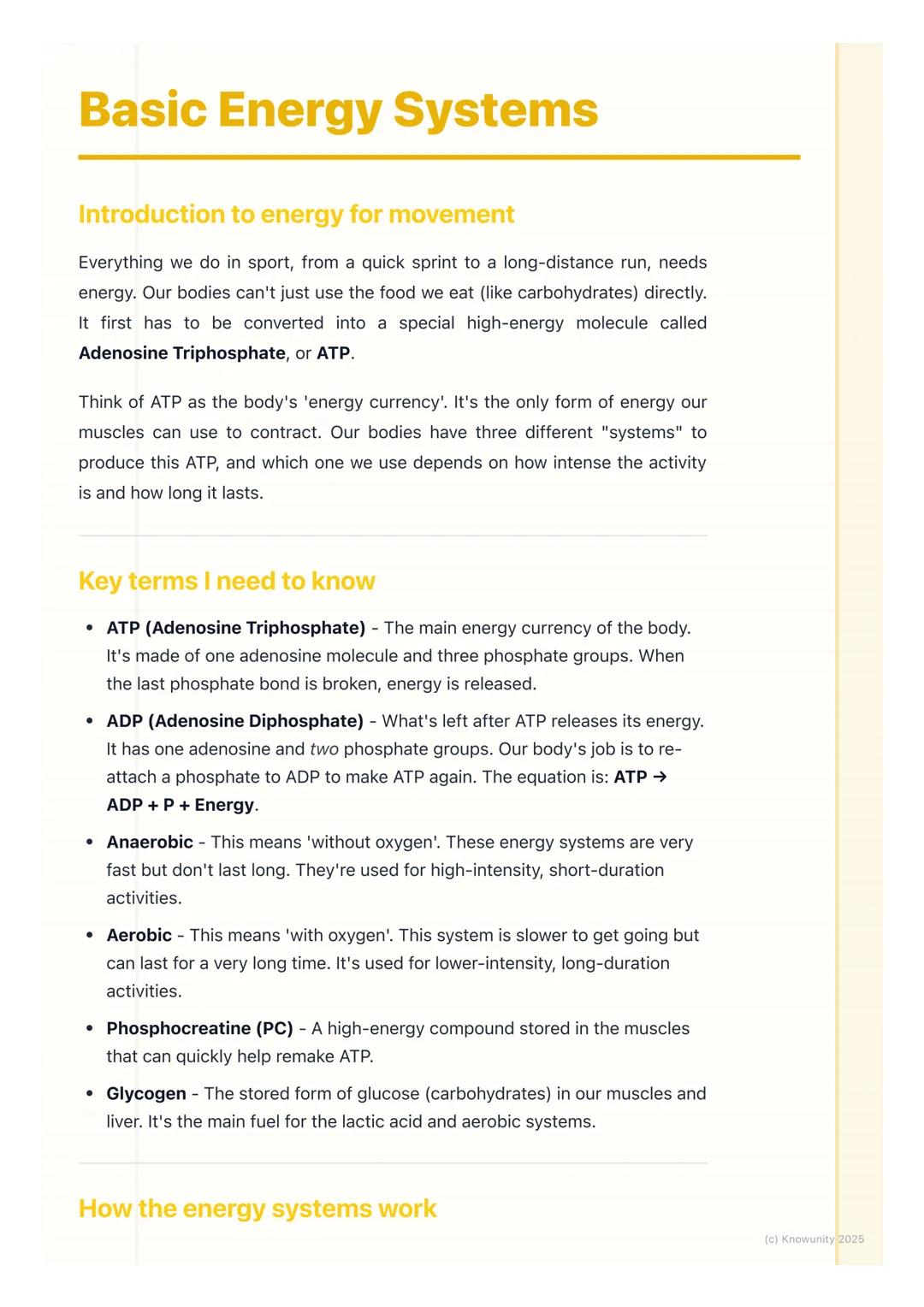
Basic Energy Systems
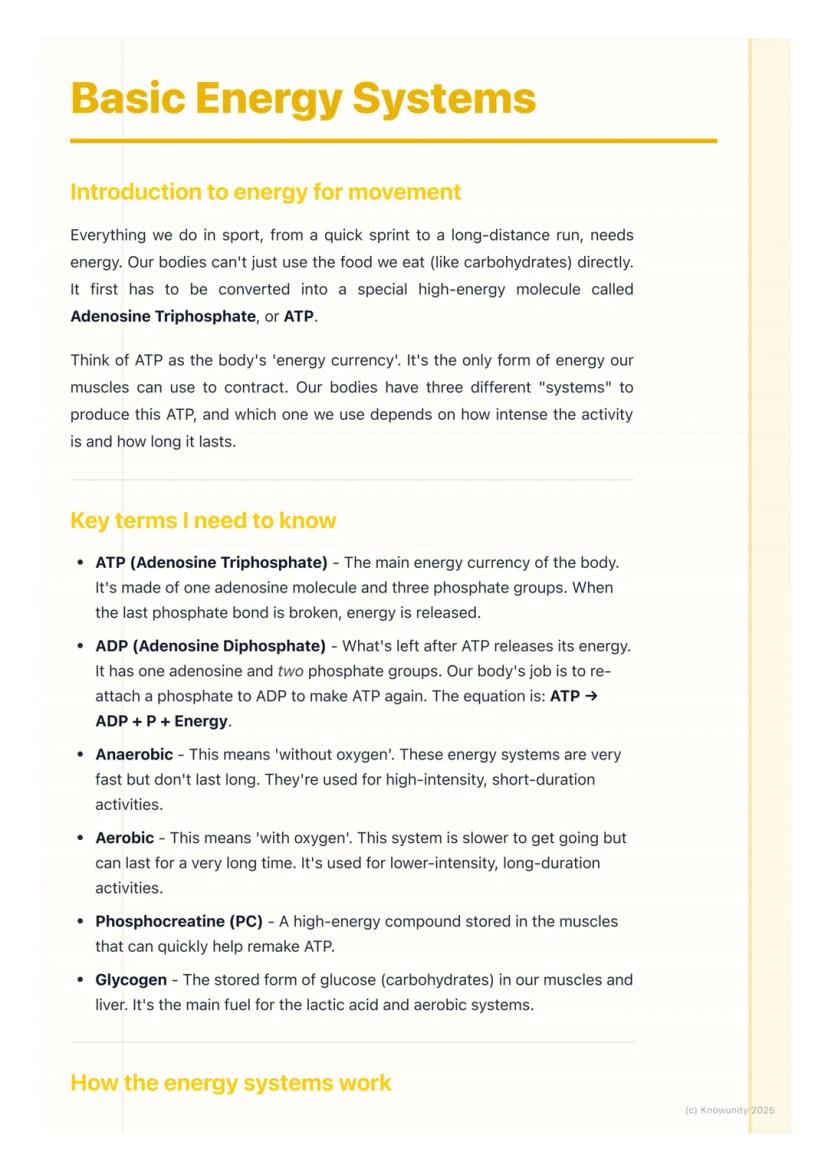
Your muscles are basically really picky eaters - they can only use one type of fuel called ATP (Adenosine Triphosphate). Think of ATP as your body's energy currency, like coins in an arcade machine.
Here's the thing though: your body only stores enough ATP for about 2-3 seconds of movement. After that, it needs to quickly make more using three different systems. The cool part is that these systems work together on what's called the energy continuum - it's not like flicking a switch, but more like a sliding scale where one system takes the lead.
The key difference between these systems is whether they need oxygen (aerobic) or can work without oxygen (anaerobic). Anaerobic systems are lightning fast but burn out quickly, whilst aerobic systems are like marathon runners - slower to start but can keep going for hours.
Quick Tip: Remember the equation ATP → ADP + P + Energy. Your body's job is constantly sticking that phosphate back on to remake ATP!
2
of 5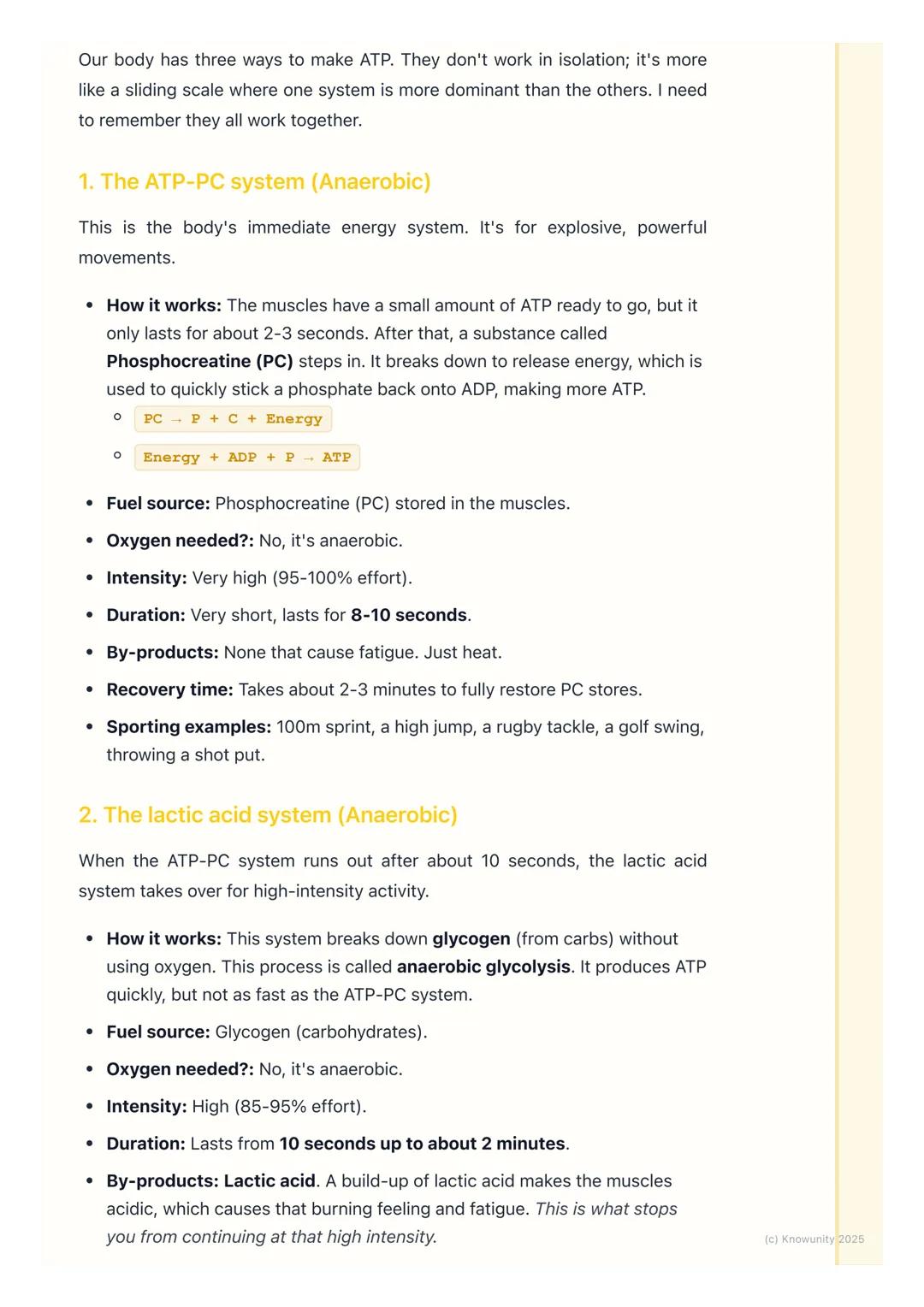
The Three Energy Systems
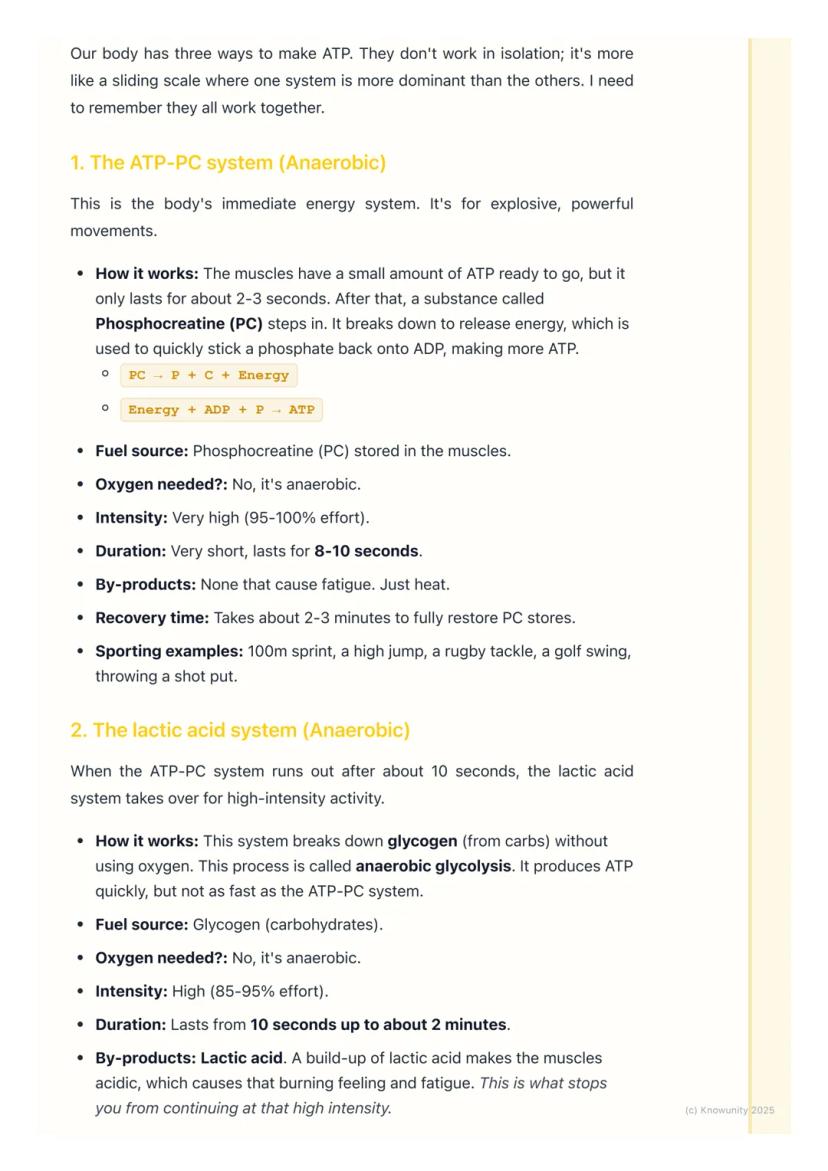
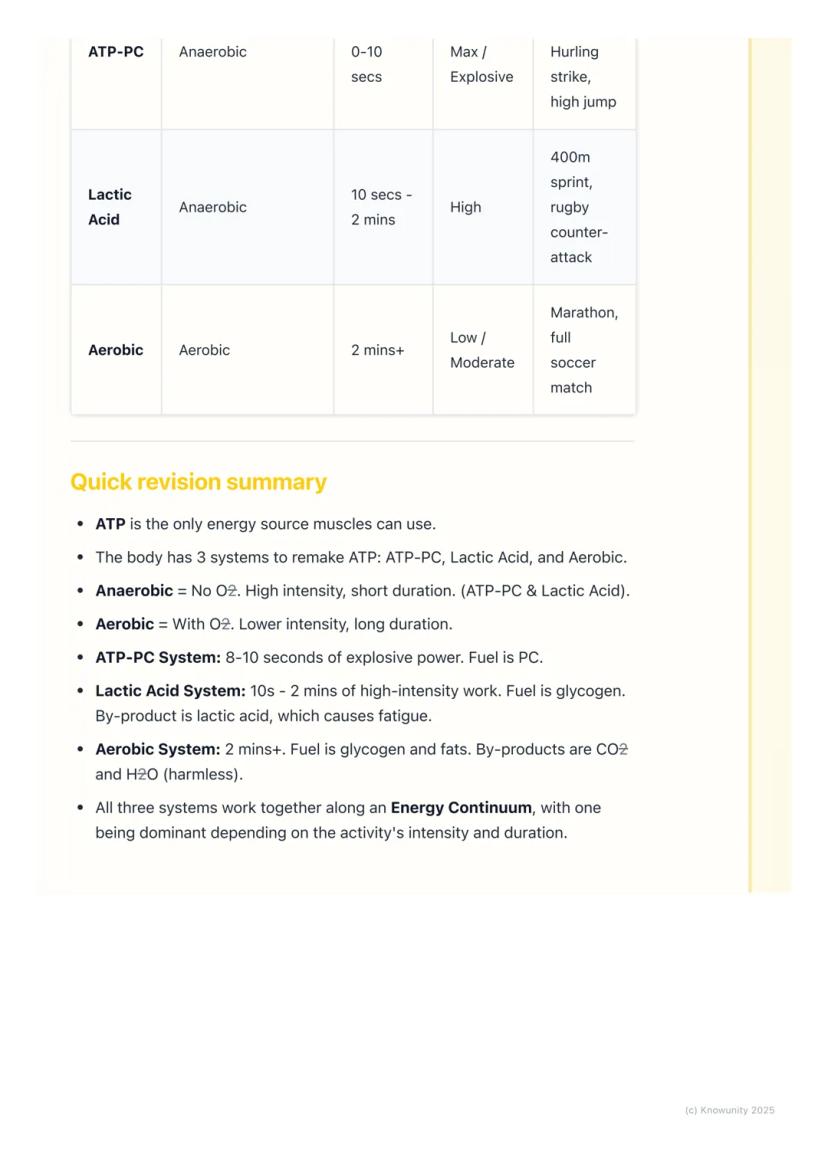
The ATP-PC System is your body's emergency energy supply. It's pure explosive power for about 8-10 seconds using phosphocreatine (PC) stored in your muscles. Think 100m sprint start or a rugby tackle - maximum effort, no oxygen needed, no nasty side effects.
The Lactic Acid System takes over when you're still going hard after 10 seconds. It breaks down glycogen (stored carbs) without oxygen, but here's the catch - it produces lactic acid that makes your muscles burn and forces you to slow down after about 2 minutes.
The Aerobic System is your endurance powerhouse. It uses oxygen to efficiently burn glycogen and fats, producing only harmless water and carbon dioxide. This system can literally keep you going for hours, but it can't produce energy fast enough for high-intensity work.
Remember: These systems don't work in isolation - they're all contributing at the same time, with one being dominant depending on what you're doing.
3
of 5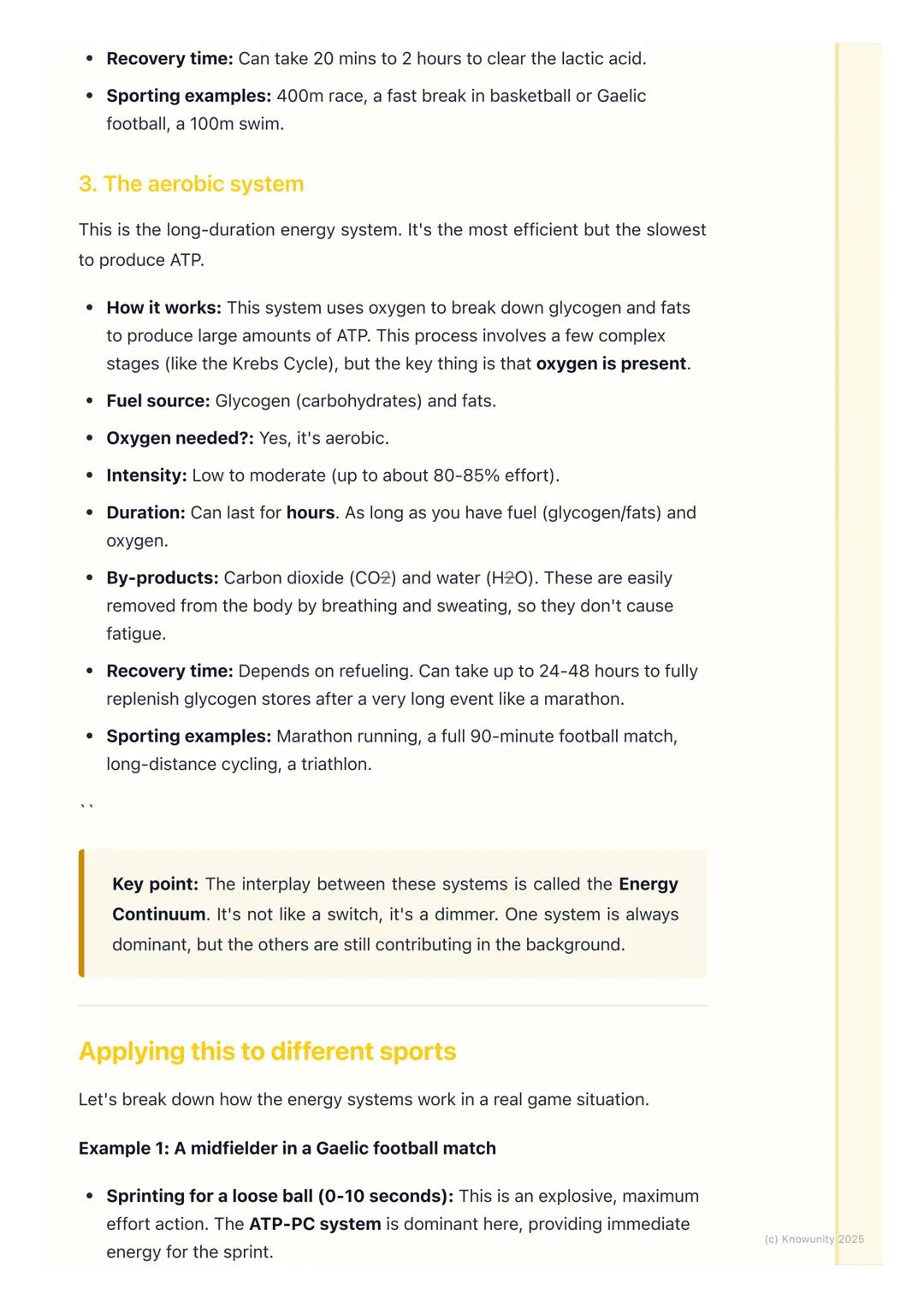
Real Sport Applications
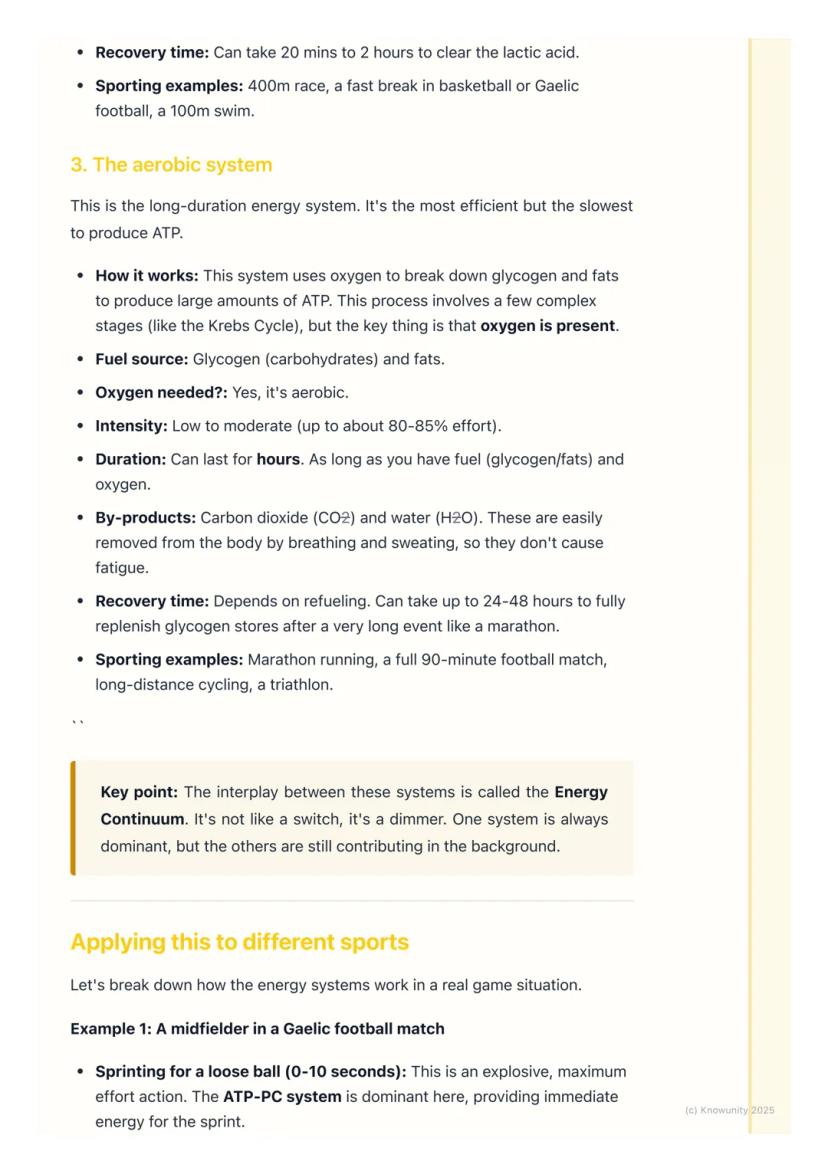
Let's look at a Gaelic football midfielder during a match. When they sprint for a loose ball , the ATP-PC system dominates, giving that explosive burst. During a gut-busting run up the pitch , the lactic acid system takes over - that's why their legs start burning.
For the rest of the 70-minute match, the aerobic system is doing most of the work during jogging and recovery periods. It's also busy helping to clear lactic acid and restock the anaerobic systems during breaks in play.
A 400m sprinter is the perfect example of lactic acid system dominance. The first 50m uses ATP-PC for that explosive start, then lactic acid takes over for the brutal middle section. By the final 100m, lactic acid buildup is causing that wall of pain every 400m runner knows too well.
Exam Gold: Never say the systems work "one at a time" - always mention the dominant system and how they work together on the energy continuum.
4
of 5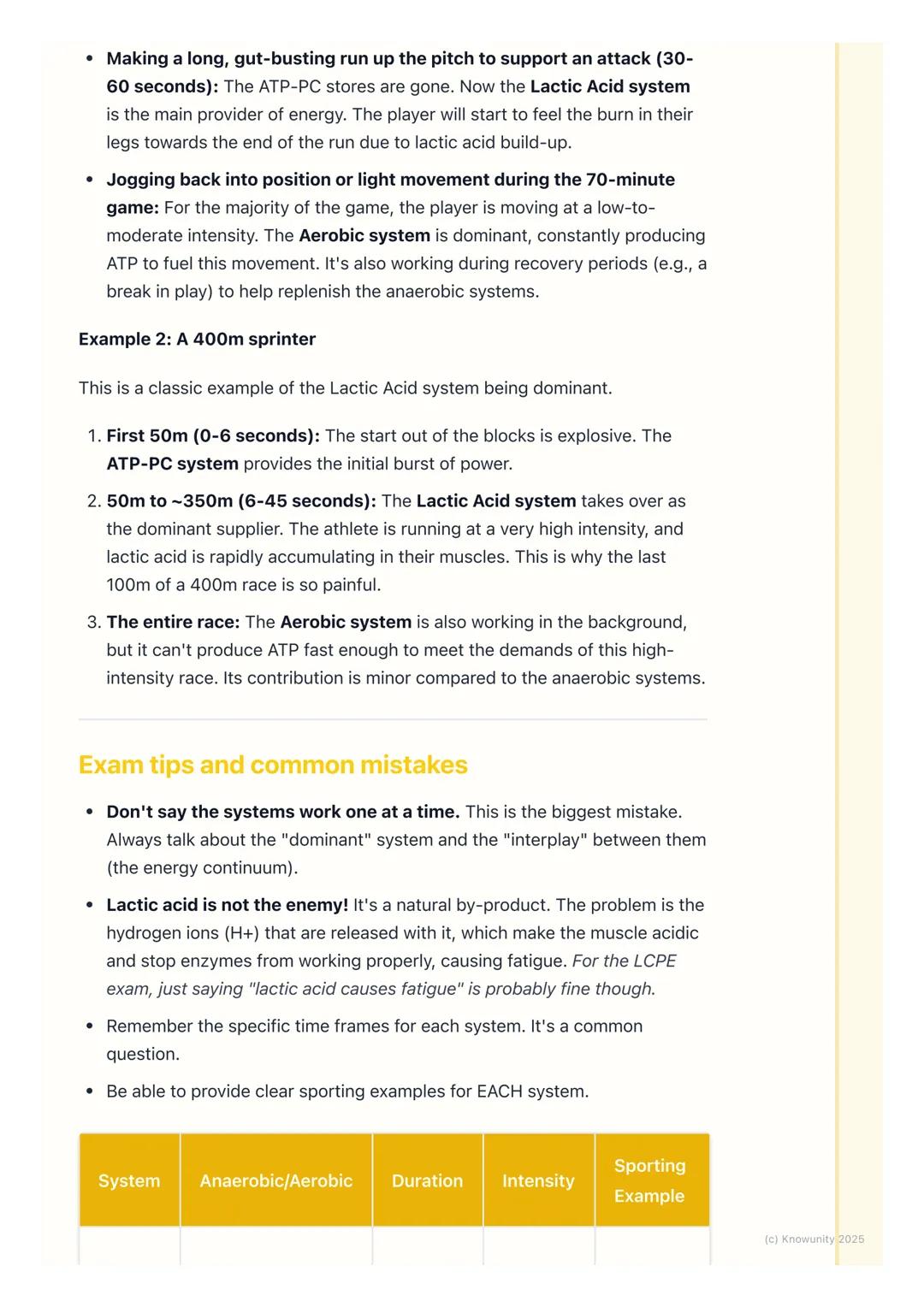
Key Details and Exam Tips
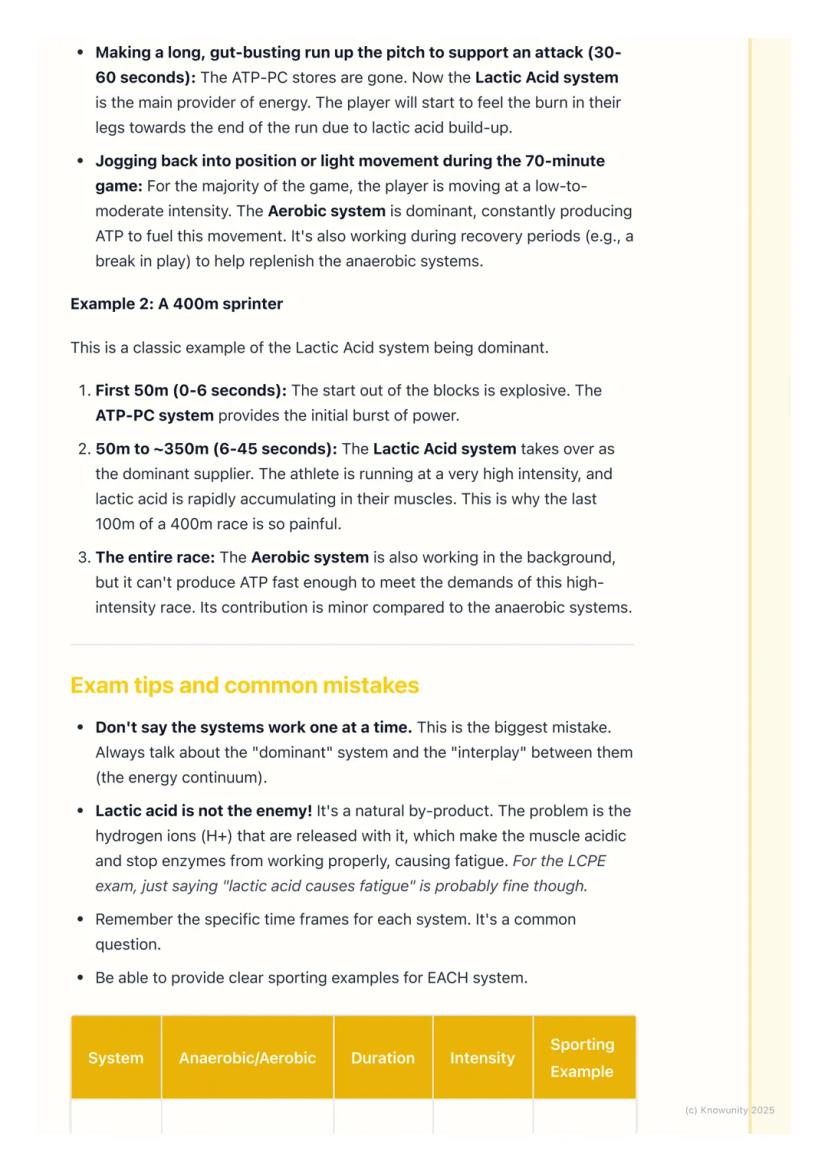
Here's what you absolutely need to know for exams: ATP-PC lasts 8-10 seconds at maximum intensity using PC as fuel. Lactic acid system goes from 10 seconds to 2 minutes at high intensity using glycogen, producing that burning sensation. Aerobic system kicks in properly after 2 minutes, using glycogen and fats with oxygen for sustained activity.
The recovery times are crucial too. ATP-PC stores refill in 2-3 minutes, lactic acid takes 20 minutes to 2 hours to clear, and full glycogen restoration can take up to 48 hours after really long events.
Common exam mistakes include saying systems work separately (they don't), forgetting that all systems contribute simultaneously, and mixing up the time frames. Also remember - it's not actually the lactic acid that causes fatigue, but the hydrogen ions that make muscles acidic.
Pro Tip: Learn one clear sporting example for each system - shot put , 400m sprint (lactic acid), and marathon (aerobic). You'll definitely need these in exams.
5
of 5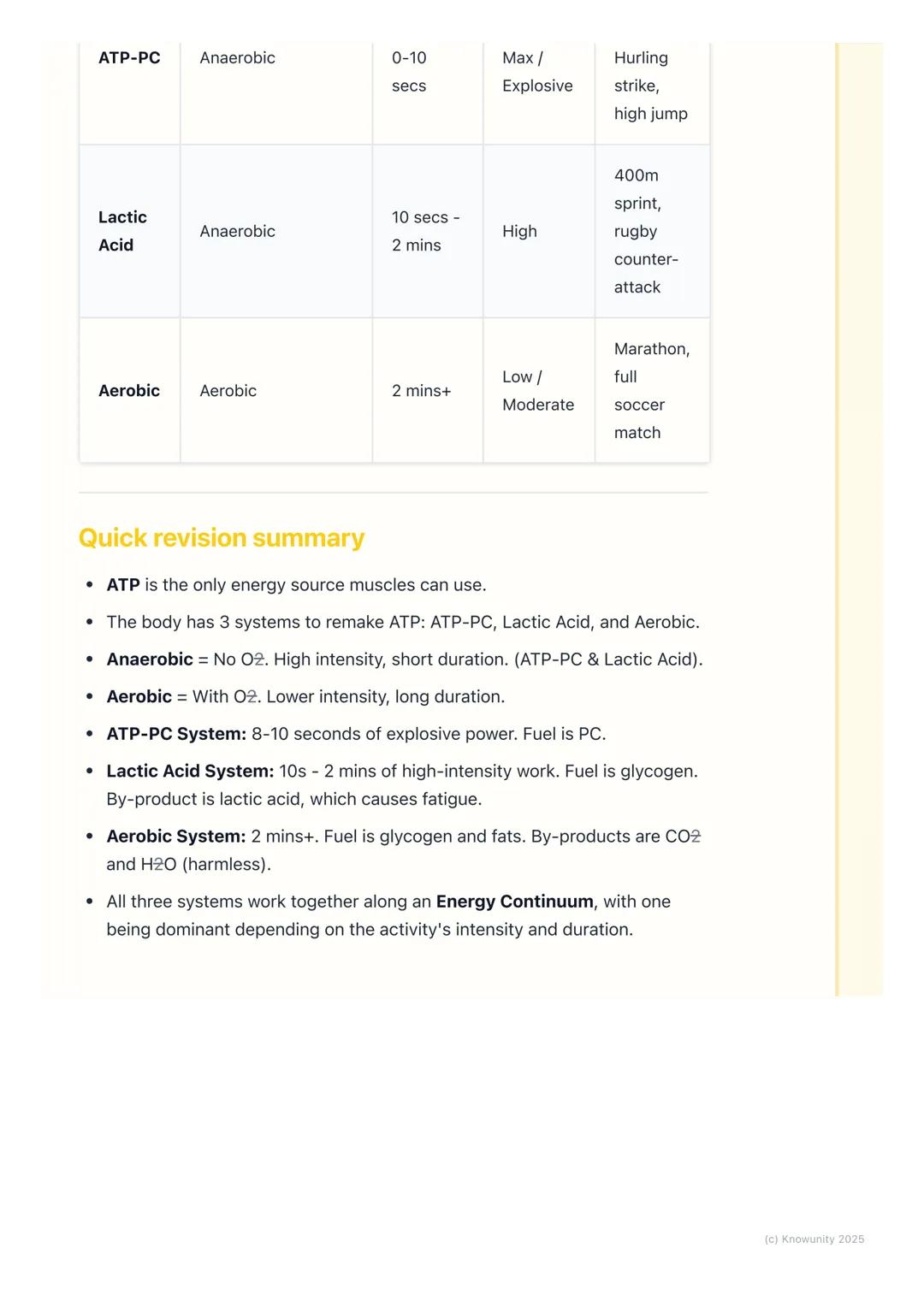
Quick Revision Summary
Your body's energy systems work like a perfectly coordinated team. The ATP-PC system handles explosive movements up to 10 seconds. The lactic acid system powers high-intensity work for 10 seconds to 2 minutes but comes with that burning penalty. The aerobic system is your long-distance champion, efficiently fueling moderate activity for hours.
Remember the energy continuum concept - these systems blend into each other rather than switching on and off. Which system dominates depends entirely on how intense your activity is and how long you're doing it for.
Master the time frames, fuel sources, and sporting examples for each system. Understanding when each system kicks in will help you make sense of training programs, why different sports feel so different, and how to pace yourself in everything from a 100m sprint to a long bike ride.
Final Check: Can you explain why a footballer can jog for 90 minutes but only sprint flat-out for 10 seconds? If yes, you've got this!
Mysleli jsme, že se nikdy nezeptáš...
Co je AI společník Knowunity?
Náš AI společník je speciálně vytvořen pro potřeby studentů. Na základě milionů obsahových materiálů, které máme na platformě, můžeme studentům poskytovat opravdu smysluplné a relevantní odpovědi. Ale nejde jen o odpovědi, společník je ještě více o provázení studentů jejich každodenními výzvami v učení, s personalizovanými studijními plány, kvízy nebo obsahovými materiály v chatu a 100% personalizací na základě dovedností a vývoje studentů.
Kde si můžu stáhnout aplikaci Knowunity?
Aplikaci si můžete stáhnout z obchodu Google Play a Apple App Store.
Jak můžu dostat svou platbu? Kolik si můžu vydělat?
Ano, máte bezplatný přístup k obsahu v aplikaci a k našemu společníkovi s umělou inteligencí. Chcete-li odemknout určité funkce aplikace, můžete si zakoupit aplikaci Knowunity Pro.
Nejpopulárnější poznámky z LCPE
4Nejpopulárnější poznámky
9Nemůžeš najít, co hledáš? Prozkoumej další předměty.
Recenze od našich uživatelů. Mají vše super — a ty taky můžeš.
4.6/5App Store
4.7/5Google Play
Aplikace je velmi jednoduchá na používání a dobře navržená. Zatím jsem našel vše, co jsem hledal, a mohl jsem se z prezentací hodně naučit! Určitě použiju aplikaci na školní úkol! A samozřejmě taky hodně pomáhá jako inspirace.
Stefan Suživatel iOS
Tahle aplikace je fakt skvělá. Je tam tolik studijních poznámek a pomůcek [...]. Můj problémový předmět je například francouzština a aplikace nabízí tolik možností pomoci. Díky této aplikaci jsem si zlepšil francouzštinu. Doporučil bych ji každému.
Samantha Klichuživatelka Androidu
Páni, jsem opravdu ohromen. Zkusil jsem aplikaci jen proto, že jsem ji mnohokrát viděl v reklamách, a byl jsem naprosto ohromen. Tato aplikace je TA POMOC, kterou chceš do školy, a především nabízí spoustu věcí, jako jsou cvičení a přehledy faktů, které mi osobně VELMI pomohly.
Annauživatelka iOS
LCPE6 zobrazení·Aktualizováno Jun 8, 2026·5 stránekIntroduction to the Body's Energy Systems
Ever wonder why you can sprint for only a few seconds but jog for ages? Your body has three different energy systems that kick in depending on what you're doing. Understanding these systems will help you make sense of why... Zobrazit více
1
of 5Registruj se, abys viděl obsah. Je to zdarma!
- Přístup ke všem dokumentům
- Zlepši své známky
- Připoj se k milionům studentů
Basic Energy Systems
Your muscles are basically really picky eaters - they can only use one type of fuel called ATP (Adenosine Triphosphate). Think of ATP as your body's energy currency, like coins in an arcade machine.
Here's the thing though: your body only stores enough ATP for about 2-3 seconds of movement. After that, it needs to quickly make more using three different systems. The cool part is that these systems work together on what's called the energy continuum - it's not like flicking a switch, but more like a sliding scale where one system takes the lead.
The key difference between these systems is whether they need oxygen (aerobic) or can work without oxygen (anaerobic). Anaerobic systems are lightning fast but burn out quickly, whilst aerobic systems are like marathon runners - slower to start but can keep going for hours.
Quick Tip: Remember the equation ATP → ADP + P + Energy. Your body's job is constantly sticking that phosphate back on to remake ATP!
2
of 5Registruj se, abys viděl obsah. Je to zdarma!
- Přístup ke všem dokumentům
- Zlepši své známky
- Připoj se k milionům studentů
The Three Energy Systems
The ATP-PC System is your body's emergency energy supply. It's pure explosive power for about 8-10 seconds using phosphocreatine (PC) stored in your muscles. Think 100m sprint start or a rugby tackle - maximum effort, no oxygen needed, no nasty side effects.
The Lactic Acid System takes over when you're still going hard after 10 seconds. It breaks down glycogen (stored carbs) without oxygen, but here's the catch - it produces lactic acid that makes your muscles burn and forces you to slow down after about 2 minutes.
The Aerobic System is your endurance powerhouse. It uses oxygen to efficiently burn glycogen and fats, producing only harmless water and carbon dioxide. This system can literally keep you going for hours, but it can't produce energy fast enough for high-intensity work.
Remember: These systems don't work in isolation - they're all contributing at the same time, with one being dominant depending on what you're doing.
3
of 5Registruj se, abys viděl obsah. Je to zdarma!
- Přístup ke všem dokumentům
- Zlepši své známky
- Připoj se k milionům studentů
Real Sport Applications
Let's look at a Gaelic football midfielder during a match. When they sprint for a loose ball , the ATP-PC system dominates, giving that explosive burst. During a gut-busting run up the pitch , the lactic acid system takes over - that's why their legs start burning.
For the rest of the 70-minute match, the aerobic system is doing most of the work during jogging and recovery periods. It's also busy helping to clear lactic acid and restock the anaerobic systems during breaks in play.
A 400m sprinter is the perfect example of lactic acid system dominance. The first 50m uses ATP-PC for that explosive start, then lactic acid takes over for the brutal middle section. By the final 100m, lactic acid buildup is causing that wall of pain every 400m runner knows too well.
Exam Gold: Never say the systems work "one at a time" - always mention the dominant system and how they work together on the energy continuum.
4
of 5Registruj se, abys viděl obsah. Je to zdarma!
- Přístup ke všem dokumentům
- Zlepši své známky
- Připoj se k milionům studentů
Key Details and Exam Tips
Here's what you absolutely need to know for exams: ATP-PC lasts 8-10 seconds at maximum intensity using PC as fuel. Lactic acid system goes from 10 seconds to 2 minutes at high intensity using glycogen, producing that burning sensation. Aerobic system kicks in properly after 2 minutes, using glycogen and fats with oxygen for sustained activity.
The recovery times are crucial too. ATP-PC stores refill in 2-3 minutes, lactic acid takes 20 minutes to 2 hours to clear, and full glycogen restoration can take up to 48 hours after really long events.
Common exam mistakes include saying systems work separately (they don't), forgetting that all systems contribute simultaneously, and mixing up the time frames. Also remember - it's not actually the lactic acid that causes fatigue, but the hydrogen ions that make muscles acidic.
Pro Tip: Learn one clear sporting example for each system - shot put , 400m sprint (lactic acid), and marathon (aerobic). You'll definitely need these in exams.
5
of 5Registruj se, abys viděl obsah. Je to zdarma!
- Přístup ke všem dokumentům
- Zlepši své známky
- Připoj se k milionům studentů
Quick Revision Summary
Your body's energy systems work like a perfectly coordinated team. The ATP-PC system handles explosive movements up to 10 seconds. The lactic acid system powers high-intensity work for 10 seconds to 2 minutes but comes with that burning penalty. The aerobic system is your long-distance champion, efficiently fueling moderate activity for hours.
Remember the energy continuum concept - these systems blend into each other rather than switching on and off. Which system dominates depends entirely on how intense your activity is and how long you're doing it for.
Master the time frames, fuel sources, and sporting examples for each system. Understanding when each system kicks in will help you make sense of training programs, why different sports feel so different, and how to pace yourself in everything from a 100m sprint to a long bike ride.
Final Check: Can you explain why a footballer can jog for 90 minutes but only sprint flat-out for 10 seconds? If yes, you've got this!
Mysleli jsme, že se nikdy nezeptáš...
Co je AI společník Knowunity?
Náš AI společník je speciálně vytvořen pro potřeby studentů. Na základě milionů obsahových materiálů, které máme na platformě, můžeme studentům poskytovat opravdu smysluplné a relevantní odpovědi. Ale nejde jen o odpovědi, společník je ještě více o provázení studentů jejich každodenními výzvami v učení, s personalizovanými studijními plány, kvízy nebo obsahovými materiály v chatu a 100% personalizací na základě dovedností a vývoje studentů.
Kde si můžu stáhnout aplikaci Knowunity?
Aplikaci si můžete stáhnout z obchodu Google Play a Apple App Store.
Jak můžu dostat svou platbu? Kolik si můžu vydělat?
Ano, máte bezplatný přístup k obsahu v aplikaci a k našemu společníkovi s umělou inteligencí. Chcete-li odemknout určité funkce aplikace, můžete si zakoupit aplikaci Knowunity Pro.
Nejpopulárnější poznámky z LCPE
4Nejpopulárnější poznámky
9Nemůžeš najít, co hledáš? Prozkoumej další předměty.
Recenze od našich uživatelů. Mají vše super — a ty taky můžeš.
4.6/5App Store
4.7/5Google Play
Aplikace je velmi jednoduchá na používání a dobře navržená. Zatím jsem našel vše, co jsem hledal, a mohl jsem se z prezentací hodně naučit! Určitě použiju aplikaci na školní úkol! A samozřejmě taky hodně pomáhá jako inspirace.
Stefan Suživatel iOS
Tahle aplikace je fakt skvělá. Je tam tolik studijních poznámek a pomůcek [...]. Můj problémový předmět je například francouzština a aplikace nabízí tolik možností pomoci. Díky této aplikaci jsem si zlepšil francouzštinu. Doporučil bych ji každému.
Samantha Klichuživatelka Androidu
Páni, jsem opravdu ohromen. Zkusil jsem aplikaci jen proto, že jsem ji mnohokrát viděl v reklamách, a byl jsem naprosto ohromen. Tato aplikace je TA POMOC, kterou chceš do školy, a především nabízí spoustu věcí, jako jsou cvičení a přehledy faktů, které mi osobně VELMI pomohly.
Annauživatelka iOS