
Writing personal letters and emails in Irish is a key...
 Irish3 zobrazení·Aktualizováno Jun 2, 2026·6 stránek
Conas Litreacha agus Ríomhphoist Phearsanta a Scríobh
1 / 6
1
of 6
Getting Started with Personal Letters and Emails
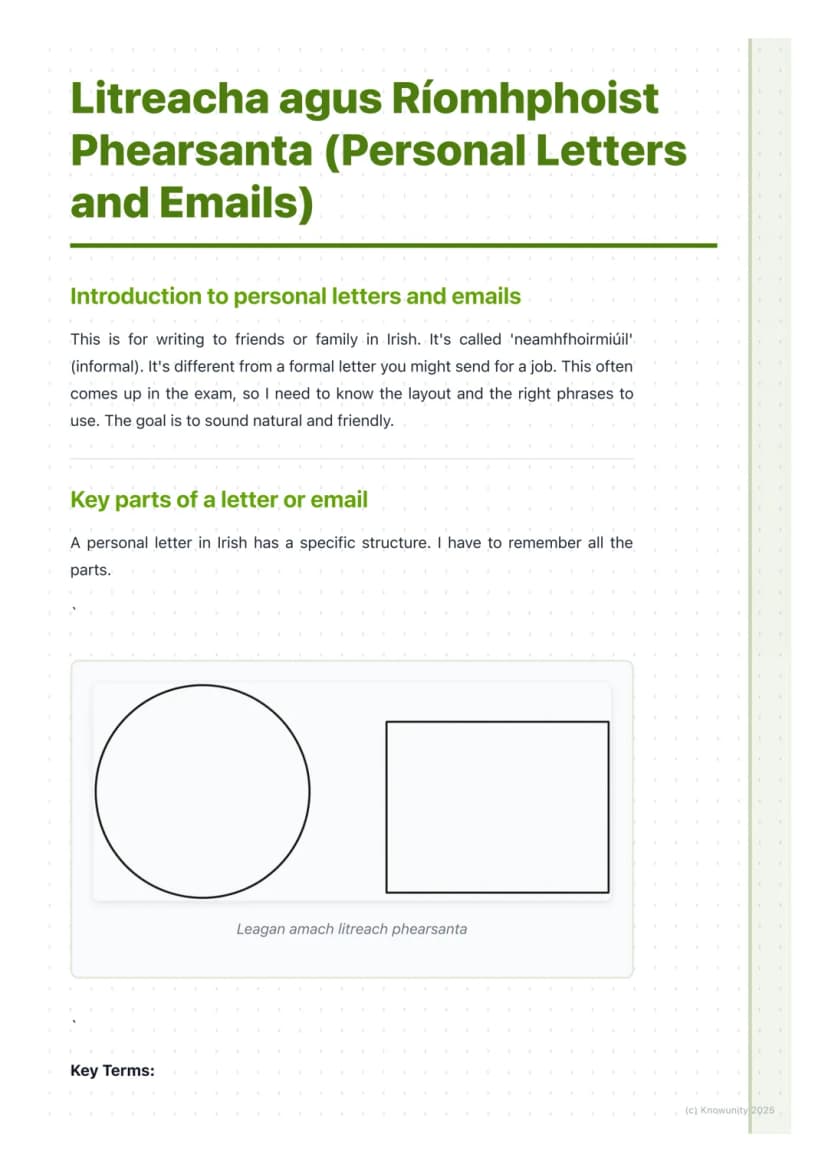
Ever wondered how to write to your mate in Irish without sounding like a robot? Personal letters and emails in Irish are called neamhfhoirmiúil (informal), and they're totally different from formal business letters.
The key is getting the structure right. Every litir phearsanta (personal letter) follows the same pattern, and once you nail this, you're sorted for the exam. Think of it like a template that you can adapt for any situation.
💡 Exam Tip: Learn the basic structure off by heart - it's easy marks waiting for you!
For emails, you can skip some parts like your address, but the friendly tone stays exactly the same. The examiners want to see that you can chat naturally in Irish whilst showing off your grammar skills.
2
of 6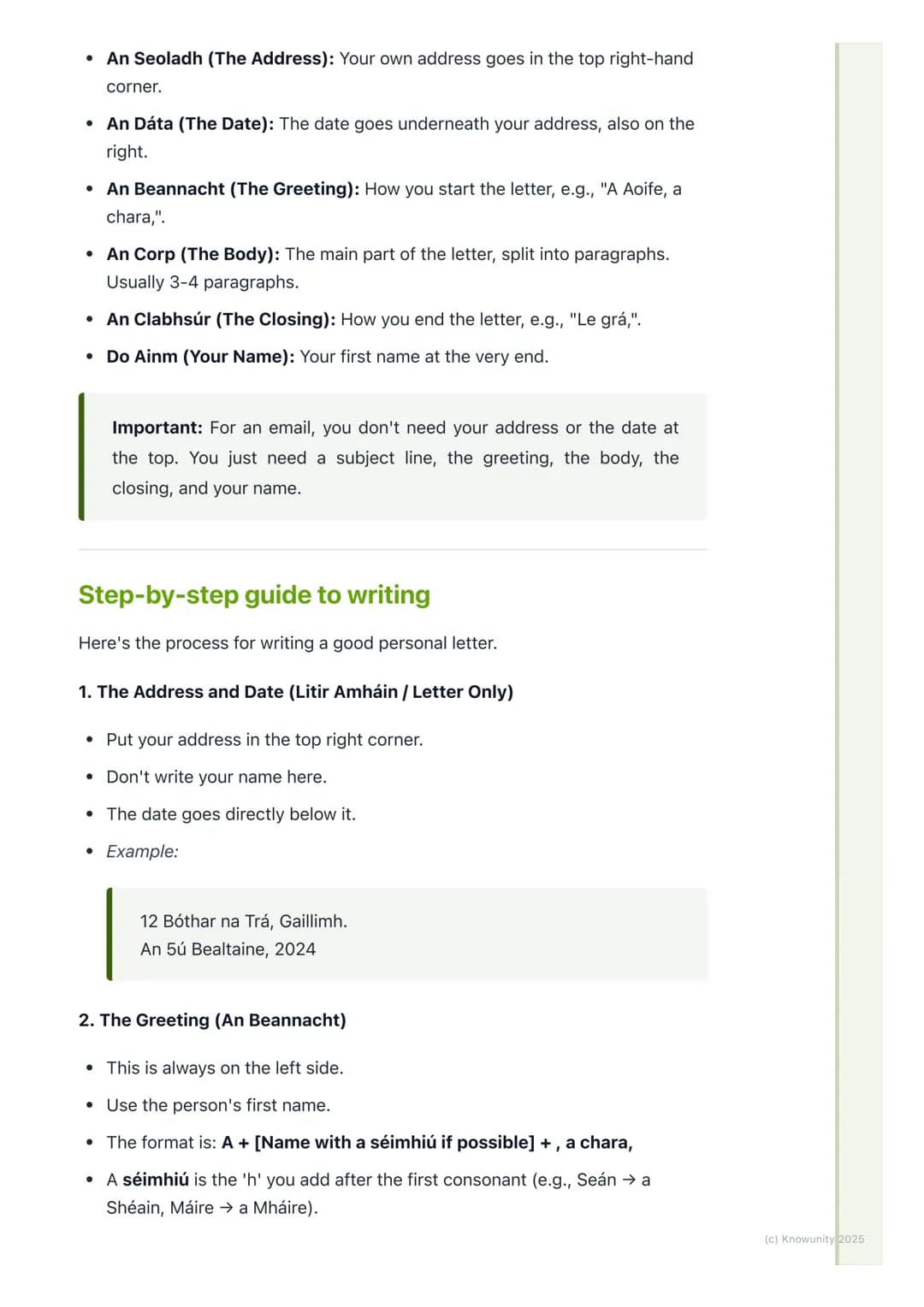
The Essential Structure You Need to Know
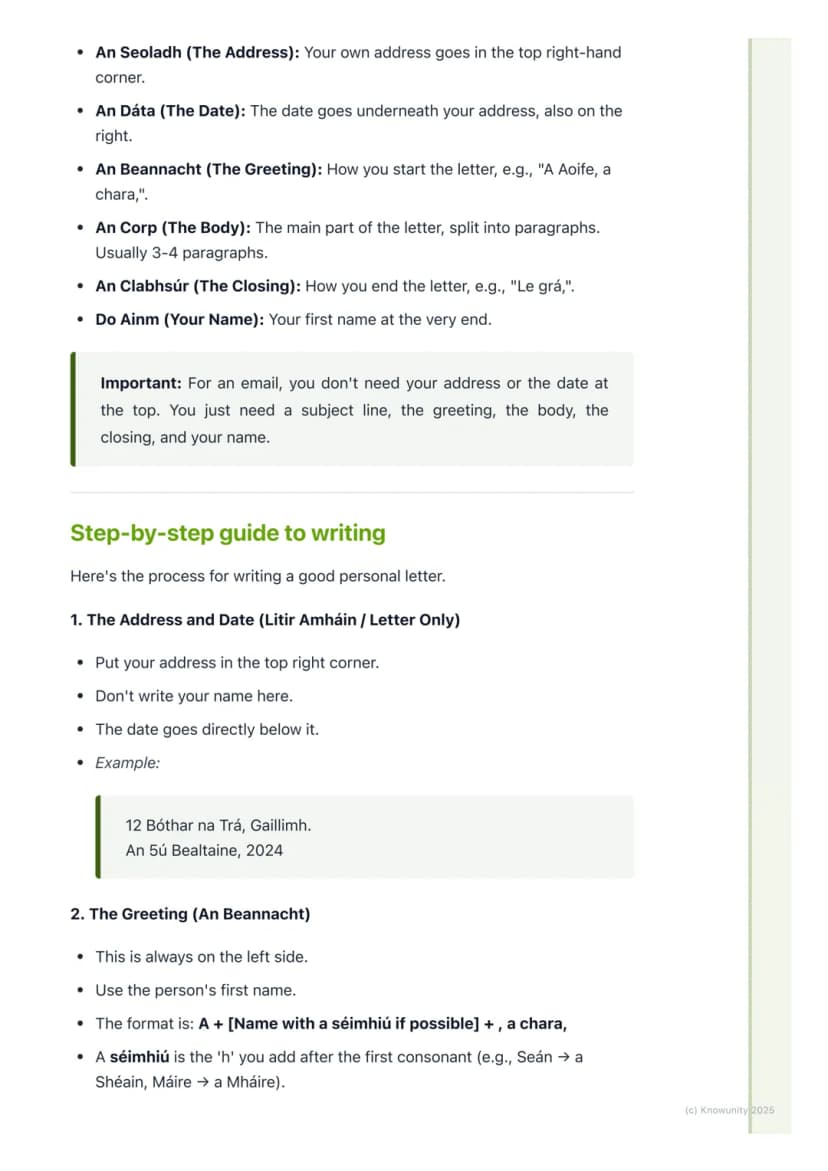
Your leagan amach litreach phearsanta (personal letter layout) has six main parts that never change. An seoladh (your address) goes top right, followed by an dáta (the date) just underneath it.
Then comes an beannacht (the greeting) on the left - this is where that tricky séimhiú comes in. You write "A" plus their name with an 'h' added: "A Shéain, a chara" or "A Mháire, a chara". If their name starts with a vowel or L, N, R, you don't add the 'h'.
An corp (the body) is your main content in 3-4 paragraphs. Finally, an clabhsúr (the closing) goes on the right with phrases like "Le grá," followed by do ainm (your first name).
💡 Quick Check: For emails, you only need a subject line, greeting, body, closing, and your name - much simpler!
Remember to put your address and date on the right, greeting on the left, and closing back on the right. This layout pattern is crucial for full marks.
3
of 6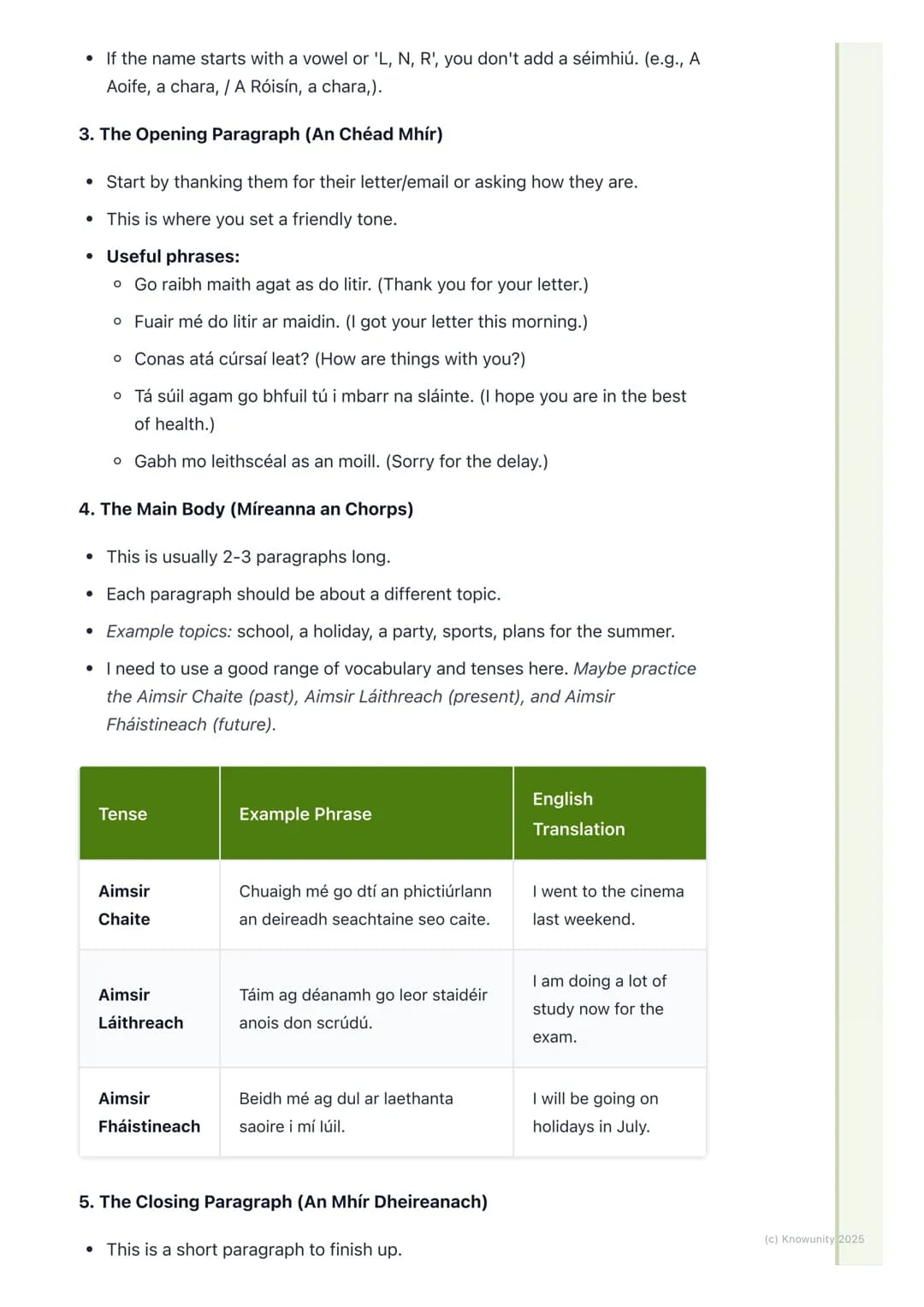
Writing Your Content Like a Pro
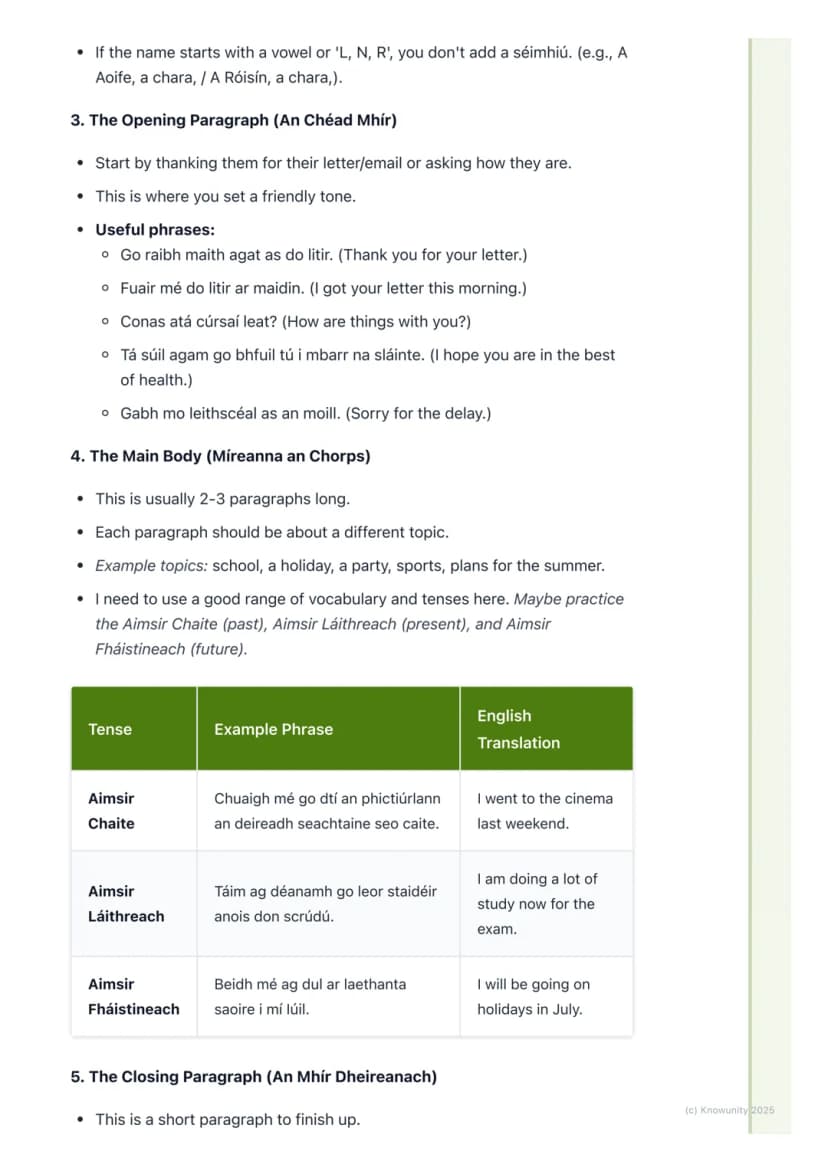
Start your opening paragraph by thanking them or asking how they are. Phrases like "Go raibh maith agat as do litir" (thanks for your letter) or "Conas atá cúrsaí leat?" (how are things?) work perfectly every time.
Your main body needs 2-3 paragraphs covering different topics - maybe school, holidays, or weekend plans. This is where you show off different tenses: Aimsir Chaite (past), Aimsir Láithreach (present), and Aimsir Fháistineach (future).
Mix up your sentences with examples like "Chuaigh mé go dtí an phictiúrlann" (I went to the cinema) for past, "Táim ag déanamh staidéir" (I'm studying) for present, and "Beidh mé ag dul ar laethanta saoire" (I'll be going on holidays) for future.
💡 Variety is Key: Using different tenses shows the examiners you're comfortable with Irish grammar!
End with a short closing paragraph asking them to write back: "Scríobh ar ais chugam go luath" (write back to me soon) keeps things friendly and natural.
4
of 6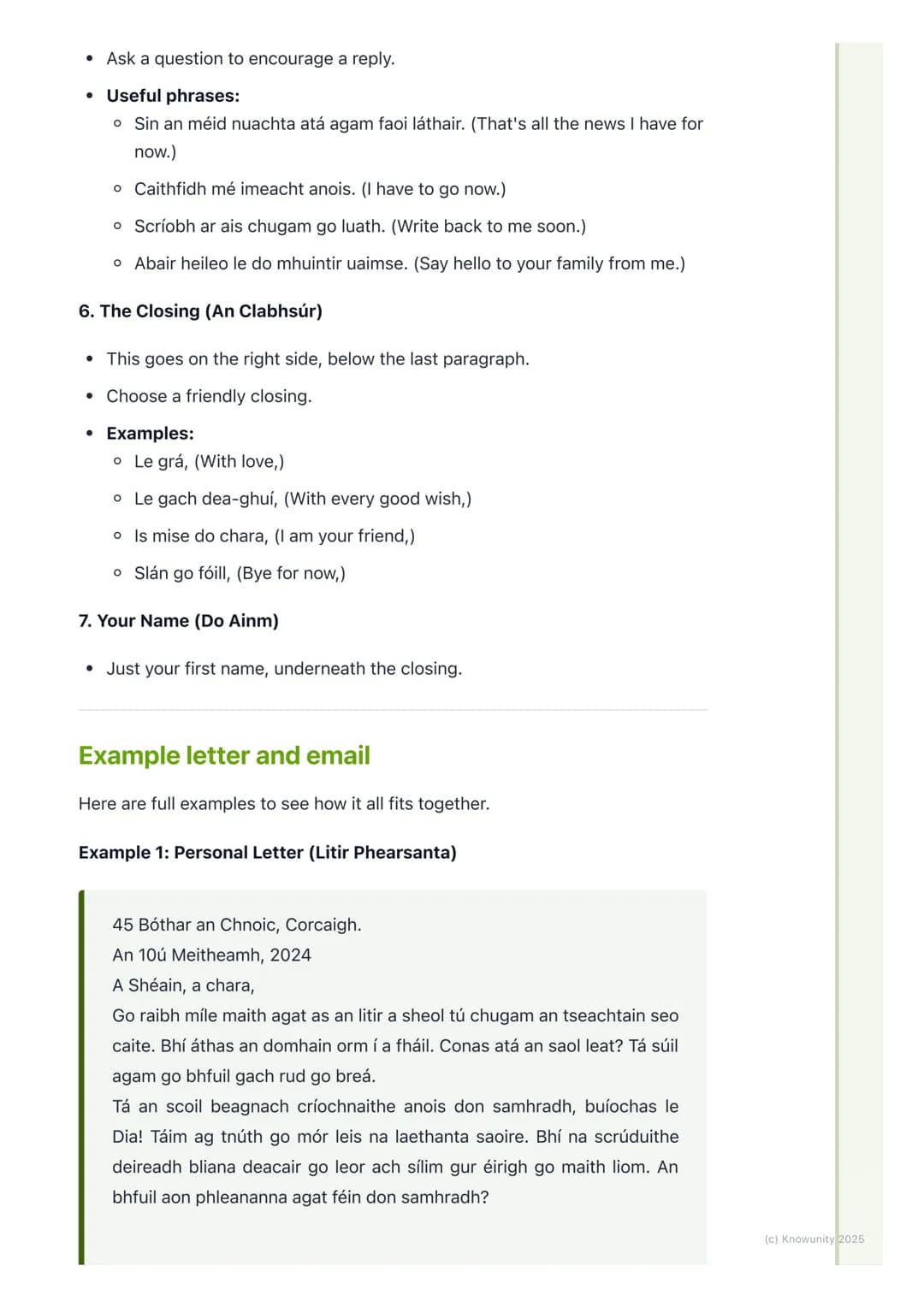
Real Examples That Actually Work
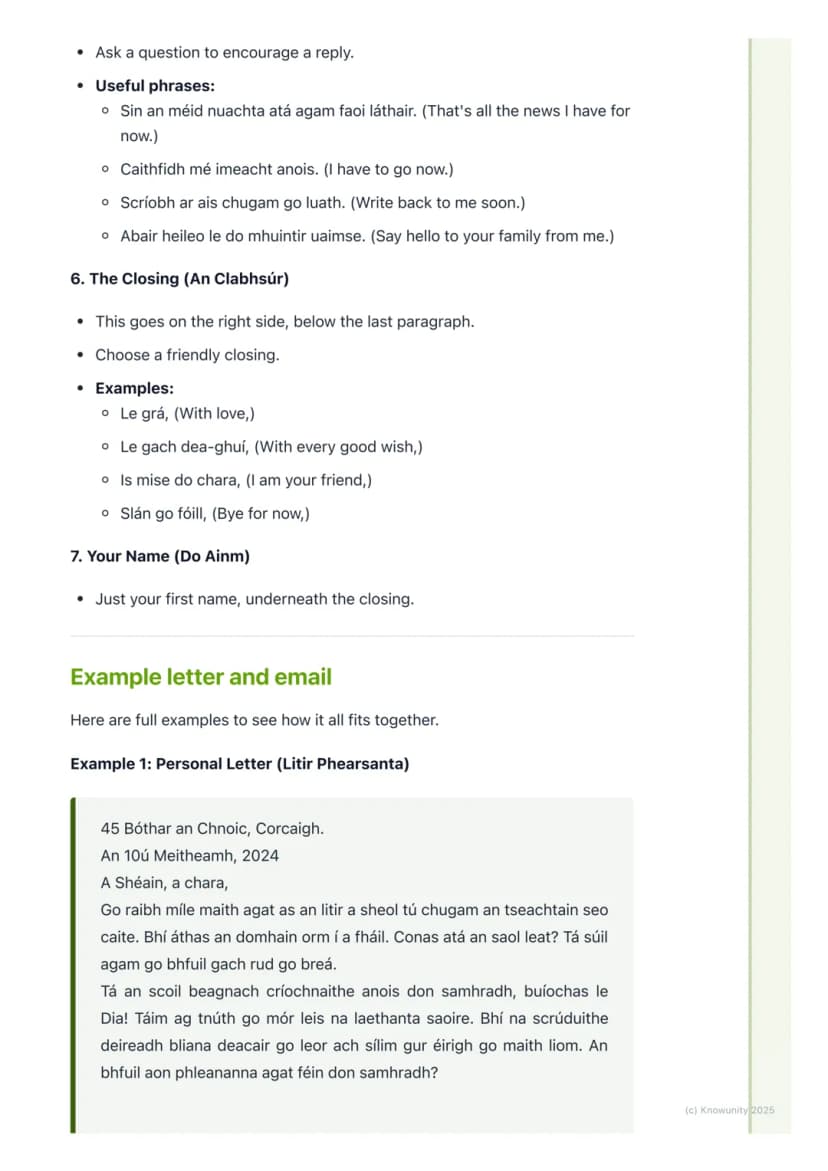
Here's how it looks in practice. Your litir phearsanta might start: "45 Bóthar an Chnoic, Corcaigh. An 10ú Meitheamh, 2024. A Shéain, a chara, Go raibh míle maith agat as an litir..."
For the main content, write about real stuff: "Tá an scoil beagnach críochnaithe anois don samhradh" (school's nearly finished for summer) or "Beidh mé ag dul go dtí an Ghaeltacht" (I'll be going to the Gaeltacht).
Ríomhphoist (emails) are even easier. Just add a subject line like "Deireadh Seachtaine i mBaile Átha Cliath" and jump straight into "A Aoife, a chara, Conas atá cúrsaí?"
💡 Sound Natural: Ask questions about their plans or experiences - it shows you understand the purpose of personal communication!
Close with friendly phrases like "Le gach dea-ghuí" (with every good wish) or "Slán go fóill" (bye for now) and you're done.
5
of 6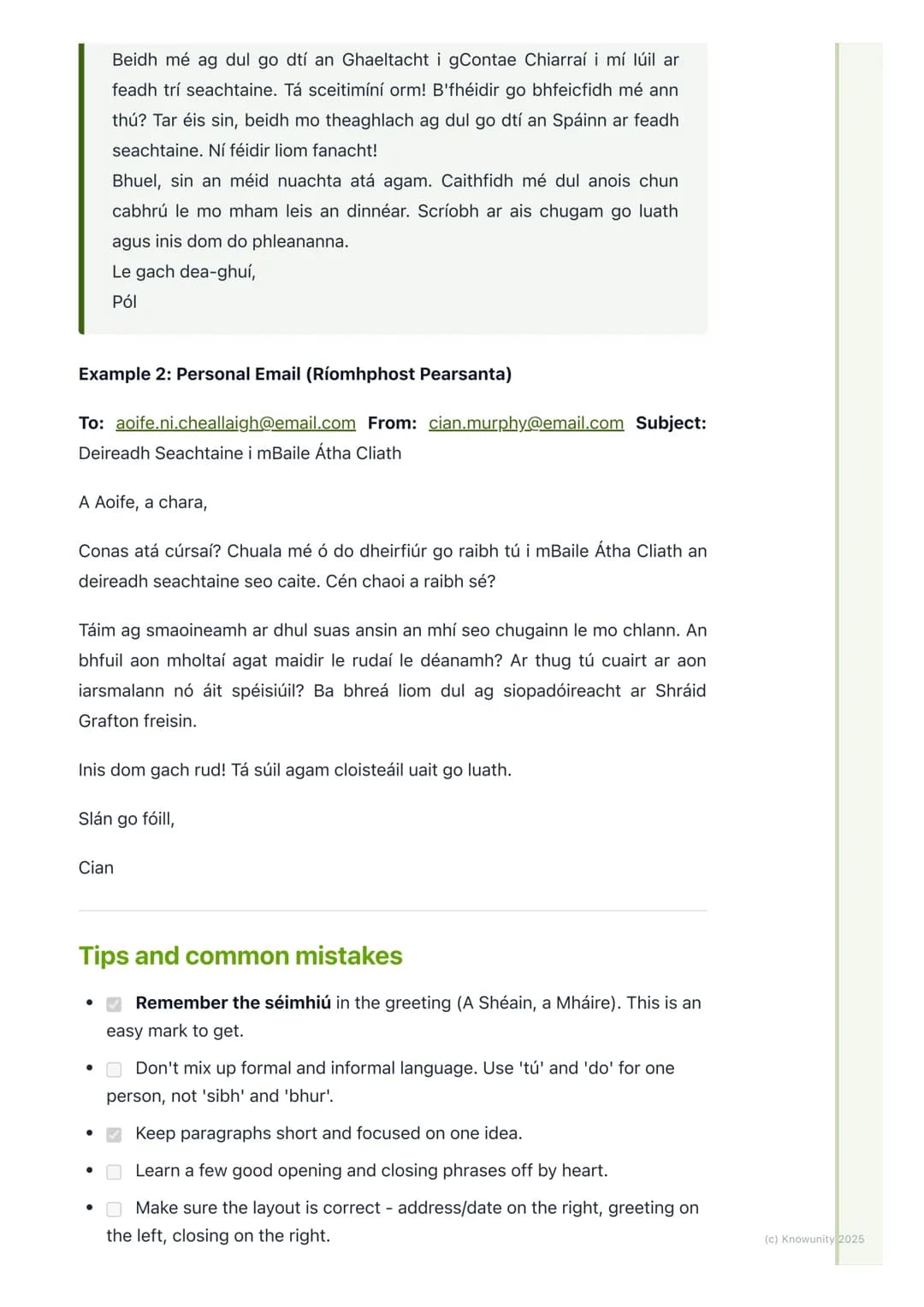
Avoiding the Most Common Mistakes
Don't mess up the séimhiú in your greeting - "A Shéain" not "A Seán". This tiny detail can cost you easy marks, so practice it until it's automatic.
Never mix formal and informal language. Stick to "tú" and "do" for one person, not "sibh" and "bhur" which are for groups or formal situations.
Keep your paragraphs short and focused. Each one should cover just one topic, whether that's school, sports, or weekend plans. Long, rambling paragraphs lose marks fast.
💡 Layout Matters: Get the positioning right - address/date on right, greeting on left, closing on right again!
For emails, make sure your ábhar (subject line) is short and in Irish. Something like "Pleananna an tSamhraidh" (summer plans) works perfectly and shows you're thinking in Irish from the start.
6
of 6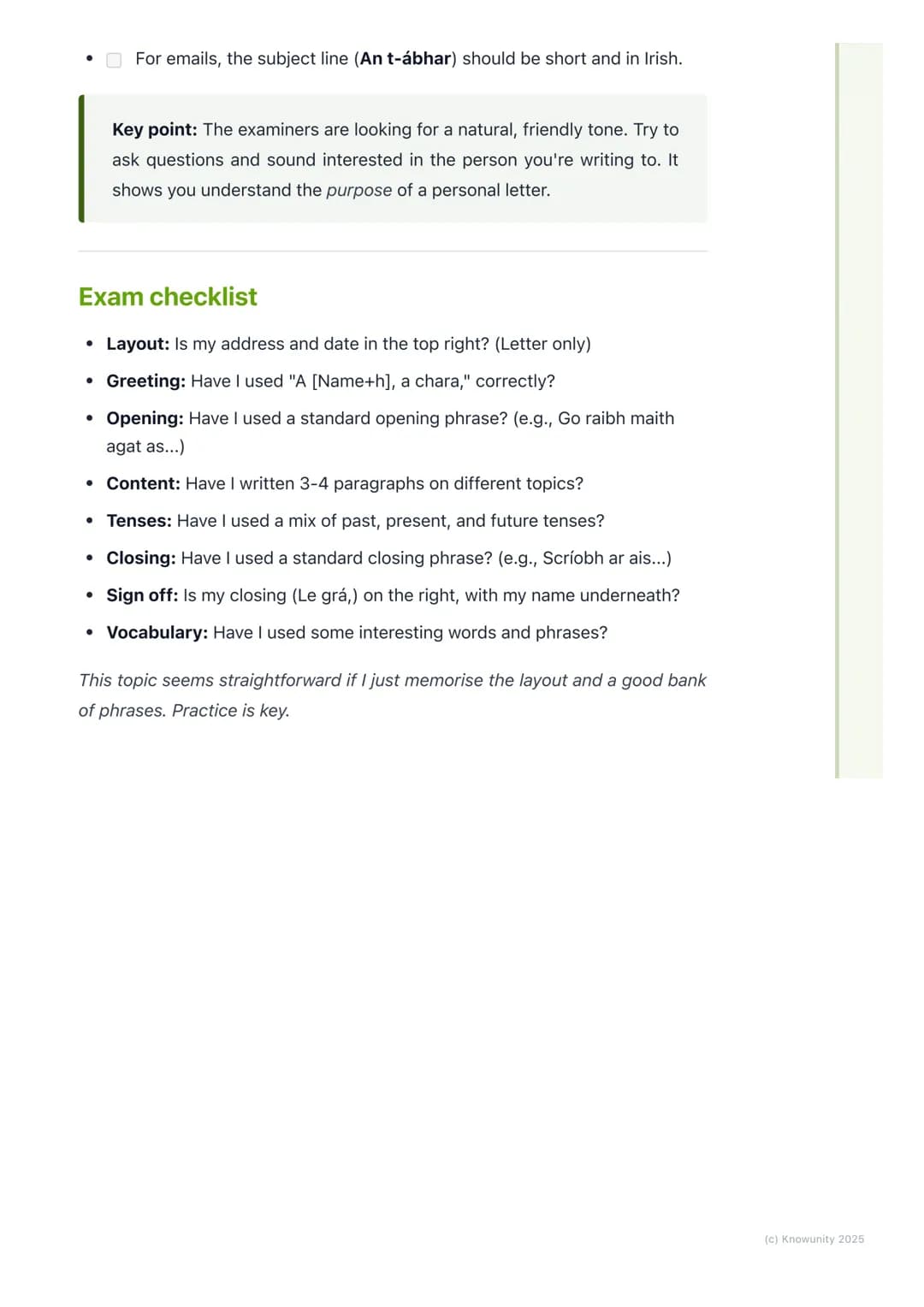
Your Exam Success Checklist
Before you hand in your paper, run through this quick checklist. Layout first: address and date top right (letters only), greeting with proper séimhiú on the left, and closing phrases positioned correctly on the right.
Content-wise, check you've used standard opening phrases, written 3-4 focused paragraphs, and mixed up your tenses properly. The examiners love seeing Aimsir Chaite, Aimsir Láithreach, and Aimsir Fháistineach all working together naturally.
Finally, make sure you sound genuinely friendly and interested. Ask questions, share news, and use phrases like "Tá súil agam go bhfuil tú i mbarr na sláinte" (I hope you're in great health) to show you understand Irish social conventions.
💡 Practice Makes Perfect: Learn a bank of useful phrases off by heart - they'll save you time and stress in the exam!
This topic is actually quite straightforward once you master the structure. The key is practising until the layout becomes second nature, then you can focus on showing off your vocabulary and grammar skills.
Mysleli jsme, že se nikdy nezeptáš...
Co je AI společník Knowunity?
Náš AI společník je speciálně vytvořen pro potřeby studentů. Na základě milionů obsahových materiálů, které máme na platformě, můžeme studentům poskytovat opravdu smysluplné a relevantní odpovědi. Ale nejde jen o odpovědi, společník je ještě více o provázení studentů jejich každodenními výzvami v učení, s personalizovanými studijními plány, kvízy nebo obsahovými materiály v chatu a 100% personalizací na základě dovedností a vývoje studentů.
Kde si můžu stáhnout aplikaci Knowunity?
Aplikaci si můžete stáhnout z obchodu Google Play a Apple App Store.
Jak můžu dostat svou platbu? Kolik si můžu vydělat?
Ano, máte bezplatný přístup k obsahu v aplikaci a k našemu společníkovi s umělou inteligencí. Chcete-li odemknout určité funkce aplikace, můžete si zakoupit aplikaci Knowunity Pro.
Nejpopulárnější poznámky z Irish
9IrishIrish oral questions and answers
Questions and answers for the leaving cert oral
5th Year4264
IrishIrish oral questions
Outline of oral questions
5th Year2055
IrishIrish poetry 2027
Iníon + Dínit an Bhróin
5th Year1133
IrishIníon- le hÁine Durkin
Aine Durkin’s poem, Iníon: Themes & summary
5th Year850
IrishLC HL notes- Iníon (poem)
Includes poem in English and Irish, theme, key words & phrases
5th Year2284
IrishMo Ghrá-sa (Idir Lúibíní)
Notes on mo ghrá-sa
5th Year380
IrishGaeilge Grammar Office
All the basics you need to know on Irish grammar.
6th Year1063
IrishAn Gaeilge Aiste
Irish Language essay
6th Year1320
IrishMé Féin & Mo Chlann (Myself & My Family)
Students will learn vocabulary to describe themselves, their family members, and daily routines. This helps in personal introductions and discussions.
TY291
Nejpopulárnější poznámky
9IrishIrish oral questions and answers
Questions and answers for the leaving cert oral
5th Year4264
 English
Key Quotes : Sive
Key Quotes and explanations: Sive
6th Year2842
IrishIrish oral questions
Outline of oral questions
5th Year2055
IrishIníon- le hÁine Durkin
Aine Durkin’s poem, Iníon: Themes & summary
5th Year850
IrishIrish poetry 2027
Iníon + Dínit an Bhróin
5th Year1133
IrishLC HL notes- Iníon (poem)
Includes poem in English and Irish, theme, key words & phrases
5th Year2284
EnglishCultural Context : Shawshank Redemption : Sive : Small Things Like These
Comparative Study : Cultural Context : Shawshank Redemption, Sive and Small Things Like These
6th Year1430
IrishMo Ghrá-sa (Idir Lúibíní)
Notes on mo ghrá-sa
5th Year380
IrishAn Gaeilge Aiste
Irish Language essay
6th Year1320
Nemůžeš najít, co hledáš? Prozkoumej další předměty.
Recenze od našich uživatelů. Mají vše super — a ty taky můžeš.
4.6/5App Store
4.7/5Google Play
Aplikace je velmi jednoduchá na používání a dobře navržená. Zatím jsem našel vše, co jsem hledal, a mohl jsem se z prezentací hodně naučit! Určitě použiju aplikaci na školní úkol! A samozřejmě taky hodně pomáhá jako inspirace.
Stefan Suživatel iOS
Tahle aplikace je fakt skvělá. Je tam tolik studijních poznámek a pomůcek [...]. Můj problémový předmět je například francouzština a aplikace nabízí tolik možností pomoci. Díky této aplikaci jsem si zlepšil francouzštinu. Doporučil bych ji každému.
Samantha Klichuživatelka Androidu
Páni, jsem opravdu ohromen. Zkusil jsem aplikaci jen proto, že jsem ji mnohokrát viděl v reklamách, a byl jsem naprosto ohromen. Tato aplikace je TA POMOC, kterou chceš do školy, a především nabízí spoustu věcí, jako jsou cvičení a přehledy faktů, které mi osobně VELMI pomohly.
Annauživatelka iOS
Irish3 zobrazení·Aktualizováno Jun 2, 2026·6 stránekConas Litreacha agus Ríomhphoist Phearsanta a Scríobh
Writing personal letters and emails in Irish is a key skill that often shows up in your Leaving Cert exam. It's all about sounding natural and friendly whilst following the proper Irish structure and using the right phrases.
1
of 6
Registruj se, abys viděl obsah. Je to zdarma!
- Přístup ke všem dokumentům
- Zlepši své známky
- Připoj se k milionům studentů
Getting Started with Personal Letters and Emails
Ever wondered how to write to your mate in Irish without sounding like a robot? Personal letters and emails in Irish are called neamhfhoirmiúil (informal), and they're totally different from formal business letters.
The key is getting the structure right. Every litir phearsanta (personal letter) follows the same pattern, and once you nail this, you're sorted for the exam. Think of it like a template that you can adapt for any situation.
💡 Exam Tip: Learn the basic structure off by heart - it's easy marks waiting for you!
For emails, you can skip some parts like your address, but the friendly tone stays exactly the same. The examiners want to see that you can chat naturally in Irish whilst showing off your grammar skills.
2
of 6Registruj se, abys viděl obsah. Je to zdarma!
- Přístup ke všem dokumentům
- Zlepši své známky
- Připoj se k milionům studentů
The Essential Structure You Need to Know
Your leagan amach litreach phearsanta (personal letter layout) has six main parts that never change. An seoladh (your address) goes top right, followed by an dáta (the date) just underneath it.
Then comes an beannacht (the greeting) on the left - this is where that tricky séimhiú comes in. You write "A" plus their name with an 'h' added: "A Shéain, a chara" or "A Mháire, a chara". If their name starts with a vowel or L, N, R, you don't add the 'h'.
An corp (the body) is your main content in 3-4 paragraphs. Finally, an clabhsúr (the closing) goes on the right with phrases like "Le grá," followed by do ainm (your first name).
💡 Quick Check: For emails, you only need a subject line, greeting, body, closing, and your name - much simpler!
Remember to put your address and date on the right, greeting on the left, and closing back on the right. This layout pattern is crucial for full marks.
3
of 6Registruj se, abys viděl obsah. Je to zdarma!
- Přístup ke všem dokumentům
- Zlepši své známky
- Připoj se k milionům studentů
Writing Your Content Like a Pro
Start your opening paragraph by thanking them or asking how they are. Phrases like "Go raibh maith agat as do litir" (thanks for your letter) or "Conas atá cúrsaí leat?" (how are things?) work perfectly every time.
Your main body needs 2-3 paragraphs covering different topics - maybe school, holidays, or weekend plans. This is where you show off different tenses: Aimsir Chaite (past), Aimsir Láithreach (present), and Aimsir Fháistineach (future).
Mix up your sentences with examples like "Chuaigh mé go dtí an phictiúrlann" (I went to the cinema) for past, "Táim ag déanamh staidéir" (I'm studying) for present, and "Beidh mé ag dul ar laethanta saoire" (I'll be going on holidays) for future.
💡 Variety is Key: Using different tenses shows the examiners you're comfortable with Irish grammar!
End with a short closing paragraph asking them to write back: "Scríobh ar ais chugam go luath" (write back to me soon) keeps things friendly and natural.
4
of 6Registruj se, abys viděl obsah. Je to zdarma!
- Přístup ke všem dokumentům
- Zlepši své známky
- Připoj se k milionům studentů
Real Examples That Actually Work
Here's how it looks in practice. Your litir phearsanta might start: "45 Bóthar an Chnoic, Corcaigh. An 10ú Meitheamh, 2024. A Shéain, a chara, Go raibh míle maith agat as an litir..."
For the main content, write about real stuff: "Tá an scoil beagnach críochnaithe anois don samhradh" (school's nearly finished for summer) or "Beidh mé ag dul go dtí an Ghaeltacht" (I'll be going to the Gaeltacht).
Ríomhphoist (emails) are even easier. Just add a subject line like "Deireadh Seachtaine i mBaile Átha Cliath" and jump straight into "A Aoife, a chara, Conas atá cúrsaí?"
💡 Sound Natural: Ask questions about their plans or experiences - it shows you understand the purpose of personal communication!
Close with friendly phrases like "Le gach dea-ghuí" (with every good wish) or "Slán go fóill" (bye for now) and you're done.
5
of 6Registruj se, abys viděl obsah. Je to zdarma!
- Přístup ke všem dokumentům
- Zlepši své známky
- Připoj se k milionům studentů
Avoiding the Most Common Mistakes
Don't mess up the séimhiú in your greeting - "A Shéain" not "A Seán". This tiny detail can cost you easy marks, so practice it until it's automatic.
Never mix formal and informal language. Stick to "tú" and "do" for one person, not "sibh" and "bhur" which are for groups or formal situations.
Keep your paragraphs short and focused. Each one should cover just one topic, whether that's school, sports, or weekend plans. Long, rambling paragraphs lose marks fast.
💡 Layout Matters: Get the positioning right - address/date on right, greeting on left, closing on right again!
For emails, make sure your ábhar (subject line) is short and in Irish. Something like "Pleananna an tSamhraidh" (summer plans) works perfectly and shows you're thinking in Irish from the start.
6
of 6Registruj se, abys viděl obsah. Je to zdarma!
- Přístup ke všem dokumentům
- Zlepši své známky
- Připoj se k milionům studentů
Your Exam Success Checklist
Before you hand in your paper, run through this quick checklist. Layout first: address and date top right (letters only), greeting with proper séimhiú on the left, and closing phrases positioned correctly on the right.
Content-wise, check you've used standard opening phrases, written 3-4 focused paragraphs, and mixed up your tenses properly. The examiners love seeing Aimsir Chaite, Aimsir Láithreach, and Aimsir Fháistineach all working together naturally.
Finally, make sure you sound genuinely friendly and interested. Ask questions, share news, and use phrases like "Tá súil agam go bhfuil tú i mbarr na sláinte" (I hope you're in great health) to show you understand Irish social conventions.
💡 Practice Makes Perfect: Learn a bank of useful phrases off by heart - they'll save you time and stress in the exam!
This topic is actually quite straightforward once you master the structure. The key is practising until the layout becomes second nature, then you can focus on showing off your vocabulary and grammar skills.
Mysleli jsme, že se nikdy nezeptáš...
Co je AI společník Knowunity?
Náš AI společník je speciálně vytvořen pro potřeby studentů. Na základě milionů obsahových materiálů, které máme na platformě, můžeme studentům poskytovat opravdu smysluplné a relevantní odpovědi. Ale nejde jen o odpovědi, společník je ještě více o provázení studentů jejich každodenními výzvami v učení, s personalizovanými studijními plány, kvízy nebo obsahovými materiály v chatu a 100% personalizací na základě dovedností a vývoje studentů.
Kde si můžu stáhnout aplikaci Knowunity?
Aplikaci si můžete stáhnout z obchodu Google Play a Apple App Store.
Jak můžu dostat svou platbu? Kolik si můžu vydělat?
Ano, máte bezplatný přístup k obsahu v aplikaci a k našemu společníkovi s umělou inteligencí. Chcete-li odemknout určité funkce aplikace, můžete si zakoupit aplikaci Knowunity Pro.
Nejpopulárnější poznámky z Irish
9IrishIrish oral questions and answers
Questions and answers for the leaving cert oral
5th Year4264
IrishIrish oral questions
Outline of oral questions
5th Year2055
IrishIrish poetry 2027
Iníon + Dínit an Bhróin
5th Year1133
IrishIníon- le hÁine Durkin
Aine Durkin’s poem, Iníon: Themes & summary
5th Year850
IrishLC HL notes- Iníon (poem)
Includes poem in English and Irish, theme, key words & phrases
5th Year2284
IrishMo Ghrá-sa (Idir Lúibíní)
Notes on mo ghrá-sa
5th Year380
IrishGaeilge Grammar Office
All the basics you need to know on Irish grammar.
6th Year1063
IrishAn Gaeilge Aiste
Irish Language essay
6th Year1320
IrishMé Féin & Mo Chlann (Myself & My Family)
Students will learn vocabulary to describe themselves, their family members, and daily routines. This helps in personal introductions and discussions.
TY291
Nejpopulárnější poznámky
9IrishIrish oral questions and answers
Questions and answers for the leaving cert oral
5th Year4264
EnglishKey Quotes : Sive
Key Quotes and explanations: Sive
6th Year2842
IrishIrish oral questions
Outline of oral questions
5th Year2055
IrishIníon- le hÁine Durkin
Aine Durkin’s poem, Iníon: Themes & summary
5th Year850
IrishIrish poetry 2027
Iníon + Dínit an Bhróin
5th Year1133
IrishLC HL notes- Iníon (poem)
Includes poem in English and Irish, theme, key words & phrases
5th Year2284
EnglishCultural Context : Shawshank Redemption : Sive : Small Things Like These
Comparative Study : Cultural Context : Shawshank Redemption, Sive and Small Things Like These
6th Year1430
IrishMo Ghrá-sa (Idir Lúibíní)
Notes on mo ghrá-sa
5th Year380
IrishAn Gaeilge Aiste
Irish Language essay
6th Year1320
Nemůžeš najít, co hledáš? Prozkoumej další předměty.
Recenze od našich uživatelů. Mají vše super — a ty taky můžeš.
4.6/5App Store
4.7/5Google Play
Aplikace je velmi jednoduchá na používání a dobře navržená. Zatím jsem našel vše, co jsem hledal, a mohl jsem se z prezentací hodně naučit! Určitě použiju aplikaci na školní úkol! A samozřejmě taky hodně pomáhá jako inspirace.
Stefan Suživatel iOS
Tahle aplikace je fakt skvělá. Je tam tolik studijních poznámek a pomůcek [...]. Můj problémový předmět je například francouzština a aplikace nabízí tolik možností pomoci. Díky této aplikaci jsem si zlepšil francouzštinu. Doporučil bych ji každému.
Samantha Klichuživatelka Androidu
Páni, jsem opravdu ohromen. Zkusil jsem aplikaci jen proto, že jsem ji mnohokrát viděl v reklamách, a byl jsem naprosto ohromen. Tato aplikace je TA POMOC, kterou chceš do školy, a především nabízí spoustu věcí, jako jsou cvičení a přehledy faktů, které mi osobně VELMI pomohly.
Annauživatelka iOS