
Ever wonder why earthquakes happen or how mountains form? It... Zobrazit více
 Geography17 zobrazení·Aktualizováno May 19, 2026·6 stránek
Understanding Plate Tectonics and Earth's Dynamic Surface

1 / 6
1
of 6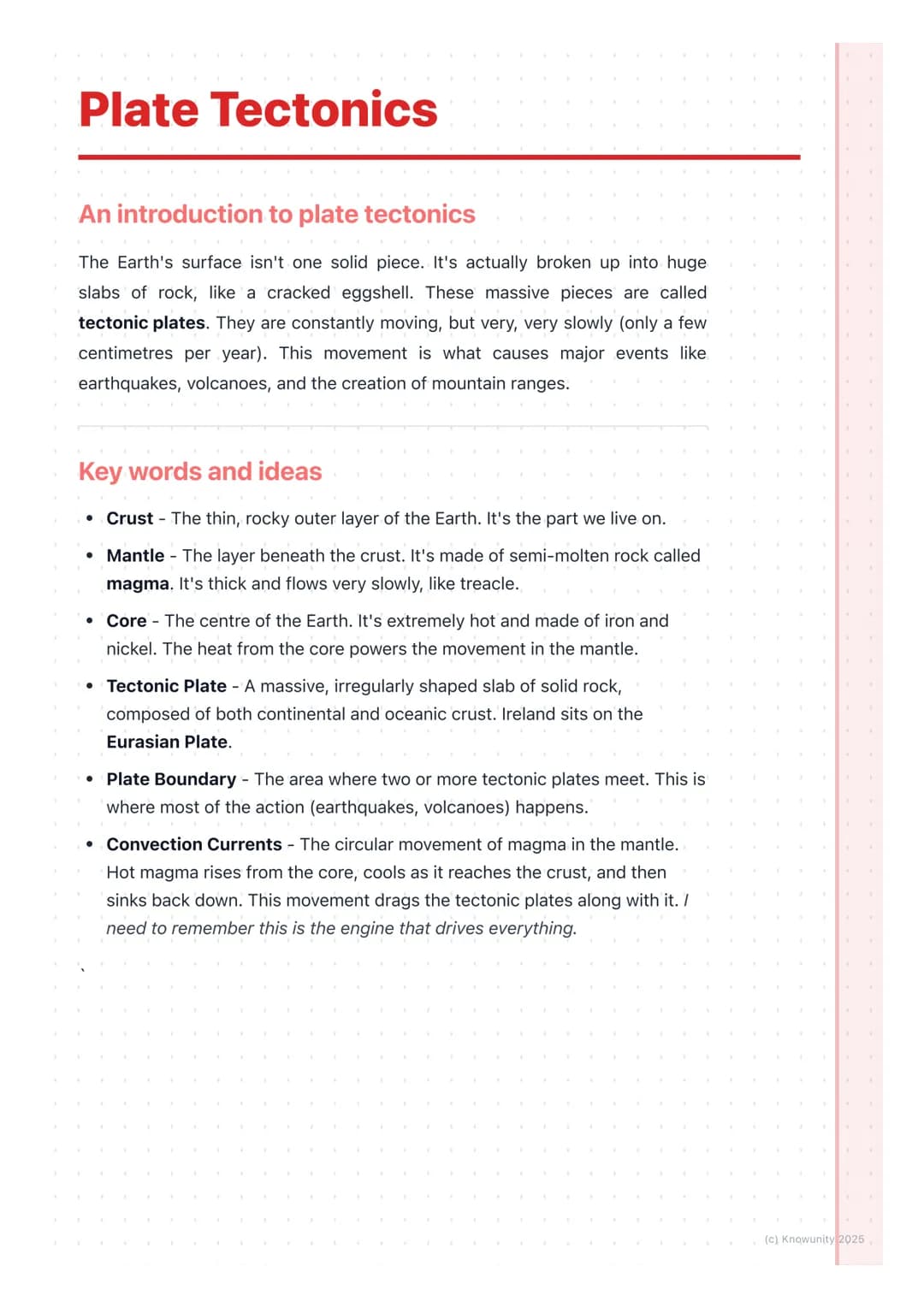
Understanding Earth's Structure and Plate Movement
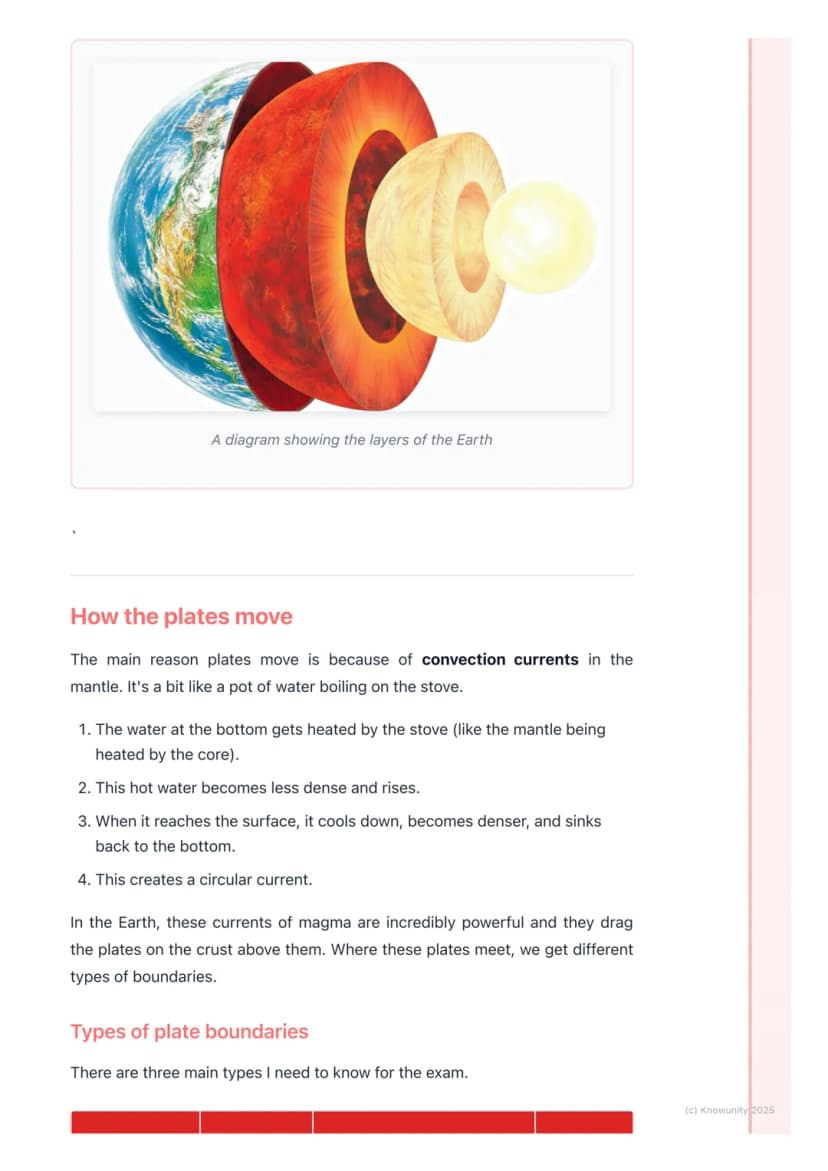
Think of Earth like a massive layered cake with a cracked outer shell. The crust is that thin, rocky outer layer where we live, whilst beneath it lies the mantle – a thick layer of semi-molten rock called magma that flows like treacle.
At Earth's centre is the incredibly hot core made of iron and nickel. This heat powers everything that happens above it! Tectonic plates are those massive, irregularly shaped slabs of solid rock that make up the crust – Ireland sits comfortably on the Eurasian Plate.
The real magic happens because of convection currents in the mantle. Picture a pot of water boiling – hot magma rises from the core, cools near the crust, then sinks back down, creating circular currents that drag the plates along with them. Plate boundaries are where two or more plates meet, and that's where all the exciting (and sometimes dangerous) action occurs!
Key Point: Convection currents are the engine that drives everything – always mention this in exam answers!
2
of 6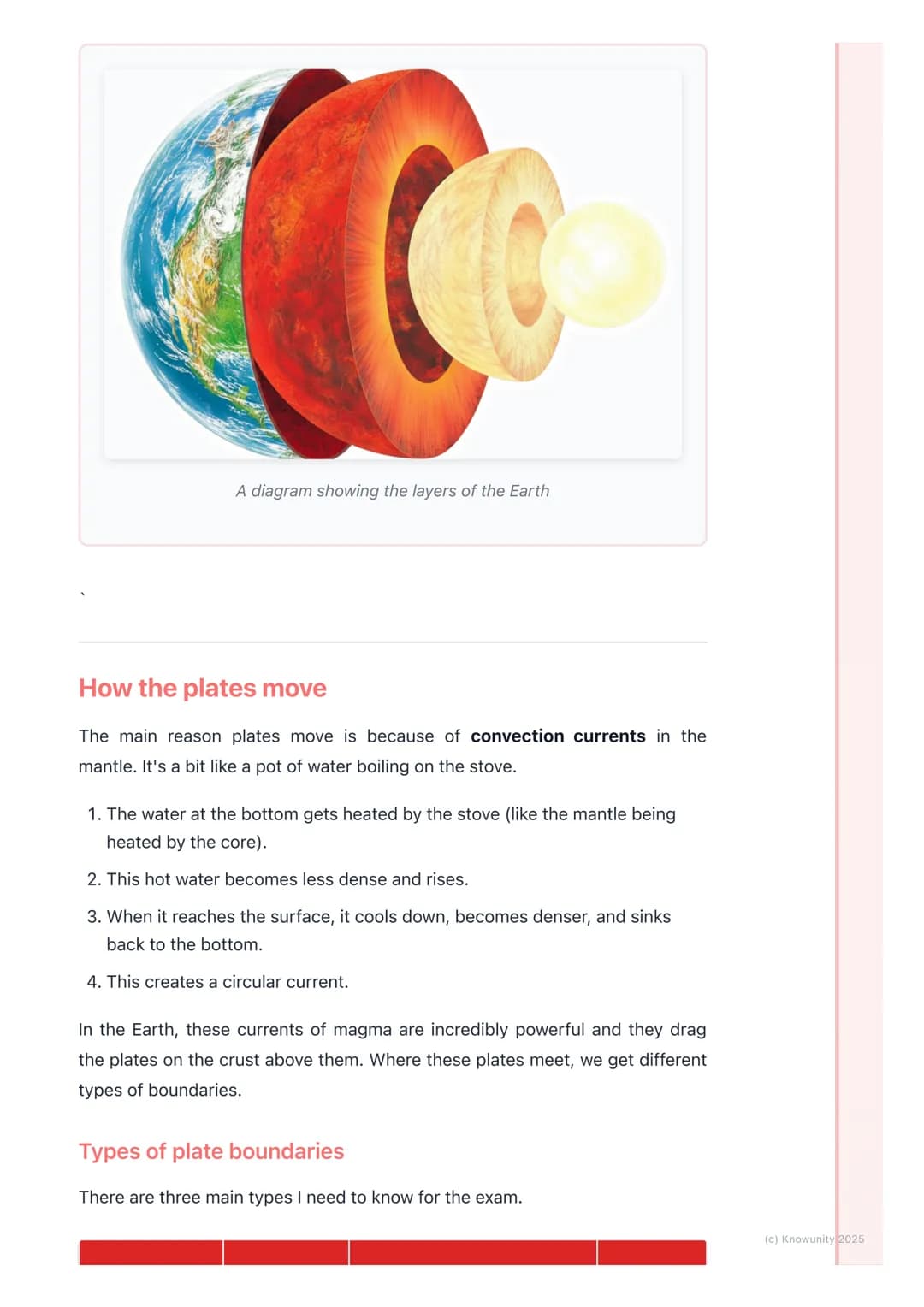
The Three Types of Plate Boundaries
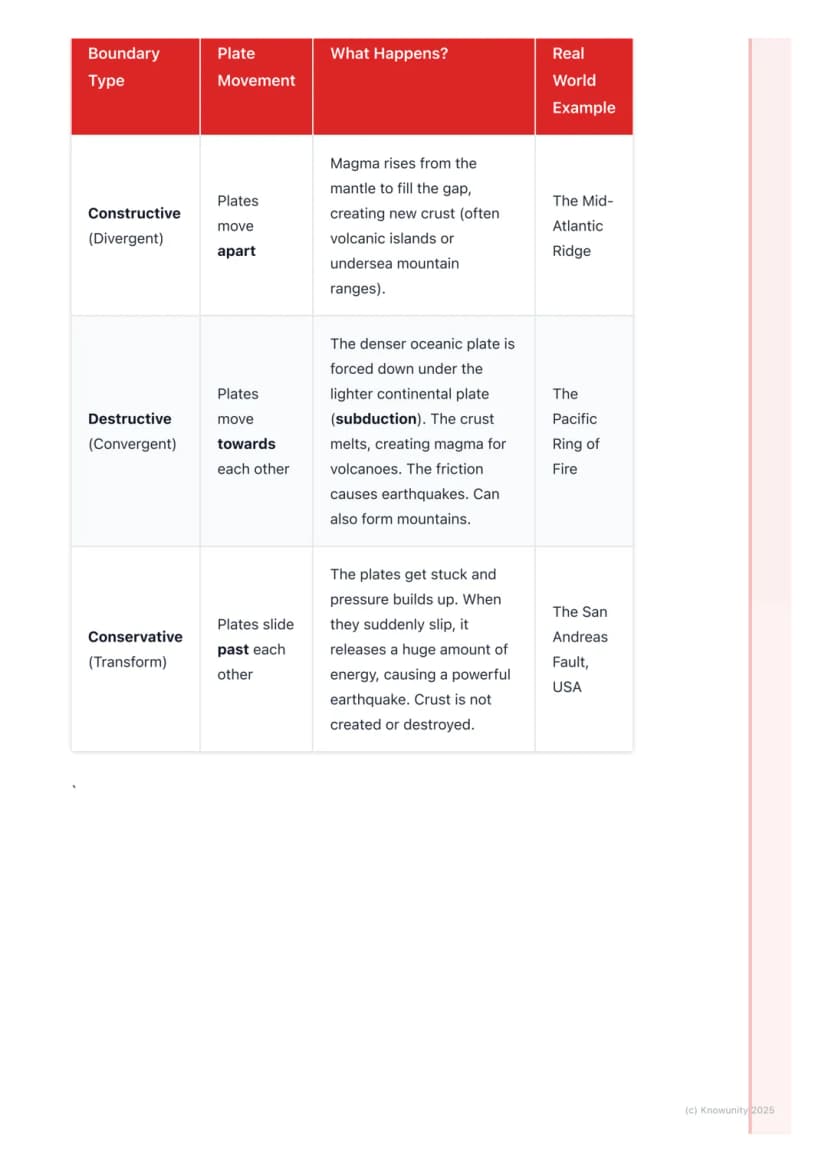
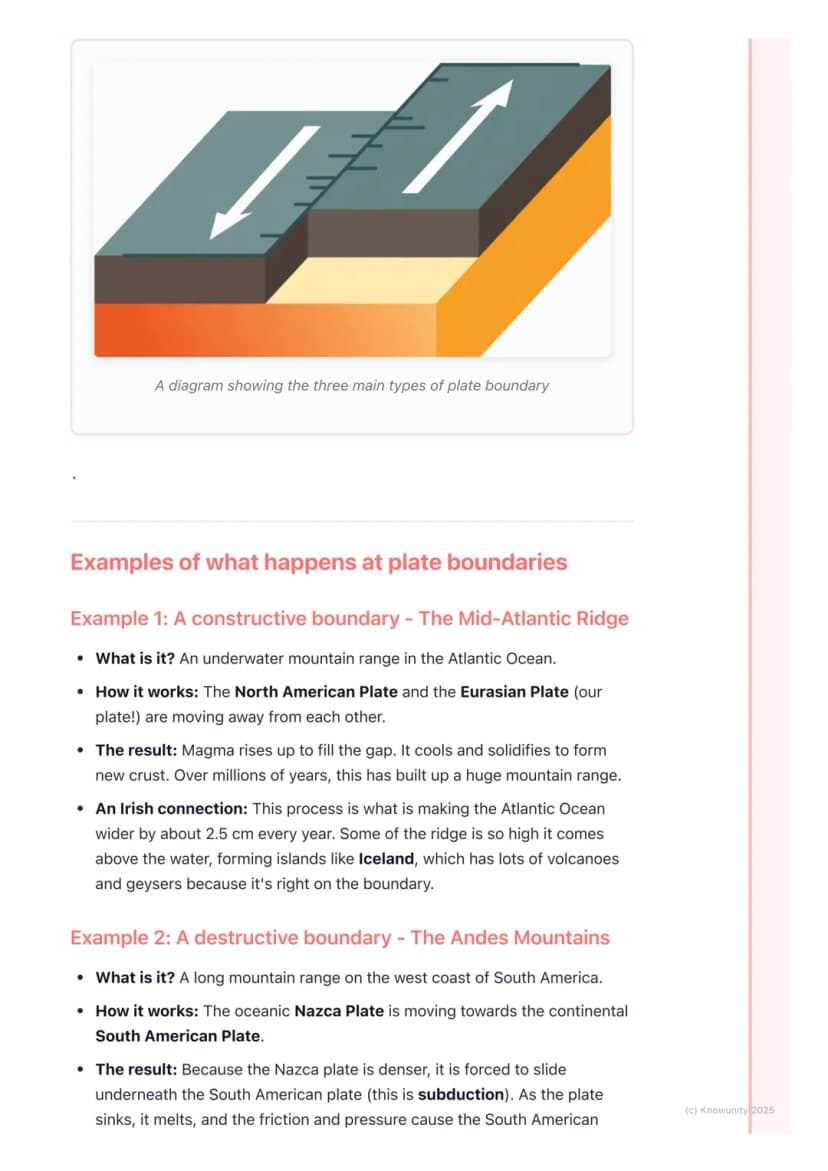
At constructive boundaries, plates move apart from each other. Magma rises to fill the gap, creating new crust and often forming volcanic islands or underwater mountain ranges. The Mid-Atlantic Ridge is a perfect example – it's making the Atlantic Ocean wider by 2.5 cm every year!
Destructive boundaries are where plates crash into each other. The denser oceanic plate gets forced down under the lighter continental plate in a process called subduction. This creates volcanoes, earthquakes, and mountain ranges like the Andes Mountains.
At conservative boundaries, plates slide past each other horizontally. They get stuck, pressure builds up, then suddenly slip, releasing massive energy as powerful earthquakes. The San Andreas Fault in California is the most famous example of this type.
Remember: Oceanic crust is always denser than continental crust, so it always sinks when they collide!
3
of 6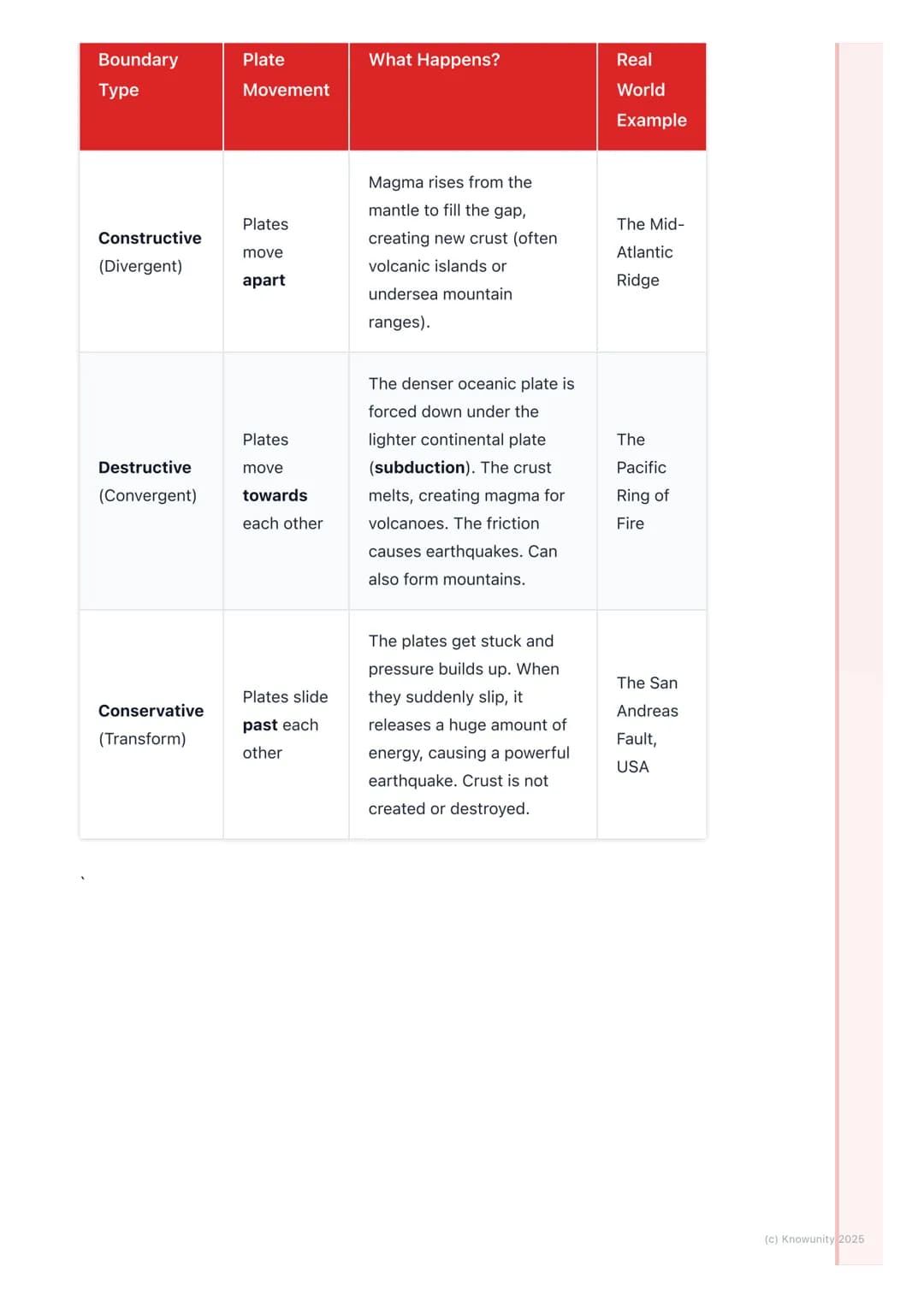
Real-World Examples You Need to Know
The Mid-Atlantic Ridge shows constructive boundaries in action. The North American Plate and our Eurasian Plate are moving apart underwater, and magma rises to fill the space. Over millions of years, this has built a massive underwater mountain range – some parts are so high they form islands like Iceland with its famous volcanoes and geysers!
The Andes Mountains demonstrate destructive boundaries perfectly. The oceanic Nazca Plate is sliding underneath the continental South American Plate through subduction. As the Nazca Plate melts, the friction and pressure cause the South American plate to buckle upwards, creating this enormous mountain range dotted with active volcanoes.
The Pacific Ring of Fire is a string of destructive plate boundaries around the Pacific Ocean where most of the world's earthquakes and volcanic eruptions happen. It's like a giant horseshoe of geological activity!
Fun Fact: Ireland is lucky to be far from any plate boundaries, which is why we don't have volcanoes or major earthquakes!
4
of 6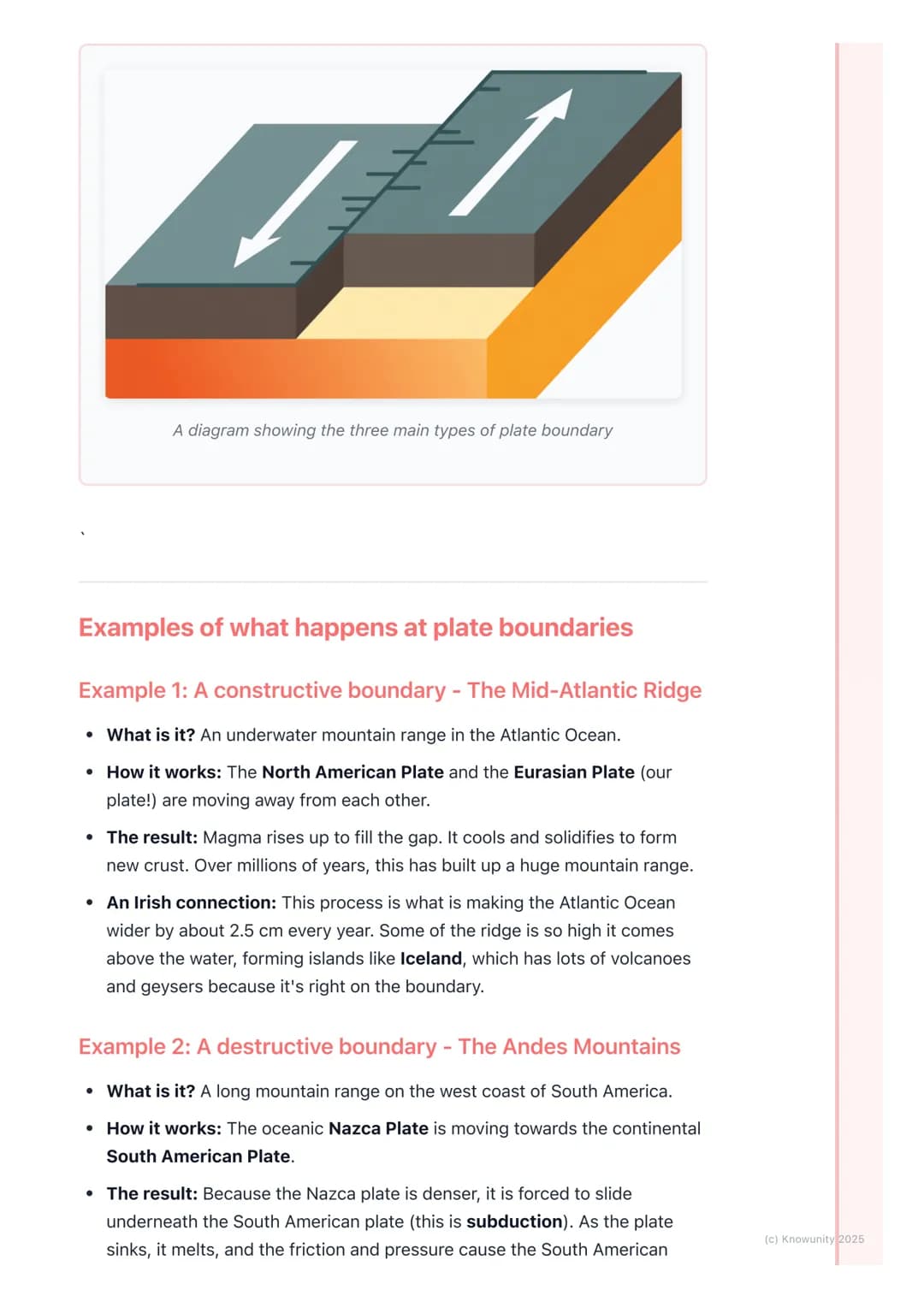
Key Concepts for Success
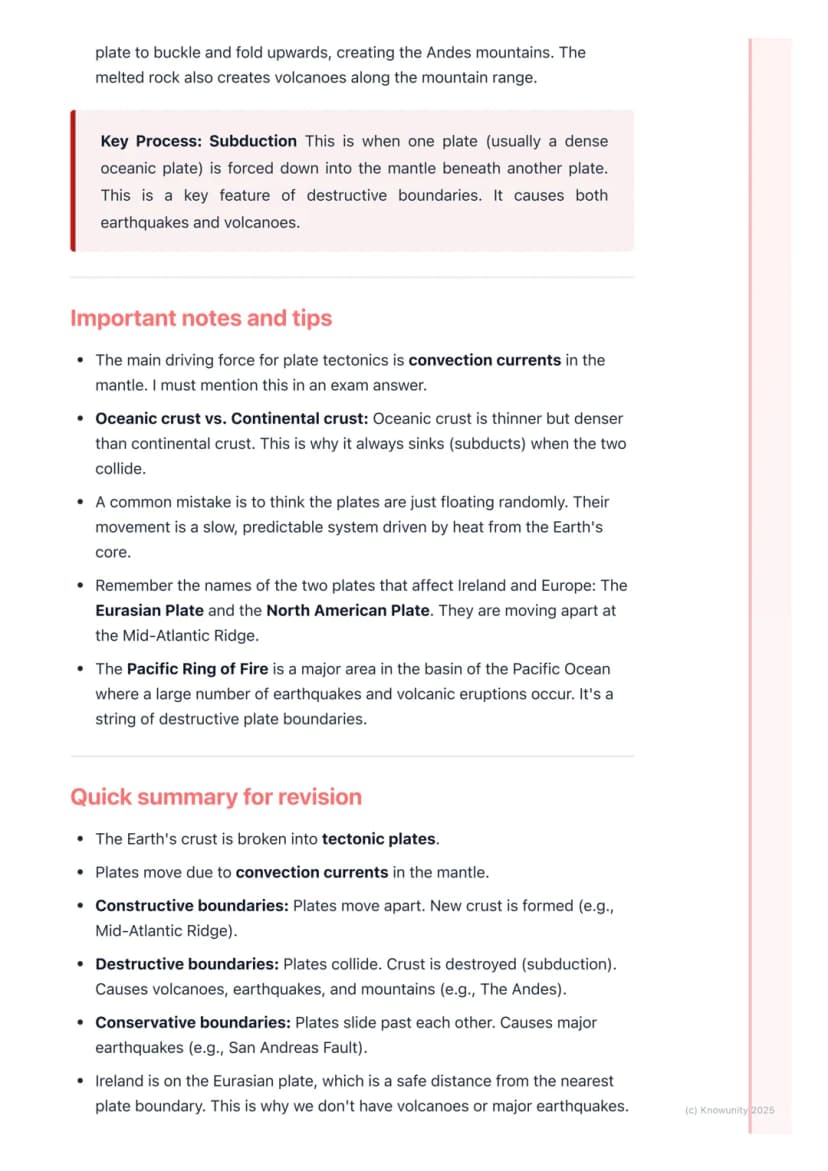
Remember that subduction is the crucial process at destructive boundaries where one plate is forced down into the mantle beneath another. This single process creates earthquakes, volcanoes, and mountain ranges all at once! The key difference between oceanic and continental crust is that oceanic crust is thinner but denser.
Don't make the common mistake of thinking plates float around randomly – their movement is a slow, predictable system entirely driven by heat from Earth's core. The plates affecting Ireland and Europe are the Eurasian Plate and the North American Plate, which are slowly moving apart.
For your exams, always explain that convection currents in the mantle are the main driving force behind plate tectonics. Think of the three boundary types as: constructive (building new crust), destructive (destroying old crust), and conservative (just sliding past without creating or destroying).
Exam Tip: Learn the real-world examples by heart – Mid-Atlantic Ridge, Andes Mountains, and San Andreas Fault are exam favourites!
5
of 6
6
of 6
Mysleli jsme, že se nikdy nezeptáš...
Co je AI společník Knowunity?
Náš AI společník je speciálně vytvořen pro potřeby studentů. Na základě milionů obsahových materiálů, které máme na platformě, můžeme studentům poskytovat opravdu smysluplné a relevantní odpovědi. Ale nejde jen o odpovědi, společník je ještě více o provázení studentů jejich každodenními výzvami v učení, s personalizovanými studijními plány, kvízy nebo obsahovými materiály v chatu a 100% personalizací na základě dovedností a vývoje studentů.
Kde si můžu stáhnout aplikaci Knowunity?
Aplikaci si můžete stáhnout z obchodu Google Play a Apple App Store.
Jak můžu dostat svou platbu? Kolik si můžu vydělat?
Ano, máte bezplatný přístup k obsahu v aplikaci a k našemu společníkovi s umělou inteligencí. Chcete-li odemknout určité funkce aplikace, můžete si zakoupit aplikaci Knowunity Pro.
Nejpopulárnější poznámky z Geography
9GeographyTerritory, economic activities in Paris basin
essay
6th Year80
GeographyGeography notes on rocks
Includes types of rocks,uses of rocks, case studies
1st Year331
GeographyRock notes geography
Geography
5th Year220
GeographyPopulation Change and Migration
This covers factors that cause populations to grow or shrink, including birth rates, death rates, and the reasons people migrate.
2nd Year90
GeographyEarthquakes revision notes
Notes on earthquakes with diagrams
1st Year110
GeographyThe sea
Jc Geography
1st Year230
GeographyGeography notes On the sea
Includes costal erosion, sea cliffs, longshore drift etc.
1st Year160
GeographyInside the Earth
Students will learn about the basic layers of the Earth: the crust, mantle, and core, understanding that our planet is made up of different parts.
1st Year51
GeographyRocks Leaving Cert Geography
The Rock Diagram , including some notes on rocks
6th Year111
Nejpopulárnější poznámky
9 Irish
IrishIrish oral questions and answers
Questions and answers for the leaving cert oral
5th Year4254
IrishIrish oral questions
Outline of oral questions
5th Year2055
IrishIníon- le hÁine Durkin
Aine Durkin’s poem, Iníon: Themes & summary
5th Year850
 English
Key Quotes : Sive
Key Quotes and explanations: Sive
6th Year2332
IrishIrish poetry 2027
Iníon + Dínit an Bhróin
5th Year1133
IrishLC HL notes- Iníon (poem)
Includes poem in English and Irish, theme, key words & phrases
5th Year2284
IrishGaeilge Grammar Office
All the basics you need to know on Irish grammar.
6th Year903
IrishMo Ghrá-sa (Idir Lúibíní)
Notes on mo ghrá-sa
5th Year350
IrishAn Gaeilge Aiste
Irish Language essay
6th Year1250
Nemůžeš najít, co hledáš? Prozkoumej další předměty.
Recenze od našich uživatelů. Mají vše super — a ty taky můžeš.
4.6/5App Store
4.7/5Google Play
Aplikace je velmi jednoduchá na používání a dobře navržená. Zatím jsem našel vše, co jsem hledal, a mohl jsem se z prezentací hodně naučit! Určitě použiju aplikaci na školní úkol! A samozřejmě taky hodně pomáhá jako inspirace.
Stefan Suživatel iOS
Tahle aplikace je fakt skvělá. Je tam tolik studijních poznámek a pomůcek [...]. Můj problémový předmět je například francouzština a aplikace nabízí tolik možností pomoci. Díky této aplikaci jsem si zlepšil francouzštinu. Doporučil bych ji každému.
Samantha Klichuživatelka Androidu
Páni, jsem opravdu ohromen. Zkusil jsem aplikaci jen proto, že jsem ji mnohokrát viděl v reklamách, a byl jsem naprosto ohromen. Tato aplikace je TA POMOC, kterou chceš do školy, a především nabízí spoustu věcí, jako jsou cvičení a přehledy faktů, které mi osobně VELMI pomohly.
Annauživatelka iOS
Geography17 zobrazení·Aktualizováno May 19, 2026·6 stránekUnderstanding Plate Tectonics and Earth's Dynamic Surface
Ever wonder why earthquakes happen or how mountains form? It all comes down to the fact that Earth's surface isn't one solid piece – it's actually broken up into massive slabs of rock called tectonic plates that are constantly moving... Zobrazit více
1
of 6Registruj se, abys viděl obsah. Je to zdarma!
- Přístup ke všem dokumentům
- Zlepši své známky
- Připoj se k milionům studentů
Understanding Earth's Structure and Plate Movement
Think of Earth like a massive layered cake with a cracked outer shell. The crust is that thin, rocky outer layer where we live, whilst beneath it lies the mantle – a thick layer of semi-molten rock called magma that flows like treacle.
At Earth's centre is the incredibly hot core made of iron and nickel. This heat powers everything that happens above it! Tectonic plates are those massive, irregularly shaped slabs of solid rock that make up the crust – Ireland sits comfortably on the Eurasian Plate.
The real magic happens because of convection currents in the mantle. Picture a pot of water boiling – hot magma rises from the core, cools near the crust, then sinks back down, creating circular currents that drag the plates along with them. Plate boundaries are where two or more plates meet, and that's where all the exciting (and sometimes dangerous) action occurs!
Key Point: Convection currents are the engine that drives everything – always mention this in exam answers!
2
of 6Registruj se, abys viděl obsah. Je to zdarma!
- Přístup ke všem dokumentům
- Zlepši své známky
- Připoj se k milionům studentů
The Three Types of Plate Boundaries
At constructive boundaries, plates move apart from each other. Magma rises to fill the gap, creating new crust and often forming volcanic islands or underwater mountain ranges. The Mid-Atlantic Ridge is a perfect example – it's making the Atlantic Ocean wider by 2.5 cm every year!
Destructive boundaries are where plates crash into each other. The denser oceanic plate gets forced down under the lighter continental plate in a process called subduction. This creates volcanoes, earthquakes, and mountain ranges like the Andes Mountains.
At conservative boundaries, plates slide past each other horizontally. They get stuck, pressure builds up, then suddenly slip, releasing massive energy as powerful earthquakes. The San Andreas Fault in California is the most famous example of this type.
Remember: Oceanic crust is always denser than continental crust, so it always sinks when they collide!
3
of 6Registruj se, abys viděl obsah. Je to zdarma!
- Přístup ke všem dokumentům
- Zlepši své známky
- Připoj se k milionům studentů
Real-World Examples You Need to Know
The Mid-Atlantic Ridge shows constructive boundaries in action. The North American Plate and our Eurasian Plate are moving apart underwater, and magma rises to fill the space. Over millions of years, this has built a massive underwater mountain range – some parts are so high they form islands like Iceland with its famous volcanoes and geysers!
The Andes Mountains demonstrate destructive boundaries perfectly. The oceanic Nazca Plate is sliding underneath the continental South American Plate through subduction. As the Nazca Plate melts, the friction and pressure cause the South American plate to buckle upwards, creating this enormous mountain range dotted with active volcanoes.
The Pacific Ring of Fire is a string of destructive plate boundaries around the Pacific Ocean where most of the world's earthquakes and volcanic eruptions happen. It's like a giant horseshoe of geological activity!
Fun Fact: Ireland is lucky to be far from any plate boundaries, which is why we don't have volcanoes or major earthquakes!
4
of 6Registruj se, abys viděl obsah. Je to zdarma!
- Přístup ke všem dokumentům
- Zlepši své známky
- Připoj se k milionům studentů
Key Concepts for Success
Remember that subduction is the crucial process at destructive boundaries where one plate is forced down into the mantle beneath another. This single process creates earthquakes, volcanoes, and mountain ranges all at once! The key difference between oceanic and continental crust is that oceanic crust is thinner but denser.
Don't make the common mistake of thinking plates float around randomly – their movement is a slow, predictable system entirely driven by heat from Earth's core. The plates affecting Ireland and Europe are the Eurasian Plate and the North American Plate, which are slowly moving apart.
For your exams, always explain that convection currents in the mantle are the main driving force behind plate tectonics. Think of the three boundary types as: constructive (building new crust), destructive (destroying old crust), and conservative (just sliding past without creating or destroying).
Exam Tip: Learn the real-world examples by heart – Mid-Atlantic Ridge, Andes Mountains, and San Andreas Fault are exam favourites!
5
of 6Registruj se, abys viděl obsah. Je to zdarma!
- Přístup ke všem dokumentům
- Zlepši své známky
- Připoj se k milionům studentů
6
of 6Registruj se, abys viděl obsah. Je to zdarma!
- Přístup ke všem dokumentům
- Zlepši své známky
- Připoj se k milionům studentů
Mysleli jsme, že se nikdy nezeptáš...
Co je AI společník Knowunity?
Náš AI společník je speciálně vytvořen pro potřeby studentů. Na základě milionů obsahových materiálů, které máme na platformě, můžeme studentům poskytovat opravdu smysluplné a relevantní odpovědi. Ale nejde jen o odpovědi, společník je ještě více o provázení studentů jejich každodenními výzvami v učení, s personalizovanými studijními plány, kvízy nebo obsahovými materiály v chatu a 100% personalizací na základě dovedností a vývoje studentů.
Kde si můžu stáhnout aplikaci Knowunity?
Aplikaci si můžete stáhnout z obchodu Google Play a Apple App Store.
Jak můžu dostat svou platbu? Kolik si můžu vydělat?
Ano, máte bezplatný přístup k obsahu v aplikaci a k našemu společníkovi s umělou inteligencí. Chcete-li odemknout určité funkce aplikace, můžete si zakoupit aplikaci Knowunity Pro.
Nejpopulárnější poznámky z Geography
9GeographyTerritory, economic activities in Paris basin
essay
6th Year80
GeographyGeography notes on rocks
Includes types of rocks,uses of rocks, case studies
1st Year331
GeographyRock notes geography
Geography
5th Year220
GeographyPopulation Change and Migration
This covers factors that cause populations to grow or shrink, including birth rates, death rates, and the reasons people migrate.
2nd Year90
GeographyEarthquakes revision notes
Notes on earthquakes with diagrams
1st Year110
GeographyThe sea
Jc Geography
1st Year230
GeographyGeography notes On the sea
Includes costal erosion, sea cliffs, longshore drift etc.
1st Year160
GeographyInside the Earth
Students will learn about the basic layers of the Earth: the crust, mantle, and core, understanding that our planet is made up of different parts.
1st Year51
GeographyRocks Leaving Cert Geography
The Rock Diagram , including some notes on rocks
6th Year111
Nejpopulárnější poznámky
9IrishIrish oral questions and answers
Questions and answers for the leaving cert oral
5th Year4254
IrishIrish oral questions
Outline of oral questions
5th Year2055
IrishIníon- le hÁine Durkin
Aine Durkin’s poem, Iníon: Themes & summary
5th Year850
EnglishKey Quotes : Sive
Key Quotes and explanations: Sive
6th Year2332
IrishIrish poetry 2027
Iníon + Dínit an Bhróin
5th Year1133
IrishLC HL notes- Iníon (poem)
Includes poem in English and Irish, theme, key words & phrases
5th Year2284
IrishGaeilge Grammar Office
All the basics you need to know on Irish grammar.
6th Year903
IrishMo Ghrá-sa (Idir Lúibíní)
Notes on mo ghrá-sa
5th Year350
IrishAn Gaeilge Aiste
Irish Language essay
6th Year1250
Nemůžeš najít, co hledáš? Prozkoumej další předměty.
Recenze od našich uživatelů. Mají vše super — a ty taky můžeš.
4.6/5App Store
4.7/5Google Play
Aplikace je velmi jednoduchá na používání a dobře navržená. Zatím jsem našel vše, co jsem hledal, a mohl jsem se z prezentací hodně naučit! Určitě použiju aplikaci na školní úkol! A samozřejmě taky hodně pomáhá jako inspirace.
Stefan Suživatel iOS
Tahle aplikace je fakt skvělá. Je tam tolik studijních poznámek a pomůcek [...]. Můj problémový předmět je například francouzština a aplikace nabízí tolik možností pomoci. Díky této aplikaci jsem si zlepšil francouzštinu. Doporučil bych ji každému.
Samantha Klichuživatelka Androidu
Páni, jsem opravdu ohromen. Zkusil jsem aplikaci jen proto, že jsem ji mnohokrát viděl v reklamách, a byl jsem naprosto ohromen. Tato aplikace je TA POMOC, kterou chceš do školy, a především nabízí spoustu věcí, jako jsou cvičení a přehledy faktů, které mi osobně VELMI pomohly.
Annauživatelka iOS