
Ever wondered why Ireland's coastline looks so dramatic with its... Zobrazit více
 Geography4 zobrazení·Aktualizováno May 29, 2026·5 stránek
Exploring Ireland's Coasts: Cliffs, Beaches, and Bays
1 / 5
1
of 5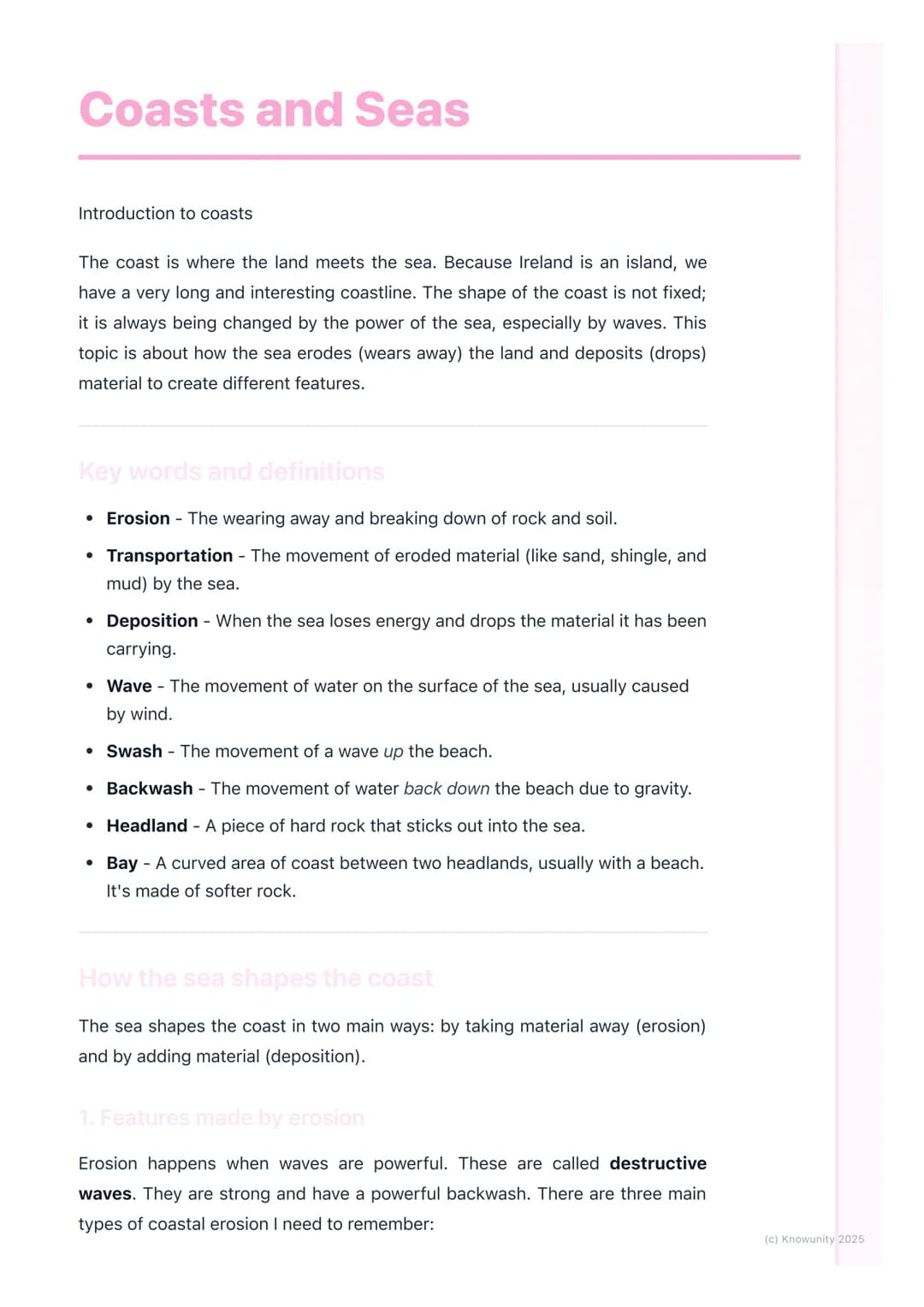
Introduction to Coasts
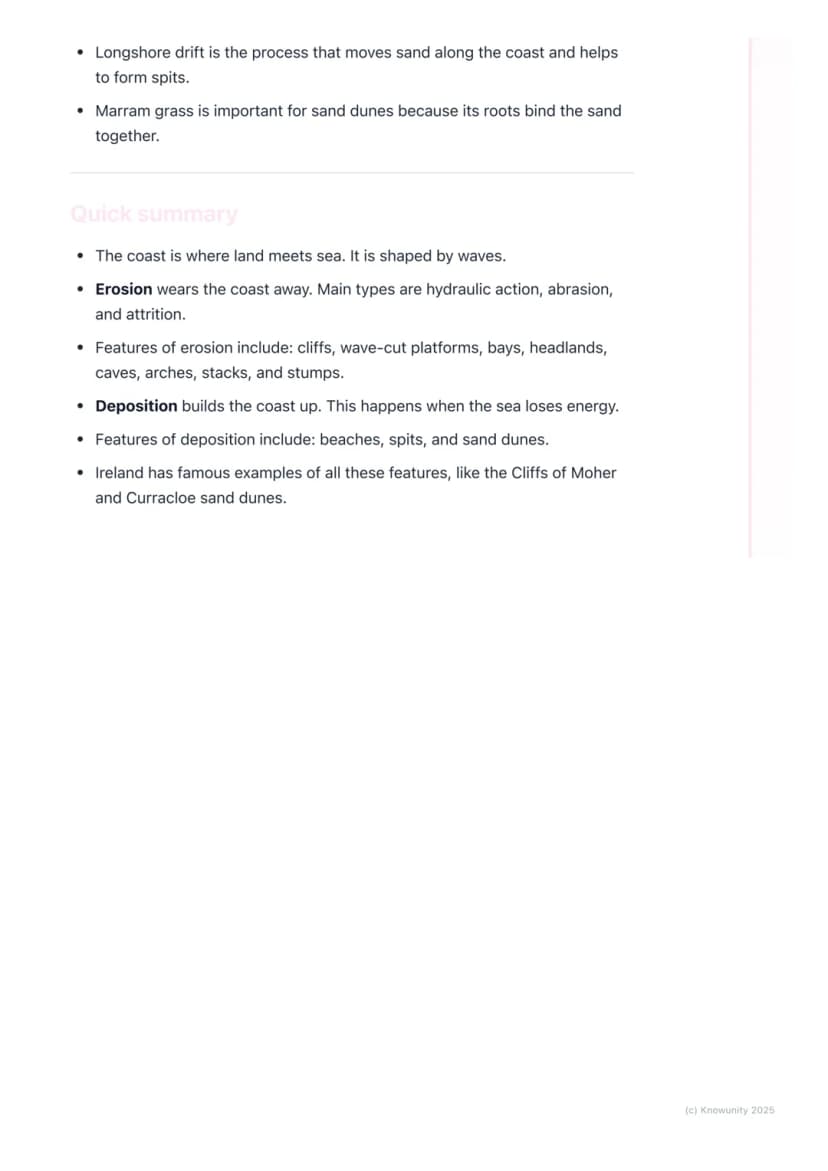
Ireland's long coastline is like a massive sculpture that the sea never stops working on. The waves are the main artist here, constantly changing the shape of our coast through two main processes: erosion (wearing things away) and deposition (dropping material off).
Understanding how coasts work is dead simple once you grasp the basics. Swash is when waves rush up the beach, and backwash is when gravity pulls that water back down. This back-and-forth motion is what does all the work!
The key thing to remember is that headlands are made of tough rock that sticks out into the sea, whilst bays are curved areas between headlands where softer rock has been worn away. You'll see this pattern all around Ireland's coast.
Quick Tip: Think of erosion as the sea being destructive (breaking things down) and deposition as being constructive (building things up).
2
of 5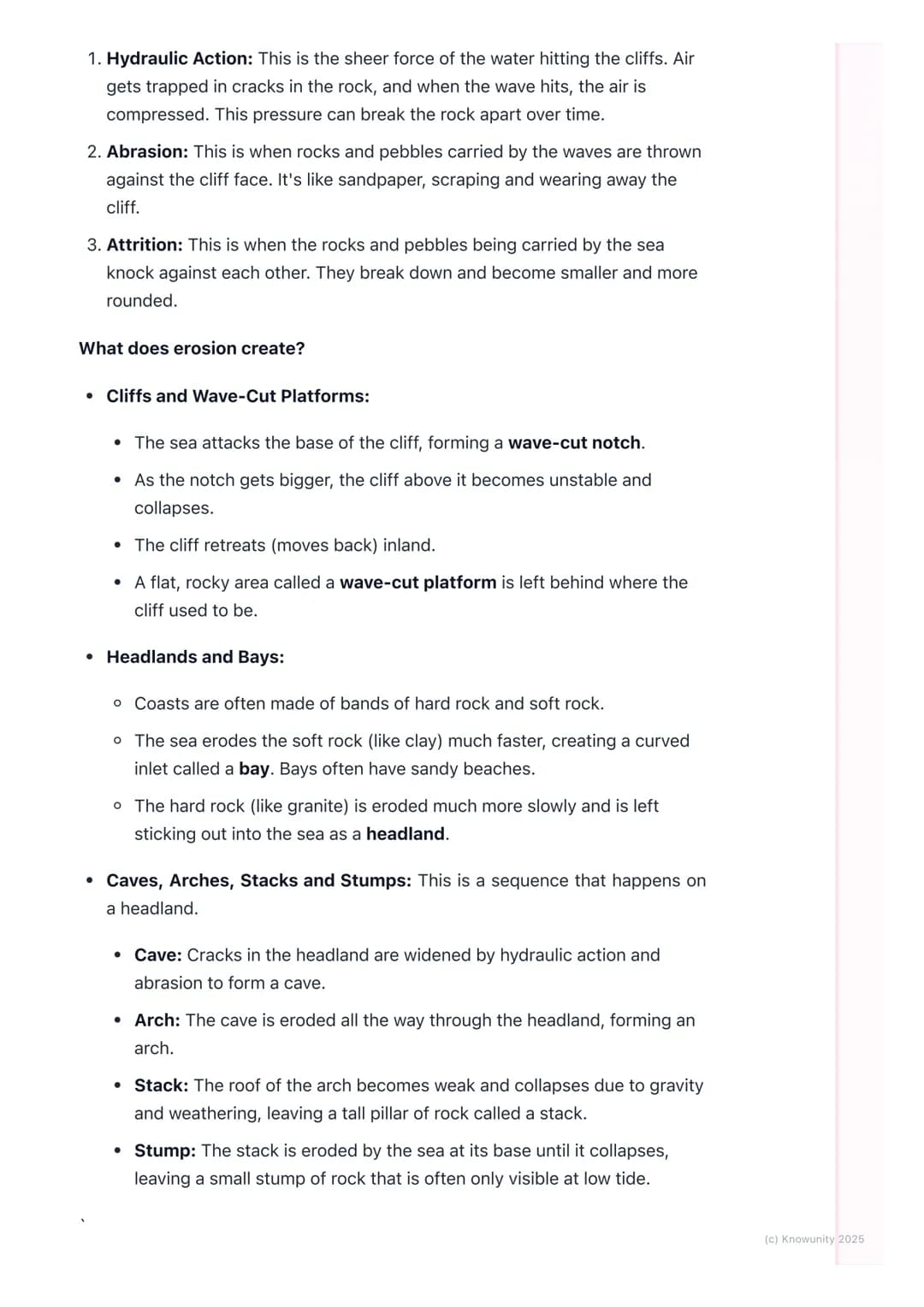
How Erosion Shapes the Coast
The sea has three main ways of attacking the coast, and they're easier to remember than you'd think. Hydraulic action is basically the sea punching the cliffs - water gets trapped in cracks and the pressure splits the rock apart.
Abrasion is like nature's sandpaper. Rocks and pebbles get hurled against cliff faces by the waves, gradually scraping them away. Meanwhile, attrition happens when all those rocks bash into each other and get smaller and rounder.
When destructive waves (the powerful ones with strong backwash) keep attacking a cliff base, they create a wave-cut platform. The cliff gets undercut, becomes unstable, and eventually collapses, leaving a flat rocky area behind.
The most famous erosion sequence you need to know creates caves, then arches, then stacks, then stumps - all in that order as the sea gradually breaks through and demolishes a headland.
Exam Alert: The cave-arch-stack-stump sequence is a guaranteed exam question, so make sure you can draw and label it!
3
of 5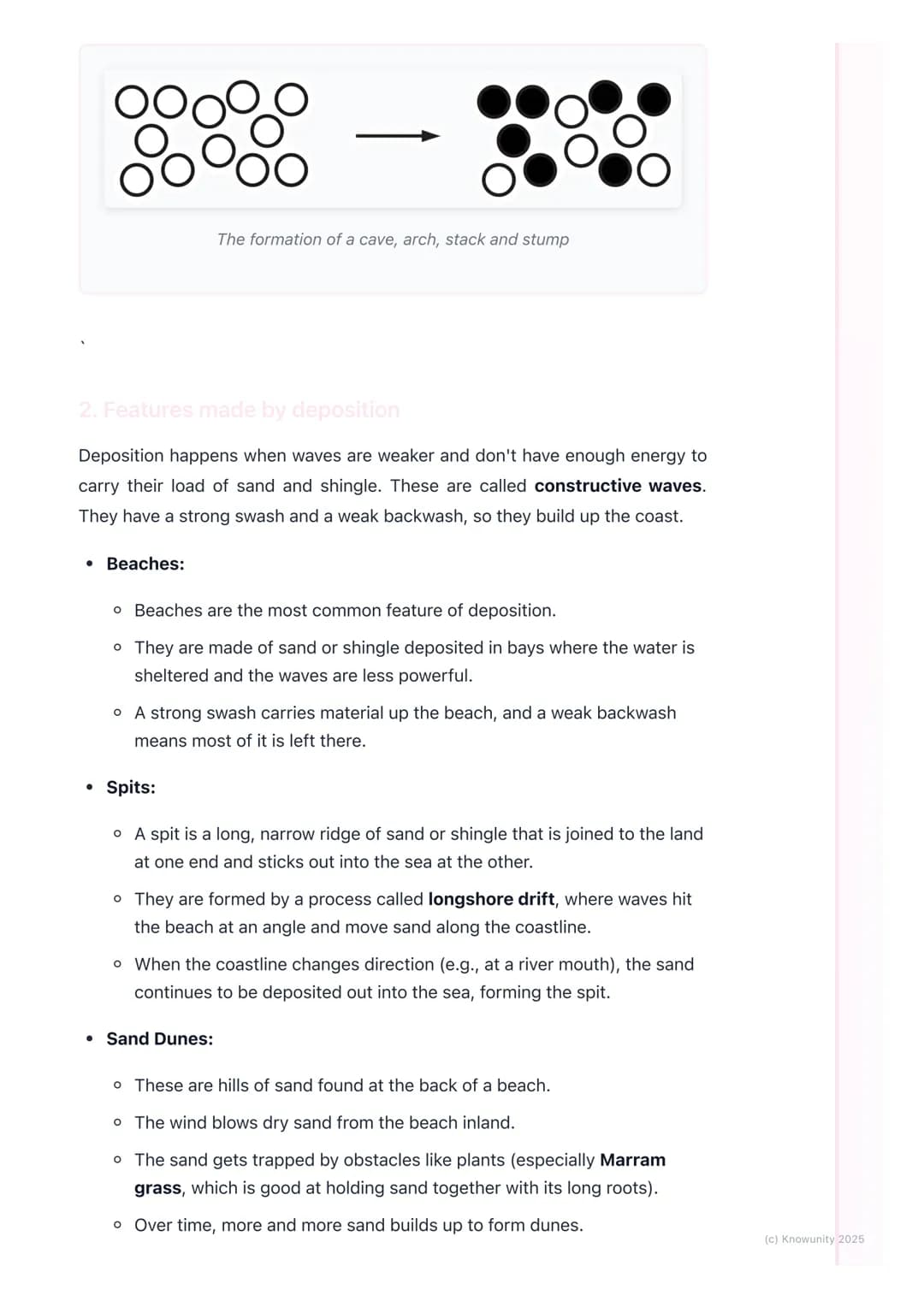
Features Created by Deposition
When waves lose their energy, they can't carry sand and pebbles anymore, so they dump them to create new landforms. Constructive waves do this job - they have strong swash but weak backwash, so they're brilliant at building things up rather than destroying them.
Beaches form in sheltered bays where the water is calmer. The waves carry sand and shingle up the beach, but there's not enough energy in the backwash to drag it all back out to sea.
Spits are probably the coolest coastal feature - they're like natural piers made of sand that stick out into the sea. They form through longshore drift, where waves hit the beach at an angle and gradually push sand along the coast until it builds up into these long ridges.
Sand dunes develop when wind blows dry sand inland from beaches. Plants like Marram grass are brilliant at trapping this sand with their long roots, and over time you get proper hills of sand building up behind the beach.
Nature Fact: Marram grass is like a natural sand-trapping machine - its roots can grow up to 2 metres deep!
4
of 5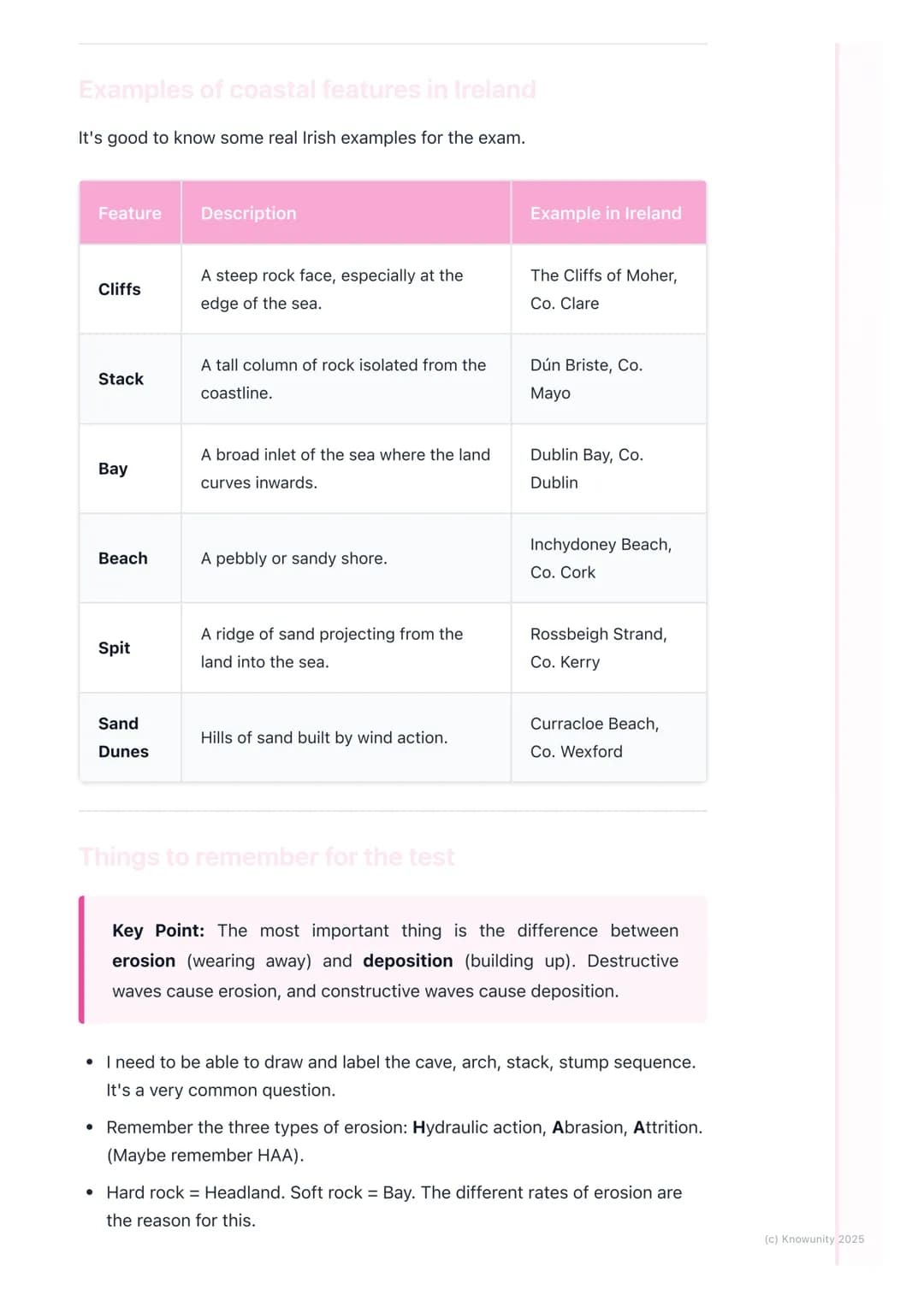
Irish Coastal Examples
Ireland's got some absolutely stunning examples of these coastal features that are perfect for understanding how they work in real life. The Cliffs of Moher in Clare are probably our most famous coastal landmark - they're a perfect example of how the sea creates dramatic cliff faces.
For erosional features, check out Dún Briste in Mayo - it's a brilliant example of a stack that's been completely cut off from the mainland. Dublin Bay shows how bays form in areas of softer rock between harder headlands.
When it comes to deposition, Inchydoney Beach in Cork demonstrates how beautiful sandy beaches develop in sheltered bays. Rossbeigh Strand in Kerry is a fantastic spit that you can actually walk along and see how it extends into the sea.
Curracloe Beach in Wexford has amazing sand dunes that show how wind and plants work together to build up these sandy hills behind the beach.
Study Tip: Learning these Irish examples will seriously boost your exam answers and show you understand how theory applies to real places!
5
of 5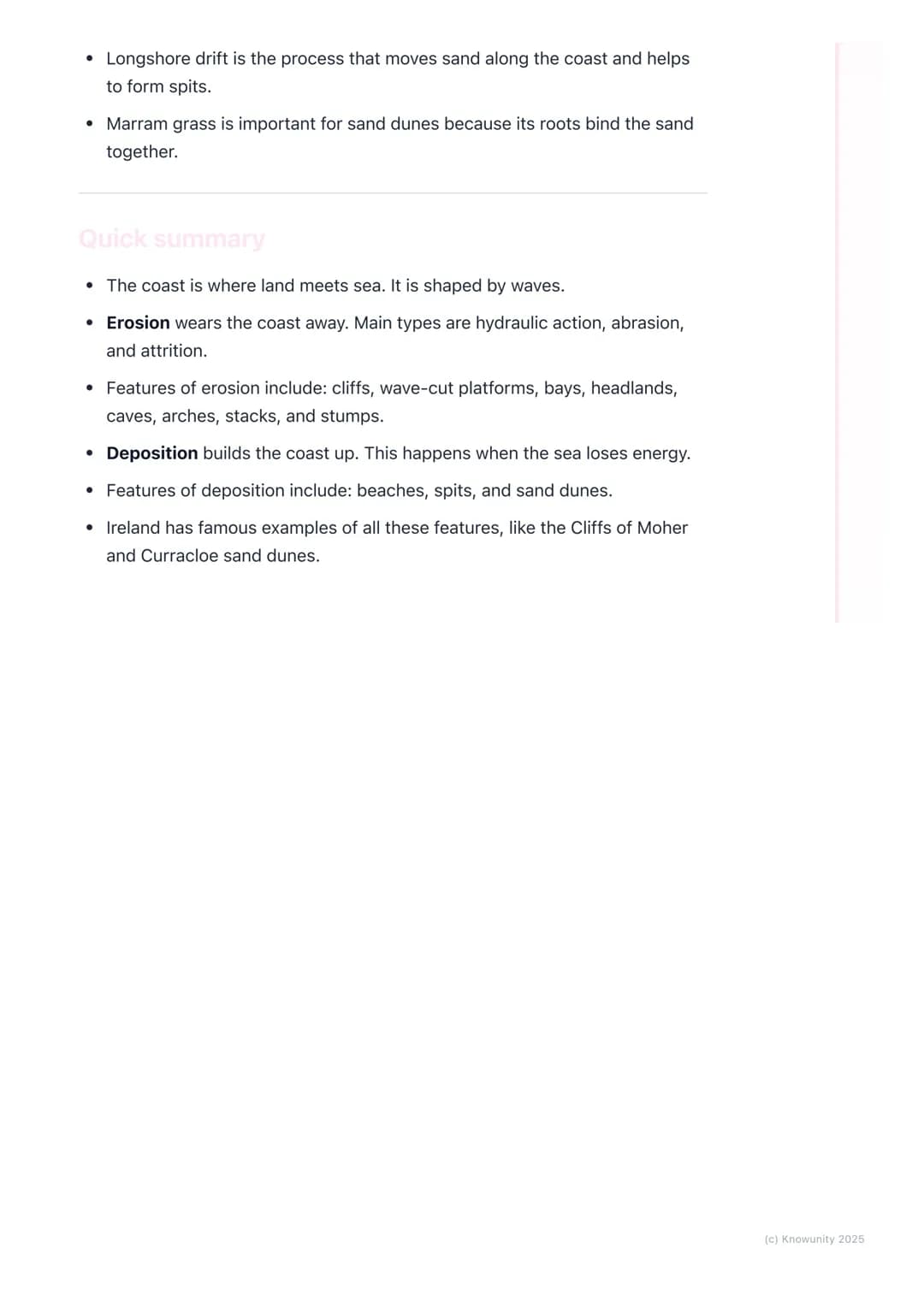
Quick Summary and Test Tips
The golden rule for coasts is simple: destructive waves cause erosion and wear things away, whilst constructive waves cause deposition and build things up. Master this concept and you're halfway there!
For erosion, remember the three types: hydraulic action (water pressure), abrasion (scraping), and attrition (rocks hitting each other). The sequence cave → arch → stack → stump happens on headlands and is absolutely guaranteed to come up in tests.
Hard rock creates headlands because it resists erosion, whilst soft rock gets worn away faster to form bays. Longshore drift is the process that moves sand along coasts and creates spits.
Ireland's coastline gives us perfect examples of every feature you need to know, from the towering Cliffs of Moher to the sandy spits of Kerry.
Exam Success: Focus on understanding the processes rather than just memorising definitions - examiners love students who can explain how and why these features form!
Mysleli jsme, že se nikdy nezeptáš...
Co je AI společník Knowunity?
Náš AI společník je speciálně vytvořen pro potřeby studentů. Na základě milionů obsahových materiálů, které máme na platformě, můžeme studentům poskytovat opravdu smysluplné a relevantní odpovědi. Ale nejde jen o odpovědi, společník je ještě více o provázení studentů jejich každodenními výzvami v učení, s personalizovanými studijními plány, kvízy nebo obsahovými materiály v chatu a 100% personalizací na základě dovedností a vývoje studentů.
Kde si můžu stáhnout aplikaci Knowunity?
Aplikaci si můžete stáhnout z obchodu Google Play a Apple App Store.
Jak můžu dostat svou platbu? Kolik si můžu vydělat?
Ano, máte bezplatný přístup k obsahu v aplikaci a k našemu společníkovi s umělou inteligencí. Chcete-li odemknout určité funkce aplikace, můžete si zakoupit aplikaci Knowunity Pro.
Nejpopulárnější poznámky z Geography
9Nejpopulárnější poznámky
9Nemůžeš najít, co hledáš? Prozkoumej další předměty.
Recenze od našich uživatelů. Mají vše super — a ty taky můžeš.
4.6/5App Store
4.7/5Google Play
Aplikace je velmi jednoduchá na používání a dobře navržená. Zatím jsem našel vše, co jsem hledal, a mohl jsem se z prezentací hodně naučit! Určitě použiju aplikaci na školní úkol! A samozřejmě taky hodně pomáhá jako inspirace.
Stefan Suživatel iOS
Tahle aplikace je fakt skvělá. Je tam tolik studijních poznámek a pomůcek [...]. Můj problémový předmět je například francouzština a aplikace nabízí tolik možností pomoci. Díky této aplikaci jsem si zlepšil francouzštinu. Doporučil bych ji každému.
Samantha Klichuživatelka Androidu
Páni, jsem opravdu ohromen. Zkusil jsem aplikaci jen proto, že jsem ji mnohokrát viděl v reklamách, a byl jsem naprosto ohromen. Tato aplikace je TA POMOC, kterou chceš do školy, a především nabízí spoustu věcí, jako jsou cvičení a přehledy faktů, které mi osobně VELMI pomohly.
Annauživatelka iOS
Geography4 zobrazení·Aktualizováno May 29, 2026·5 stránekExploring Ireland's Coasts: Cliffs, Beaches, and Bays
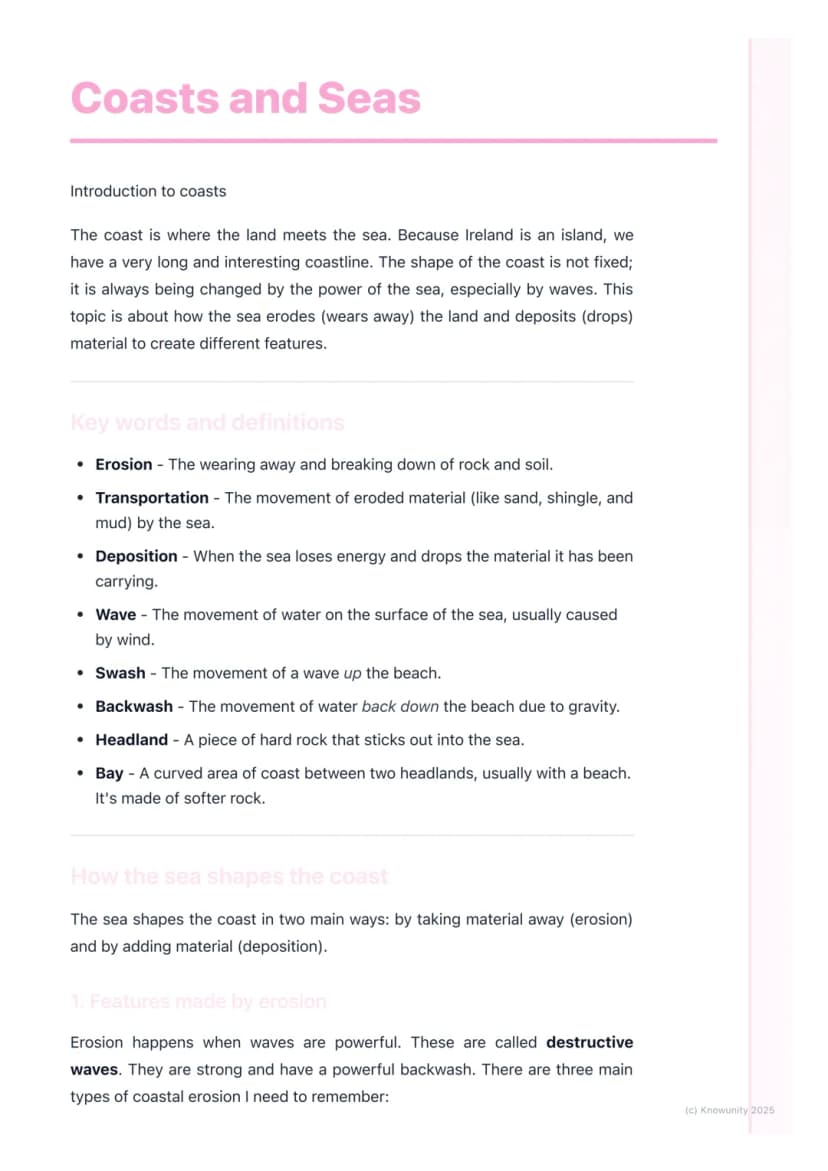
Ever wondered why Ireland's coastline looks so dramatic with its towering cliffs and beautiful sandy beaches? The sea is constantly reshaping our coast through powerful forces that both destroy and create amazing landforms.
1
of 5Registruj se, abys viděl obsah. Je to zdarma!
- Přístup ke všem dokumentům
- Zlepši své známky
- Připoj se k milionům studentů
Introduction to Coasts
Ireland's long coastline is like a massive sculpture that the sea never stops working on. The waves are the main artist here, constantly changing the shape of our coast through two main processes: erosion (wearing things away) and deposition (dropping material off).
Understanding how coasts work is dead simple once you grasp the basics. Swash is when waves rush up the beach, and backwash is when gravity pulls that water back down. This back-and-forth motion is what does all the work!
The key thing to remember is that headlands are made of tough rock that sticks out into the sea, whilst bays are curved areas between headlands where softer rock has been worn away. You'll see this pattern all around Ireland's coast.
Quick Tip: Think of erosion as the sea being destructive (breaking things down) and deposition as being constructive (building things up).
2
of 5Registruj se, abys viděl obsah. Je to zdarma!
- Přístup ke všem dokumentům
- Zlepši své známky
- Připoj se k milionům studentů
How Erosion Shapes the Coast
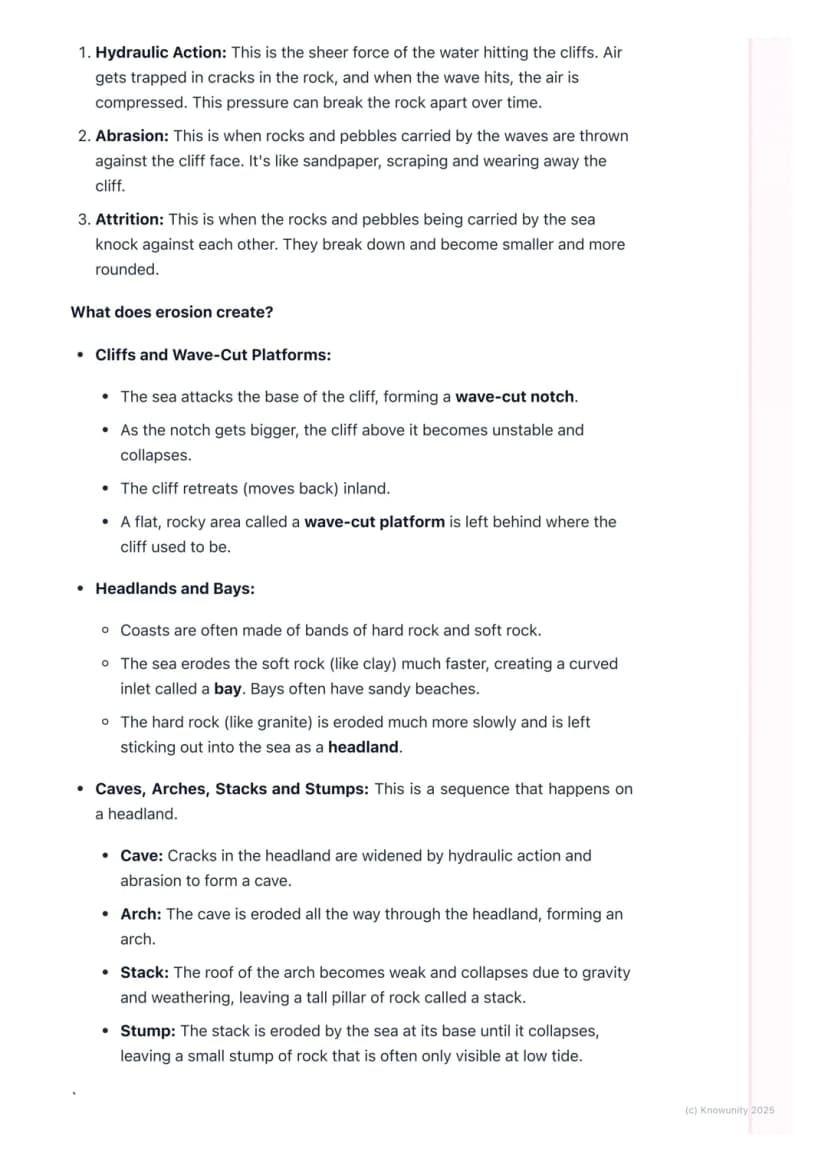
The sea has three main ways of attacking the coast, and they're easier to remember than you'd think. Hydraulic action is basically the sea punching the cliffs - water gets trapped in cracks and the pressure splits the rock apart.
Abrasion is like nature's sandpaper. Rocks and pebbles get hurled against cliff faces by the waves, gradually scraping them away. Meanwhile, attrition happens when all those rocks bash into each other and get smaller and rounder.
When destructive waves (the powerful ones with strong backwash) keep attacking a cliff base, they create a wave-cut platform. The cliff gets undercut, becomes unstable, and eventually collapses, leaving a flat rocky area behind.
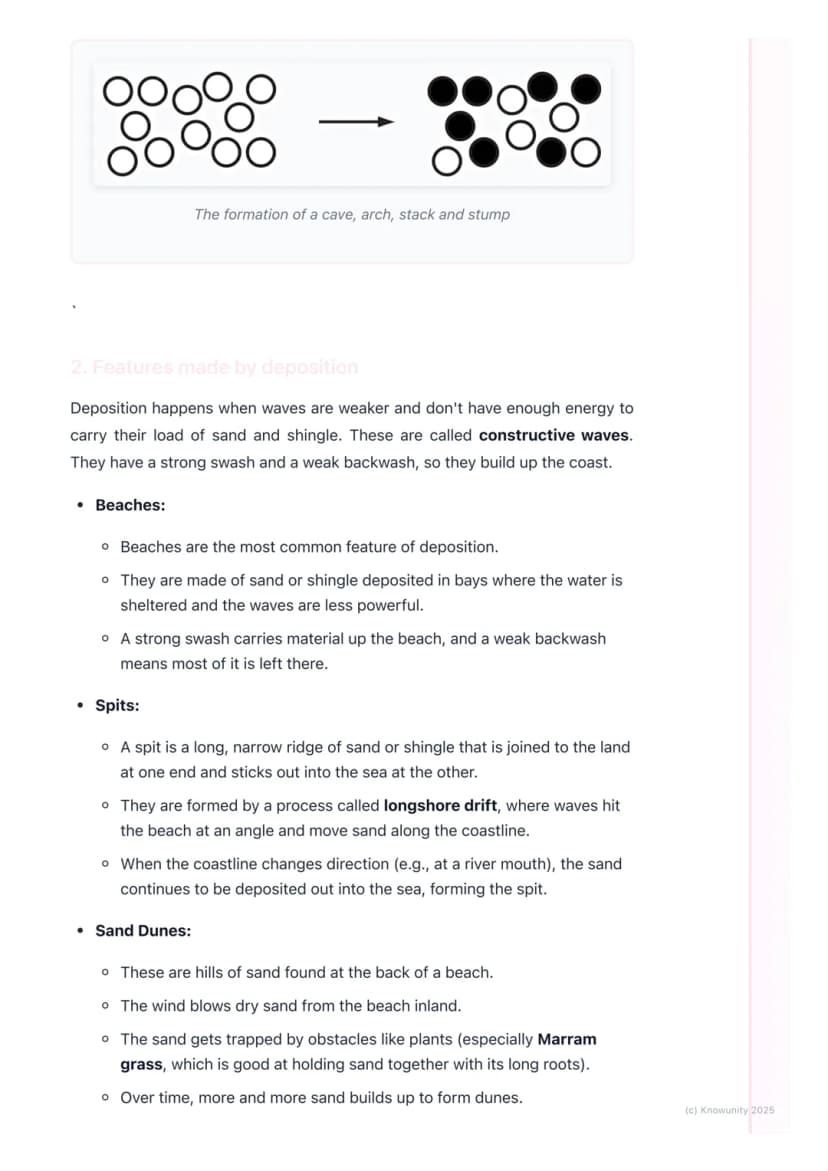
The most famous erosion sequence you need to know creates caves, then arches, then stacks, then stumps - all in that order as the sea gradually breaks through and demolishes a headland.
Exam Alert: The cave-arch-stack-stump sequence is a guaranteed exam question, so make sure you can draw and label it!
3
of 5Registruj se, abys viděl obsah. Je to zdarma!
- Přístup ke všem dokumentům
- Zlepši své známky
- Připoj se k milionům studentů
Features Created by Deposition
When waves lose their energy, they can't carry sand and pebbles anymore, so they dump them to create new landforms. Constructive waves do this job - they have strong swash but weak backwash, so they're brilliant at building things up rather than destroying them.
Beaches form in sheltered bays where the water is calmer. The waves carry sand and shingle up the beach, but there's not enough energy in the backwash to drag it all back out to sea.
Spits are probably the coolest coastal feature - they're like natural piers made of sand that stick out into the sea. They form through longshore drift, where waves hit the beach at an angle and gradually push sand along the coast until it builds up into these long ridges.
Sand dunes develop when wind blows dry sand inland from beaches. Plants like Marram grass are brilliant at trapping this sand with their long roots, and over time you get proper hills of sand building up behind the beach.
Nature Fact: Marram grass is like a natural sand-trapping machine - its roots can grow up to 2 metres deep!
4
of 5Registruj se, abys viděl obsah. Je to zdarma!
- Přístup ke všem dokumentům
- Zlepši své známky
- Připoj se k milionům studentů
Irish Coastal Examples
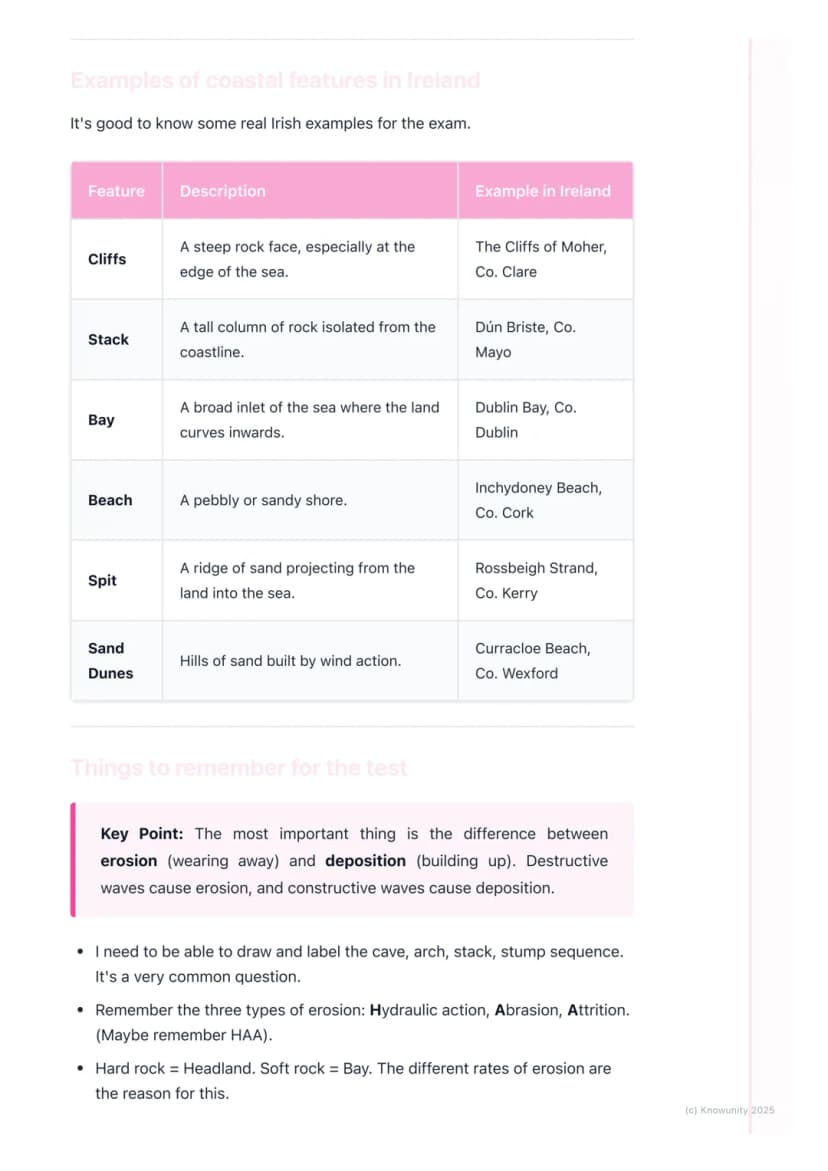
Ireland's got some absolutely stunning examples of these coastal features that are perfect for understanding how they work in real life. The Cliffs of Moher in Clare are probably our most famous coastal landmark - they're a perfect example of how the sea creates dramatic cliff faces.
For erosional features, check out Dún Briste in Mayo - it's a brilliant example of a stack that's been completely cut off from the mainland. Dublin Bay shows how bays form in areas of softer rock between harder headlands.
When it comes to deposition, Inchydoney Beach in Cork demonstrates how beautiful sandy beaches develop in sheltered bays. Rossbeigh Strand in Kerry is a fantastic spit that you can actually walk along and see how it extends into the sea.
Curracloe Beach in Wexford has amazing sand dunes that show how wind and plants work together to build up these sandy hills behind the beach.
Study Tip: Learning these Irish examples will seriously boost your exam answers and show you understand how theory applies to real places!
5
of 5Registruj se, abys viděl obsah. Je to zdarma!
- Přístup ke všem dokumentům
- Zlepši své známky
- Připoj se k milionům studentů
Quick Summary and Test Tips
The golden rule for coasts is simple: destructive waves cause erosion and wear things away, whilst constructive waves cause deposition and build things up. Master this concept and you're halfway there!
For erosion, remember the three types: hydraulic action (water pressure), abrasion (scraping), and attrition (rocks hitting each other). The sequence cave → arch → stack → stump happens on headlands and is absolutely guaranteed to come up in tests.
Hard rock creates headlands because it resists erosion, whilst soft rock gets worn away faster to form bays. Longshore drift is the process that moves sand along coasts and creates spits.
Ireland's coastline gives us perfect examples of every feature you need to know, from the towering Cliffs of Moher to the sandy spits of Kerry.
Exam Success: Focus on understanding the processes rather than just memorising definitions - examiners love students who can explain how and why these features form!
Mysleli jsme, že se nikdy nezeptáš...
Co je AI společník Knowunity?
Náš AI společník je speciálně vytvořen pro potřeby studentů. Na základě milionů obsahových materiálů, které máme na platformě, můžeme studentům poskytovat opravdu smysluplné a relevantní odpovědi. Ale nejde jen o odpovědi, společník je ještě více o provázení studentů jejich každodenními výzvami v učení, s personalizovanými studijními plány, kvízy nebo obsahovými materiály v chatu a 100% personalizací na základě dovedností a vývoje studentů.
Kde si můžu stáhnout aplikaci Knowunity?
Aplikaci si můžete stáhnout z obchodu Google Play a Apple App Store.
Jak můžu dostat svou platbu? Kolik si můžu vydělat?
Ano, máte bezplatný přístup k obsahu v aplikaci a k našemu společníkovi s umělou inteligencí. Chcete-li odemknout určité funkce aplikace, můžete si zakoupit aplikaci Knowunity Pro.
Nejpopulárnější poznámky z Geography
9Nejpopulárnější poznámky
9Nemůžeš najít, co hledáš? Prozkoumej další předměty.
Recenze od našich uživatelů. Mají vše super — a ty taky můžeš.
4.6/5App Store
4.7/5Google Play
Aplikace je velmi jednoduchá na používání a dobře navržená. Zatím jsem našel vše, co jsem hledal, a mohl jsem se z prezentací hodně naučit! Určitě použiju aplikaci na školní úkol! A samozřejmě taky hodně pomáhá jako inspirace.
Stefan Suživatel iOS
Tahle aplikace je fakt skvělá. Je tam tolik studijních poznámek a pomůcek [...]. Můj problémový předmět je například francouzština a aplikace nabízí tolik možností pomoci. Díky této aplikaci jsem si zlepšil francouzštinu. Doporučil bych ji každému.
Samantha Klichuživatelka Androidu
Páni, jsem opravdu ohromen. Zkusil jsem aplikaci jen proto, že jsem ji mnohokrát viděl v reklamách, a byl jsem naprosto ohromen. Tato aplikace je TA POMOC, kterou chceš do školy, a především nabízí spoustu věcí, jako jsou cvičení a přehledy faktů, které mi osobně VELMI pomohly.
Annauživatelka iOS