
Weather talk is everywhere in Ireland, so mastering French weather...
 French2 zobrazení·Aktualizováno Jun 12, 2026·6 stránek
Parler du Temps: Expressions Météorologiques

1 / 6
1
of 6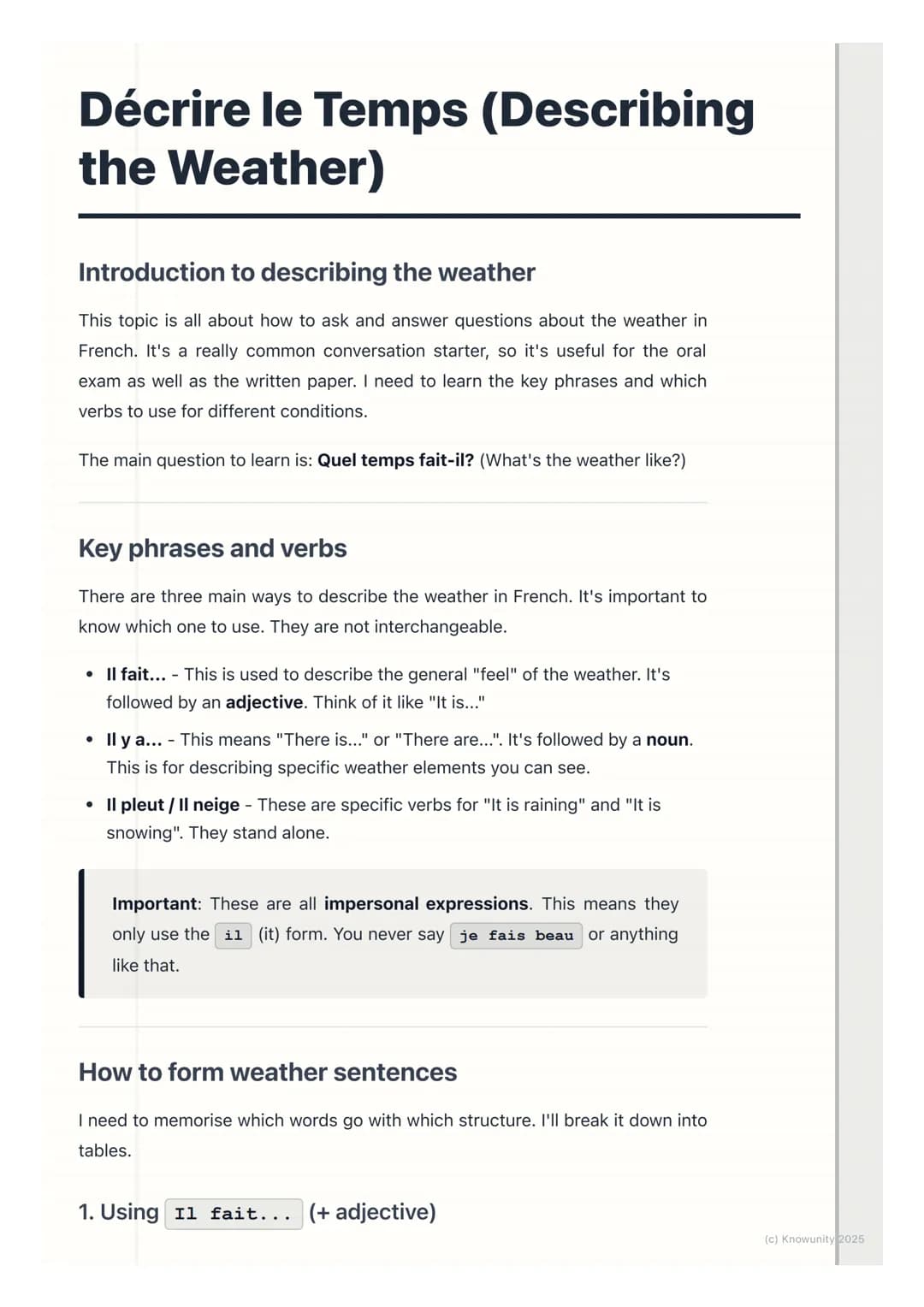
Getting Started with Weather Questions
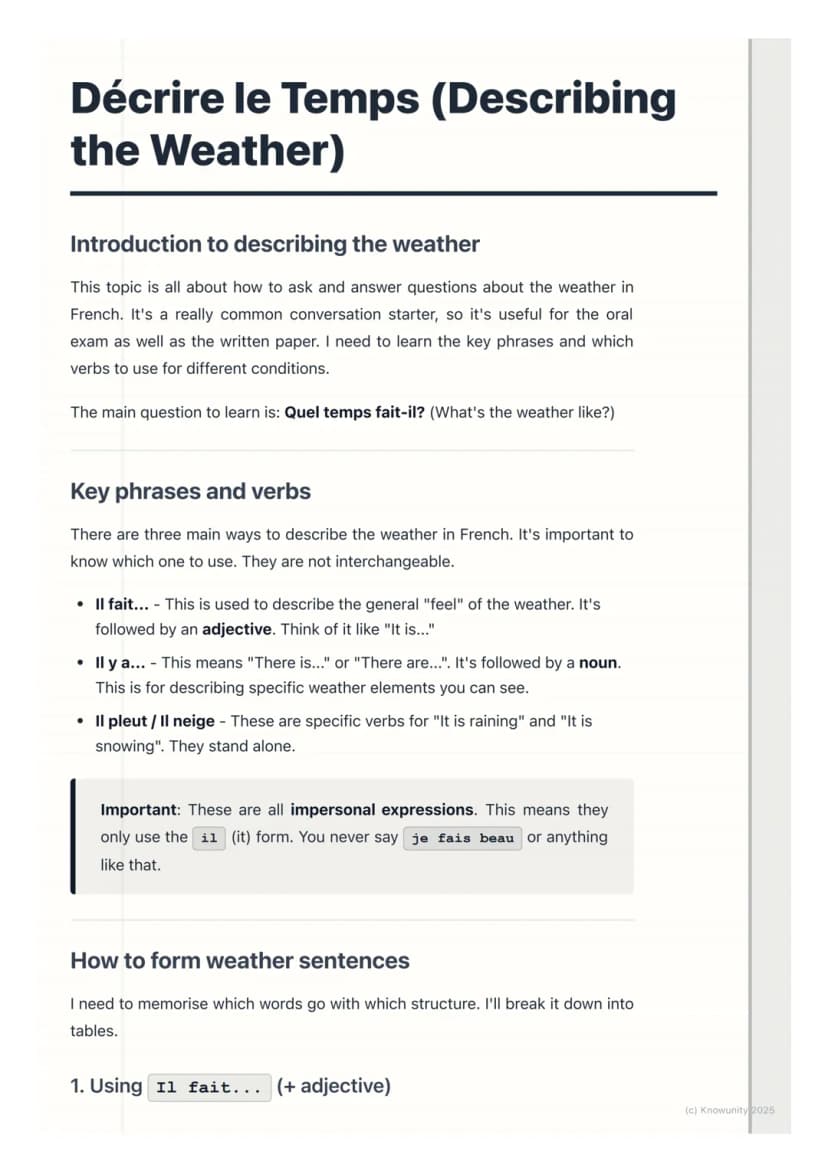
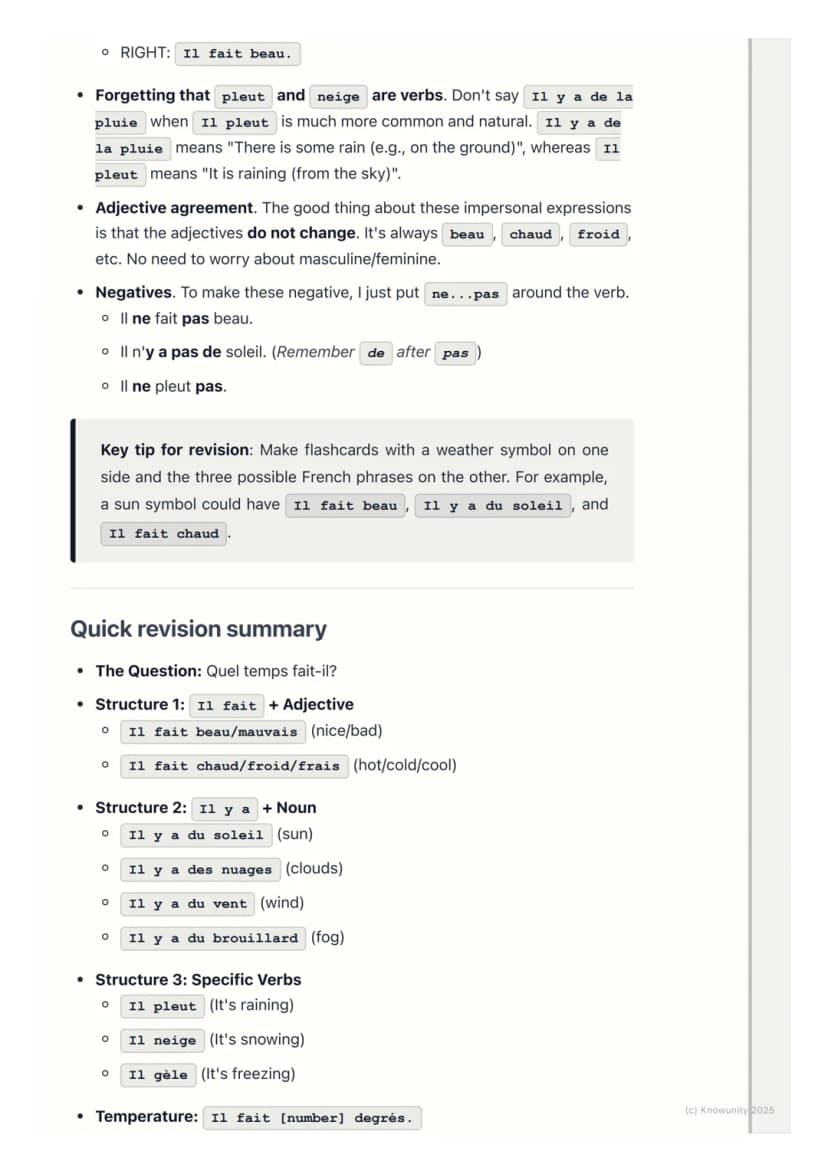
The magic question you need to know is "Quel temps fait-il?" (What's the weather like?). This is your go-to phrase for starting weather conversations, and it's dead handy for oral exams too.
French has three main ways to describe weather, and they're not interchangeable - each has its own job. Think of them like different tools in a toolbox: Il fait... for general feelings, Il y a... for things you can see, and specific verbs like Il pleut for actions happening right now.
Here's the crucial bit: these are all impersonal expressions. That means they only work with "il" (it) - you'd never say "je fais beau" or anything mad like that! It's always about "it" doing the weather.
Quick Tip: Think of weather as something that just "happens" - it's never about you personally doing the weather!
2
of 6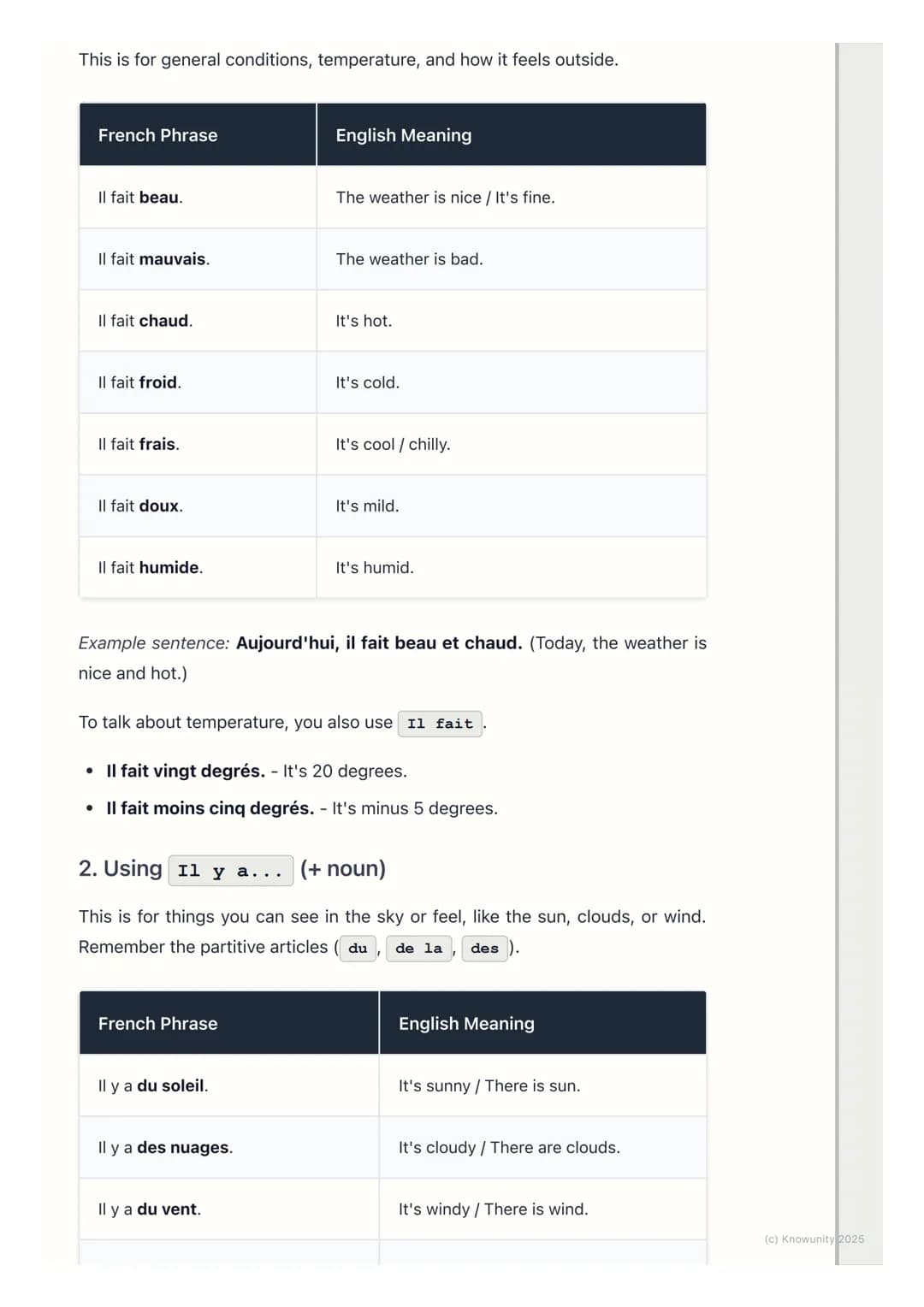
Structure 1: Il fait + Adjective
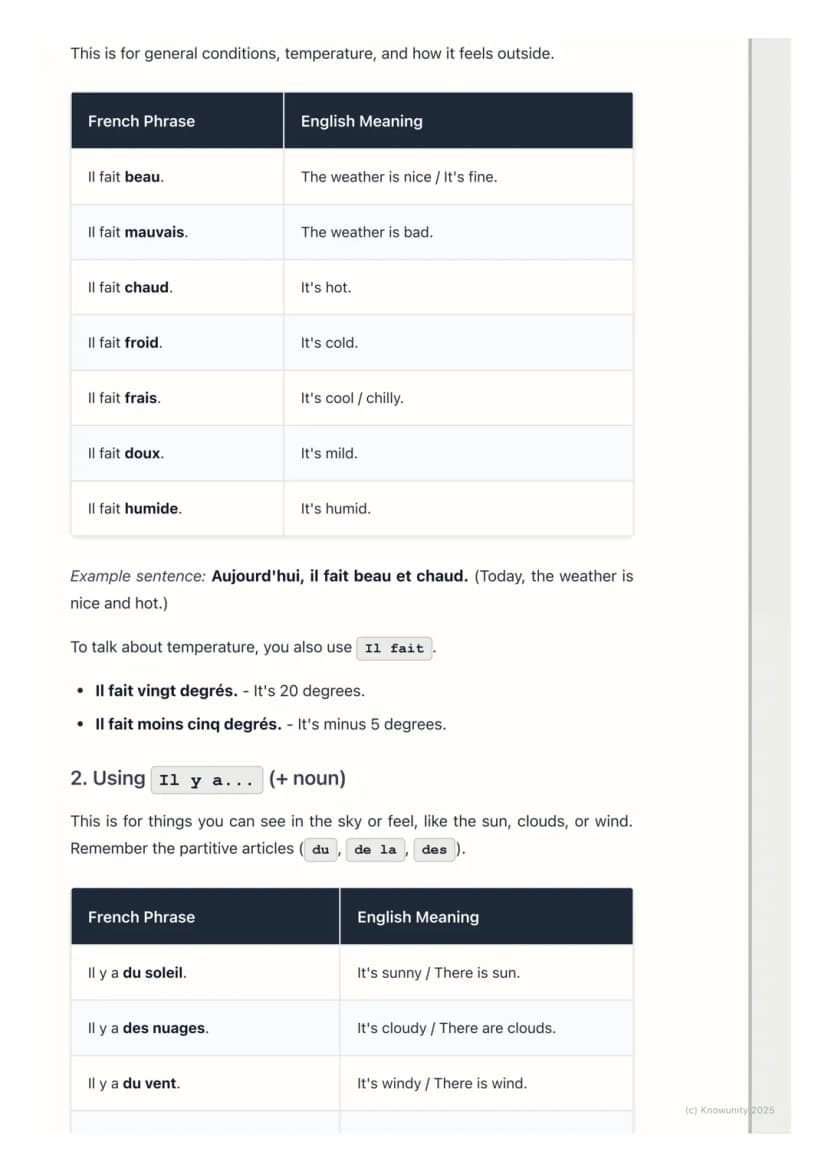
When you want to describe how the weather feels generally, use Il fait followed by an adjective. This covers temperature and the overall vibe of the day.
Il fait beau (nice weather), Il fait mauvais (bad weather), Il fait chaud (hot), Il fait froid (cold), Il fait frais (cool), and Il fait doux (mild) are your essential phrases. For example: "Aujourd'hui, il fait beau et chaud" (Today, it's nice and hot).
Temperature is dead simple with this structure too. Il fait vingt degrés (It's 20 degrees) or Il fait moins cinq degrés (It's minus 5 degrees). Just stick the number after "Il fait" and you're sorted.
Remember: These adjectives never change form - no worrying about masculine/feminine endings here!
3
of 6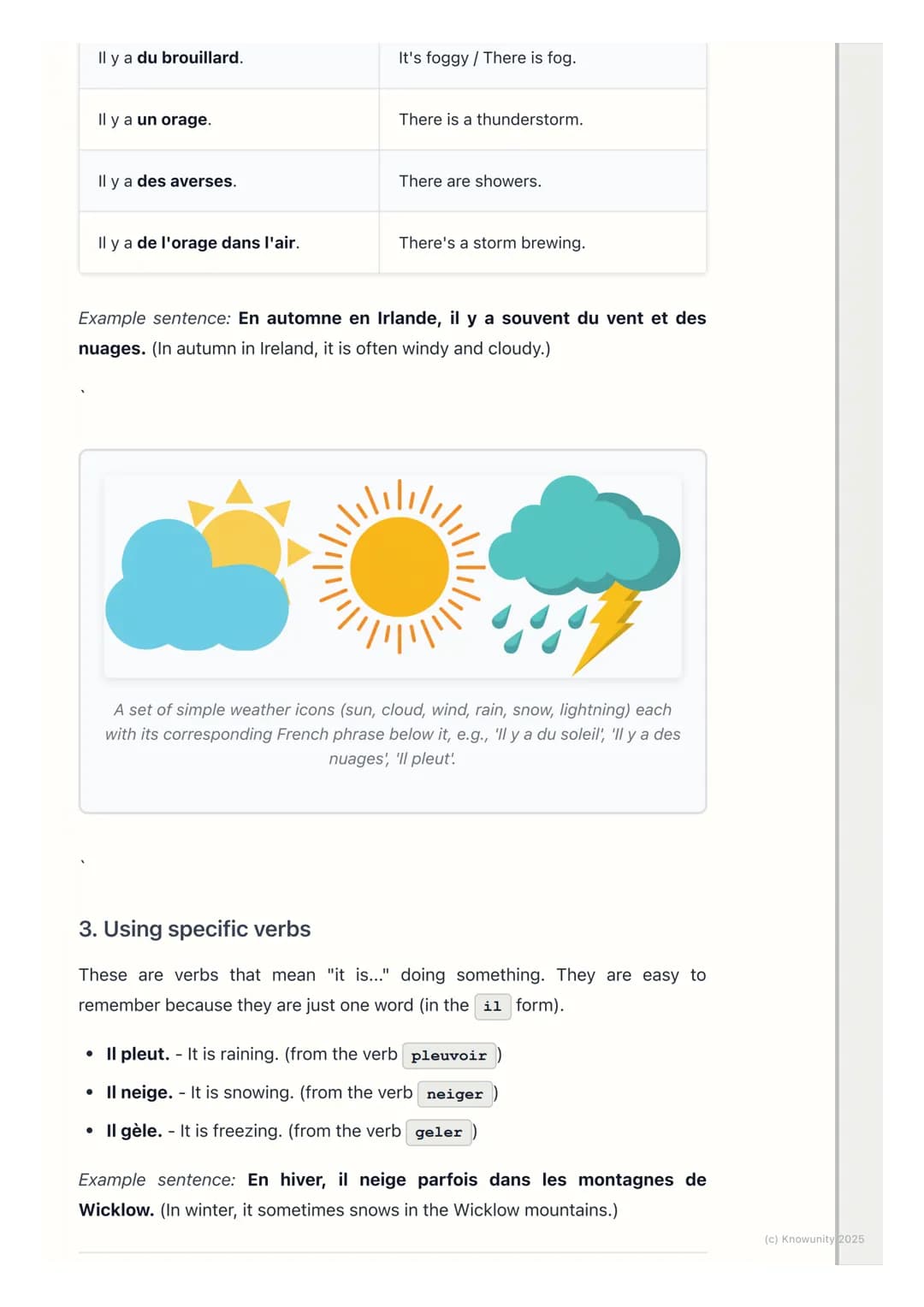
Structure 2: Il y a + Noun
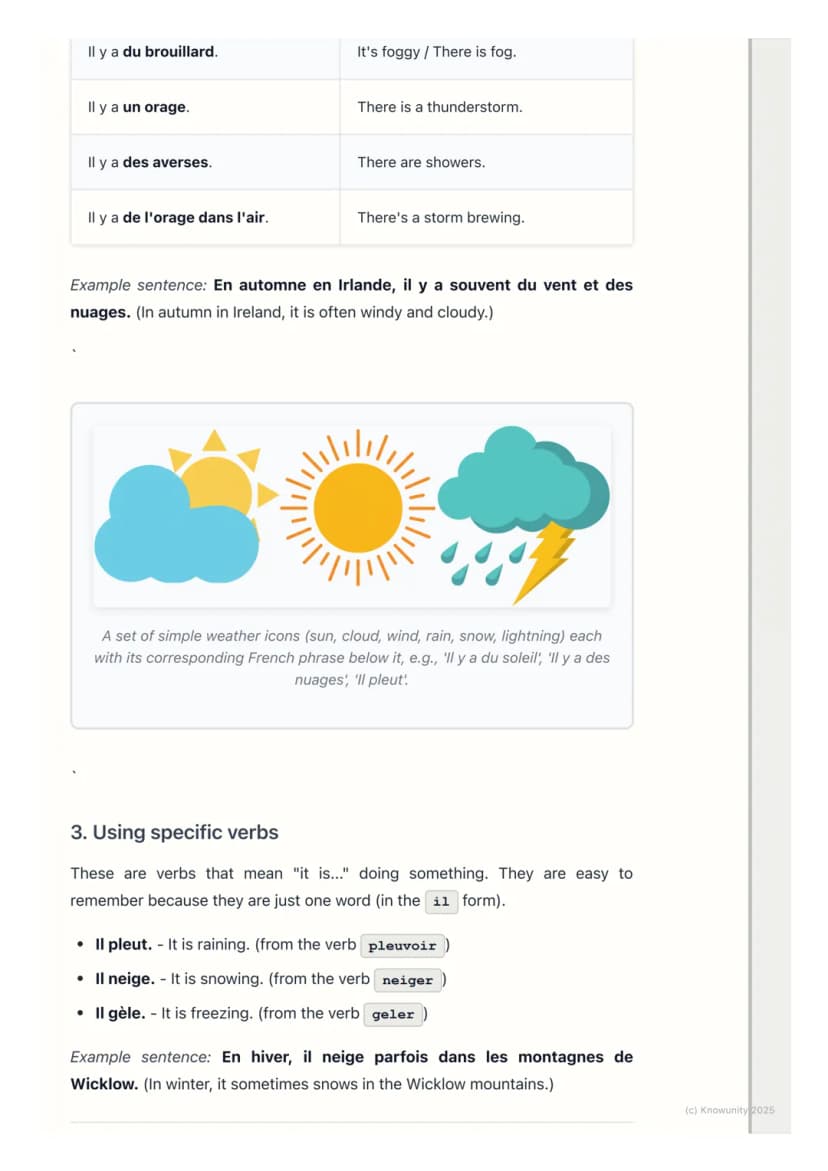
Use Il y a when describing specific weather elements you can actually see or feel - like sun, clouds, or wind. Remember your partitive articles: du, de la, des!
Il y a du soleil (it's sunny), Il y a des nuages (it's cloudy), Il y a du vent (it's windy), and Il y a du brouillard (it's foggy) are brilliant for painting a picture of what's happening outside. You can also say Il y a un orage (there's a thunderstorm) or Il y a des averses (there are showers).
Try this example: "En automne en Irlande, il y a souvent du vent et des nuages" (In autumn in Ireland, it's often windy and cloudy). Dead accurate for Irish weather!
Top Tip: If you can point at it in the sky or feel it on your face, use "Il y a"!
4
of 6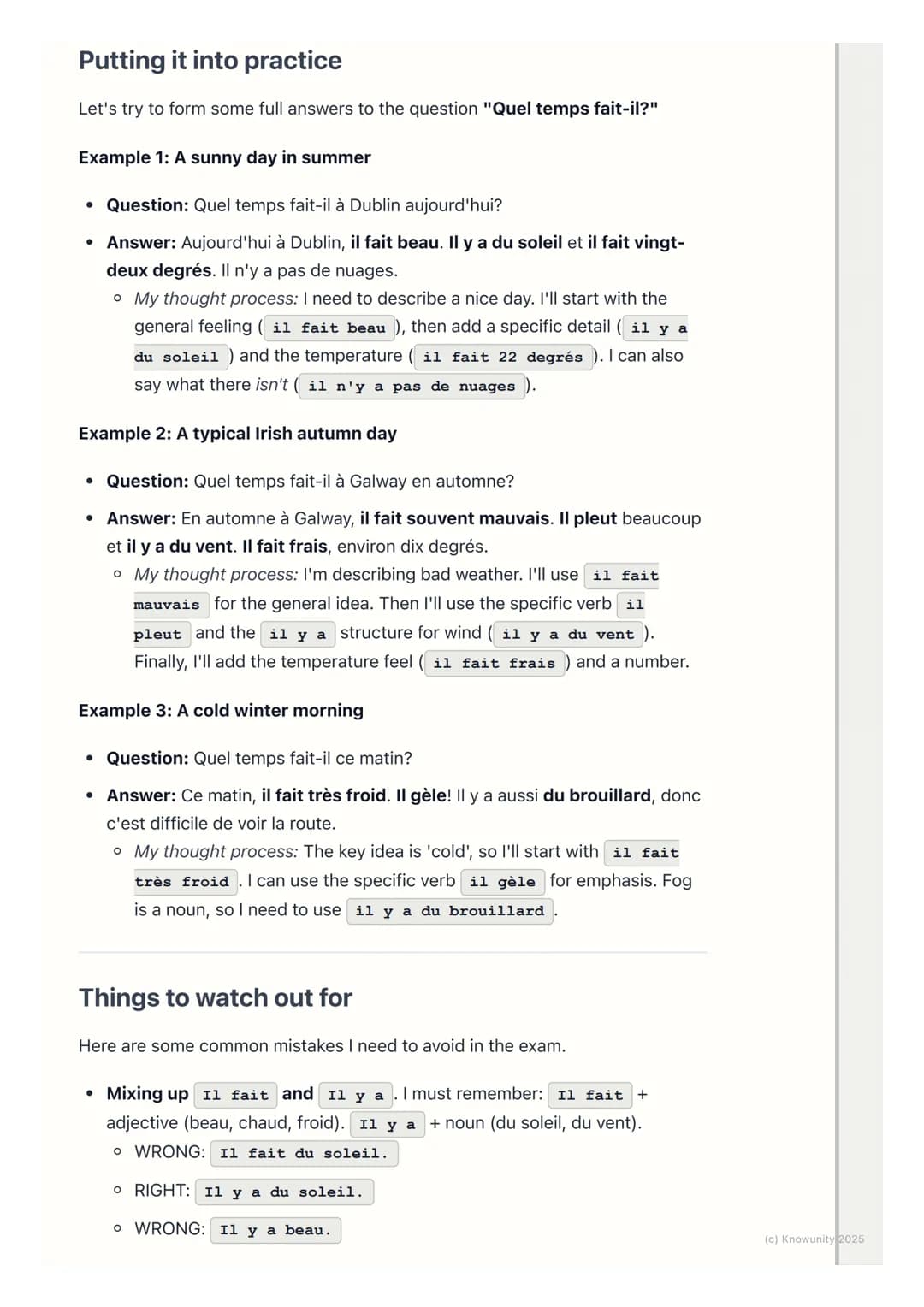
Structure 3: Specific Weather Verbs
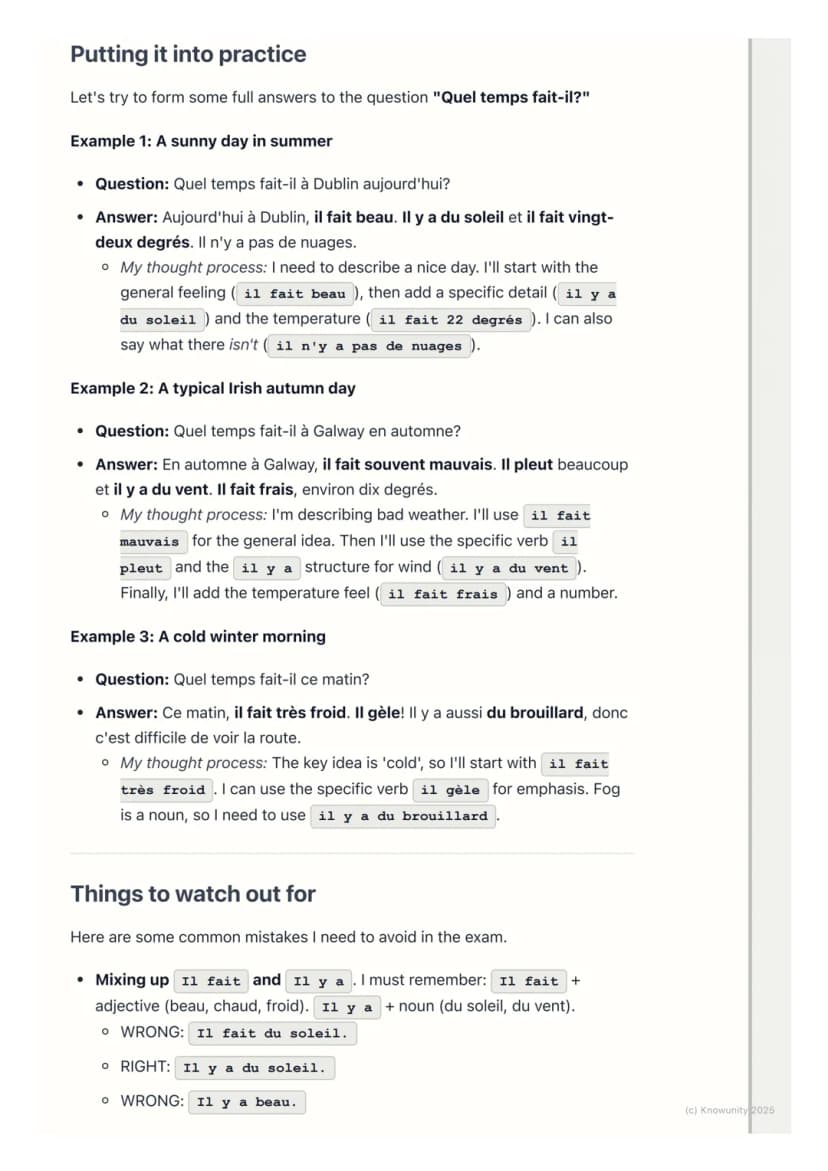
Some weather conditions get their own special verbs - these are one-word wonders that pack a punch! The big three are Il pleut (it's raining), Il neige (it's snowing), and Il gèle (it's freezing).
These verbs come from pleuvoir, neiger, and geler, but you only need to remember the "il" form. They're perfect for describing active weather that's happening right now.
Here's a proper Irish example: "En hiver, il neige parfois dans les montagnes de Wicklow" (In winter, it sometimes snows in the Wicklow mountains). These verbs make your French sound natural and confident.
Don't mix these up with "Il y a de la pluie" - while that's technically correct, saying Il pleut is much more common and sounds way better!
Watch Out: Don't say "Il y a de la pluie" when "Il pleut" does the job perfectly!
5
of 6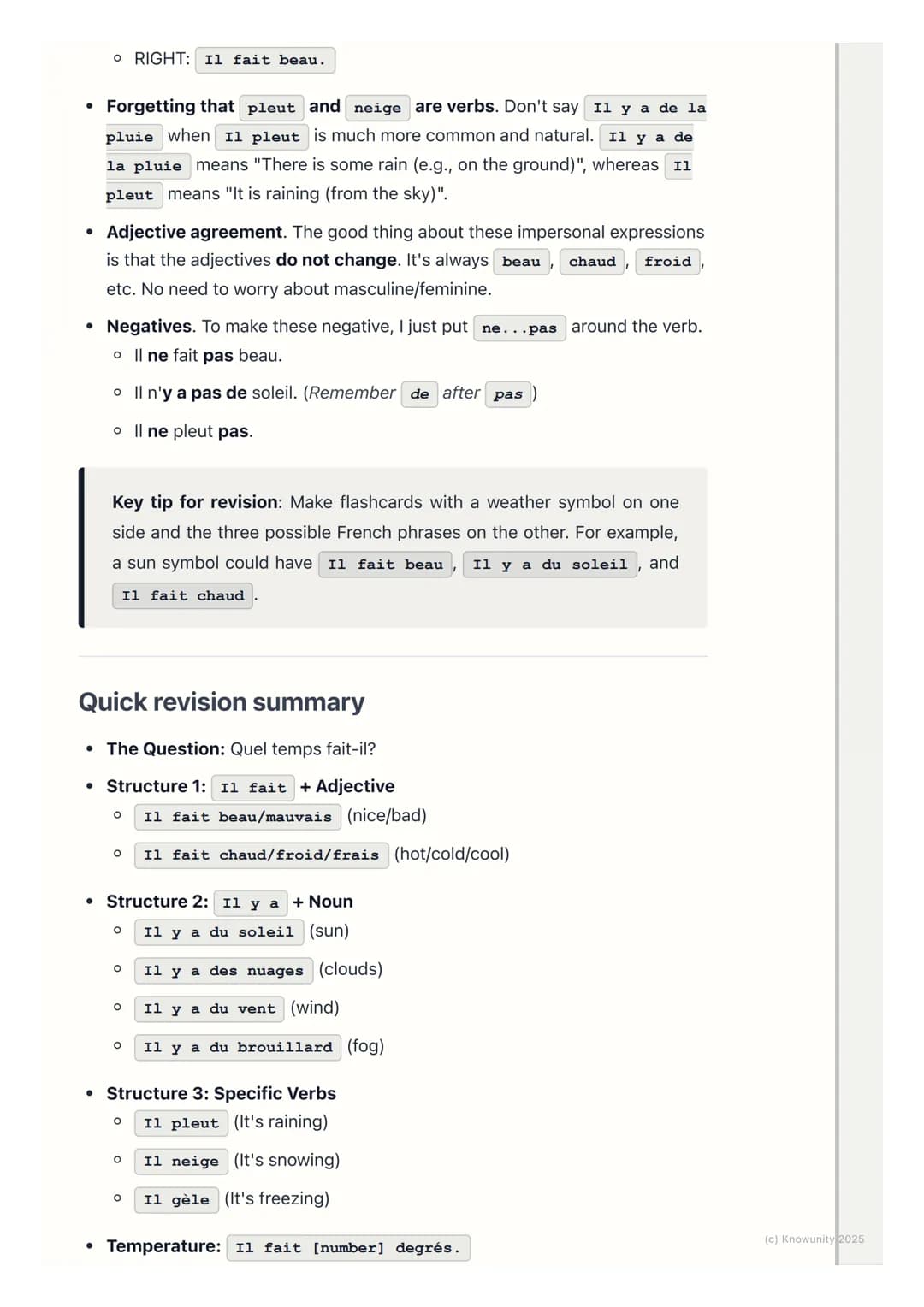
Putting It All Together
Now let's build some proper answers to "Quel temps fait-il?" that'll impress in your exams! Start with the general feel, add specific details, then mention temperature.
For a lovely summer day: "Aujourd'hui à Dublin, il fait beau. Il y a du soleil et il fait vingt-deux degrés. Il n'y a pas de nuages." You're mixing all three structures like a pro!
For typical Irish autumn weather: "En automne à Galway, il fait souvent mauvais. Il pleut beaucoup et il y a du vent. Il fait frais, environ dix degrés." Perfect for describing our lovely Irish climate!
The key is layering your descriptions - don't just stick to one structure. Mix them up to create rich, detailed answers that show off your French skills brilliantly.
Exam Gold: Always start with the general feel (Il fait...), then add what you can see (Il y a...), and finish with specific actions or temperature!
6
of 6
Mysleli jsme, že se nikdy nezeptáš...
Co je AI společník Knowunity?
Náš AI společník je speciálně vytvořen pro potřeby studentů. Na základě milionů obsahových materiálů, které máme na platformě, můžeme studentům poskytovat opravdu smysluplné a relevantní odpovědi. Ale nejde jen o odpovědi, společník je ještě více o provázení studentů jejich každodenními výzvami v učení, s personalizovanými studijními plány, kvízy nebo obsahovými materiály v chatu a 100% personalizací na základě dovedností a vývoje studentů.
Kde si můžu stáhnout aplikaci Knowunity?
Aplikaci si můžete stáhnout z obchodu Google Play a Apple App Store.
Jak můžu dostat svou platbu? Kolik si můžu vydělat?
Ano, máte bezplatný přístup k obsahu v aplikaci a k našemu společníkovi s umělou inteligencí. Chcete-li odemknout určité funkce aplikace, můžete si zakoupit aplikaci Knowunity Pro.
Nejpopulárnější poznámky z French
2Nejpopulárnější poznámky
9 Irish
IrishIrish oral questions and answers
Questions and answers for the leaving cert oral
5th Year4264
 English
Key Quotes : Sive
Key Quotes and explanations: Sive
6th Year2842
IrishIrish oral questions
Outline of oral questions
5th Year2055
IrishIníon- le hÁine Durkin
Aine Durkin’s poem, Iníon: Themes & summary
5th Year850
IrishIrish poetry 2027
Iníon + Dínit an Bhróin
5th Year1133
IrishLC HL notes- Iníon (poem)
Includes poem in English and Irish, theme, key words & phrases
5th Year2284
EnglishCultural Context : Shawshank Redemption : Sive : Small Things Like These
Comparative Study : Cultural Context : Shawshank Redemption, Sive and Small Things Like These
6th Year1430
IrishMo Ghrá-sa (Idir Lúibíní)
Notes on mo ghrá-sa
5th Year380
IrishAn Gaeilge Aiste
Irish Language essay
6th Year1320
Nemůžeš najít, co hledáš? Prozkoumej další předměty.
Recenze od našich uživatelů. Mají vše super — a ty taky můžeš.
4.6/5App Store
4.7/5Google Play
Aplikace je velmi jednoduchá na používání a dobře navržená. Zatím jsem našel vše, co jsem hledal, a mohl jsem se z prezentací hodně naučit! Určitě použiju aplikaci na školní úkol! A samozřejmě taky hodně pomáhá jako inspirace.
Stefan Suživatel iOS
Tahle aplikace je fakt skvělá. Je tam tolik studijních poznámek a pomůcek [...]. Můj problémový předmět je například francouzština a aplikace nabízí tolik možností pomoci. Díky této aplikaci jsem si zlepšil francouzštinu. Doporučil bych ji každému.
Samantha Klichuživatelka Androidu
Páni, jsem opravdu ohromen. Zkusil jsem aplikaci jen proto, že jsem ji mnohokrát viděl v reklamách, a byl jsem naprosto ohromen. Tato aplikace je TA POMOC, kterou chceš do školy, a především nabízí spoustu věcí, jako jsou cvičení a přehledy faktů, které mi osobně VELMI pomohly.
Annauživatelka iOS
French2 zobrazení·Aktualizováno Jun 12, 2026·6 stránekParler du Temps: Expressions Météorologiques
Weather talk is everywhere in Ireland, so mastering French weather expressions is brilliant for both your exams and real conversations! You'll learn the three main ways to describe weather in French, plus loads of useful phrases that'll make you sound...
1
of 6
Registruj se, abys viděl obsah. Je to zdarma!
- Přístup ke všem dokumentům
- Zlepši své známky
- Připoj se k milionům studentů
Getting Started with Weather Questions
The magic question you need to know is "Quel temps fait-il?" (What's the weather like?). This is your go-to phrase for starting weather conversations, and it's dead handy for oral exams too.
French has three main ways to describe weather, and they're not interchangeable - each has its own job. Think of them like different tools in a toolbox: Il fait... for general feelings, Il y a... for things you can see, and specific verbs like Il pleut for actions happening right now.
Here's the crucial bit: these are all impersonal expressions. That means they only work with "il" (it) - you'd never say "je fais beau" or anything mad like that! It's always about "it" doing the weather.
Quick Tip: Think of weather as something that just "happens" - it's never about you personally doing the weather!
2
of 6Registruj se, abys viděl obsah. Je to zdarma!
- Přístup ke všem dokumentům
- Zlepši své známky
- Připoj se k milionům studentů
Structure 1: Il fait + Adjective
When you want to describe how the weather feels generally, use Il fait followed by an adjective. This covers temperature and the overall vibe of the day.
Il fait beau (nice weather), Il fait mauvais (bad weather), Il fait chaud (hot), Il fait froid (cold), Il fait frais (cool), and Il fait doux (mild) are your essential phrases. For example: "Aujourd'hui, il fait beau et chaud" (Today, it's nice and hot).
Temperature is dead simple with this structure too. Il fait vingt degrés (It's 20 degrees) or Il fait moins cinq degrés (It's minus 5 degrees). Just stick the number after "Il fait" and you're sorted.
Remember: These adjectives never change form - no worrying about masculine/feminine endings here!
3
of 6Registruj se, abys viděl obsah. Je to zdarma!
- Přístup ke všem dokumentům
- Zlepši své známky
- Připoj se k milionům studentů
Structure 2: Il y a + Noun
Use Il y a when describing specific weather elements you can actually see or feel - like sun, clouds, or wind. Remember your partitive articles: du, de la, des!
Il y a du soleil (it's sunny), Il y a des nuages (it's cloudy), Il y a du vent (it's windy), and Il y a du brouillard (it's foggy) are brilliant for painting a picture of what's happening outside. You can also say Il y a un orage (there's a thunderstorm) or Il y a des averses (there are showers).
Try this example: "En automne en Irlande, il y a souvent du vent et des nuages" (In autumn in Ireland, it's often windy and cloudy). Dead accurate for Irish weather!
Top Tip: If you can point at it in the sky or feel it on your face, use "Il y a"!
4
of 6Registruj se, abys viděl obsah. Je to zdarma!
- Přístup ke všem dokumentům
- Zlepši své známky
- Připoj se k milionům studentů
Structure 3: Specific Weather Verbs
Some weather conditions get their own special verbs - these are one-word wonders that pack a punch! The big three are Il pleut (it's raining), Il neige (it's snowing), and Il gèle (it's freezing).
These verbs come from pleuvoir, neiger, and geler, but you only need to remember the "il" form. They're perfect for describing active weather that's happening right now.
Here's a proper Irish example: "En hiver, il neige parfois dans les montagnes de Wicklow" (In winter, it sometimes snows in the Wicklow mountains). These verbs make your French sound natural and confident.
Don't mix these up with "Il y a de la pluie" - while that's technically correct, saying Il pleut is much more common and sounds way better!
Watch Out: Don't say "Il y a de la pluie" when "Il pleut" does the job perfectly!
5
of 6Registruj se, abys viděl obsah. Je to zdarma!
- Přístup ke všem dokumentům
- Zlepši své známky
- Připoj se k milionům studentů
Putting It All Together
Now let's build some proper answers to "Quel temps fait-il?" that'll impress in your exams! Start with the general feel, add specific details, then mention temperature.
For a lovely summer day: "Aujourd'hui à Dublin, il fait beau. Il y a du soleil et il fait vingt-deux degrés. Il n'y a pas de nuages." You're mixing all three structures like a pro!
For typical Irish autumn weather: "En automne à Galway, il fait souvent mauvais. Il pleut beaucoup et il y a du vent. Il fait frais, environ dix degrés." Perfect for describing our lovely Irish climate!
The key is layering your descriptions - don't just stick to one structure. Mix them up to create rich, detailed answers that show off your French skills brilliantly.
Exam Gold: Always start with the general feel (Il fait...), then add what you can see (Il y a...), and finish with specific actions or temperature!
6
of 6Registruj se, abys viděl obsah. Je to zdarma!
- Přístup ke všem dokumentům
- Zlepši své známky
- Připoj se k milionům studentů
Mysleli jsme, že se nikdy nezeptáš...
Co je AI společník Knowunity?
Náš AI společník je speciálně vytvořen pro potřeby studentů. Na základě milionů obsahových materiálů, které máme na platformě, můžeme studentům poskytovat opravdu smysluplné a relevantní odpovědi. Ale nejde jen o odpovědi, společník je ještě více o provázení studentů jejich každodenními výzvami v učení, s personalizovanými studijními plány, kvízy nebo obsahovými materiály v chatu a 100% personalizací na základě dovedností a vývoje studentů.
Kde si můžu stáhnout aplikaci Knowunity?
Aplikaci si můžete stáhnout z obchodu Google Play a Apple App Store.
Jak můžu dostat svou platbu? Kolik si můžu vydělat?
Ano, máte bezplatný přístup k obsahu v aplikaci a k našemu společníkovi s umělou inteligencí. Chcete-li odemknout určité funkce aplikace, můžete si zakoupit aplikaci Knowunity Pro.
Nejpopulárnější poznámky z French
2Nejpopulárnější poznámky
9IrishIrish oral questions and answers
Questions and answers for the leaving cert oral
5th Year4264
EnglishKey Quotes : Sive
Key Quotes and explanations: Sive
6th Year2842
IrishIrish oral questions
Outline of oral questions
5th Year2055
IrishIníon- le hÁine Durkin
Aine Durkin’s poem, Iníon: Themes & summary
5th Year850
IrishIrish poetry 2027
Iníon + Dínit an Bhróin
5th Year1133
IrishLC HL notes- Iníon (poem)
Includes poem in English and Irish, theme, key words & phrases
5th Year2284
EnglishCultural Context : Shawshank Redemption : Sive : Small Things Like These
Comparative Study : Cultural Context : Shawshank Redemption, Sive and Small Things Like These
6th Year1430
IrishMo Ghrá-sa (Idir Lúibíní)
Notes on mo ghrá-sa
5th Year380
IrishAn Gaeilge Aiste
Irish Language essay
6th Year1320
Nemůžeš najít, co hledáš? Prozkoumej další předměty.
Recenze od našich uživatelů. Mají vše super — a ty taky můžeš.
4.6/5App Store
4.7/5Google Play
Aplikace je velmi jednoduchá na používání a dobře navržená. Zatím jsem našel vše, co jsem hledal, a mohl jsem se z prezentací hodně naučit! Určitě použiju aplikaci na školní úkol! A samozřejmě taky hodně pomáhá jako inspirace.
Stefan Suživatel iOS
Tahle aplikace je fakt skvělá. Je tam tolik studijních poznámek a pomůcek [...]. Můj problémový předmět je například francouzština a aplikace nabízí tolik možností pomoci. Díky této aplikaci jsem si zlepšil francouzštinu. Doporučil bych ji každému.
Samantha Klichuživatelka Androidu
Páni, jsem opravdu ohromen. Zkusil jsem aplikaci jen proto, že jsem ji mnohokrát viděl v reklamách, a byl jsem naprosto ohromen. Tato aplikace je TA POMOC, kterou chceš do školy, a především nabízí spoustu věcí, jako jsou cvičení a přehledy faktů, které mi osobně VELMI pomohly.
Annauživatelka iOS