
Engineering materials are at the heart of everything we build... Zobrazit více
 Engineering
 Irish
Irish English
Registruj se, abys viděl obsahJe to zdarma!
Přístup ke všem dokumentům
Zlepši své známky
Připoj se k milionům studentů
Knowunity AI
Předměty
Triangle Congruence and Similarity Theorems
Triangle Properties and Classification
Linear Equations and Graphs
Geometric Angle Relationships
Trigonometric Functions and Identities
Equation Solving Techniques
Circle Geometry Fundamentals
Division Operations and Methods
Basic Differentiation Rules
Exponent and Logarithm Properties
Zobrazit všechna témata
Human Organ Systems
Reproductive Cell Cycles
Biological Sciences Subdisciplines
Cellular Energy Metabolism
Autotrophic Energy Processes
Inheritance Patterns and Principles
Biomolecular Structure and Organization
Cell Cycle and Division Mechanics
Cellular Organization and Development
Biological Structural Organization
Zobrazit všechna témata
Chemical Sciences and Applications
Atomic Structure and Composition
Molecular Electron Structure Representation
Atomic Electron Behavior
Matter Properties and Water
Mole Concept and Calculations
Gas Laws and Behavior
Periodic Table Organization
Chemical Thermodynamics Fundamentals
Chemical Bond Types and Properties
Zobrazit všechna témata
European Renaissance and Enlightenment
European Cultural Movements 800-1920
American Revolution Era 1763-1797
American Civil War 1861-1865
Global Imperial Systems
Mongol and Chinese Dynasties
U.S. Presidents and World Leaders
Historical Sources and Documentation
World Wars Era and Impact
World Religious Systems
Zobrazit všechna témata
Classic and Contemporary Novels
Literary Character Analysis
Rhetorical Theory and Practice
Classic Literary Narratives
Reading Analysis and Interpretation
Narrative Structure and Techniques
English Language Components
Influential English-Language Authors
Basic Sentence Structure
Narrative Voice and Perspective
Zobrazit všechna témata
2
•
Aktualizováno Apr 30, 2026
•
Engineering materials are at the heart of everything we build... Zobrazit více
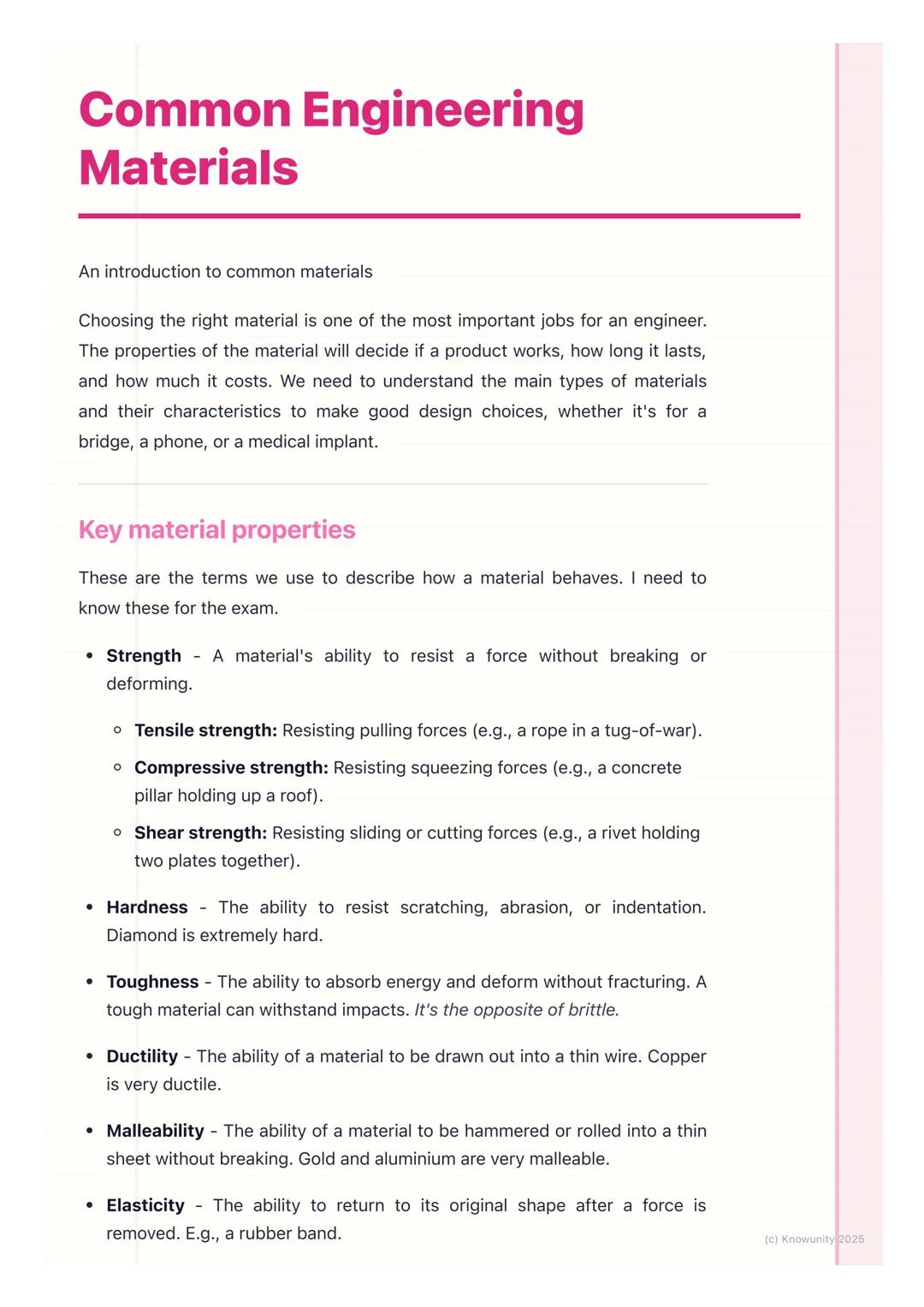
When designing products, engineers must understand how materials behave under different conditions. These properties determine which materials are suitable for specific applications.
Materials have different types of strength: tensile strength helps resist pulling forces , compressive strength resists squeezing forces (like concrete pillars supporting a roof), and shear strength resists sliding forces (like rivets holding plates together). Hardness measures resistance to scratching or indentation, while toughness is about absorbing energy without breaking.
Ductility and malleability are related but different properties. Ductile materials like copper can be drawn into wires, while malleable materials like gold can be hammered into sheets without breaking. Elasticity describes how well materials return to their original shape after a force is removed, like a rubber band. When materials permanently change shape, they've undergone plastic deformation.
Remember: Don't confuse hardness with toughness! A ceramic tile is hard but not tough (it shatters easily), while a car bumper is tough (absorbs impact) but not very hard.
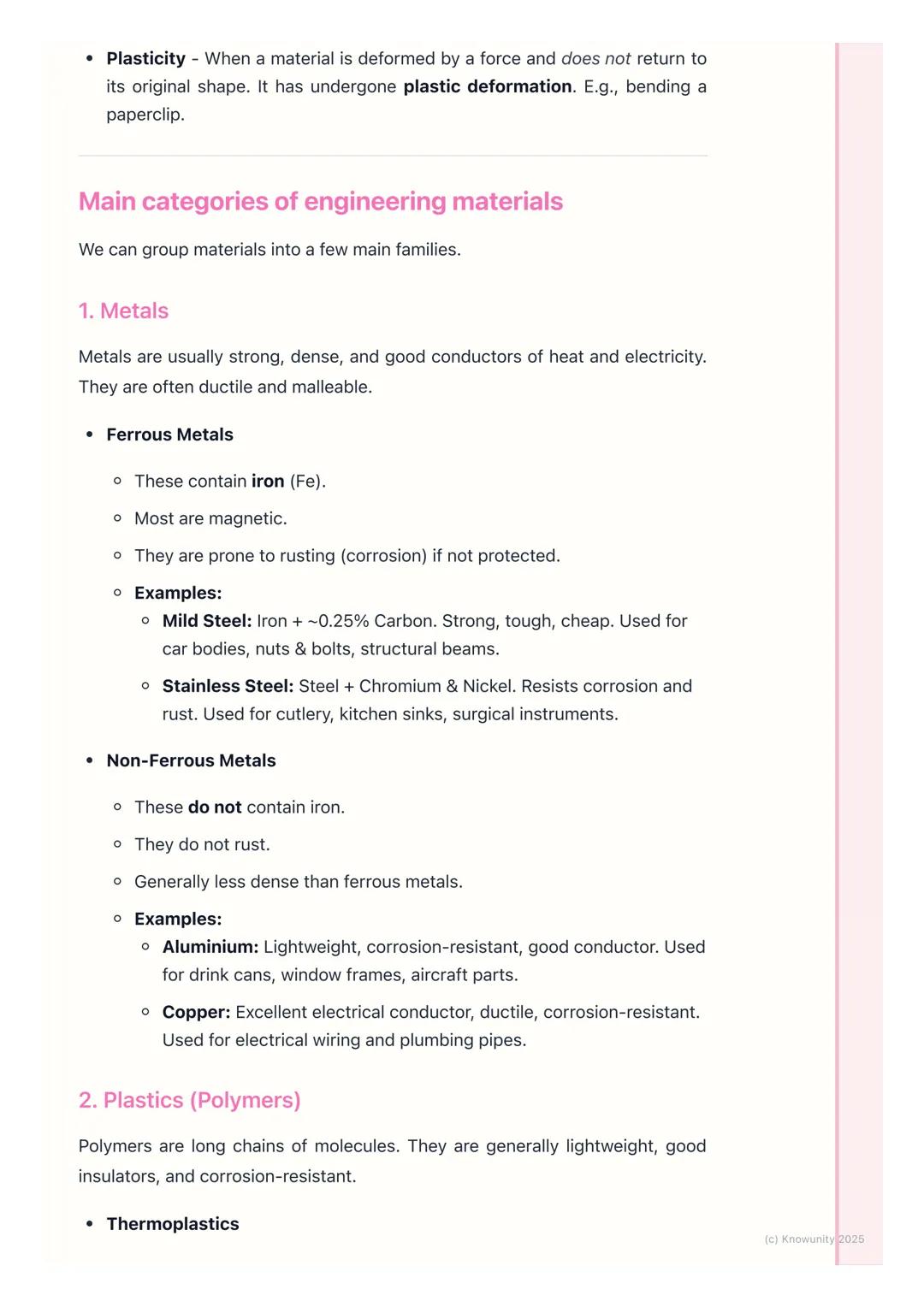
Metals are the workhorses of engineering materials, known for their strength and conductivity. You'll find them in everything from your smartphone to massive bridges.
Ferrous metals contain iron and include mild steel (iron with about 0.25% carbon) which is strong, tough, and affordable, making it perfect for car bodies and structural beams. Stainless steel adds chromium and nickel to create a rust-resistant metal ideal for cutlery and surgical instruments. Most ferrous metals are magnetic and prone to rusting if not protected.
Non-ferrous metals don't contain iron and don't rust, which makes them valuable for specific applications. Aluminium is lightweight and corrosion-resistant, making it perfect for aircraft parts and window frames. Copper is an excellent electrical conductor that's also ductile and corrosion-resistant, which is why it's used for electrical wiring and plumbing.
When choosing between ferrous and non-ferrous metals, consider the environment where they'll be used. For outdoor applications exposed to moisture, non-ferrous metals or specially treated ferrous metals are often better choices.
Pro tip: When preparing for exams, remember ferrous metals with the phrase "Fe-rrous" – Fe is the chemical symbol for iron!
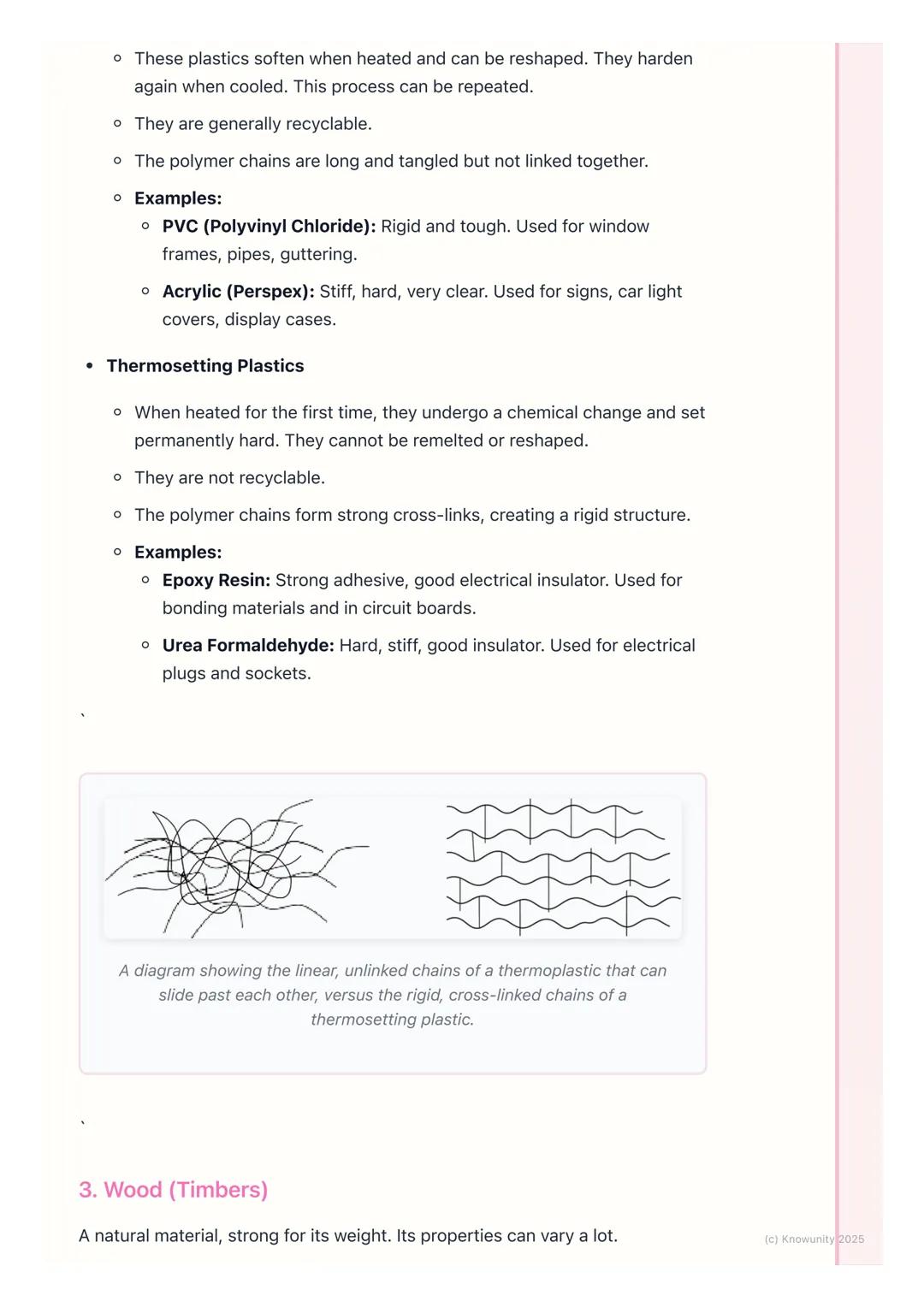
Plastics are everywhere in our modern world, from your water bottle to parts in your computer. Their versatility comes from their molecular structure.
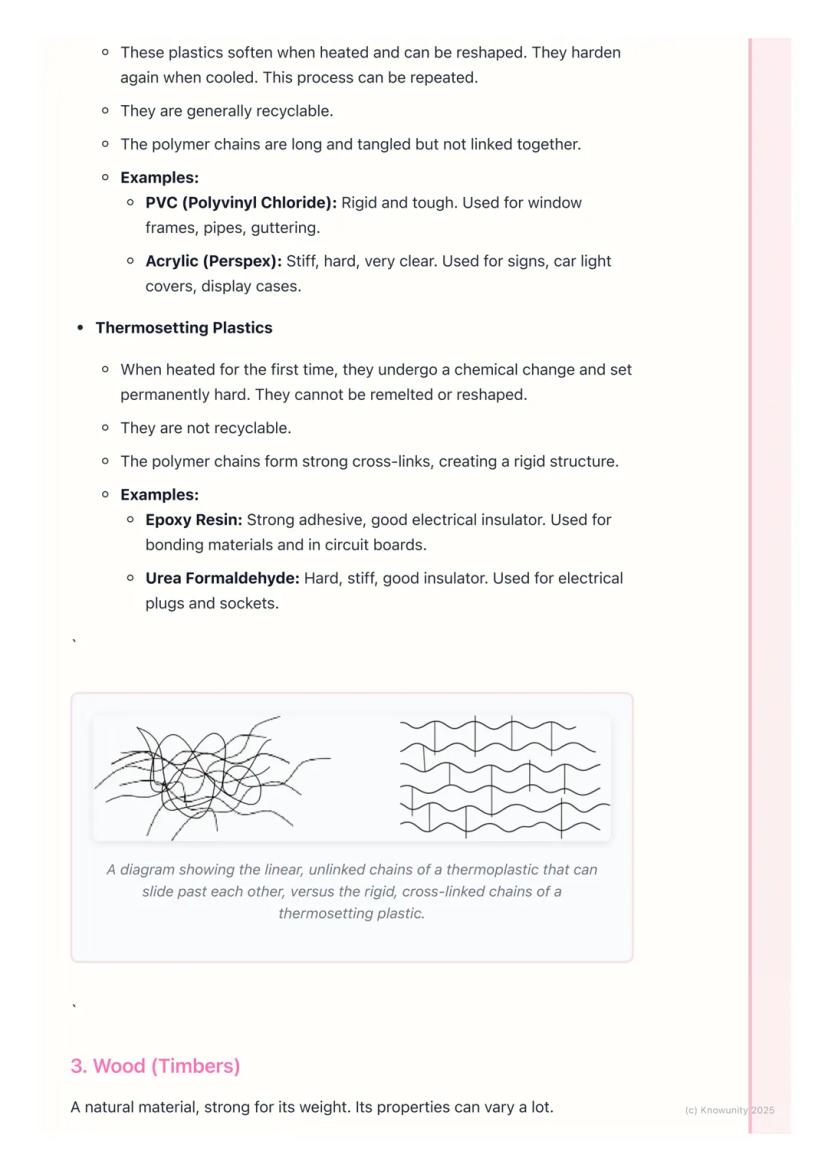
Thermoplastics can be melted and reshaped repeatedly, making them ideal for recycling. Their long polymer chains tangle but don't link together, allowing them to soften when heated. PVC (polyvinyl chloride) is a rigid, tough thermoplastic used for pipes and window frames, while acrylic (Perspex) offers clarity for signs and car light covers.
Thermosetting plastics undergo a permanent chemical change when first heated, creating strong cross-links between polymer chains. Once set, they can't be remelted or reshaped. Epoxy resin is a strong adhesive and electrical insulator used in circuit boards, while urea formaldehyde provides hard, stiff material for electrical plugs and sockets.
The key difference between these plastic types is in their molecular structure – thermoplastics have linear chains that can slide past each other when heated, while thermosets have rigid cross-linked structures that cannot be broken down by reheating.
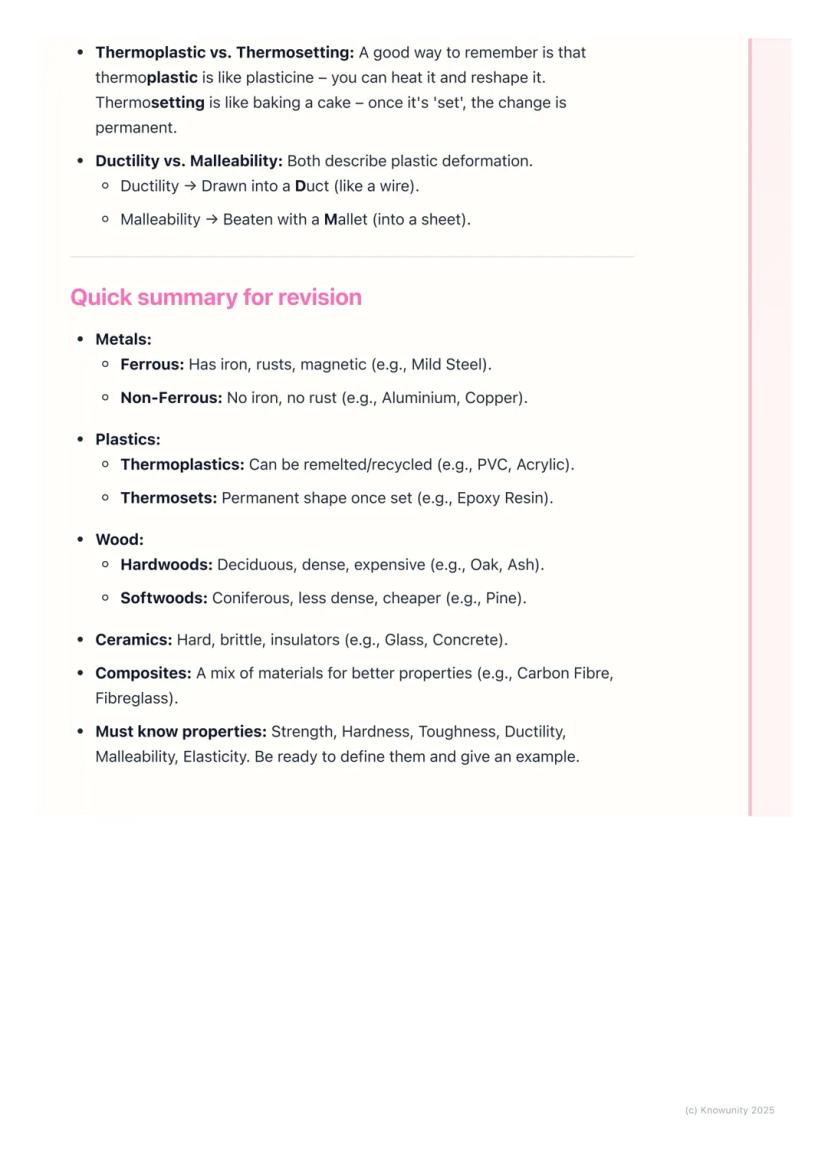
Visual comparison: Think of thermoplastics as a bowl of spaghetti (strands can move) and thermosetting plastics as a fishing net (permanently connected at junction points).
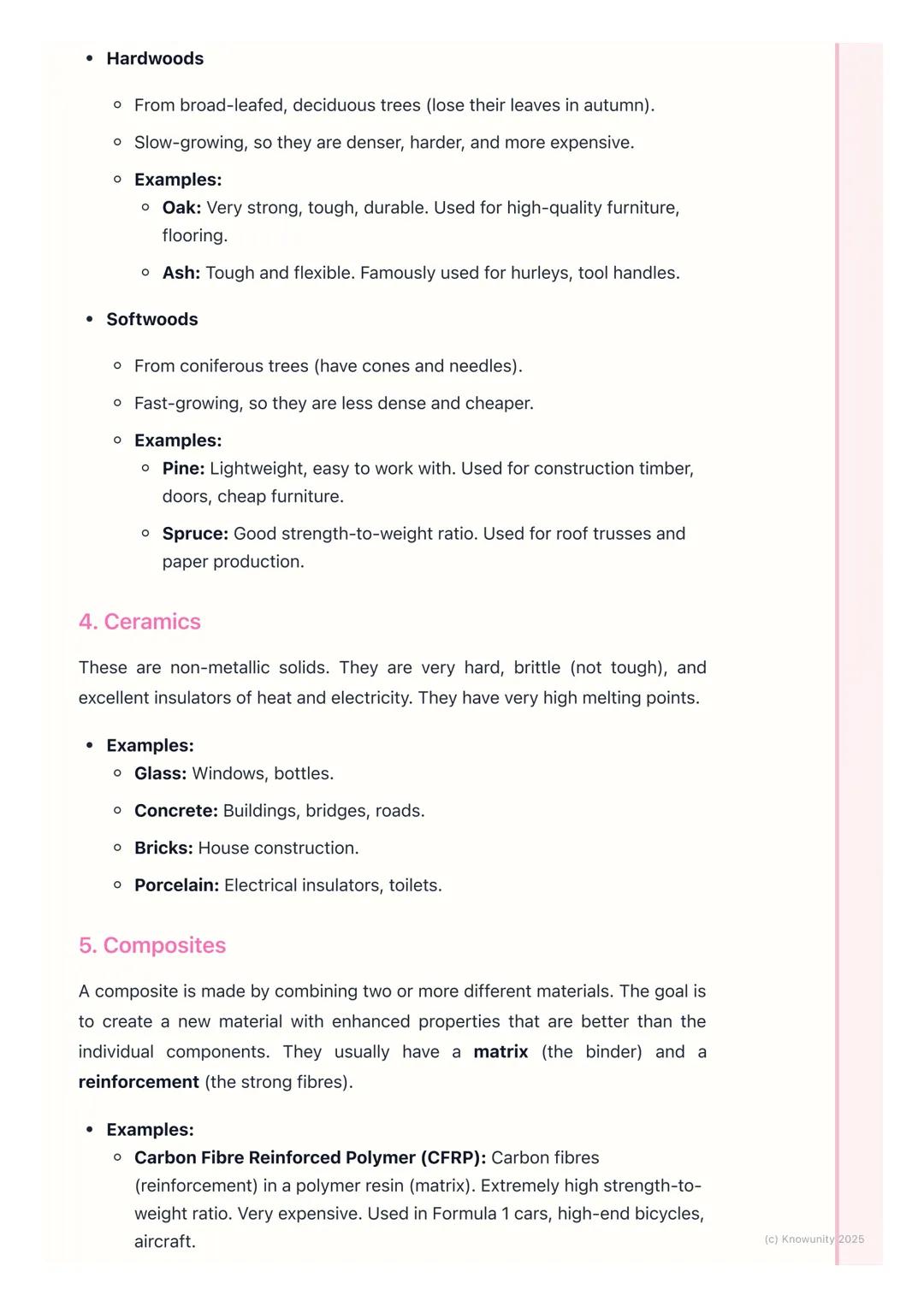
Natural and traditional materials still play crucial roles in modern engineering despite advancements in synthetic options.
Wood offers excellent strength-to-weight properties and comes in two main categories. Hardwoods come from broad-leafed deciduous trees, grow slowly, and are generally denser and more expensive. Oak provides durability for high-quality furniture, while ash's flexibility makes it perfect for hurley sticks and tool handles. Softwoods from coniferous trees grow faster and are less dense and cheaper. Pine is lightweight and easy to work with, making it ideal for construction timber and affordable furniture.
Ceramics are non-metallic solids known for extreme hardness, brittleness, and excellent insulation properties. They have incredibly high melting points and maintain strength at high temperatures. Glass provides transparency for windows and bottles, while concrete creates the foundation for buildings and bridges. Bricks have been used in construction for centuries, and porcelain serves as both an electrical insulator and durable bathroom fixture material.
Wood and ceramics represent opposite ends of the materials spectrum – wood is flexible and organic, while ceramics are rigid and processed. Each has properties that make them irreplaceable in certain applications.
Interesting fact: Despite advances in synthetic materials, wood still has one of the best strength-to-weight ratios of any engineering material, which is why it remains popular for many applications.
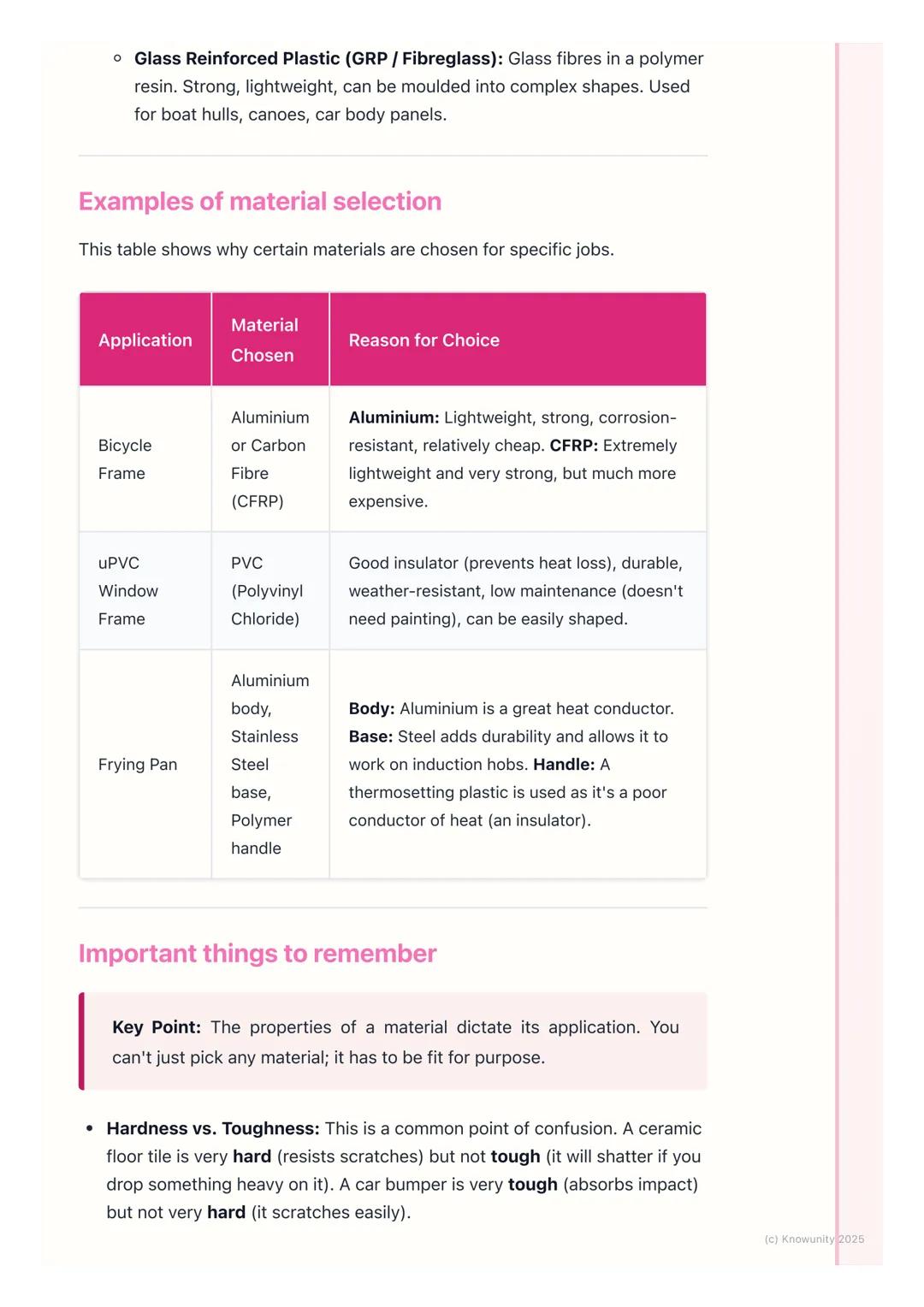
Composites represent the cutting edge of engineering materials, combining the best properties of different materials to create something superior to the individual components.
Composites typically consist of a matrix (binder) and reinforcement (strong fibres). Carbon Fibre Reinforced Polymer (CFRP) uses carbon fibres in a polymer resin to create an incredibly strong yet lightweight material used in Formula 1 cars and high-end bicycles. Glass Reinforced Plastic combines glass fibres with polymer resin for strong, lightweight boat hulls and car body panels.
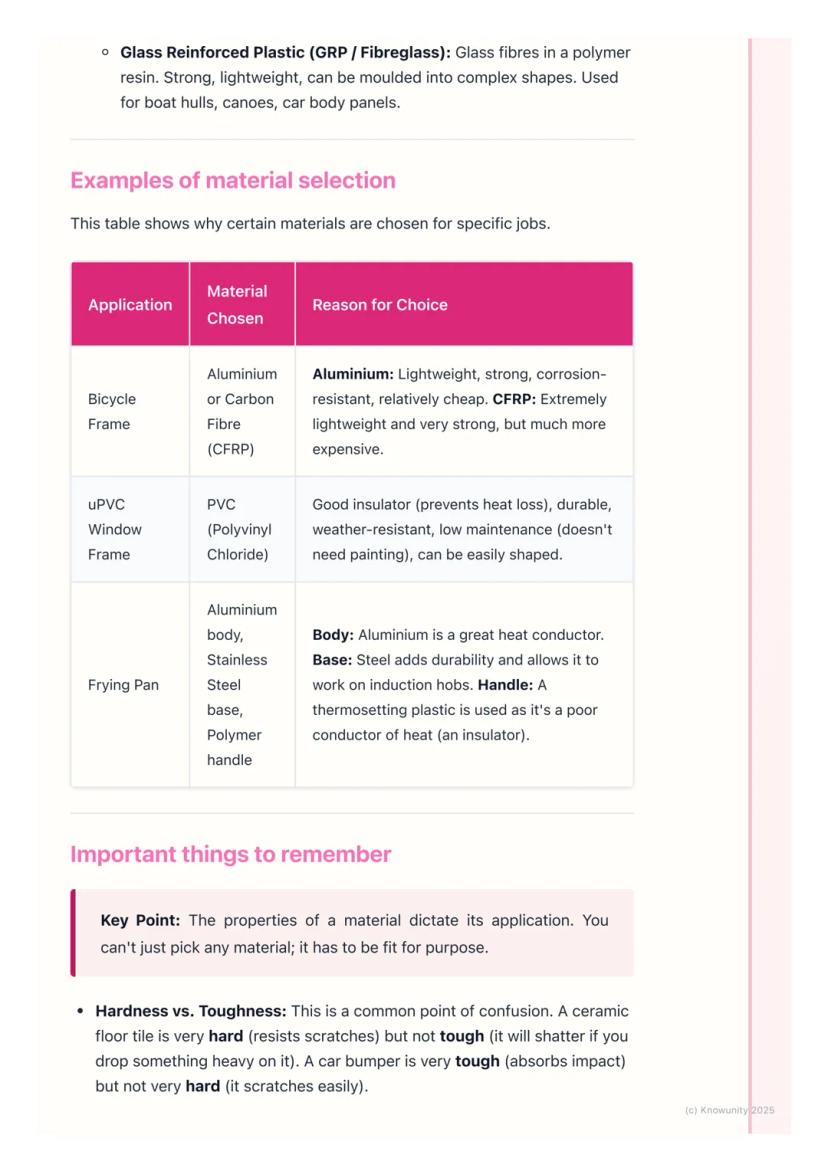
Engineers select materials based on specific requirements. Bicycle frames use aluminium or carbon fibre for their strength-to-weight ratio and corrosion resistance. uPVC window frames offer insulation, weather resistance, and low maintenance. Frying pans combine aluminium bodies (good heat conductors) with stainless steel bases (durability) and polymer handles (heat insulation).
The key principle in material selection is fitness for purpose – you must consider all requirements, constraints, and environmental factors when choosing materials for a specific application.
Exam tip: When answering questions about material selection, always explain both the property AND why it matters for that specific application (e.g., "Aluminium is lightweight, which reduces the energy needed to propel a bicycle").
As you prepare for your exams, focus on understanding the relationships between material properties and their applications in real-world engineering.
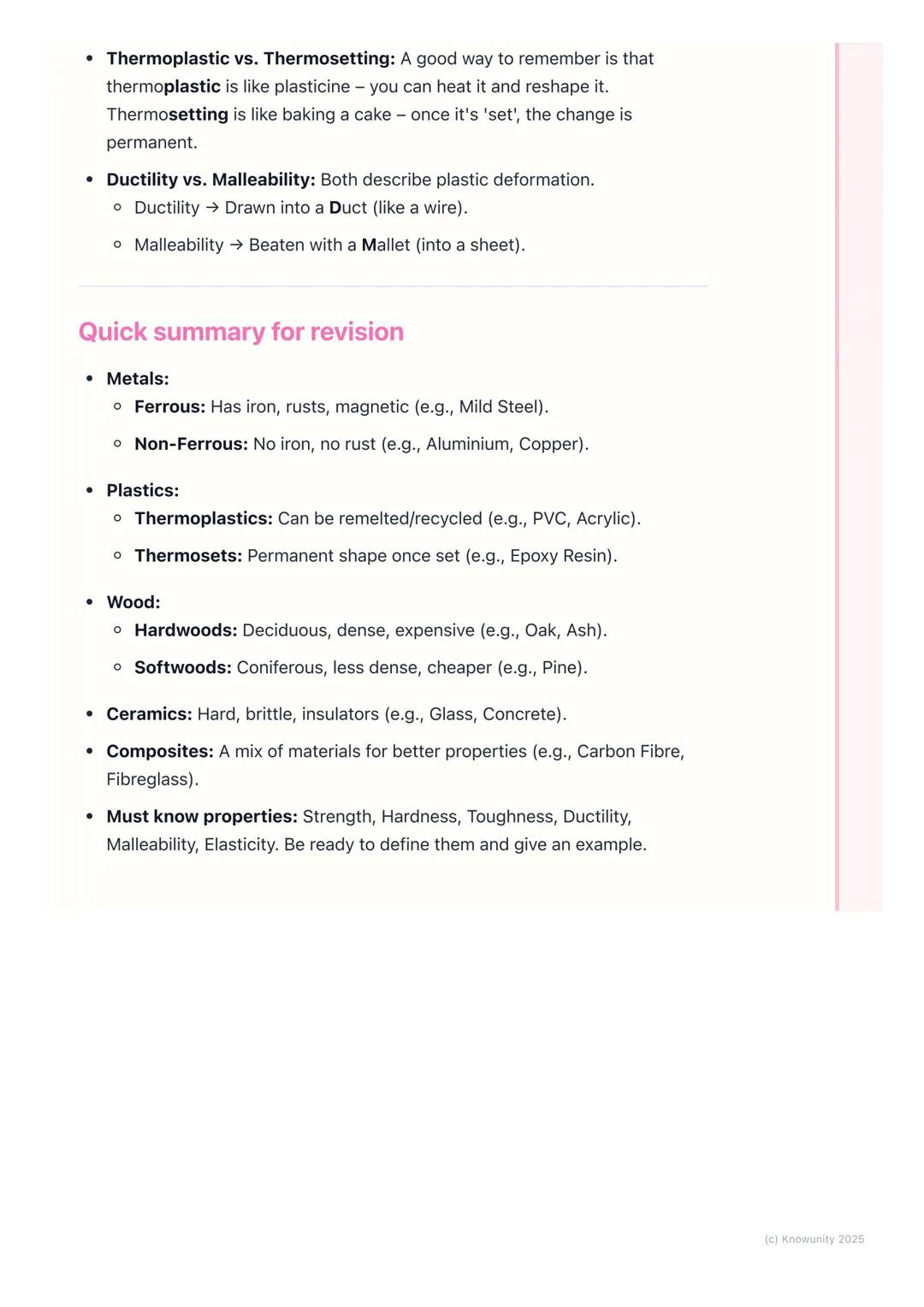
To distinguish between similar-sounding properties, use memory aids: think of ductility as drawing into a "duct" (wire), and malleability as beating with a "mallet" (sheet). For plastics, remember that thermoplastics are like plasticine (reheat to reshape), while thermosetting plastics are like a baked cake (once set, the change is permanent).
For quick revision, group materials by family: Metals , Plastics (thermoplastics can be remelted; thermosets cannot), Wood (hardwoods are dense and expensive; softwoods are less dense and cheaper), Ceramics (hard, brittle insulators), and Composites (material combinations with enhanced properties).
The essential properties to know include strength (tensile, compressive, shear), hardness, toughness, ductility, malleability, and elasticity. Be prepared to define each and provide relevant examples. Understanding these fundamentals will help you analyse and solve engineering material problems in your exams.
Final tip: When studying materials, try to physically handle examples of each type. The tactile experience of feeling the weight of metals, the flexibility of thermoplastics, or the grain of different woods will help cement your understanding better than text alone.
Náš AI společník je speciálně vytvořen pro potřeby studentů. Na základě milionů obsahových materiálů, které máme na platformě, můžeme studentům poskytovat opravdu smysluplné a relevantní odpovědi. Ale nejde jen o odpovědi, společník je ještě více o provázení studentů jejich každodenními výzvami v učení, s personalizovanými studijními plány, kvízy nebo obsahovými materiály v chatu a 100% personalizací na základě dovedností a vývoje studentů.
Aplikaci si můžete stáhnout z obchodu Google Play a Apple App Store.
Ano, máte bezplatný přístup k obsahu v aplikaci a k našemu společníkovi s umělou inteligencí. Chcete-li odemknout určité funkce aplikace, můžete si zakoupit aplikaci Knowunity Pro.
App Store
Google Play
Aplikace je velmi jednoduchá na používání a dobře navržená. Zatím jsem našel vše, co jsem hledal, a mohl jsem se z prezentací hodně naučit! Určitě použiju aplikaci na školní úkol! A samozřejmě taky hodně pomáhá jako inspirace.
Stefan S
uživatel iOS
Tahle aplikace je fakt skvělá. Je tam tolik studijních poznámek a pomůcek [...]. Můj problémový předmět je například francouzština a aplikace nabízí tolik možností pomoci. Díky této aplikaci jsem si zlepšil francouzštinu. Doporučil bych ji každému.
Samantha Klich
uživatelka Androidu
Páni, jsem opravdu ohromen. Zkusil jsem aplikaci jen proto, že jsem ji mnohokrát viděl v reklamách, a byl jsem naprosto ohromen. Tato aplikace je TA POMOC, kterou chceš do školy, a především nabízí spoustu věcí, jako jsou cvičení a přehledy faktů, které mi osobně VELMI pomohly.
Anna
uživatelka iOS
Dříve jsem měl problémy s dokončováním úkolů včas, dokud jsem neobjevil Knowunity, který nejen usnadňuje nahrávání mého vlastního obsahu, ale také poskytuje skvělé shrnutí, díky kterým je moje práce rychlejší a efektivnější.
Thomas R
uživatel iOS
Vždy bylo výzvou najít všechny důležité informace pro mé úkoly – od té doby, co používám Knowunity, můžu jednoduše nahrát svůj obsah a těžit ze shrnutí ostatních, což mi hodně pomáhá s organizací.
Lisa M
uživatelka Androidu
Často jsem měl pocit, že nemám dostatečný přehled při učení, ale od té doby, co používám Knowunity, to už neplatí – nahraju svůj obsah a vždy najdu užitečná shrnutí na platformě, což mi učení značně usnadňuje.
David K
uživatel iOS
Ta aplikace je prostě skvělá! Stačí zadat téma do vyhledávání a dostanu odpověď opravdu rychle. Nemusím koukat na 10 YouTube videí, abych něčemu porozuměl, takže šetřím čas. Vřele doporučuji!
Sudenaz Ocak
uživatel Androidu
Ve škole mi matematika vůbec nešla, ale díky této aplikaci se mi teď daří lépe. Jsem moc vděčný, že jste tuhle aplikaci vytvořili.
Greenlight Bonnie
uživatel Androidu
Dřív bylo opravdu těžké shromáždit všechny informace na moje prezentace. Ale od té doby, co používám Knowunity, prostě nahraju svoje poznámky a najdu skvělé souhrny od ostatních – díky tomu je moje studium mnohem efektivnější!
Julia S
uživatelka Androidu
Byl jsem neustále ve stresu kvůli všem studijním materiálům, ale od té doby, co používám Knowunity, nahrávám svoje věci a koukám na super souhrny od ostatních – opravdu mi to pomáhá všechno lépe zvládat a je to mnohem méně stresující.
Marco B
uživatel iOS
TY KVÍZY A KARTIČKY SOU TAK UŽITEČNÝ A MILUJU Knowunity AI. JE TO TAKY DOSLOVA JAKO CHATGPT ALE CHYTŘEJŠÍ!! POMOHLO MI TO I S PROBLÉMY S ŘASENKOU!! A TAKY S MÝMA SKUTEČNÝMA PŘEDMĚTAMA! JASNÝ 😍😁😲🤑💗✨🎀😮
Sarah L
uživatelka Androidu
Dřív jsem trávil hodiny googlováním školních materiálů, ale teď prostě nahraju svoje věci na Knowunity a prohlížím si užitečné souhrny od ostatních – při přípravě na zkoušky se cítím mnohem jistější.
Paul T
uživatel iOS
Aplikace je velmi jednoduchá na používání a dobře navržená. Zatím jsem našel vše, co jsem hledal, a mohl jsem se z prezentací hodně naučit! Určitě použiju aplikaci na školní úkol! A samozřejmě taky hodně pomáhá jako inspirace.
Stefan S
uživatel iOS
Tahle aplikace je fakt skvělá. Je tam tolik studijních poznámek a pomůcek [...]. Můj problémový předmět je například francouzština a aplikace nabízí tolik možností pomoci. Díky této aplikaci jsem si zlepšil francouzštinu. Doporučil bych ji každému.
Samantha Klich
uživatelka Androidu
Páni, jsem opravdu ohromen. Zkusil jsem aplikaci jen proto, že jsem ji mnohokrát viděl v reklamách, a byl jsem naprosto ohromen. Tato aplikace je TA POMOC, kterou chceš do školy, a především nabízí spoustu věcí, jako jsou cvičení a přehledy faktů, které mi osobně VELMI pomohly.
Anna
uživatelka iOS
Dříve jsem měl problémy s dokončováním úkolů včas, dokud jsem neobjevil Knowunity, který nejen usnadňuje nahrávání mého vlastního obsahu, ale také poskytuje skvělé shrnutí, díky kterým je moje práce rychlejší a efektivnější.
Thomas R
uživatel iOS
Vždy bylo výzvou najít všechny důležité informace pro mé úkoly – od té doby, co používám Knowunity, můžu jednoduše nahrát svůj obsah a těžit ze shrnutí ostatních, což mi hodně pomáhá s organizací.
Lisa M
uživatelka Androidu
Často jsem měl pocit, že nemám dostatečný přehled při učení, ale od té doby, co používám Knowunity, to už neplatí – nahraju svůj obsah a vždy najdu užitečná shrnutí na platformě, což mi učení značně usnadňuje.
David K
uživatel iOS
Ta aplikace je prostě skvělá! Stačí zadat téma do vyhledávání a dostanu odpověď opravdu rychle. Nemusím koukat na 10 YouTube videí, abych něčemu porozuměl, takže šetřím čas. Vřele doporučuji!
Sudenaz Ocak
uživatel Androidu
Ve škole mi matematika vůbec nešla, ale díky této aplikaci se mi teď daří lépe. Jsem moc vděčný, že jste tuhle aplikaci vytvořili.
Greenlight Bonnie
uživatel Androidu
Dřív bylo opravdu těžké shromáždit všechny informace na moje prezentace. Ale od té doby, co používám Knowunity, prostě nahraju svoje poznámky a najdu skvělé souhrny od ostatních – díky tomu je moje studium mnohem efektivnější!
Julia S
uživatelka Androidu
Byl jsem neustále ve stresu kvůli všem studijním materiálům, ale od té doby, co používám Knowunity, nahrávám svoje věci a koukám na super souhrny od ostatních – opravdu mi to pomáhá všechno lépe zvládat a je to mnohem méně stresující.
Marco B
uživatel iOS
TY KVÍZY A KARTIČKY SOU TAK UŽITEČNÝ A MILUJU Knowunity AI. JE TO TAKY DOSLOVA JAKO CHATGPT ALE CHYTŘEJŠÍ!! POMOHLO MI TO I S PROBLÉMY S ŘASENKOU!! A TAKY S MÝMA SKUTEČNÝMA PŘEDMĚTAMA! JASNÝ 😍😁😲🤑💗✨🎀😮
Sarah L
uživatelka Androidu
Dřív jsem trávil hodiny googlováním školních materiálů, ale teď prostě nahraju svoje věci na Knowunity a prohlížím si užitečné souhrny od ostatních – při přípravě na zkoušky se cítím mnohem jistější.
Paul T
uživatel iOS
Engineering materials are at the heart of everything we build and use daily. Selecting the right material can make the difference between a product that excels and one that fails. This guide explores the key properties of materials and the... Zobrazit více
Přístup ke všem dokumentům
Zlepši své známky
Připoj se k milionům studentů
When designing products, engineers must understand how materials behave under different conditions. These properties determine which materials are suitable for specific applications.
Materials have different types of strength: tensile strength helps resist pulling forces , compressive strength resists squeezing forces (like concrete pillars supporting a roof), and shear strength resists sliding forces (like rivets holding plates together). Hardness measures resistance to scratching or indentation, while toughness is about absorbing energy without breaking.
Ductility and malleability are related but different properties. Ductile materials like copper can be drawn into wires, while malleable materials like gold can be hammered into sheets without breaking. Elasticity describes how well materials return to their original shape after a force is removed, like a rubber band. When materials permanently change shape, they've undergone plastic deformation.
Remember: Don't confuse hardness with toughness! A ceramic tile is hard but not tough (it shatters easily), while a car bumper is tough (absorbs impact) but not very hard.
Přístup ke všem dokumentům
Zlepši své známky
Připoj se k milionům studentů
Metals are the workhorses of engineering materials, known for their strength and conductivity. You'll find them in everything from your smartphone to massive bridges.
Ferrous metals contain iron and include mild steel (iron with about 0.25% carbon) which is strong, tough, and affordable, making it perfect for car bodies and structural beams. Stainless steel adds chromium and nickel to create a rust-resistant metal ideal for cutlery and surgical instruments. Most ferrous metals are magnetic and prone to rusting if not protected.
Non-ferrous metals don't contain iron and don't rust, which makes them valuable for specific applications. Aluminium is lightweight and corrosion-resistant, making it perfect for aircraft parts and window frames. Copper is an excellent electrical conductor that's also ductile and corrosion-resistant, which is why it's used for electrical wiring and plumbing.
When choosing between ferrous and non-ferrous metals, consider the environment where they'll be used. For outdoor applications exposed to moisture, non-ferrous metals or specially treated ferrous metals are often better choices.
Pro tip: When preparing for exams, remember ferrous metals with the phrase "Fe-rrous" – Fe is the chemical symbol for iron!
Přístup ke všem dokumentům
Zlepši své známky
Připoj se k milionům studentů
Plastics are everywhere in our modern world, from your water bottle to parts in your computer. Their versatility comes from their molecular structure.
Thermoplastics can be melted and reshaped repeatedly, making them ideal for recycling. Their long polymer chains tangle but don't link together, allowing them to soften when heated. PVC (polyvinyl chloride) is a rigid, tough thermoplastic used for pipes and window frames, while acrylic (Perspex) offers clarity for signs and car light covers.
Thermosetting plastics undergo a permanent chemical change when first heated, creating strong cross-links between polymer chains. Once set, they can't be remelted or reshaped. Epoxy resin is a strong adhesive and electrical insulator used in circuit boards, while urea formaldehyde provides hard, stiff material for electrical plugs and sockets.
The key difference between these plastic types is in their molecular structure – thermoplastics have linear chains that can slide past each other when heated, while thermosets have rigid cross-linked structures that cannot be broken down by reheating.
Visual comparison: Think of thermoplastics as a bowl of spaghetti (strands can move) and thermosetting plastics as a fishing net (permanently connected at junction points).
Přístup ke všem dokumentům
Zlepši své známky
Připoj se k milionům studentů
Natural and traditional materials still play crucial roles in modern engineering despite advancements in synthetic options.
Wood offers excellent strength-to-weight properties and comes in two main categories. Hardwoods come from broad-leafed deciduous trees, grow slowly, and are generally denser and more expensive. Oak provides durability for high-quality furniture, while ash's flexibility makes it perfect for hurley sticks and tool handles. Softwoods from coniferous trees grow faster and are less dense and cheaper. Pine is lightweight and easy to work with, making it ideal for construction timber and affordable furniture.
Ceramics are non-metallic solids known for extreme hardness, brittleness, and excellent insulation properties. They have incredibly high melting points and maintain strength at high temperatures. Glass provides transparency for windows and bottles, while concrete creates the foundation for buildings and bridges. Bricks have been used in construction for centuries, and porcelain serves as both an electrical insulator and durable bathroom fixture material.
Wood and ceramics represent opposite ends of the materials spectrum – wood is flexible and organic, while ceramics are rigid and processed. Each has properties that make them irreplaceable in certain applications.
Interesting fact: Despite advances in synthetic materials, wood still has one of the best strength-to-weight ratios of any engineering material, which is why it remains popular for many applications.
Přístup ke všem dokumentům
Zlepši své známky
Připoj se k milionům studentů
Composites represent the cutting edge of engineering materials, combining the best properties of different materials to create something superior to the individual components.
Composites typically consist of a matrix (binder) and reinforcement (strong fibres). Carbon Fibre Reinforced Polymer (CFRP) uses carbon fibres in a polymer resin to create an incredibly strong yet lightweight material used in Formula 1 cars and high-end bicycles. Glass Reinforced Plastic combines glass fibres with polymer resin for strong, lightweight boat hulls and car body panels.
Engineers select materials based on specific requirements. Bicycle frames use aluminium or carbon fibre for their strength-to-weight ratio and corrosion resistance. uPVC window frames offer insulation, weather resistance, and low maintenance. Frying pans combine aluminium bodies (good heat conductors) with stainless steel bases (durability) and polymer handles (heat insulation).
The key principle in material selection is fitness for purpose – you must consider all requirements, constraints, and environmental factors when choosing materials for a specific application.
Exam tip: When answering questions about material selection, always explain both the property AND why it matters for that specific application (e.g., "Aluminium is lightweight, which reduces the energy needed to propel a bicycle").
Přístup ke všem dokumentům
Zlepši své známky
Připoj se k milionům studentů
As you prepare for your exams, focus on understanding the relationships between material properties and their applications in real-world engineering.
To distinguish between similar-sounding properties, use memory aids: think of ductility as drawing into a "duct" (wire), and malleability as beating with a "mallet" (sheet). For plastics, remember that thermoplastics are like plasticine (reheat to reshape), while thermosetting plastics are like a baked cake (once set, the change is permanent).
For quick revision, group materials by family: Metals , Plastics (thermoplastics can be remelted; thermosets cannot), Wood (hardwoods are dense and expensive; softwoods are less dense and cheaper), Ceramics (hard, brittle insulators), and Composites (material combinations with enhanced properties).
The essential properties to know include strength (tensile, compressive, shear), hardness, toughness, ductility, malleability, and elasticity. Be prepared to define each and provide relevant examples. Understanding these fundamentals will help you analyse and solve engineering material problems in your exams.
Final tip: When studying materials, try to physically handle examples of each type. The tactile experience of feeling the weight of metals, the flexibility of thermoplastics, or the grain of different woods will help cement your understanding better than text alone.
Náš AI společník je speciálně vytvořen pro potřeby studentů. Na základě milionů obsahových materiálů, které máme na platformě, můžeme studentům poskytovat opravdu smysluplné a relevantní odpovědi. Ale nejde jen o odpovědi, společník je ještě více o provázení studentů jejich každodenními výzvami v učení, s personalizovanými studijními plány, kvízy nebo obsahovými materiály v chatu a 100% personalizací na základě dovedností a vývoje studentů.
Aplikaci si můžete stáhnout z obchodu Google Play a Apple App Store.
Ano, máte bezplatný přístup k obsahu v aplikaci a k našemu společníkovi s umělou inteligencí. Chcete-li odemknout určité funkce aplikace, můžete si zakoupit aplikaci Knowunity Pro.
0
Chytré Nástroje NOVÉ
Přeměň tyto poznámky na: ✓ 50+ Cvičných Otázek ✓ Interaktivní Kartičky ✓ Úplný zkušební test ✓ Osnovy Esejů
App Store
Google Play
Aplikace je velmi jednoduchá na používání a dobře navržená. Zatím jsem našel vše, co jsem hledal, a mohl jsem se z prezentací hodně naučit! Určitě použiju aplikaci na školní úkol! A samozřejmě taky hodně pomáhá jako inspirace.
Stefan S
uživatel iOS
Tahle aplikace je fakt skvělá. Je tam tolik studijních poznámek a pomůcek [...]. Můj problémový předmět je například francouzština a aplikace nabízí tolik možností pomoci. Díky této aplikaci jsem si zlepšil francouzštinu. Doporučil bych ji každému.
Samantha Klich
uživatelka Androidu
Páni, jsem opravdu ohromen. Zkusil jsem aplikaci jen proto, že jsem ji mnohokrát viděl v reklamách, a byl jsem naprosto ohromen. Tato aplikace je TA POMOC, kterou chceš do školy, a především nabízí spoustu věcí, jako jsou cvičení a přehledy faktů, které mi osobně VELMI pomohly.
Anna
uživatelka iOS
Dříve jsem měl problémy s dokončováním úkolů včas, dokud jsem neobjevil Knowunity, který nejen usnadňuje nahrávání mého vlastního obsahu, ale také poskytuje skvělé shrnutí, díky kterým je moje práce rychlejší a efektivnější.
Thomas R
uživatel iOS
Vždy bylo výzvou najít všechny důležité informace pro mé úkoly – od té doby, co používám Knowunity, můžu jednoduše nahrát svůj obsah a těžit ze shrnutí ostatních, což mi hodně pomáhá s organizací.
Lisa M
uživatelka Androidu
Často jsem měl pocit, že nemám dostatečný přehled při učení, ale od té doby, co používám Knowunity, to už neplatí – nahraju svůj obsah a vždy najdu užitečná shrnutí na platformě, což mi učení značně usnadňuje.
David K
uživatel iOS
Ta aplikace je prostě skvělá! Stačí zadat téma do vyhledávání a dostanu odpověď opravdu rychle. Nemusím koukat na 10 YouTube videí, abych něčemu porozuměl, takže šetřím čas. Vřele doporučuji!
Sudenaz Ocak
uživatel Androidu
Ve škole mi matematika vůbec nešla, ale díky této aplikaci se mi teď daří lépe. Jsem moc vděčný, že jste tuhle aplikaci vytvořili.
Greenlight Bonnie
uživatel Androidu
Dřív bylo opravdu těžké shromáždit všechny informace na moje prezentace. Ale od té doby, co používám Knowunity, prostě nahraju svoje poznámky a najdu skvělé souhrny od ostatních – díky tomu je moje studium mnohem efektivnější!
Julia S
uživatelka Androidu
Byl jsem neustále ve stresu kvůli všem studijním materiálům, ale od té doby, co používám Knowunity, nahrávám svoje věci a koukám na super souhrny od ostatních – opravdu mi to pomáhá všechno lépe zvládat a je to mnohem méně stresující.
Marco B
uživatel iOS
TY KVÍZY A KARTIČKY SOU TAK UŽITEČNÝ A MILUJU Knowunity AI. JE TO TAKY DOSLOVA JAKO CHATGPT ALE CHYTŘEJŠÍ!! POMOHLO MI TO I S PROBLÉMY S ŘASENKOU!! A TAKY S MÝMA SKUTEČNÝMA PŘEDMĚTAMA! JASNÝ 😍😁😲🤑💗✨🎀😮
Sarah L
uživatelka Androidu
Dřív jsem trávil hodiny googlováním školních materiálů, ale teď prostě nahraju svoje věci na Knowunity a prohlížím si užitečné souhrny od ostatních – při přípravě na zkoušky se cítím mnohem jistější.
Paul T
uživatel iOS
Aplikace je velmi jednoduchá na používání a dobře navržená. Zatím jsem našel vše, co jsem hledal, a mohl jsem se z prezentací hodně naučit! Určitě použiju aplikaci na školní úkol! A samozřejmě taky hodně pomáhá jako inspirace.
Stefan S
uživatel iOS
Tahle aplikace je fakt skvělá. Je tam tolik studijních poznámek a pomůcek [...]. Můj problémový předmět je například francouzština a aplikace nabízí tolik možností pomoci. Díky této aplikaci jsem si zlepšil francouzštinu. Doporučil bych ji každému.
Samantha Klich
uživatelka Androidu
Páni, jsem opravdu ohromen. Zkusil jsem aplikaci jen proto, že jsem ji mnohokrát viděl v reklamách, a byl jsem naprosto ohromen. Tato aplikace je TA POMOC, kterou chceš do školy, a především nabízí spoustu věcí, jako jsou cvičení a přehledy faktů, které mi osobně VELMI pomohly.
Anna
uživatelka iOS
Dříve jsem měl problémy s dokončováním úkolů včas, dokud jsem neobjevil Knowunity, který nejen usnadňuje nahrávání mého vlastního obsahu, ale také poskytuje skvělé shrnutí, díky kterým je moje práce rychlejší a efektivnější.
Thomas R
uživatel iOS
Vždy bylo výzvou najít všechny důležité informace pro mé úkoly – od té doby, co používám Knowunity, můžu jednoduše nahrát svůj obsah a těžit ze shrnutí ostatních, což mi hodně pomáhá s organizací.
Lisa M
uživatelka Androidu
Často jsem měl pocit, že nemám dostatečný přehled při učení, ale od té doby, co používám Knowunity, to už neplatí – nahraju svůj obsah a vždy najdu užitečná shrnutí na platformě, což mi učení značně usnadňuje.
David K
uživatel iOS
Ta aplikace je prostě skvělá! Stačí zadat téma do vyhledávání a dostanu odpověď opravdu rychle. Nemusím koukat na 10 YouTube videí, abych něčemu porozuměl, takže šetřím čas. Vřele doporučuji!
Sudenaz Ocak
uživatel Androidu
Ve škole mi matematika vůbec nešla, ale díky této aplikaci se mi teď daří lépe. Jsem moc vděčný, že jste tuhle aplikaci vytvořili.
Greenlight Bonnie
uživatel Androidu
Dřív bylo opravdu těžké shromáždit všechny informace na moje prezentace. Ale od té doby, co používám Knowunity, prostě nahraju svoje poznámky a najdu skvělé souhrny od ostatních – díky tomu je moje studium mnohem efektivnější!
Julia S
uživatelka Androidu
Byl jsem neustále ve stresu kvůli všem studijním materiálům, ale od té doby, co používám Knowunity, nahrávám svoje věci a koukám na super souhrny od ostatních – opravdu mi to pomáhá všechno lépe zvládat a je to mnohem méně stresující.
Marco B
uživatel iOS
TY KVÍZY A KARTIČKY SOU TAK UŽITEČNÝ A MILUJU Knowunity AI. JE TO TAKY DOSLOVA JAKO CHATGPT ALE CHYTŘEJŠÍ!! POMOHLO MI TO I S PROBLÉMY S ŘASENKOU!! A TAKY S MÝMA SKUTEČNÝMA PŘEDMĚTAMA! JASNÝ 😍😁😲🤑💗✨🎀😮
Sarah L
uživatelka Androidu
Dřív jsem trávil hodiny googlováním školních materiálů, ale teď prostě nahraju svoje věci na Knowunity a prohlížím si užitečné souhrny od ostatních – při přípravě na zkoušky se cítím mnohem jistější.
Paul T
uživatel iOS