
Applied Mathematics is basically using the maths you learn in...
 Applied Mathematics11 zobrazení·Aktualizováno Jun 16, 2026·6 stránek
Exploring Applied Mathematics: Tools for Real-World Problems
1 / 6
1
of 6
What is Applied Mathematics?
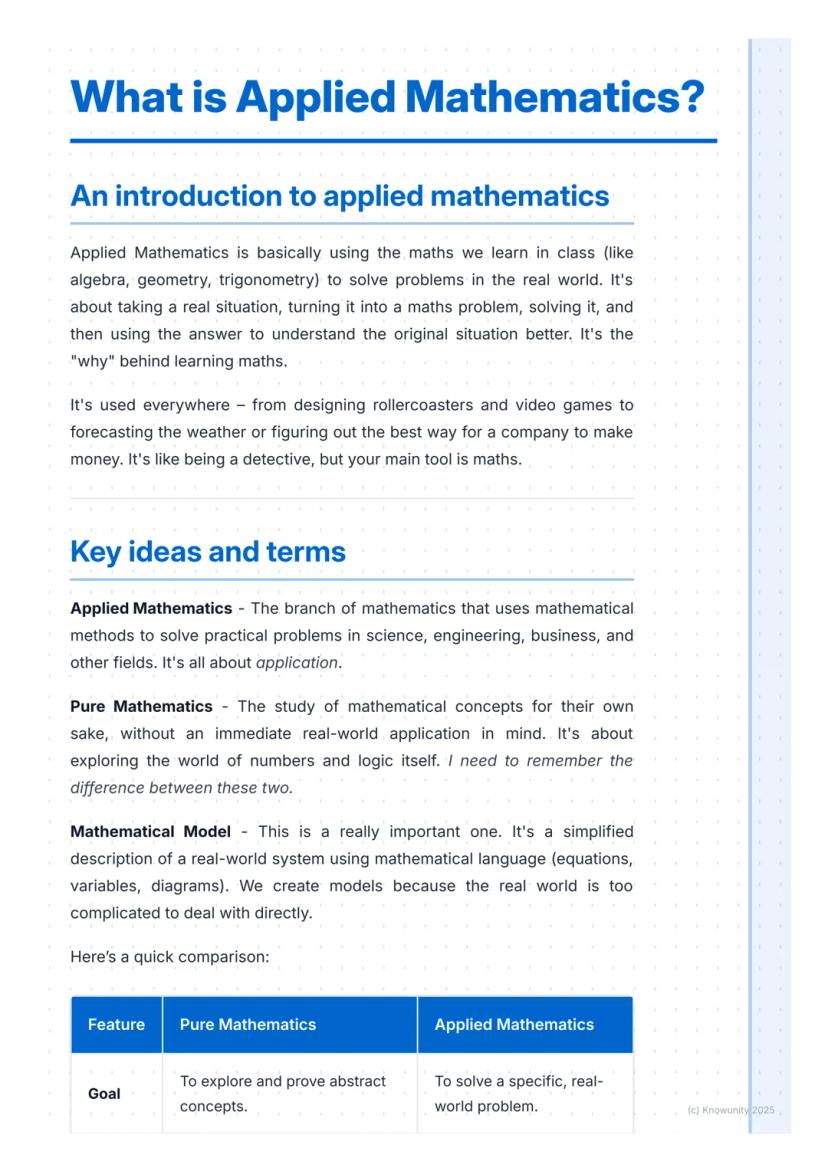
Ever wondered why you're learning algebra or trigonometry? Applied Mathematics is the answer - it's about taking those classroom concepts and using them to solve actual problems in the real world.
Unlike Pure Mathematics (which explores mathematical concepts just for the sake of it), applied maths has a clear goal: solve something practical. Whether it's figuring out the best angle for a football free kick or helping companies make more profit, you're always working towards a real solution.
The secret weapon in applied maths is the mathematical model - basically a simplified maths version of a complex real-world situation. Since the real world is incredibly messy and complicated, we create these models using equations and variables to make problems manageable.
Remember: Pure maths asks "What if?" whilst applied maths asks "How can we fix this?"
2
of 6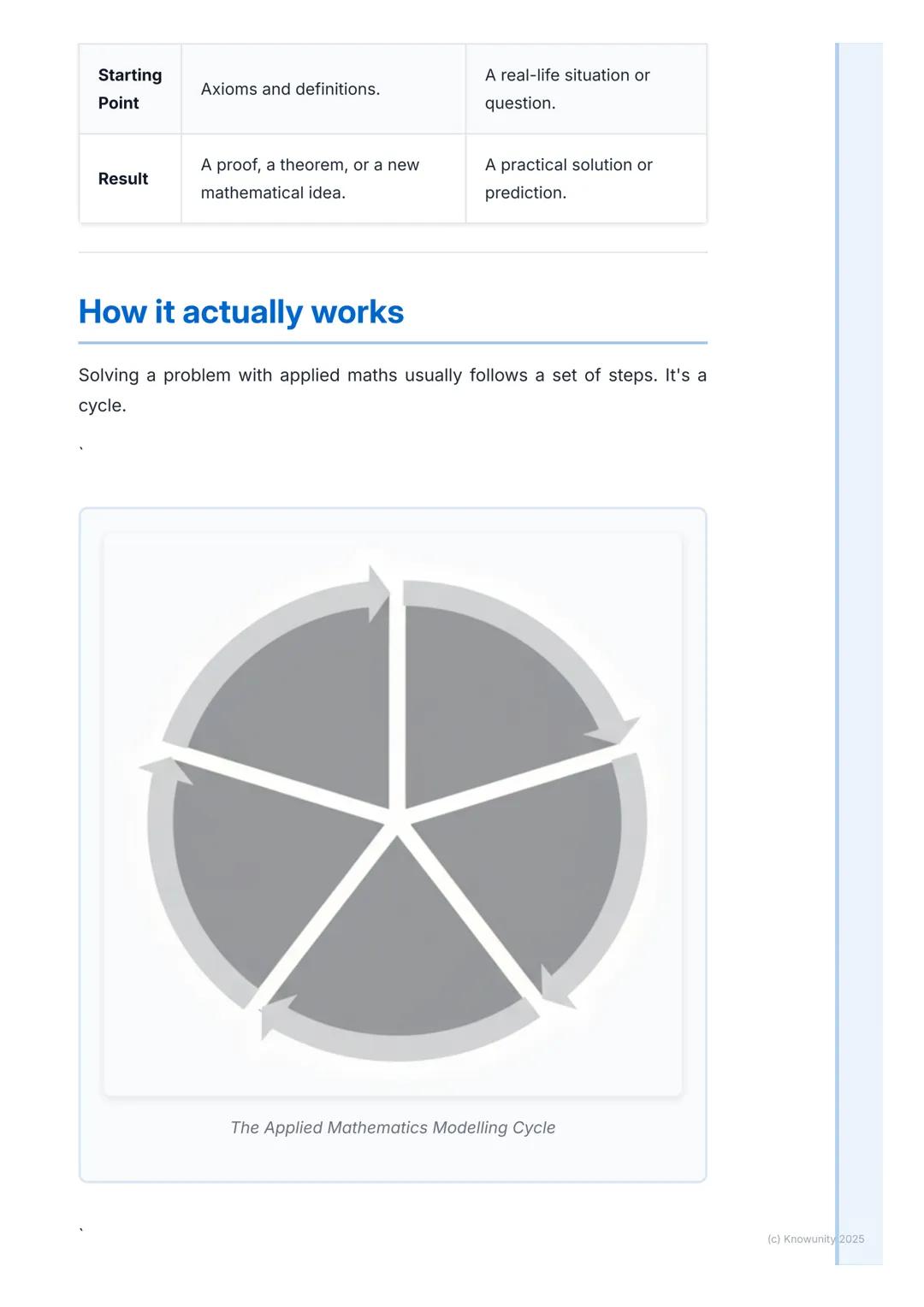
The Applied Mathematics Process
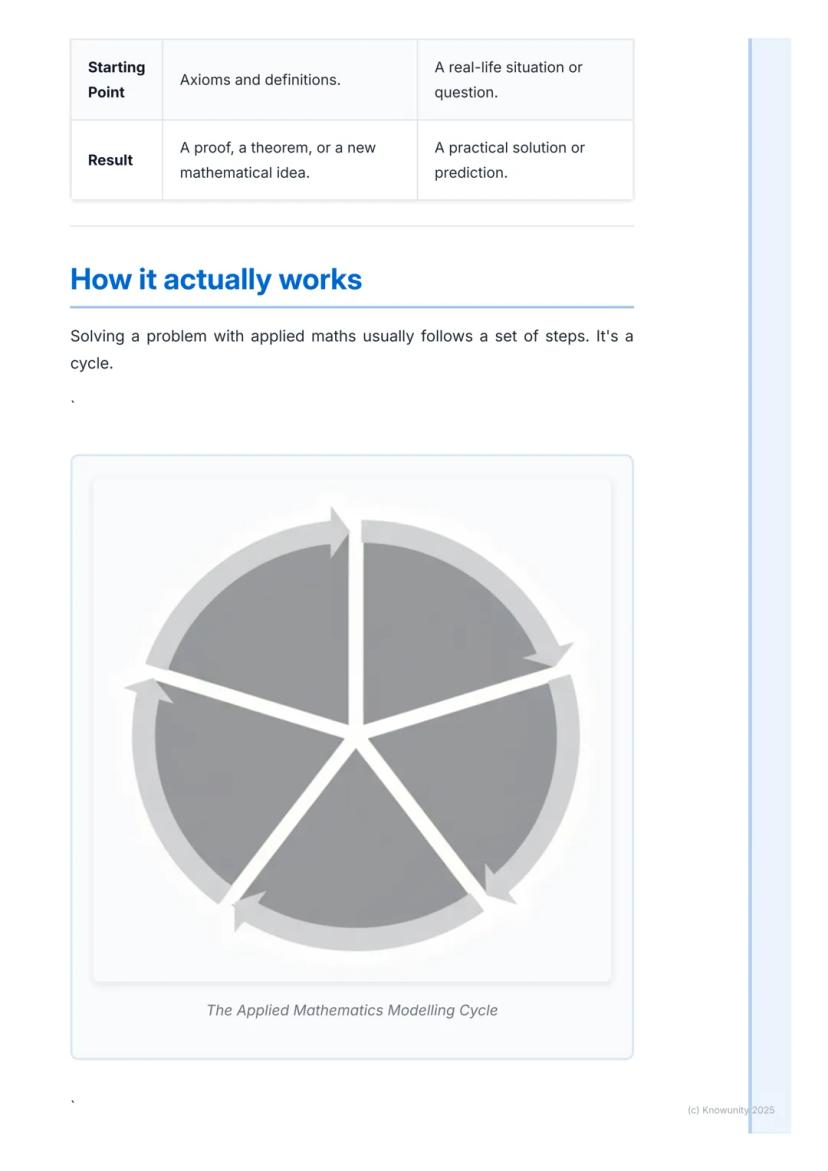
Solving problems with applied mathematics follows a clear cycle that you'll use again and again. It's like having a recipe for tackling any real-world challenge.
The process starts with a real-world problem and moves through several stages: making assumptions, creating a mathematical model, solving it, and interpreting your results. Think of it as translating between two languages - from real life to maths, then back to real life.
This modelling cycle is crucial because it shows that applied maths isn't just about getting the right answer. It's about understanding whether that answer actually makes sense in the original situation.
Key insight: The cycle often repeats - if your answer seems wrong, you go back and refine your model!
3
of 6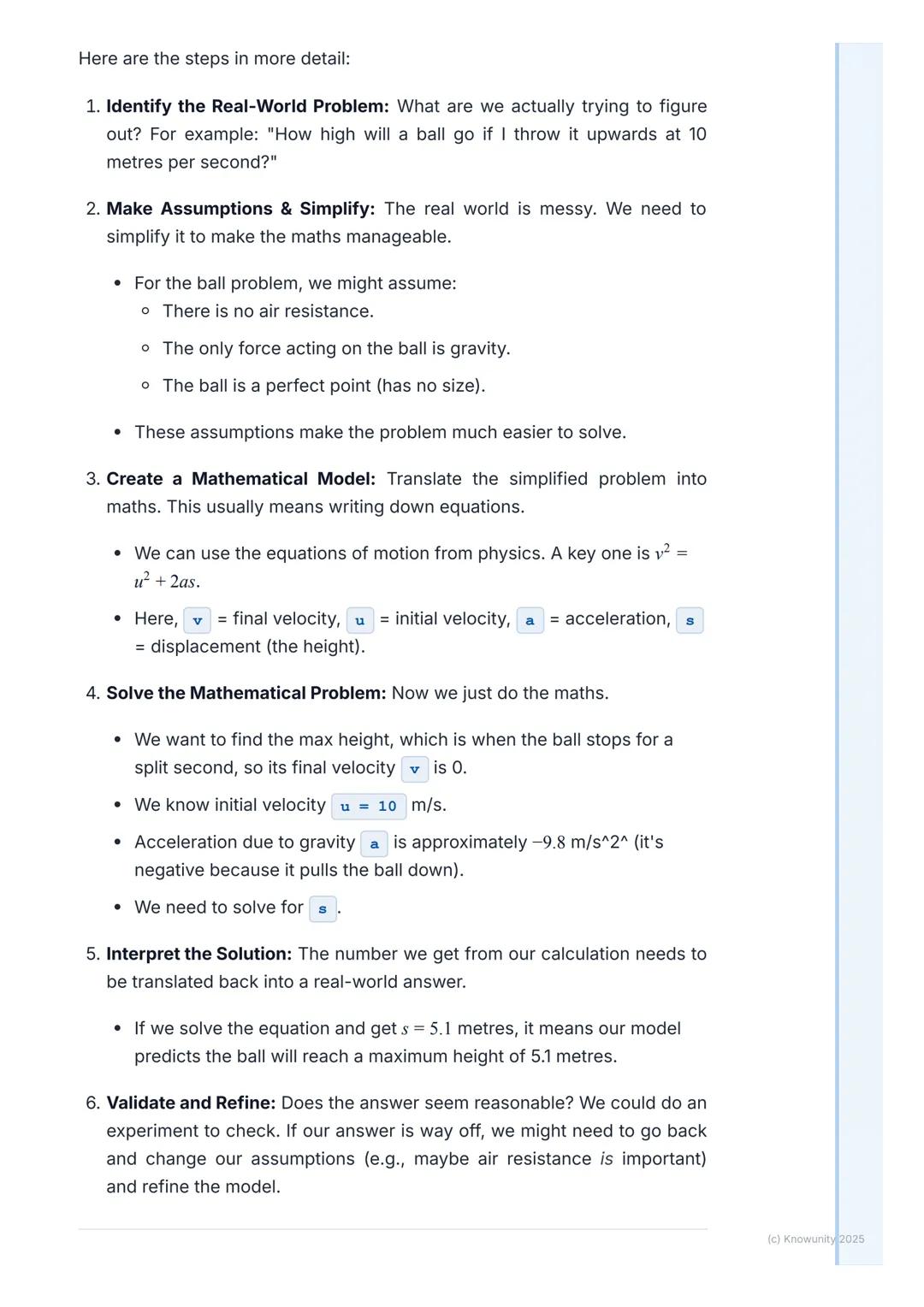
Breaking Down the Steps
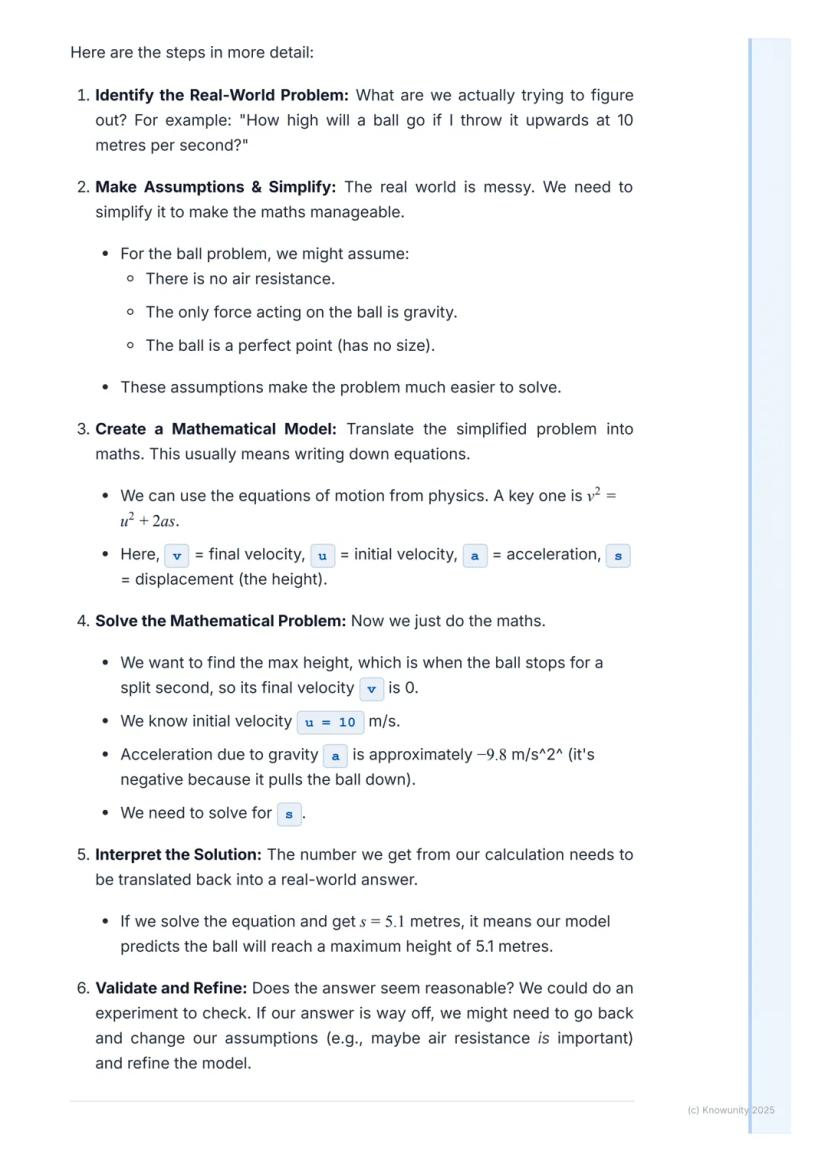
Let's follow the mathematical modelling process with a simple example: "How high will a ball go if I throw it upwards at 10 metres per second?"
First, you identify the problem clearly. Then comes the crucial step of making assumptions - this is where you simplify reality. For our ball, we'll ignore air resistance and assume only gravity affects it.
Next, you create a mathematical model using equations. Here, we'd use physics equations like v² = u² + 2as, where the letters represent velocity, acceleration, and displacement. After solving the maths (plugging in numbers and calculating), you get a numerical answer.
The final steps are interpreting your solution and validating it . If something seems off, you might need to revisit your assumptions.
Pro tip: Always state your assumptions clearly in exams - it shows you understand that you're simplifying a complex problem!
4
of 6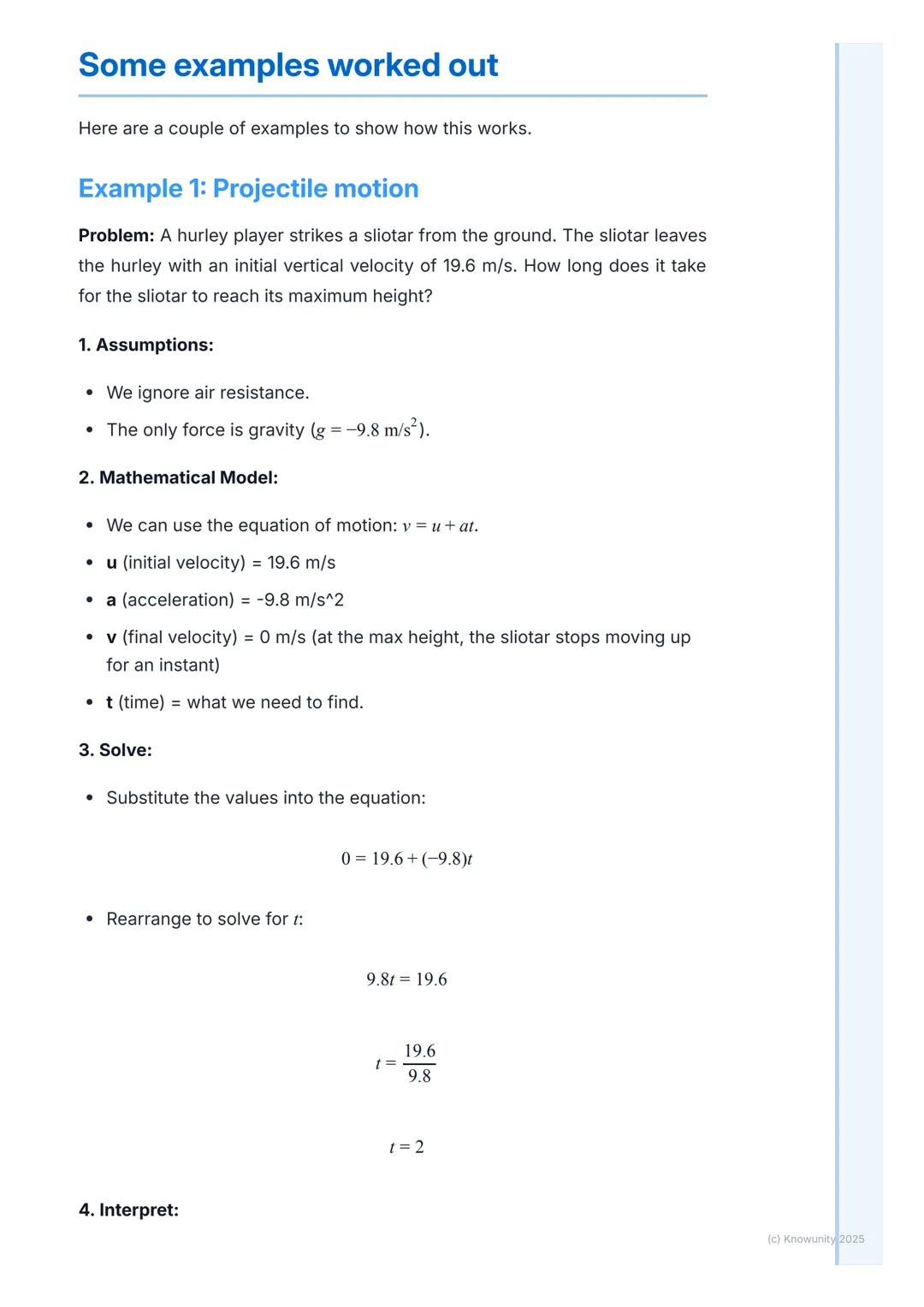
Worked Example: Hurling Physics
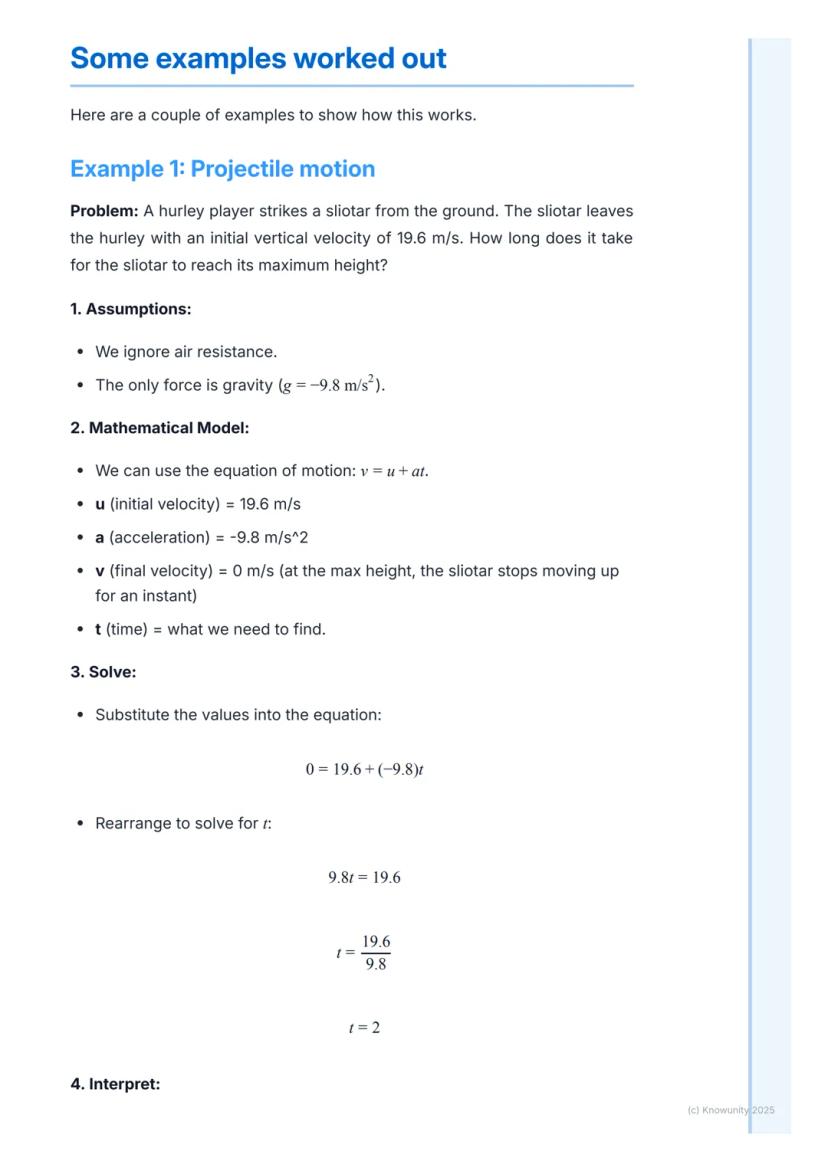
Here's how applied mathematics works with a proper Irish example: A hurler strikes a sliotar with an initial vertical velocity of 19.6 m/s. How long until it reaches maximum height?
Starting with assumptions: we ignore air resistance and only consider gravity . Our mathematical model uses the equation v = u + at, where v (final velocity) = 0 at maximum height, u (initial velocity) = 19.6 m/s, and a (acceleration) = -9.8 m/s².
Solving the equation: 0 = 19.6 + (-9.8)t, which rearranges to t = 19.6/9.8 = 2. The interpretation is straightforward: the sliotar takes 2 seconds to reach its maximum height.
This demonstrates how mathematical modelling transforms a sports scenario into a solvable equation, then translates the numerical result back into practical knowledge.
Reality check: Does 2 seconds seem reasonable for a sliotar to reach its peak? Trust your instincts!
5
of 6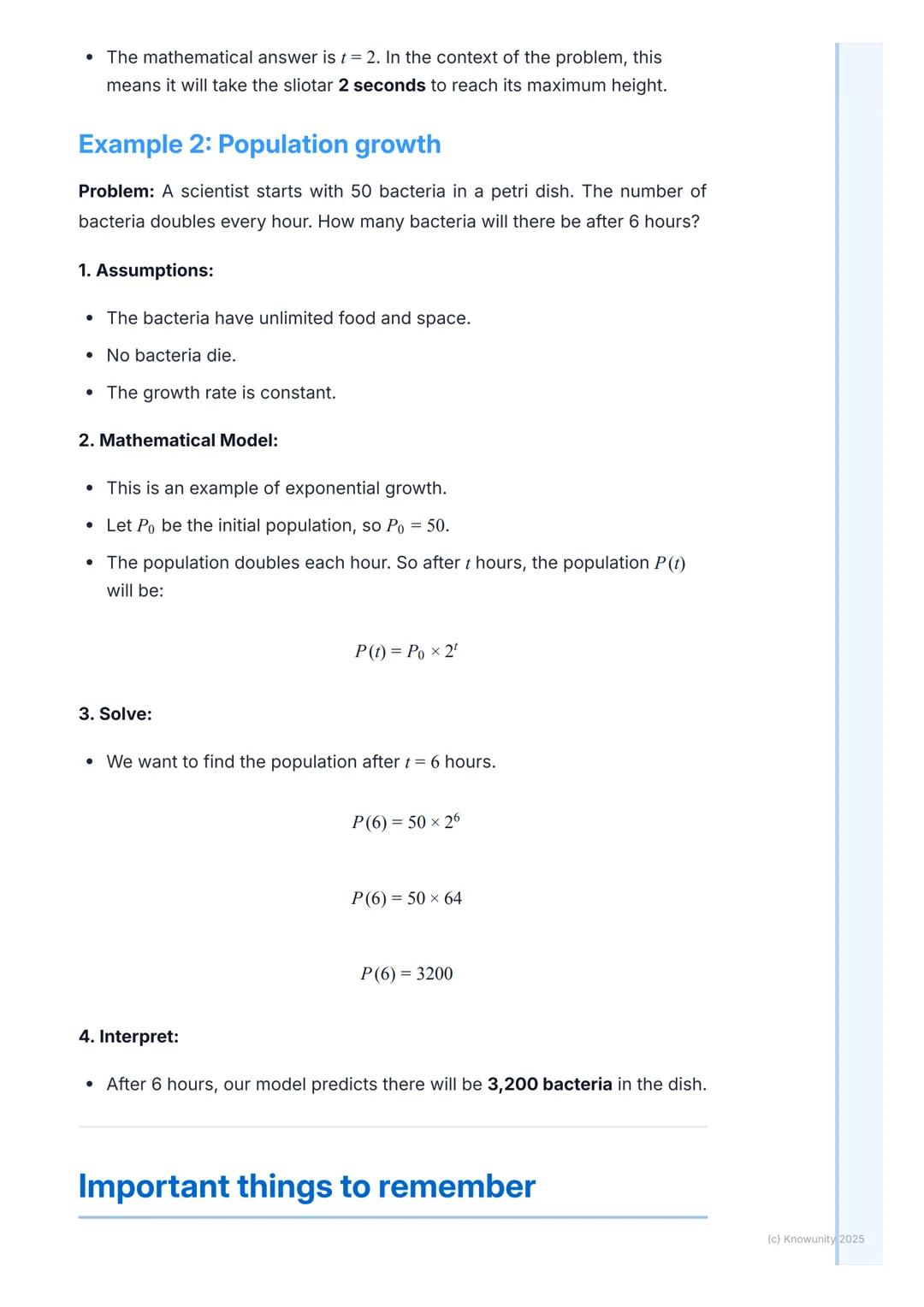
Population Growth Example
Applied mathematics also tackles biological problems brilliantly. Consider: 50 bacteria double every hour - how many after 6 hours?
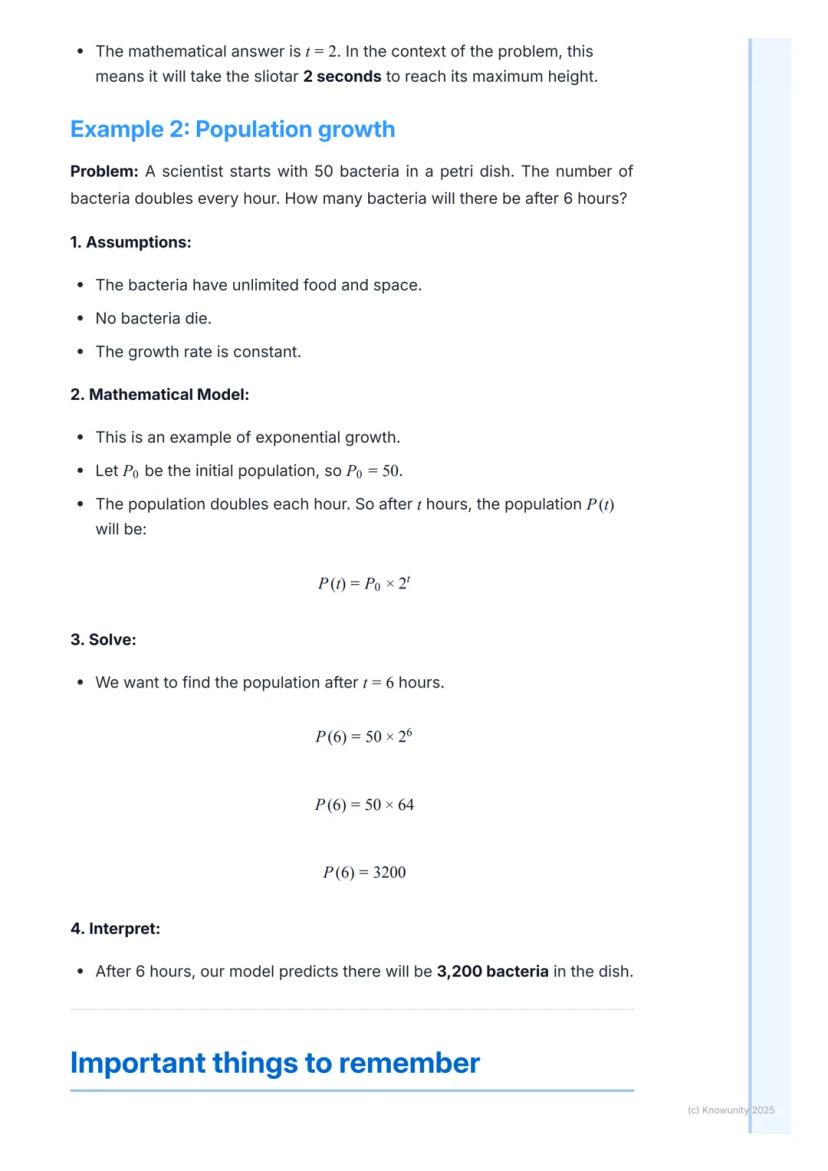
Our assumptions include unlimited food, no deaths, and constant growth rate. The mathematical model for this exponential growth is P(t) = P₀ × 2ᵗ, where P₀ = 50 bacteria and t = time in hours.
Solving: P(6) = 50 × 2⁶ = 50 × 64 = 3,200 bacteria. The interpretation shows how quickly bacterial populations can explode under ideal conditions.
This example demonstrates how mathematical modelling applies across different fields - from sports physics to biological sciences. The same systematic approach works whether you're dealing with projectiles or populations.
Important: Notice how different real-world situations need completely different mathematical models!
6
of 6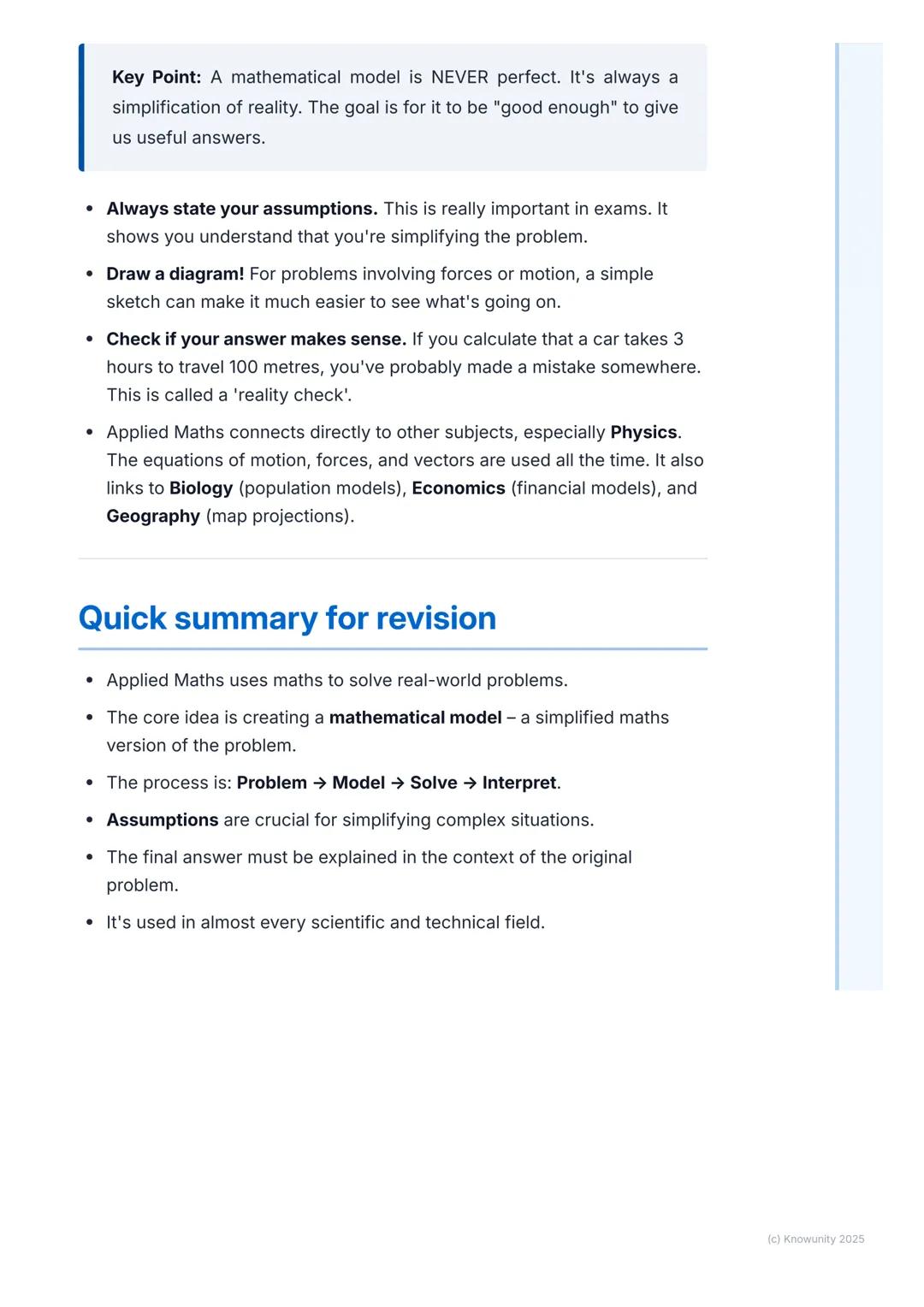
Key Points for Success
Remember that mathematical models are never perfect - they're always simplified versions of reality. The goal is making them "good enough" to provide useful answers, not to capture every tiny detail.
Always state your assumptions clearly and draw diagrams for physics problems. Your applied mathematics solutions should pass the reality check - if a car supposedly takes 3 hours to travel 100 metres, something's gone wrong!
Applied mathematics connects directly to Physics (motion and forces), Biology (population models), Economics (financial planning), and Geography (map projections). It's the bridge between classroom maths and real-world problem-solving.
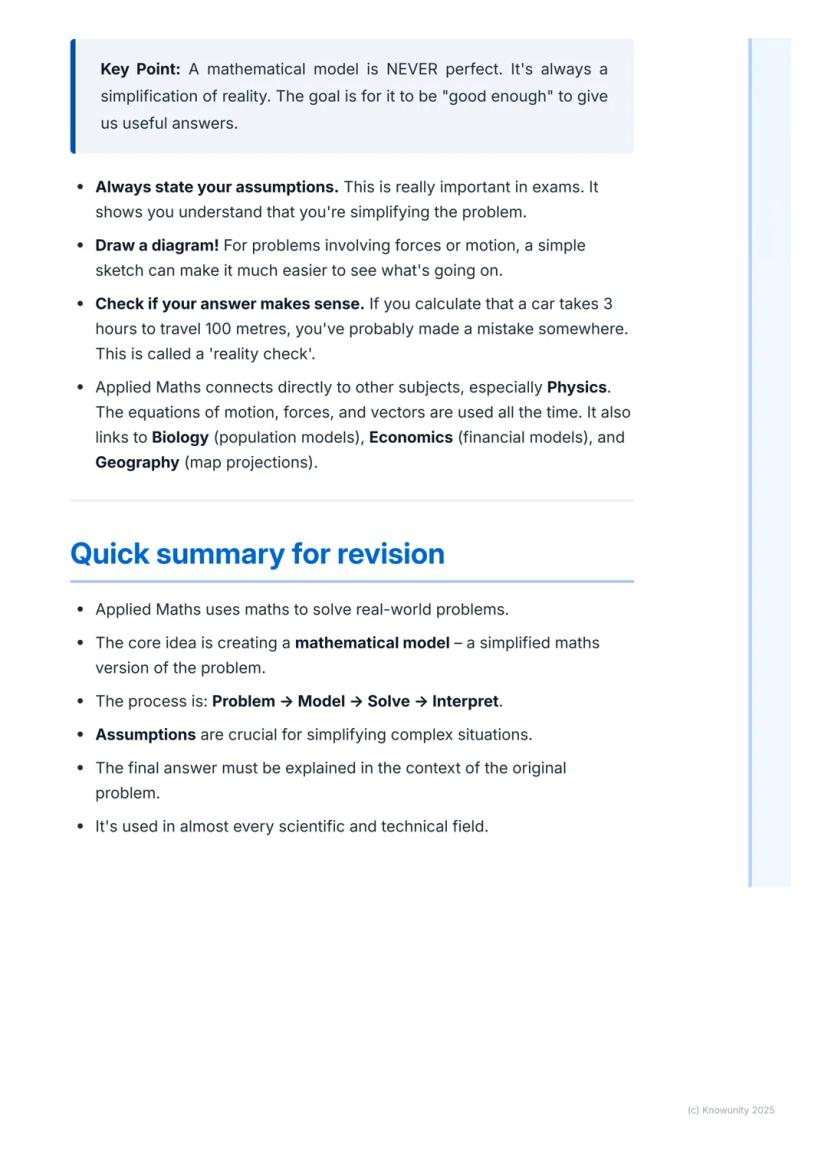
The core process remains constant: Problem → Model → Solve → Interpret. Master this cycle, and you'll be able to tackle everything from engineering challenges to environmental predictions.
Exam success tip: Always explain your final answer in the context of the original problem - numbers alone aren't enough!
Mysleli jsme, že se nikdy nezeptáš...
Co je AI společník Knowunity?
Náš AI společník je speciálně vytvořen pro potřeby studentů. Na základě milionů obsahových materiálů, které máme na platformě, můžeme studentům poskytovat opravdu smysluplné a relevantní odpovědi. Ale nejde jen o odpovědi, společník je ještě více o provázení studentů jejich každodenními výzvami v učení, s personalizovanými studijními plány, kvízy nebo obsahovými materiály v chatu a 100% personalizací na základě dovedností a vývoje studentů.
Kde si můžu stáhnout aplikaci Knowunity?
Aplikaci si můžete stáhnout z obchodu Google Play a Apple App Store.
Jak můžu dostat svou platbu? Kolik si můžu vydělat?
Ano, máte bezplatný přístup k obsahu v aplikaci a k našemu společníkovi s umělou inteligencí. Chcete-li odemknout určité funkce aplikace, můžete si zakoupit aplikaci Knowunity Pro.
Nejpopulárnější poznámky
9 Irish
IrishIrish oral questions and answers
Questions and answers for the leaving cert oral
5th Year4264
 English
Key Quotes : Sive
Key Quotes and explanations: Sive
6th Year2842
IrishIrish oral questions
Outline of oral questions
5th Year2055
IrishIníon- le hÁine Durkin
Aine Durkin’s poem, Iníon: Themes & summary
5th Year850
IrishIrish poetry 2027
Iníon + Dínit an Bhróin
5th Year1133
IrishLC HL notes- Iníon (poem)
Includes poem in English and Irish, theme, key words & phrases
5th Year2284
EnglishCultural Context : Shawshank Redemption : Sive : Small Things Like These
Comparative Study : Cultural Context : Shawshank Redemption, Sive and Small Things Like These
6th Year1430
IrishMo Ghrá-sa (Idir Lúibíní)
Notes on mo ghrá-sa
5th Year380
IrishAn Gaeilge Aiste
Irish Language essay
6th Year1320
Nemůžeš najít, co hledáš? Prozkoumej další předměty.
Recenze od našich uživatelů. Mají vše super — a ty taky můžeš.
4.6/5App Store
4.7/5Google Play
Aplikace je velmi jednoduchá na používání a dobře navržená. Zatím jsem našel vše, co jsem hledal, a mohl jsem se z prezentací hodně naučit! Určitě použiju aplikaci na školní úkol! A samozřejmě taky hodně pomáhá jako inspirace.
Stefan Suživatel iOS
Tahle aplikace je fakt skvělá. Je tam tolik studijních poznámek a pomůcek [...]. Můj problémový předmět je například francouzština a aplikace nabízí tolik možností pomoci. Díky této aplikaci jsem si zlepšil francouzštinu. Doporučil bych ji každému.
Samantha Klichuživatelka Androidu
Páni, jsem opravdu ohromen. Zkusil jsem aplikaci jen proto, že jsem ji mnohokrát viděl v reklamách, a byl jsem naprosto ohromen. Tato aplikace je TA POMOC, kterou chceš do školy, a především nabízí spoustu věcí, jako jsou cvičení a přehledy faktů, které mi osobně VELMI pomohly.
Annauživatelka iOS
Applied Mathematics11 zobrazení·Aktualizováno Jun 16, 2026·6 stránekExploring Applied Mathematics: Tools for Real-World Problems
Applied Mathematics is basically using the maths you learn in class to solve real-world problems - from designing rollercoasters to predicting weather patterns. Think of it as being a detective where your main tool is maths instead of a magnifying...
1
of 6
Registruj se, abys viděl obsah. Je to zdarma!
- Přístup ke všem dokumentům
- Zlepši své známky
- Připoj se k milionům studentů
What is Applied Mathematics?
Ever wondered why you're learning algebra or trigonometry? Applied Mathematics is the answer - it's about taking those classroom concepts and using them to solve actual problems in the real world.
Unlike Pure Mathematics (which explores mathematical concepts just for the sake of it), applied maths has a clear goal: solve something practical. Whether it's figuring out the best angle for a football free kick or helping companies make more profit, you're always working towards a real solution.
The secret weapon in applied maths is the mathematical model - basically a simplified maths version of a complex real-world situation. Since the real world is incredibly messy and complicated, we create these models using equations and variables to make problems manageable.
Remember: Pure maths asks "What if?" whilst applied maths asks "How can we fix this?"
2
of 6Registruj se, abys viděl obsah. Je to zdarma!
- Přístup ke všem dokumentům
- Zlepši své známky
- Připoj se k milionům studentů
The Applied Mathematics Process
Solving problems with applied mathematics follows a clear cycle that you'll use again and again. It's like having a recipe for tackling any real-world challenge.
The process starts with a real-world problem and moves through several stages: making assumptions, creating a mathematical model, solving it, and interpreting your results. Think of it as translating between two languages - from real life to maths, then back to real life.
This modelling cycle is crucial because it shows that applied maths isn't just about getting the right answer. It's about understanding whether that answer actually makes sense in the original situation.
Key insight: The cycle often repeats - if your answer seems wrong, you go back and refine your model!
3
of 6Registruj se, abys viděl obsah. Je to zdarma!
- Přístup ke všem dokumentům
- Zlepši své známky
- Připoj se k milionům studentů
Breaking Down the Steps
Let's follow the mathematical modelling process with a simple example: "How high will a ball go if I throw it upwards at 10 metres per second?"
First, you identify the problem clearly. Then comes the crucial step of making assumptions - this is where you simplify reality. For our ball, we'll ignore air resistance and assume only gravity affects it.
Next, you create a mathematical model using equations. Here, we'd use physics equations like v² = u² + 2as, where the letters represent velocity, acceleration, and displacement. After solving the maths (plugging in numbers and calculating), you get a numerical answer.
The final steps are interpreting your solution and validating it . If something seems off, you might need to revisit your assumptions.
Pro tip: Always state your assumptions clearly in exams - it shows you understand that you're simplifying a complex problem!
4
of 6Registruj se, abys viděl obsah. Je to zdarma!
- Přístup ke všem dokumentům
- Zlepši své známky
- Připoj se k milionům studentů
Worked Example: Hurling Physics
Here's how applied mathematics works with a proper Irish example: A hurler strikes a sliotar with an initial vertical velocity of 19.6 m/s. How long until it reaches maximum height?
Starting with assumptions: we ignore air resistance and only consider gravity . Our mathematical model uses the equation v = u + at, where v (final velocity) = 0 at maximum height, u (initial velocity) = 19.6 m/s, and a (acceleration) = -9.8 m/s².
Solving the equation: 0 = 19.6 + (-9.8)t, which rearranges to t = 19.6/9.8 = 2. The interpretation is straightforward: the sliotar takes 2 seconds to reach its maximum height.
This demonstrates how mathematical modelling transforms a sports scenario into a solvable equation, then translates the numerical result back into practical knowledge.
Reality check: Does 2 seconds seem reasonable for a sliotar to reach its peak? Trust your instincts!
5
of 6Registruj se, abys viděl obsah. Je to zdarma!
- Přístup ke všem dokumentům
- Zlepši své známky
- Připoj se k milionům studentů
Population Growth Example
Applied mathematics also tackles biological problems brilliantly. Consider: 50 bacteria double every hour - how many after 6 hours?
Our assumptions include unlimited food, no deaths, and constant growth rate. The mathematical model for this exponential growth is P(t) = P₀ × 2ᵗ, where P₀ = 50 bacteria and t = time in hours.
Solving: P(6) = 50 × 2⁶ = 50 × 64 = 3,200 bacteria. The interpretation shows how quickly bacterial populations can explode under ideal conditions.
This example demonstrates how mathematical modelling applies across different fields - from sports physics to biological sciences. The same systematic approach works whether you're dealing with projectiles or populations.
Important: Notice how different real-world situations need completely different mathematical models!
6
of 6Registruj se, abys viděl obsah. Je to zdarma!
- Přístup ke všem dokumentům
- Zlepši své známky
- Připoj se k milionům studentů
Key Points for Success
Remember that mathematical models are never perfect - they're always simplified versions of reality. The goal is making them "good enough" to provide useful answers, not to capture every tiny detail.
Always state your assumptions clearly and draw diagrams for physics problems. Your applied mathematics solutions should pass the reality check - if a car supposedly takes 3 hours to travel 100 metres, something's gone wrong!
Applied mathematics connects directly to Physics (motion and forces), Biology (population models), Economics (financial planning), and Geography (map projections). It's the bridge between classroom maths and real-world problem-solving.
The core process remains constant: Problem → Model → Solve → Interpret. Master this cycle, and you'll be able to tackle everything from engineering challenges to environmental predictions.
Exam success tip: Always explain your final answer in the context of the original problem - numbers alone aren't enough!
Mysleli jsme, že se nikdy nezeptáš...
Co je AI společník Knowunity?
Náš AI společník je speciálně vytvořen pro potřeby studentů. Na základě milionů obsahových materiálů, které máme na platformě, můžeme studentům poskytovat opravdu smysluplné a relevantní odpovědi. Ale nejde jen o odpovědi, společník je ještě více o provázení studentů jejich každodenními výzvami v učení, s personalizovanými studijními plány, kvízy nebo obsahovými materiály v chatu a 100% personalizací na základě dovedností a vývoje studentů.
Kde si můžu stáhnout aplikaci Knowunity?
Aplikaci si můžete stáhnout z obchodu Google Play a Apple App Store.
Jak můžu dostat svou platbu? Kolik si můžu vydělat?
Ano, máte bezplatný přístup k obsahu v aplikaci a k našemu společníkovi s umělou inteligencí. Chcete-li odemknout určité funkce aplikace, můžete si zakoupit aplikaci Knowunity Pro.
Nejpopulárnější poznámky
9IrishIrish oral questions and answers
Questions and answers for the leaving cert oral
5th Year4264
EnglishKey Quotes : Sive
Key Quotes and explanations: Sive
6th Year2842
IrishIrish oral questions
Outline of oral questions
5th Year2055
IrishIníon- le hÁine Durkin
Aine Durkin’s poem, Iníon: Themes & summary
5th Year850
IrishIrish poetry 2027
Iníon + Dínit an Bhróin
5th Year1133
IrishLC HL notes- Iníon (poem)
Includes poem in English and Irish, theme, key words & phrases
5th Year2284
EnglishCultural Context : Shawshank Redemption : Sive : Small Things Like These
Comparative Study : Cultural Context : Shawshank Redemption, Sive and Small Things Like These
6th Year1430
IrishMo Ghrá-sa (Idir Lúibíní)
Notes on mo ghrá-sa
5th Year380
IrishAn Gaeilge Aiste
Irish Language essay
6th Year1320
Nemůžeš najít, co hledáš? Prozkoumej další předměty.
Recenze od našich uživatelů. Mají vše super — a ty taky můžeš.
4.6/5App Store
4.7/5Google Play
Aplikace je velmi jednoduchá na používání a dobře navržená. Zatím jsem našel vše, co jsem hledal, a mohl jsem se z prezentací hodně naučit! Určitě použiju aplikaci na školní úkol! A samozřejmě taky hodně pomáhá jako inspirace.
Stefan Suživatel iOS
Tahle aplikace je fakt skvělá. Je tam tolik studijních poznámek a pomůcek [...]. Můj problémový předmět je například francouzština a aplikace nabízí tolik možností pomoci. Díky této aplikaci jsem si zlepšil francouzštinu. Doporučil bych ji každému.
Samantha Klichuživatelka Androidu
Páni, jsem opravdu ohromen. Zkusil jsem aplikaci jen proto, že jsem ji mnohokrát viděl v reklamách, a byl jsem naprosto ohromen. Tato aplikace je TA POMOC, kterou chceš do školy, a především nabízí spoustu věcí, jako jsou cvičení a přehledy faktů, které mi osobně VELMI pomohly.
Annauživatelka iOS