
Ever wonder why you might have your mum's eyes but... Zobrazit více
 Irish
Irish English
 Geography
Registruj se, abys viděl obsahJe to zdarma!
Přístup ke všem dokumentům
Zlepši své známky
Připoj se k milionům studentů
Knowunity AI
Předměty
Triangle Congruence and Similarity Theorems
Triangle Properties and Classification
Linear Equations and Graphs
Geometric Angle Relationships
Trigonometric Functions and Identities
Equation Solving Techniques
Circle Geometry Fundamentals
Division Operations and Methods
Basic Differentiation Rules
Exponent and Logarithm Properties
Zobrazit všechna témata
Human Organ Systems
Reproductive Cell Cycles
Biological Sciences Subdisciplines
Cellular Energy Metabolism
Autotrophic Energy Processes
Inheritance Patterns and Principles
Biomolecular Structure and Organization
Cell Cycle and Division Mechanics
Cellular Organization and Development
Biological Structural Organization
Zobrazit všechna témata
Chemical Sciences and Applications
Atomic Structure and Composition
Molecular Electron Structure Representation
Atomic Electron Behavior
Matter Properties and Water
Mole Concept and Calculations
Gas Laws and Behavior
Periodic Table Organization
Chemical Thermodynamics Fundamentals
Chemical Bond Types and Properties
Zobrazit všechna témata
European Renaissance and Enlightenment
European Cultural Movements 800-1920
American Revolution Era 1763-1797
American Civil War 1861-1865
Global Imperial Systems
Mongol and Chinese Dynasties
U.S. Presidents and World Leaders
Historical Sources and Documentation
World Wars Era and Impact
World Religious Systems
Zobrazit všechna témata
Classic and Contemporary Novels
Literary Character Analysis
Rhetorical Theory and Practice
Classic Literary Narratives
Reading Analysis and Interpretation
Narrative Structure and Techniques
English Language Components
Influential English-Language Authors
Basic Sentence Structure
Narrative Voice and Perspective
Zobrazit všechna témata
46
•
Aktualizováno May 19, 2026
•
Ever wonder why you might have your mum's eyes but... Zobrazit více
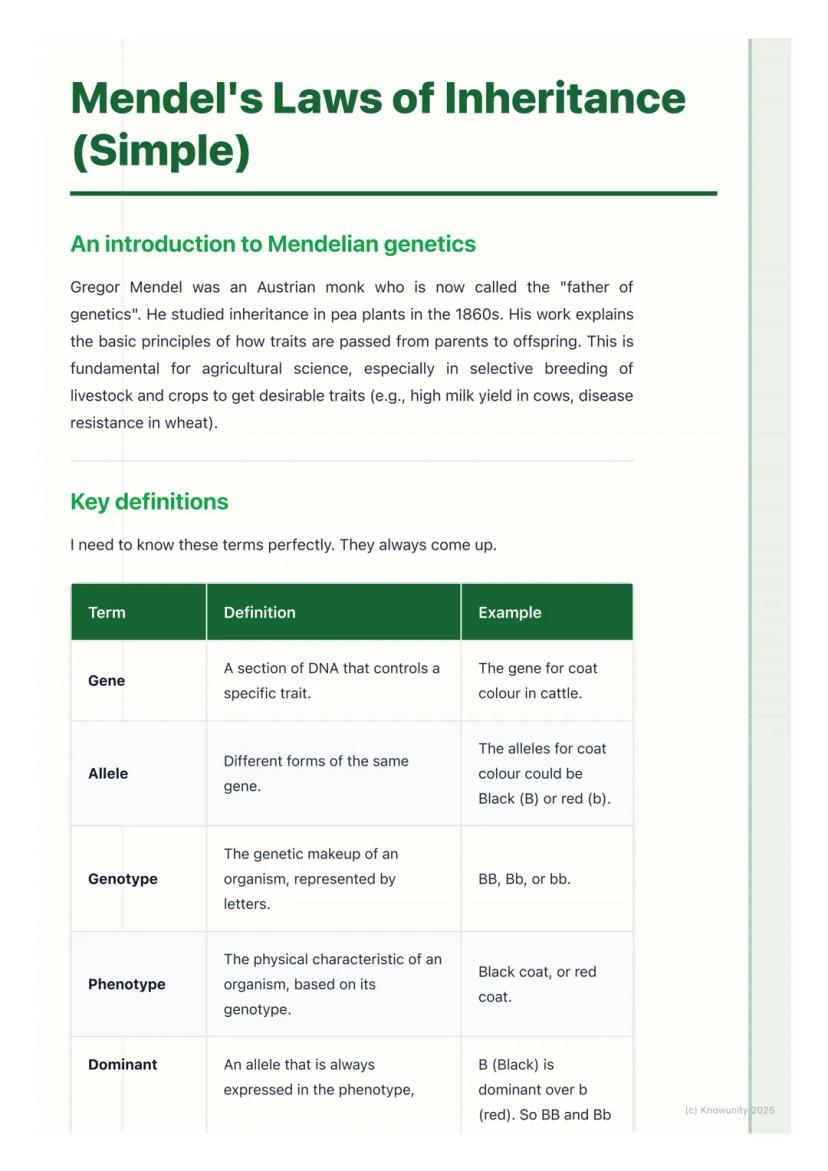
Meet Gregor Mendel, the "father of genetics" who figured out how traits pass from parents to offspring. His work with pea plants in the 1860s gives us the foundation for understanding inheritance - something that's crucial in agriculture today for breeding high-yield crops and healthy livestock.
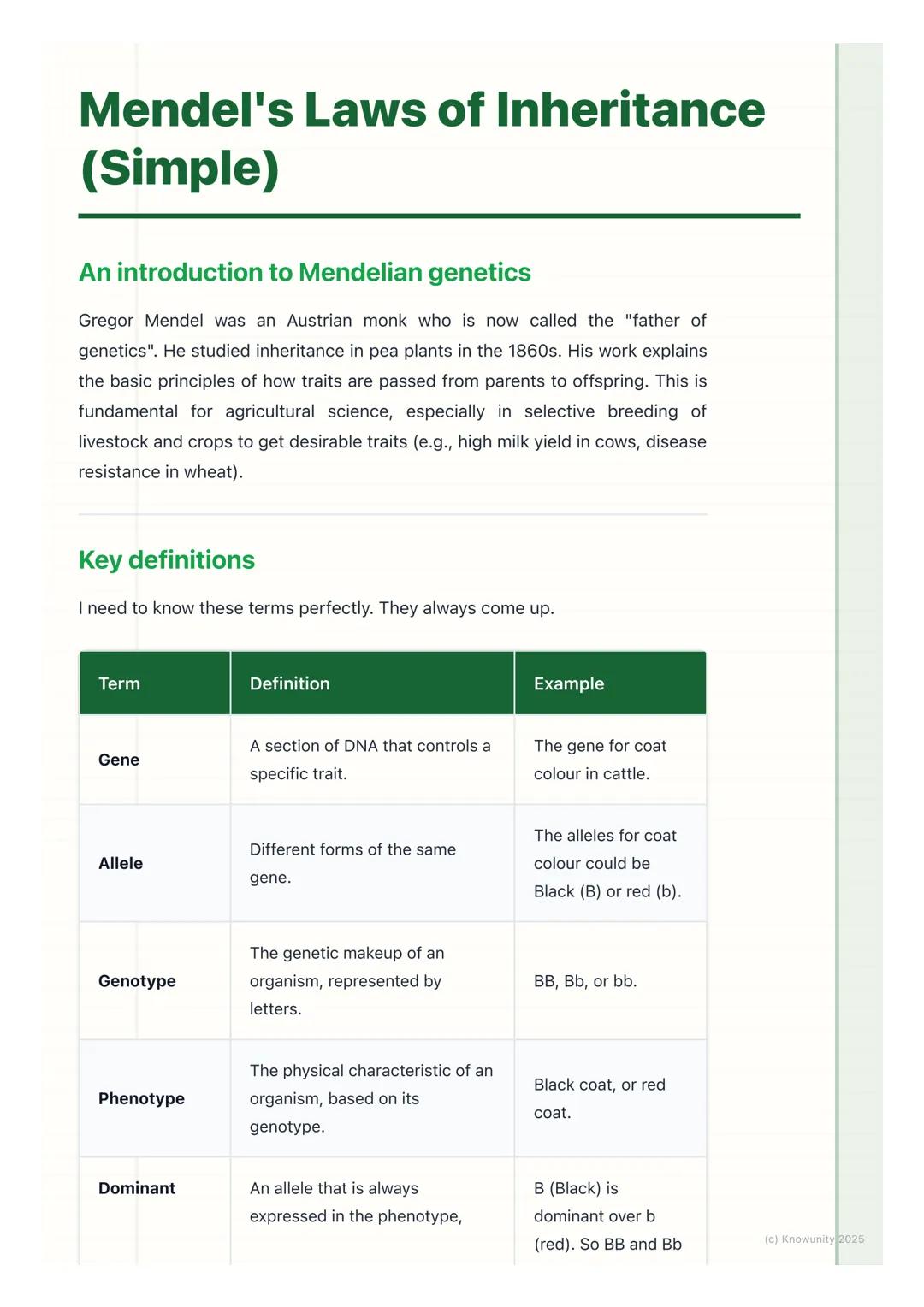
You absolutely need to nail these key genetic terms because they show up in every exam. A gene is a section of DNA controlling a specific trait (like coat colour in cattle), while alleles are different versions of the same gene (like black or red coat colour). Your genotype is your genetic makeup written in letters (BB, Bb, or bb), and your phenotype is what you actually look like based on those genes (black coat or red coat).
Dominant alleles (written as capital letters like B) always show up in your appearance even if you only have one copy. Recessive alleles (lowercase letters like b) only appear when you have two copies - so an animal needs bb to have a red coat, while both BB and Bb give you a black coat.
Quick Tip: Think of dominant alleles as the "bossy" ones - they always get their way when they're present!
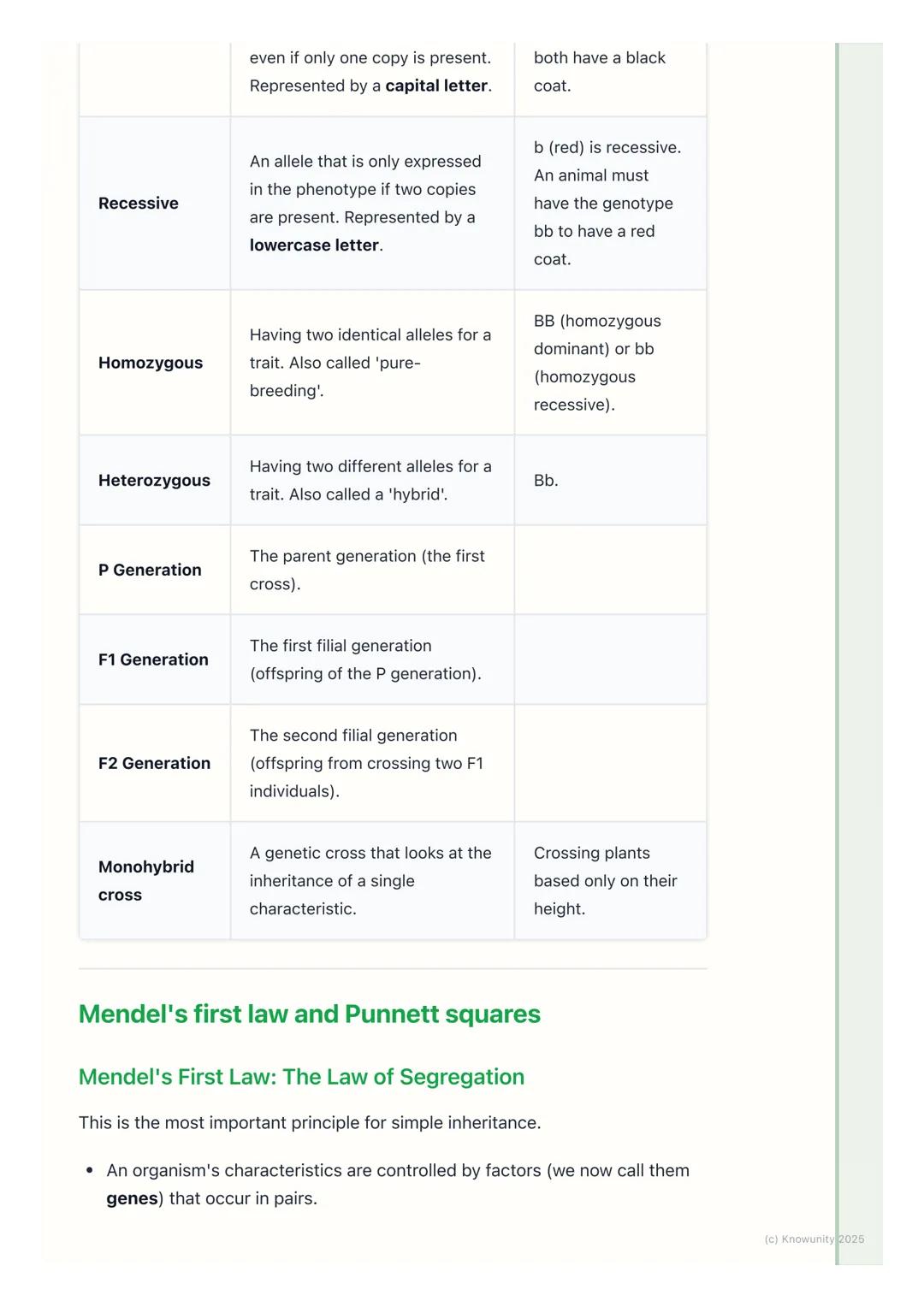
Understanding homozygous and heterozygous is crucial for your exams. Homozygous means having two identical alleles (BB or bb) - these are also called "pure-breeding" because they always produce the same type of offspring. Heterozygous means having two different alleles (Bb) - these are "hybrids" that can produce different types of offspring.
Scientists use specific labels for different generations in breeding experiments. The P generation is the original parent cross, the F1 generation is their immediate offspring, and the F2 generation comes from crossing two F1 individuals together. A monohybrid cross focuses on tracking just one characteristic, like plant height or coat colour.
These terms aren't just academic - they're used every day in agriculture and animal breeding. When farmers want to predict what traits their livestock will have, they're using exactly these principles that Mendel discovered over 150 years ago.
Remember: F1 stands for "first filial" and F2 means "second filial" - filial just means "offspring"!
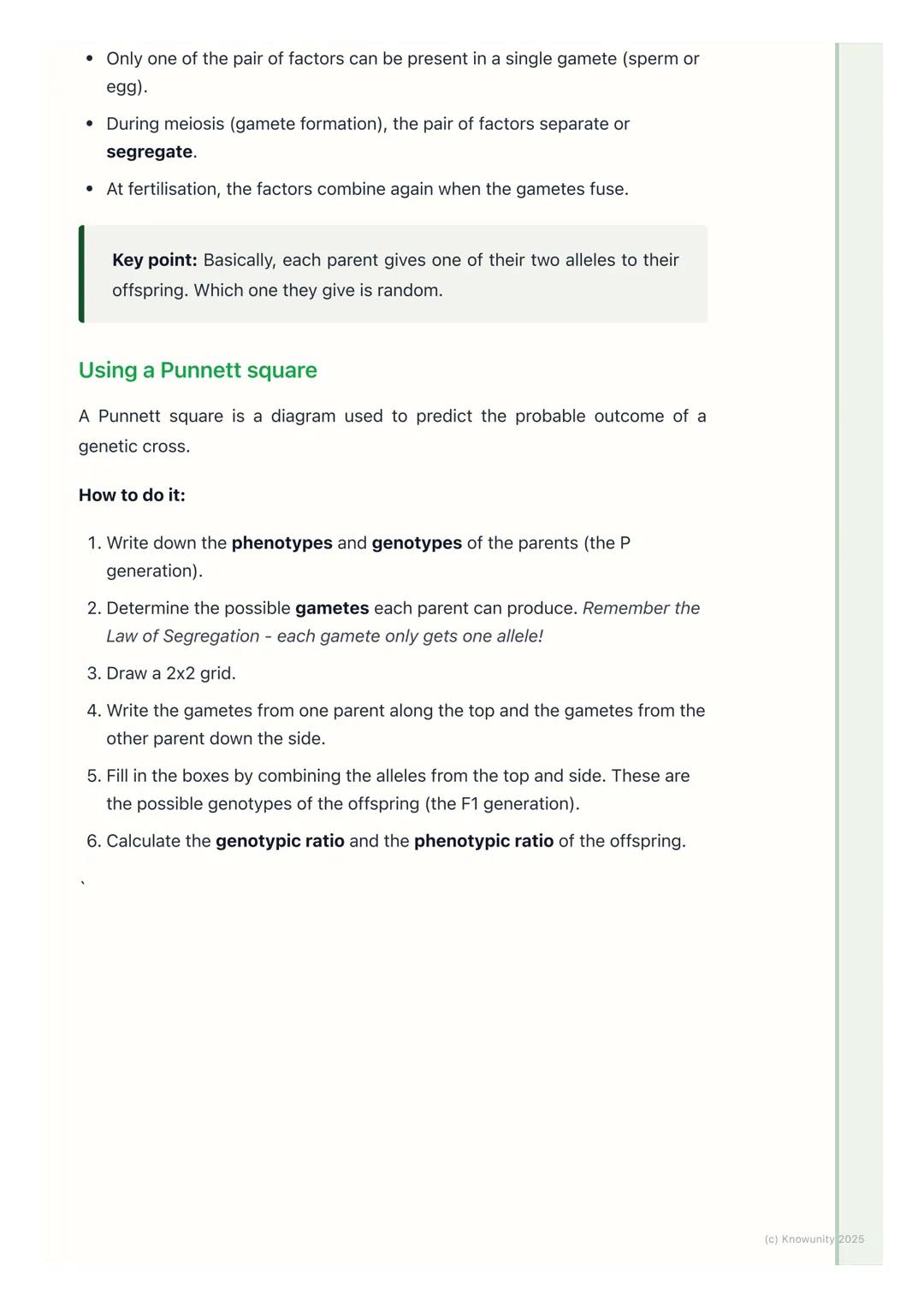
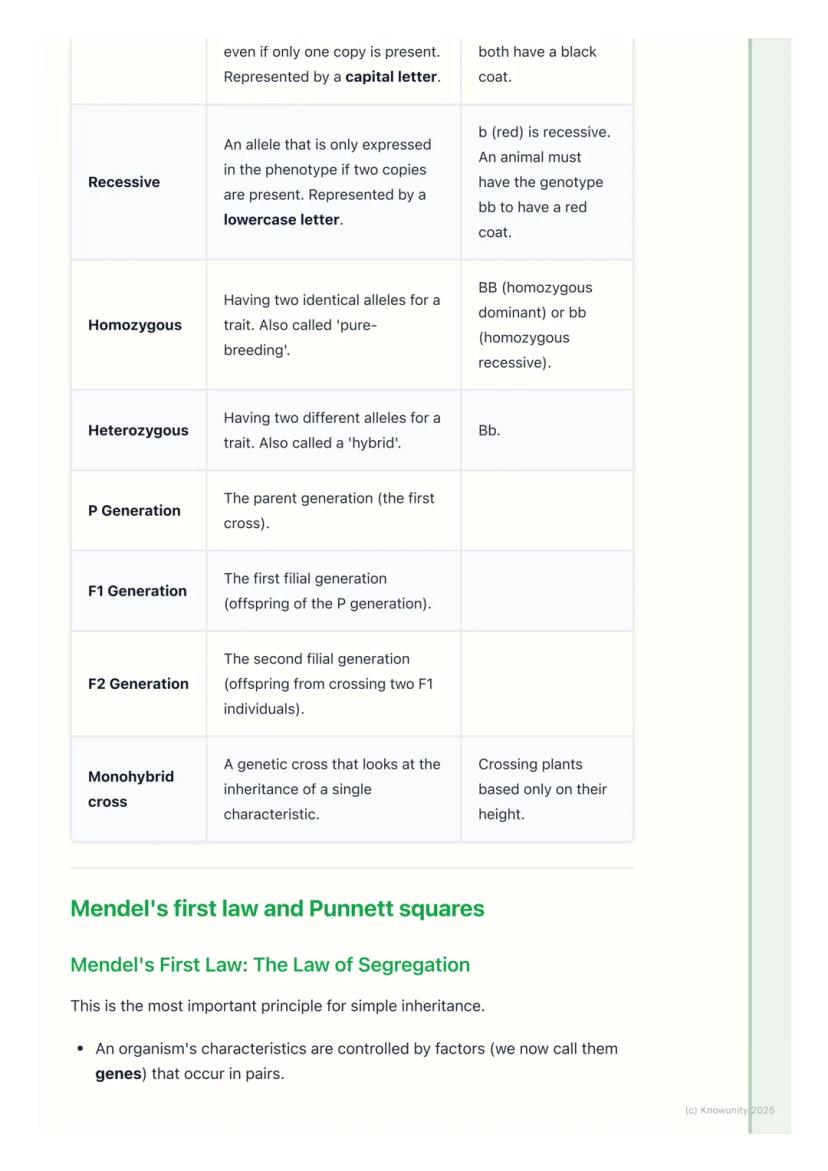
This is the most important concept you need to understand for simple inheritance. Mendel's Law of Segregation states that each organism has paired factors (genes) for every trait, but only one factor from each pair ends up in each gamete (sperm or egg cell).
Here's how it works: during meiosis (when gametes form), the paired alleles separate completely. Each sperm or egg only gets one allele from each pair, not both. Then during fertilisation, when sperm meets egg, the pairs form again as the offspring gets one allele from each parent.
Think of it like this - if you're heterozygous (Bb) for eye colour, your gametes will either carry the B allele OR the b allele, never both. Which one each gamete gets is completely random, like flipping a coin.
This separation during meiosis is why Punnett squares work so well for predicting inheritance patterns. They're basically showing you all the possible ways these separated alleles can recombine in the next generation.
Key Insight: The Law of Segregation explains why you're a unique mix of your parents' traits rather than an exact copy of either one!
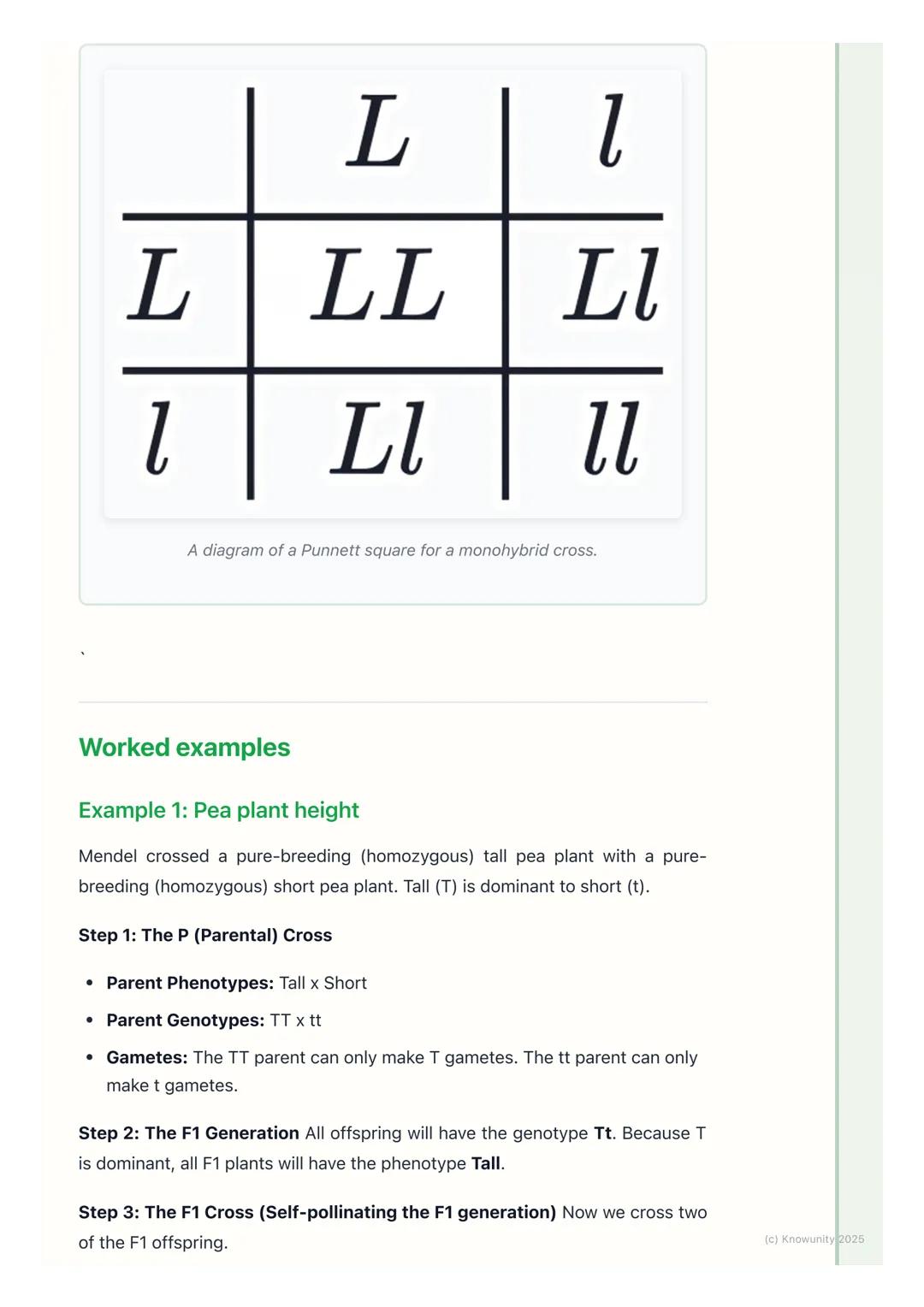
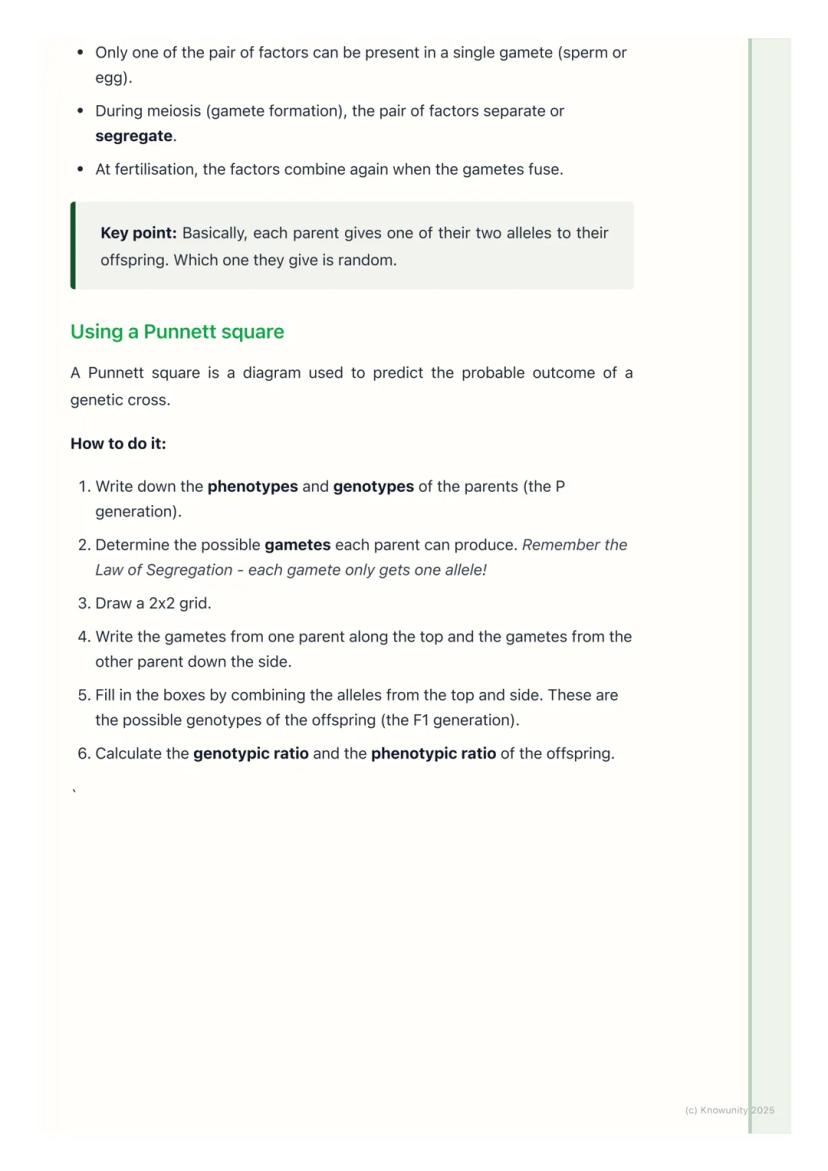
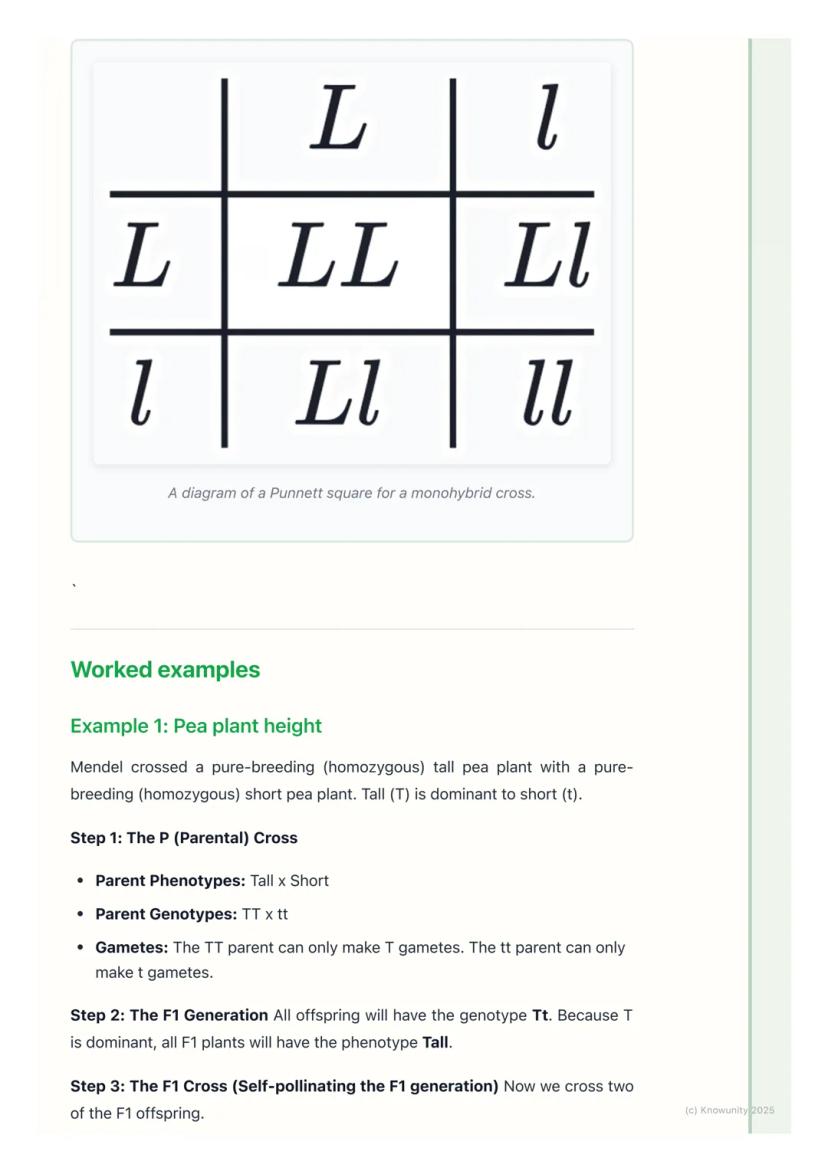
Punnett squares are your best tool for predicting genetic crosses, and mastering them is essential for exam success. They're essentially grids that show all possible combinations when alleles from two parents come together.
Here's the step-by-step method: First, identify the phenotypes and genotypes of both parents. Next, work out what gametes each parent can produce (remember, each gamete only gets one allele from each pair). Draw your 2×2 grid, write one parent's gametes across the top and the other parent's down the side.
Fill in each box by combining the allele from the top with the allele from the side. These combinations show you all possible genotypes for the offspring. Finally, count up the results to get your genotypic ratio (the genetic combinations) and phenotypic ratio (what the offspring actually look like).
Let's look at a real example with pea plant height, where tall (T) is dominant over short (t). When Mendel crossed a pure-breeding tall plant (TT) with a pure-breeding short plant (tt), every F1 offspring was Tt - and since T is dominant, they all looked tall.
Pro Tip: Always double-check that your ratios add up correctly - it's an easy way to spot mistakes!
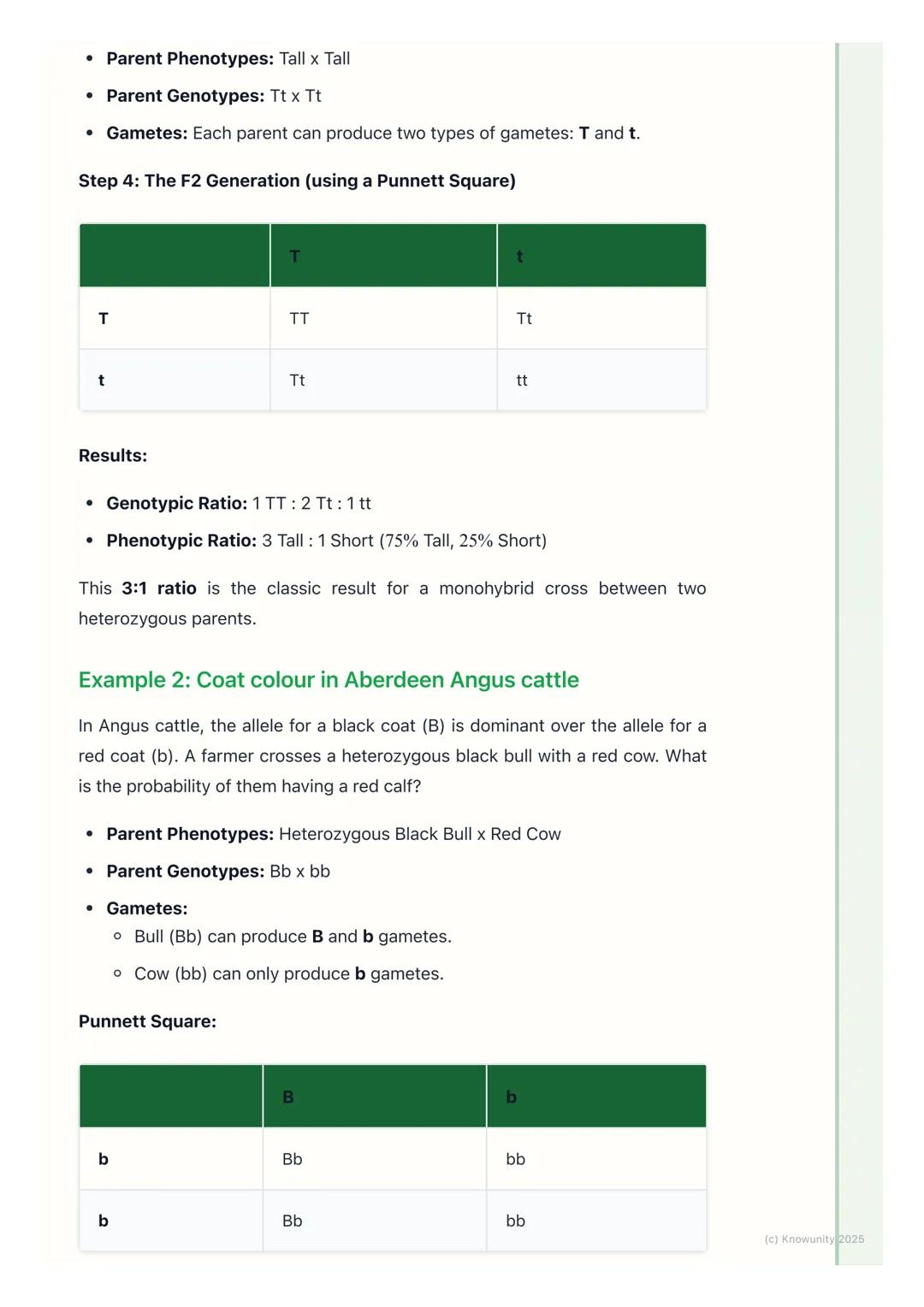
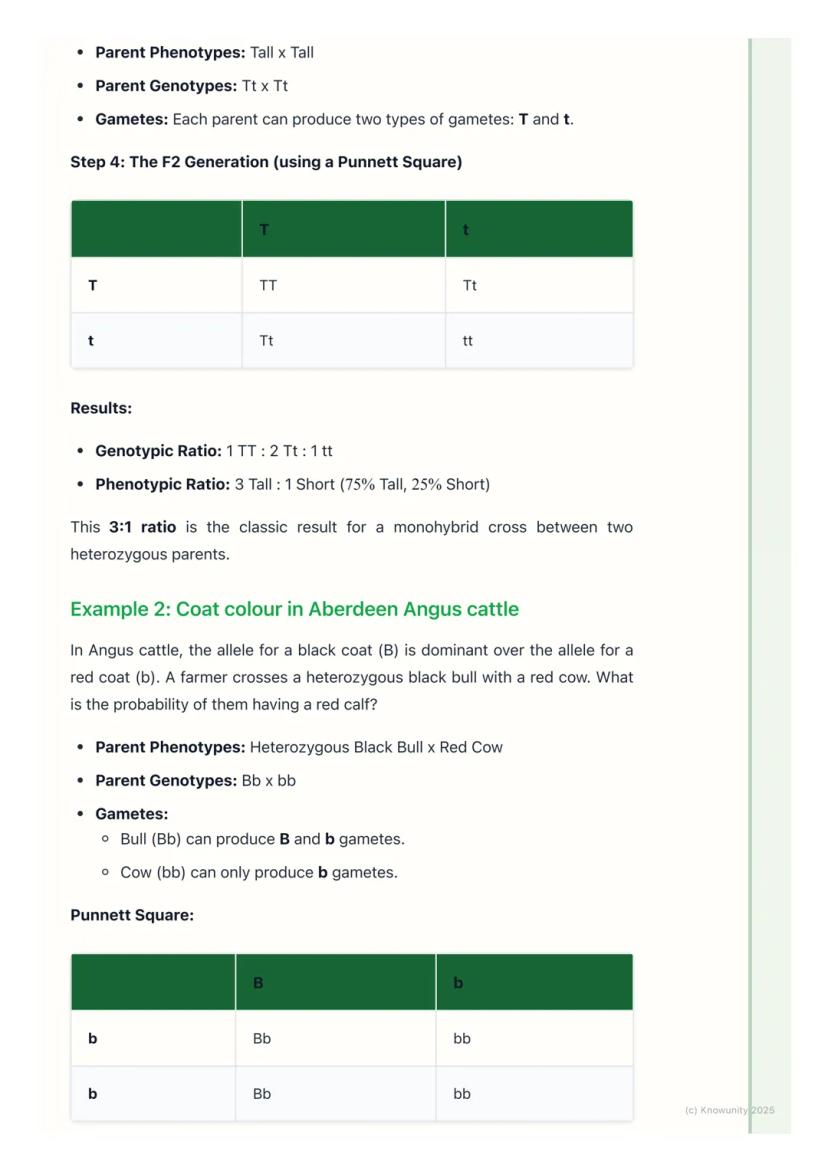
When Mendel crossed two F1 heterozygous plants (Tt × Tt), he discovered the famous 3:1 phenotypic ratio. Using a Punnett square, the cross produces TT, Tt, Tt, and tt offspring - giving you a genotypic ratio of 1:2:1 but a phenotypic ratio of 3 tall : 1 short.
This happens because both TT and Tt plants look tall (since T is dominant), while only tt plants look short. So out of four possible combinations, three appear tall and one appears short - hence the classic 3:1 ratio you'll see repeatedly in genetics problems.
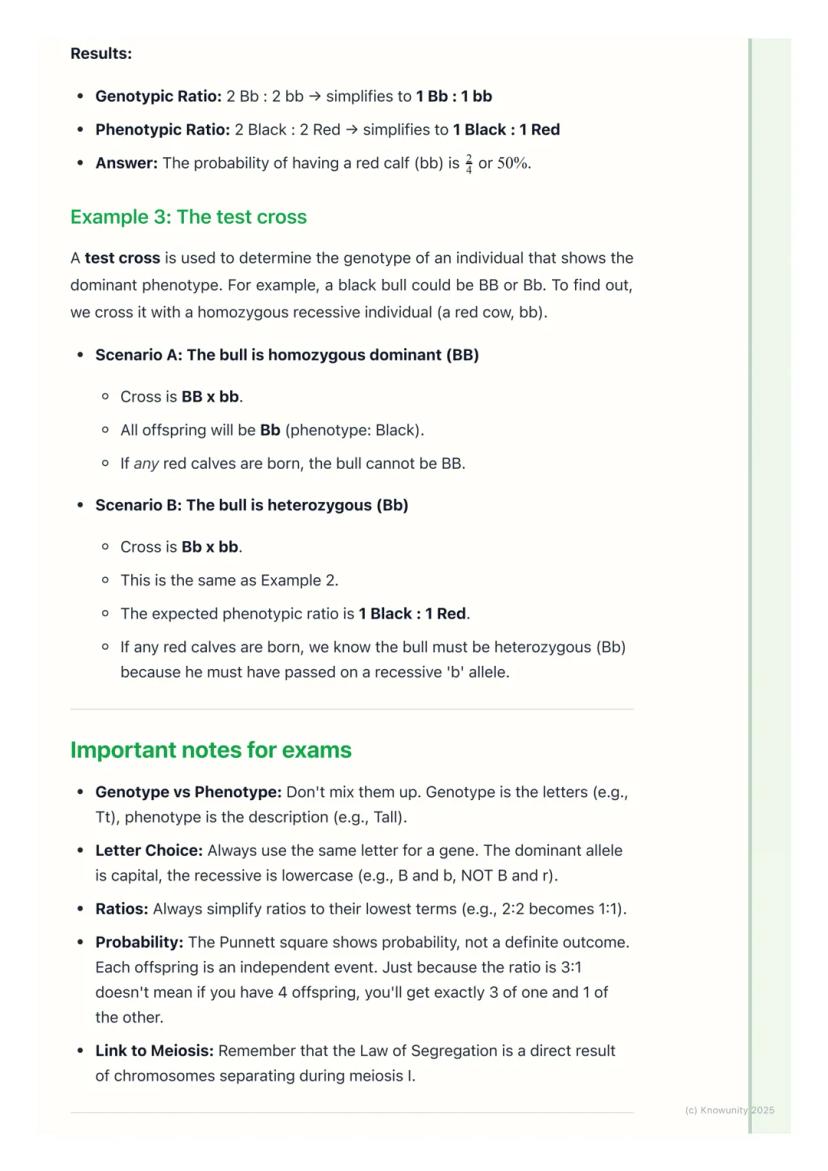
Here's a practical example with Aberdeen Angus cattle: black coat (B) is dominant over red coat (b). If you cross a heterozygous black bull (Bb) with a red cow (bb), the Punnett square gives you Bb, bb, Bb, bb. This means a 1:1 phenotypic ratio of black to red calves, so there's a 50% chance of getting a red calf.
Remember, these are probability predictions, not guarantees. Just like flipping a coin doesn't guarantee exactly 5 heads in 10 flips, genetic ratios show likelihood rather than certainty.
Exam Alert: The 3:1 ratio only appears when crossing two heterozygous parents - make sure you can spot this pattern!
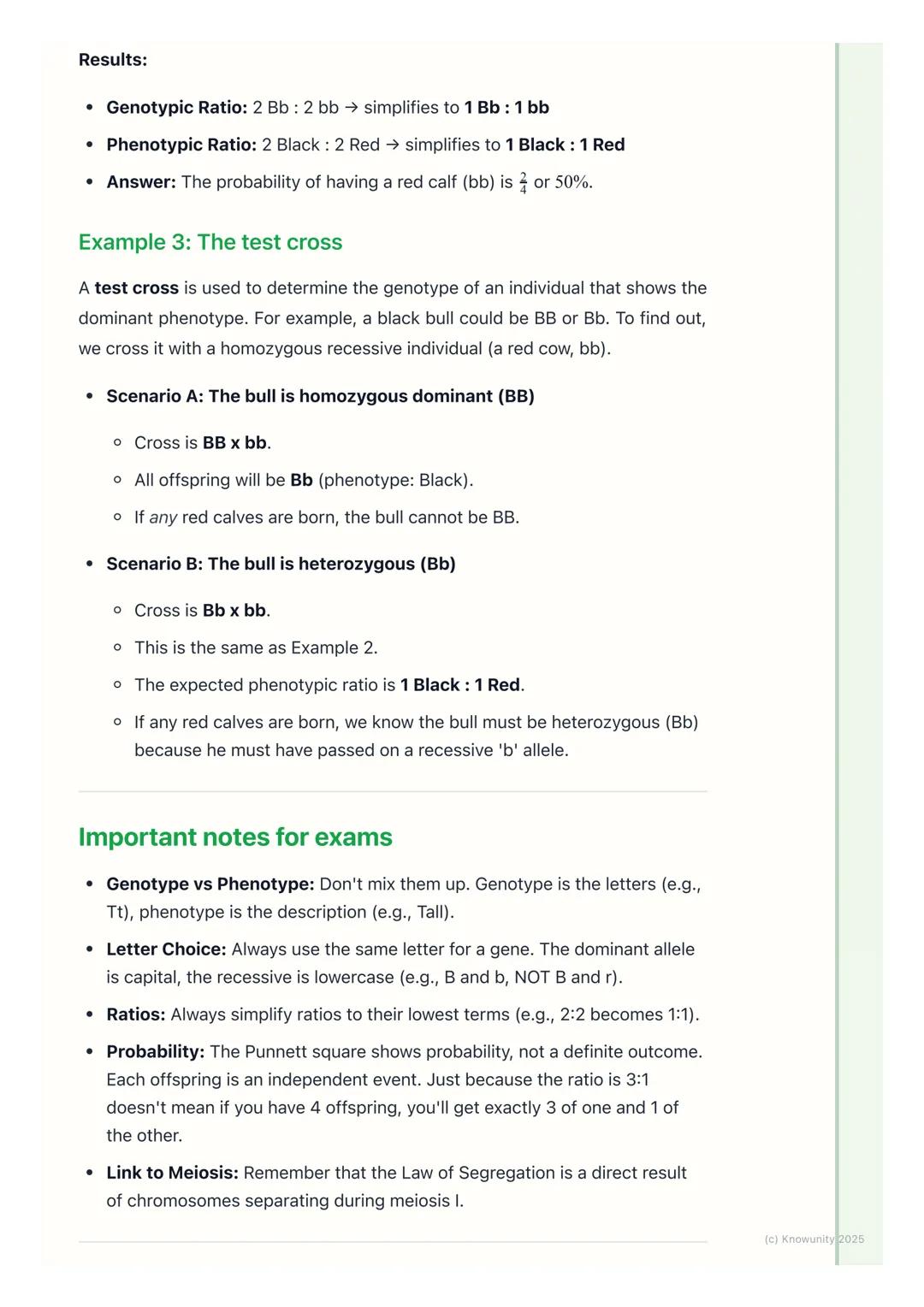
Sometimes you need to figure out an animal's genotype when you only know its phenotype. This is where test crosses become invaluable - you cross the unknown individual with a homozygous recessive partner and analyse the offspring.
For example, if you have a black bull that could be either BB or Bb, cross him with a red cow (bb). If he's BB, all calves will be black (Bb). If he's Bb, you'll get approximately half black and half red calves. The appearance of even one red calf proves the bull must be heterozygous.
Here are crucial exam tips to avoid common mistakes: Never mix up genotype (the letters like Tt) with phenotype (the appearance like "tall"). Always use the same letter for related alleles - dominant gets capitals, recessive gets lowercase. Simplify all ratios to lowest terms, and remember that Punnett squares show probability, not definite outcomes.
The Law of Segregation links directly to meiosis - when chromosomes separate during meiosis I, that's exactly when alleles segregate into different gametes. This connection between cell biology and inheritance patterns shows how beautifully integrated biology really is.
Real-world Connection: Farmers use test crosses regularly to identify the best breeding animals for their herds!
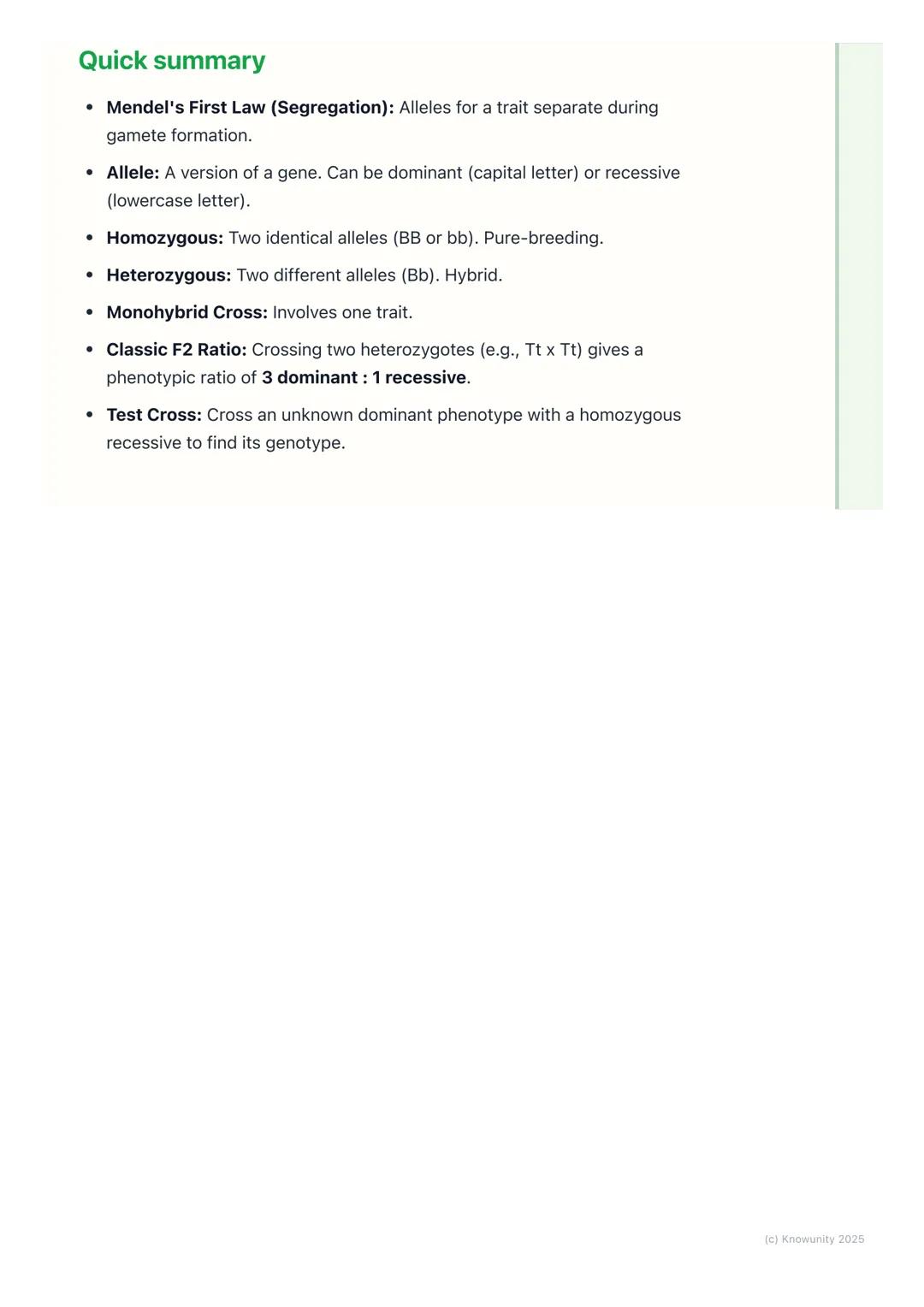
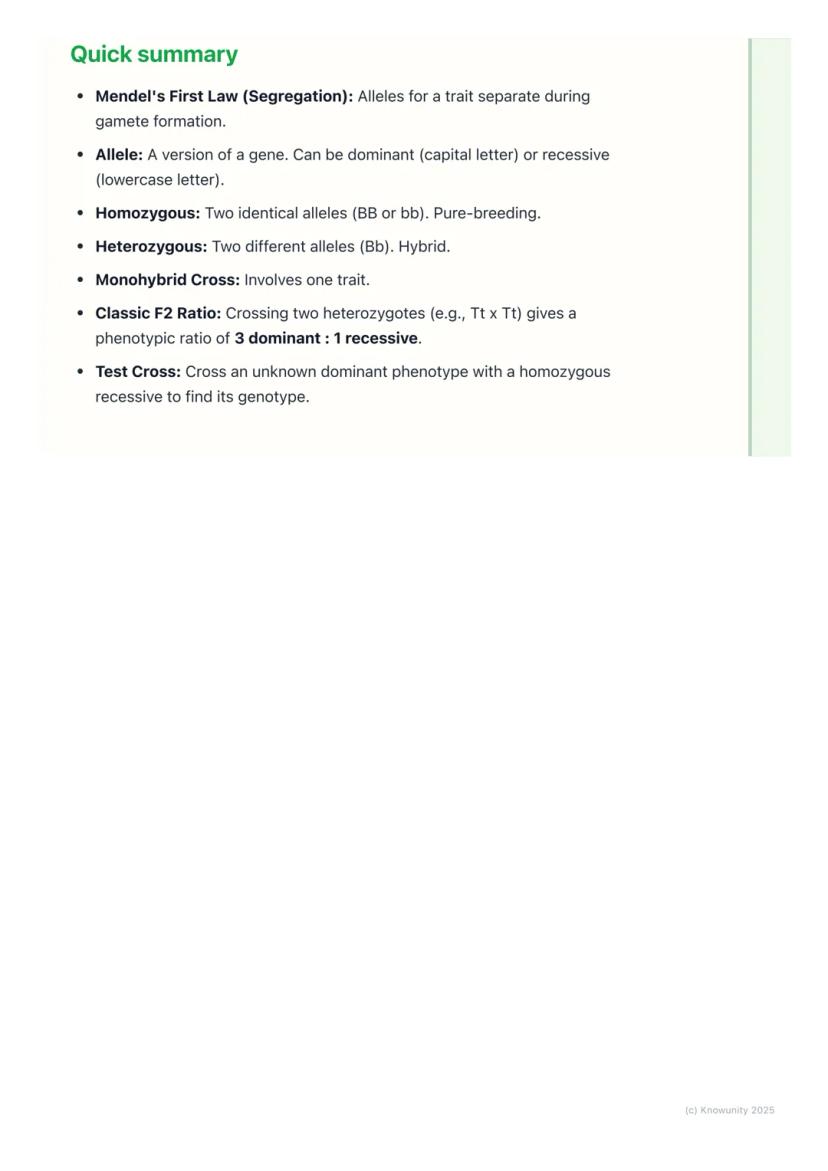
Here's what you absolutely must remember about Mendelian genetics: Alleles separate during gamete formation (Law of Segregation), with dominant alleles (capitals) masking recessive alleles (lowercase) in the phenotype. Homozygous individuals have identical alleles and breed true, while heterozygous individuals have different alleles.
The classic monohybrid cross between two heterozygotes always gives a 3:1 phenotypic ratio in the F2 generation. Test crosses help determine unknown genotypes by crossing with homozygous recessive individuals.
These principles aren't just academic - they're used daily in agriculture, animal breeding, and understanding human inheritance. Whether you're predicting crop yields or understanding why certain traits run in families, you're using Mendel's discoveries.
Remember that genetics is fundamentally about probability and patterns. Once you understand the basic rules of how alleles behave during reproduction, you can predict inheritance for any single-gene trait.
Final Thought: Mendel's work with simple pea plants unlocked the secrets of inheritance that we still use today - pretty amazing for a 19th-century monk!
Náš AI společník je speciálně vytvořen pro potřeby studentů. Na základě milionů obsahových materiálů, které máme na platformě, můžeme studentům poskytovat opravdu smysluplné a relevantní odpovědi. Ale nejde jen o odpovědi, společník je ještě více o provázení studentů jejich každodenními výzvami v učení, s personalizovanými studijními plány, kvízy nebo obsahovými materiály v chatu a 100% personalizací na základě dovedností a vývoje studentů.
Aplikaci si můžete stáhnout z obchodu Google Play a Apple App Store.
Ano, máte bezplatný přístup k obsahu v aplikaci a k našemu společníkovi s umělou inteligencí. Chcete-li odemknout určité funkce aplikace, můžete si zakoupit aplikaci Knowunity Pro.
App Store
Google Play
Aplikace je velmi jednoduchá na používání a dobře navržená. Zatím jsem našel vše, co jsem hledal, a mohl jsem se z prezentací hodně naučit! Určitě použiju aplikaci na školní úkol! A samozřejmě taky hodně pomáhá jako inspirace.
Stefan S
uživatel iOS
Tahle aplikace je fakt skvělá. Je tam tolik studijních poznámek a pomůcek [...]. Můj problémový předmět je například francouzština a aplikace nabízí tolik možností pomoci. Díky této aplikaci jsem si zlepšil francouzštinu. Doporučil bych ji každému.
Samantha Klich
uživatelka Androidu
Páni, jsem opravdu ohromen. Zkusil jsem aplikaci jen proto, že jsem ji mnohokrát viděl v reklamách, a byl jsem naprosto ohromen. Tato aplikace je TA POMOC, kterou chceš do školy, a především nabízí spoustu věcí, jako jsou cvičení a přehledy faktů, které mi osobně VELMI pomohly.
Anna
uživatelka iOS
Dříve jsem měl problémy s dokončováním úkolů včas, dokud jsem neobjevil Knowunity, který nejen usnadňuje nahrávání mého vlastního obsahu, ale také poskytuje skvělé shrnutí, díky kterým je moje práce rychlejší a efektivnější.
Thomas R
uživatel iOS
Vždy bylo výzvou najít všechny důležité informace pro mé úkoly – od té doby, co používám Knowunity, můžu jednoduše nahrát svůj obsah a těžit ze shrnutí ostatních, což mi hodně pomáhá s organizací.
Lisa M
uživatelka Androidu
Často jsem měl pocit, že nemám dostatečný přehled při učení, ale od té doby, co používám Knowunity, to už neplatí – nahraju svůj obsah a vždy najdu užitečná shrnutí na platformě, což mi učení značně usnadňuje.
David K
uživatel iOS
Ta aplikace je prostě skvělá! Stačí zadat téma do vyhledávání a dostanu odpověď opravdu rychle. Nemusím koukat na 10 YouTube videí, abych něčemu porozuměl, takže šetřím čas. Vřele doporučuji!
Sudenaz Ocak
uživatel Androidu
Ve škole mi matematika vůbec nešla, ale díky této aplikaci se mi teď daří lépe. Jsem moc vděčný, že jste tuhle aplikaci vytvořili.
Greenlight Bonnie
uživatel Androidu
Dřív bylo opravdu těžké shromáždit všechny informace na moje prezentace. Ale od té doby, co používám Knowunity, prostě nahraju svoje poznámky a najdu skvělé souhrny od ostatních – díky tomu je moje studium mnohem efektivnější!
Julia S
uživatelka Androidu
Byl jsem neustále ve stresu kvůli všem studijním materiálům, ale od té doby, co používám Knowunity, nahrávám svoje věci a koukám na super souhrny od ostatních – opravdu mi to pomáhá všechno lépe zvládat a je to mnohem méně stresující.
Marco B
uživatel iOS
TY KVÍZY A KARTIČKY SOU TAK UŽITEČNÝ A MILUJU Knowunity AI. JE TO TAKY DOSLOVA JAKO CHATGPT ALE CHYTŘEJŠÍ!! POMOHLO MI TO I S PROBLÉMY S ŘASENKOU!! A TAKY S MÝMA SKUTEČNÝMA PŘEDMĚTAMA! JASNÝ 😍😁😲🤑💗✨🎀😮
Sarah L
uživatelka Androidu
Dřív jsem trávil hodiny googlováním školních materiálů, ale teď prostě nahraju svoje věci na Knowunity a prohlížím si užitečné souhrny od ostatních – při přípravě na zkoušky se cítím mnohem jistější.
Paul T
uživatel iOS
Aplikace je velmi jednoduchá na používání a dobře navržená. Zatím jsem našel vše, co jsem hledal, a mohl jsem se z prezentací hodně naučit! Určitě použiju aplikaci na školní úkol! A samozřejmě taky hodně pomáhá jako inspirace.
Stefan S
uživatel iOS
Tahle aplikace je fakt skvělá. Je tam tolik studijních poznámek a pomůcek [...]. Můj problémový předmět je například francouzština a aplikace nabízí tolik možností pomoci. Díky této aplikaci jsem si zlepšil francouzštinu. Doporučil bych ji každému.
Samantha Klich
uživatelka Androidu
Páni, jsem opravdu ohromen. Zkusil jsem aplikaci jen proto, že jsem ji mnohokrát viděl v reklamách, a byl jsem naprosto ohromen. Tato aplikace je TA POMOC, kterou chceš do školy, a především nabízí spoustu věcí, jako jsou cvičení a přehledy faktů, které mi osobně VELMI pomohly.
Anna
uživatelka iOS
Dříve jsem měl problémy s dokončováním úkolů včas, dokud jsem neobjevil Knowunity, který nejen usnadňuje nahrávání mého vlastního obsahu, ale také poskytuje skvělé shrnutí, díky kterým je moje práce rychlejší a efektivnější.
Thomas R
uživatel iOS
Vždy bylo výzvou najít všechny důležité informace pro mé úkoly – od té doby, co používám Knowunity, můžu jednoduše nahrát svůj obsah a těžit ze shrnutí ostatních, což mi hodně pomáhá s organizací.
Lisa M
uživatelka Androidu
Často jsem měl pocit, že nemám dostatečný přehled při učení, ale od té doby, co používám Knowunity, to už neplatí – nahraju svůj obsah a vždy najdu užitečná shrnutí na platformě, což mi učení značně usnadňuje.
David K
uživatel iOS
Ta aplikace je prostě skvělá! Stačí zadat téma do vyhledávání a dostanu odpověď opravdu rychle. Nemusím koukat na 10 YouTube videí, abych něčemu porozuměl, takže šetřím čas. Vřele doporučuji!
Sudenaz Ocak
uživatel Androidu
Ve škole mi matematika vůbec nešla, ale díky této aplikaci se mi teď daří lépe. Jsem moc vděčný, že jste tuhle aplikaci vytvořili.
Greenlight Bonnie
uživatel Androidu
Dřív bylo opravdu těžké shromáždit všechny informace na moje prezentace. Ale od té doby, co používám Knowunity, prostě nahraju svoje poznámky a najdu skvělé souhrny od ostatních – díky tomu je moje studium mnohem efektivnější!
Julia S
uživatelka Androidu
Byl jsem neustále ve stresu kvůli všem studijním materiálům, ale od té doby, co používám Knowunity, nahrávám svoje věci a koukám na super souhrny od ostatních – opravdu mi to pomáhá všechno lépe zvládat a je to mnohem méně stresující.
Marco B
uživatel iOS
TY KVÍZY A KARTIČKY SOU TAK UŽITEČNÝ A MILUJU Knowunity AI. JE TO TAKY DOSLOVA JAKO CHATGPT ALE CHYTŘEJŠÍ!! POMOHLO MI TO I S PROBLÉMY S ŘASENKOU!! A TAKY S MÝMA SKUTEČNÝMA PŘEDMĚTAMA! JASNÝ 😍😁😲🤑💗✨🎀😮
Sarah L
uživatelka Androidu
Dřív jsem trávil hodiny googlováním školních materiálů, ale teď prostě nahraju svoje věci na Knowunity a prohlížím si užitečné souhrny od ostatních – při přípravě na zkoušky se cítím mnohem jistější.
Paul T
uživatel iOS
Ever wonder why you might have your mum's eyes but your dad's height? It all comes down to genetics! Gregor Mendel, an Austrian monk from the 1860s, cracked the code of inheritance by studying pea plants, and his discoveries still... Zobrazit více
Přístup ke všem dokumentům
Zlepši své známky
Připoj se k milionům studentů
Meet Gregor Mendel, the "father of genetics" who figured out how traits pass from parents to offspring. His work with pea plants in the 1860s gives us the foundation for understanding inheritance - something that's crucial in agriculture today for breeding high-yield crops and healthy livestock.
You absolutely need to nail these key genetic terms because they show up in every exam. A gene is a section of DNA controlling a specific trait (like coat colour in cattle), while alleles are different versions of the same gene (like black or red coat colour). Your genotype is your genetic makeup written in letters (BB, Bb, or bb), and your phenotype is what you actually look like based on those genes (black coat or red coat).
Dominant alleles (written as capital letters like B) always show up in your appearance even if you only have one copy. Recessive alleles (lowercase letters like b) only appear when you have two copies - so an animal needs bb to have a red coat, while both BB and Bb give you a black coat.
Quick Tip: Think of dominant alleles as the "bossy" ones - they always get their way when they're present!
Přístup ke všem dokumentům
Zlepši své známky
Připoj se k milionům studentů
Understanding homozygous and heterozygous is crucial for your exams. Homozygous means having two identical alleles (BB or bb) - these are also called "pure-breeding" because they always produce the same type of offspring. Heterozygous means having two different alleles (Bb) - these are "hybrids" that can produce different types of offspring.
Scientists use specific labels for different generations in breeding experiments. The P generation is the original parent cross, the F1 generation is their immediate offspring, and the F2 generation comes from crossing two F1 individuals together. A monohybrid cross focuses on tracking just one characteristic, like plant height or coat colour.
These terms aren't just academic - they're used every day in agriculture and animal breeding. When farmers want to predict what traits their livestock will have, they're using exactly these principles that Mendel discovered over 150 years ago.
Remember: F1 stands for "first filial" and F2 means "second filial" - filial just means "offspring"!
Přístup ke všem dokumentům
Zlepši své známky
Připoj se k milionům studentů
This is the most important concept you need to understand for simple inheritance. Mendel's Law of Segregation states that each organism has paired factors (genes) for every trait, but only one factor from each pair ends up in each gamete (sperm or egg cell).
Here's how it works: during meiosis (when gametes form), the paired alleles separate completely. Each sperm or egg only gets one allele from each pair, not both. Then during fertilisation, when sperm meets egg, the pairs form again as the offspring gets one allele from each parent.
Think of it like this - if you're heterozygous (Bb) for eye colour, your gametes will either carry the B allele OR the b allele, never both. Which one each gamete gets is completely random, like flipping a coin.
This separation during meiosis is why Punnett squares work so well for predicting inheritance patterns. They're basically showing you all the possible ways these separated alleles can recombine in the next generation.
Key Insight: The Law of Segregation explains why you're a unique mix of your parents' traits rather than an exact copy of either one!
Přístup ke všem dokumentům
Zlepši své známky
Připoj se k milionům studentů
Punnett squares are your best tool for predicting genetic crosses, and mastering them is essential for exam success. They're essentially grids that show all possible combinations when alleles from two parents come together.
Here's the step-by-step method: First, identify the phenotypes and genotypes of both parents. Next, work out what gametes each parent can produce (remember, each gamete only gets one allele from each pair). Draw your 2×2 grid, write one parent's gametes across the top and the other parent's down the side.
Fill in each box by combining the allele from the top with the allele from the side. These combinations show you all possible genotypes for the offspring. Finally, count up the results to get your genotypic ratio (the genetic combinations) and phenotypic ratio (what the offspring actually look like).
Let's look at a real example with pea plant height, where tall (T) is dominant over short (t). When Mendel crossed a pure-breeding tall plant (TT) with a pure-breeding short plant (tt), every F1 offspring was Tt - and since T is dominant, they all looked tall.
Pro Tip: Always double-check that your ratios add up correctly - it's an easy way to spot mistakes!
Přístup ke všem dokumentům
Zlepši své známky
Připoj se k milionům studentů
When Mendel crossed two F1 heterozygous plants (Tt × Tt), he discovered the famous 3:1 phenotypic ratio. Using a Punnett square, the cross produces TT, Tt, Tt, and tt offspring - giving you a genotypic ratio of 1:2:1 but a phenotypic ratio of 3 tall : 1 short.
This happens because both TT and Tt plants look tall (since T is dominant), while only tt plants look short. So out of four possible combinations, three appear tall and one appears short - hence the classic 3:1 ratio you'll see repeatedly in genetics problems.
Here's a practical example with Aberdeen Angus cattle: black coat (B) is dominant over red coat (b). If you cross a heterozygous black bull (Bb) with a red cow (bb), the Punnett square gives you Bb, bb, Bb, bb. This means a 1:1 phenotypic ratio of black to red calves, so there's a 50% chance of getting a red calf.
Remember, these are probability predictions, not guarantees. Just like flipping a coin doesn't guarantee exactly 5 heads in 10 flips, genetic ratios show likelihood rather than certainty.
Exam Alert: The 3:1 ratio only appears when crossing two heterozygous parents - make sure you can spot this pattern!
Přístup ke všem dokumentům
Zlepši své známky
Připoj se k milionům studentů
Sometimes you need to figure out an animal's genotype when you only know its phenotype. This is where test crosses become invaluable - you cross the unknown individual with a homozygous recessive partner and analyse the offspring.
For example, if you have a black bull that could be either BB or Bb, cross him with a red cow (bb). If he's BB, all calves will be black (Bb). If he's Bb, you'll get approximately half black and half red calves. The appearance of even one red calf proves the bull must be heterozygous.
Here are crucial exam tips to avoid common mistakes: Never mix up genotype (the letters like Tt) with phenotype (the appearance like "tall"). Always use the same letter for related alleles - dominant gets capitals, recessive gets lowercase. Simplify all ratios to lowest terms, and remember that Punnett squares show probability, not definite outcomes.
The Law of Segregation links directly to meiosis - when chromosomes separate during meiosis I, that's exactly when alleles segregate into different gametes. This connection between cell biology and inheritance patterns shows how beautifully integrated biology really is.
Real-world Connection: Farmers use test crosses regularly to identify the best breeding animals for their herds!
Přístup ke všem dokumentům
Zlepši své známky
Připoj se k milionům studentů
Here's what you absolutely must remember about Mendelian genetics: Alleles separate during gamete formation (Law of Segregation), with dominant alleles (capitals) masking recessive alleles (lowercase) in the phenotype. Homozygous individuals have identical alleles and breed true, while heterozygous individuals have different alleles.
The classic monohybrid cross between two heterozygotes always gives a 3:1 phenotypic ratio in the F2 generation. Test crosses help determine unknown genotypes by crossing with homozygous recessive individuals.
These principles aren't just academic - they're used daily in agriculture, animal breeding, and understanding human inheritance. Whether you're predicting crop yields or understanding why certain traits run in families, you're using Mendel's discoveries.
Remember that genetics is fundamentally about probability and patterns. Once you understand the basic rules of how alleles behave during reproduction, you can predict inheritance for any single-gene trait.
Final Thought: Mendel's work with simple pea plants unlocked the secrets of inheritance that we still use today - pretty amazing for a 19th-century monk!
Náš AI společník je speciálně vytvořen pro potřeby studentů. Na základě milionů obsahových materiálů, které máme na platformě, můžeme studentům poskytovat opravdu smysluplné a relevantní odpovědi. Ale nejde jen o odpovědi, společník je ještě více o provázení studentů jejich každodenními výzvami v učení, s personalizovanými studijními plány, kvízy nebo obsahovými materiály v chatu a 100% personalizací na základě dovedností a vývoje studentů.
Aplikaci si můžete stáhnout z obchodu Google Play a Apple App Store.
Ano, máte bezplatný přístup k obsahu v aplikaci a k našemu společníkovi s umělou inteligencí. Chcete-li odemknout určité funkce aplikace, můžete si zakoupit aplikaci Knowunity Pro.
0
Chytré Nástroje NOVÉ
Přeměň tyto poznámky na: ✓ 50+ Cvičných Otázek ✓ Interaktivní Kartičky ✓ Úplný zkušební test ✓ Osnovy Esejů
App Store
Google Play
Aplikace je velmi jednoduchá na používání a dobře navržená. Zatím jsem našel vše, co jsem hledal, a mohl jsem se z prezentací hodně naučit! Určitě použiju aplikaci na školní úkol! A samozřejmě taky hodně pomáhá jako inspirace.
Stefan S
uživatel iOS
Tahle aplikace je fakt skvělá. Je tam tolik studijních poznámek a pomůcek [...]. Můj problémový předmět je například francouzština a aplikace nabízí tolik možností pomoci. Díky této aplikaci jsem si zlepšil francouzštinu. Doporučil bych ji každému.
Samantha Klich
uživatelka Androidu
Páni, jsem opravdu ohromen. Zkusil jsem aplikaci jen proto, že jsem ji mnohokrát viděl v reklamách, a byl jsem naprosto ohromen. Tato aplikace je TA POMOC, kterou chceš do školy, a především nabízí spoustu věcí, jako jsou cvičení a přehledy faktů, které mi osobně VELMI pomohly.
Anna
uživatelka iOS
Dříve jsem měl problémy s dokončováním úkolů včas, dokud jsem neobjevil Knowunity, který nejen usnadňuje nahrávání mého vlastního obsahu, ale také poskytuje skvělé shrnutí, díky kterým je moje práce rychlejší a efektivnější.
Thomas R
uživatel iOS
Vždy bylo výzvou najít všechny důležité informace pro mé úkoly – od té doby, co používám Knowunity, můžu jednoduše nahrát svůj obsah a těžit ze shrnutí ostatních, což mi hodně pomáhá s organizací.
Lisa M
uživatelka Androidu
Často jsem měl pocit, že nemám dostatečný přehled při učení, ale od té doby, co používám Knowunity, to už neplatí – nahraju svůj obsah a vždy najdu užitečná shrnutí na platformě, což mi učení značně usnadňuje.
David K
uživatel iOS
Ta aplikace je prostě skvělá! Stačí zadat téma do vyhledávání a dostanu odpověď opravdu rychle. Nemusím koukat na 10 YouTube videí, abych něčemu porozuměl, takže šetřím čas. Vřele doporučuji!
Sudenaz Ocak
uživatel Androidu
Ve škole mi matematika vůbec nešla, ale díky této aplikaci se mi teď daří lépe. Jsem moc vděčný, že jste tuhle aplikaci vytvořili.
Greenlight Bonnie
uživatel Androidu
Dřív bylo opravdu těžké shromáždit všechny informace na moje prezentace. Ale od té doby, co používám Knowunity, prostě nahraju svoje poznámky a najdu skvělé souhrny od ostatních – díky tomu je moje studium mnohem efektivnější!
Julia S
uživatelka Androidu
Byl jsem neustále ve stresu kvůli všem studijním materiálům, ale od té doby, co používám Knowunity, nahrávám svoje věci a koukám na super souhrny od ostatních – opravdu mi to pomáhá všechno lépe zvládat a je to mnohem méně stresující.
Marco B
uživatel iOS
TY KVÍZY A KARTIČKY SOU TAK UŽITEČNÝ A MILUJU Knowunity AI. JE TO TAKY DOSLOVA JAKO CHATGPT ALE CHYTŘEJŠÍ!! POMOHLO MI TO I S PROBLÉMY S ŘASENKOU!! A TAKY S MÝMA SKUTEČNÝMA PŘEDMĚTAMA! JASNÝ 😍😁😲🤑💗✨🎀😮
Sarah L
uživatelka Androidu
Dřív jsem trávil hodiny googlováním školních materiálů, ale teď prostě nahraju svoje věci na Knowunity a prohlížím si užitečné souhrny od ostatních – při přípravě na zkoušky se cítím mnohem jistější.
Paul T
uživatel iOS
Aplikace je velmi jednoduchá na používání a dobře navržená. Zatím jsem našel vše, co jsem hledal, a mohl jsem se z prezentací hodně naučit! Určitě použiju aplikaci na školní úkol! A samozřejmě taky hodně pomáhá jako inspirace.
Stefan S
uživatel iOS
Tahle aplikace je fakt skvělá. Je tam tolik studijních poznámek a pomůcek [...]. Můj problémový předmět je například francouzština a aplikace nabízí tolik možností pomoci. Díky této aplikaci jsem si zlepšil francouzštinu. Doporučil bych ji každému.
Samantha Klich
uživatelka Androidu
Páni, jsem opravdu ohromen. Zkusil jsem aplikaci jen proto, že jsem ji mnohokrát viděl v reklamách, a byl jsem naprosto ohromen. Tato aplikace je TA POMOC, kterou chceš do školy, a především nabízí spoustu věcí, jako jsou cvičení a přehledy faktů, které mi osobně VELMI pomohly.
Anna
uživatelka iOS
Dříve jsem měl problémy s dokončováním úkolů včas, dokud jsem neobjevil Knowunity, který nejen usnadňuje nahrávání mého vlastního obsahu, ale také poskytuje skvělé shrnutí, díky kterým je moje práce rychlejší a efektivnější.
Thomas R
uživatel iOS
Vždy bylo výzvou najít všechny důležité informace pro mé úkoly – od té doby, co používám Knowunity, můžu jednoduše nahrát svůj obsah a těžit ze shrnutí ostatních, což mi hodně pomáhá s organizací.
Lisa M
uživatelka Androidu
Často jsem měl pocit, že nemám dostatečný přehled při učení, ale od té doby, co používám Knowunity, to už neplatí – nahraju svůj obsah a vždy najdu užitečná shrnutí na platformě, což mi učení značně usnadňuje.
David K
uživatel iOS
Ta aplikace je prostě skvělá! Stačí zadat téma do vyhledávání a dostanu odpověď opravdu rychle. Nemusím koukat na 10 YouTube videí, abych něčemu porozuměl, takže šetřím čas. Vřele doporučuji!
Sudenaz Ocak
uživatel Androidu
Ve škole mi matematika vůbec nešla, ale díky této aplikaci se mi teď daří lépe. Jsem moc vděčný, že jste tuhle aplikaci vytvořili.
Greenlight Bonnie
uživatel Androidu
Dřív bylo opravdu těžké shromáždit všechny informace na moje prezentace. Ale od té doby, co používám Knowunity, prostě nahraju svoje poznámky a najdu skvělé souhrny od ostatních – díky tomu je moje studium mnohem efektivnější!
Julia S
uživatelka Androidu
Byl jsem neustále ve stresu kvůli všem studijním materiálům, ale od té doby, co používám Knowunity, nahrávám svoje věci a koukám na super souhrny od ostatních – opravdu mi to pomáhá všechno lépe zvládat a je to mnohem méně stresující.
Marco B
uživatel iOS
TY KVÍZY A KARTIČKY SOU TAK UŽITEČNÝ A MILUJU Knowunity AI. JE TO TAKY DOSLOVA JAKO CHATGPT ALE CHYTŘEJŠÍ!! POMOHLO MI TO I S PROBLÉMY S ŘASENKOU!! A TAKY S MÝMA SKUTEČNÝMA PŘEDMĚTAMA! JASNÝ 😍😁😲🤑💗✨🎀😮
Sarah L
uživatelka Androidu
Dřív jsem trávil hodiny googlováním školních materiálů, ale teď prostě nahraju svoje věci na Knowunity a prohlížím si užitečné souhrny od ostatních – při přípravě na zkoušky se cítím mnohem jistější.
Paul T
uživatel iOS